Conversion Coating Line
ProductOverview
Conversion coating is a thin, chemically bonded metal oxide or phosphate layer that forms directly on the substrate surface through a controlled electrochemical reaction. Unlike coatings that are applied (paint, plating, thermal spray), conversion coatings grow from the base metal itself: the metal surface is partially dissolved and immediately redeposited as an insoluble oxide or phosphate, becoming an integral part of the substrate. The Conversion Coating Line is a series of immersion tanks where parts are cleaned, chemically converted, rinsed, and dried. Conversion coatings are ultra-thin (2–5 µm), have exceptional adhesion, provide moderate corrosion resistance (especially when sealed with paint or oil), and cost pennies per square foot. They are the foundation of virtually every aerospace aluminum structure, automotive body, and military specification component.
The process begins with the Degrease Tank. A Degrease Vessel stainless steel tank (300 L) contains alkaline cleaner at 50–65°C. Parts are immersed for 5–10 minutes; a Degrease Pump centrifugal pump agitates to remove oils, machining fluid, and particulate. A Degrease Heater 5 kW electric heater maintains temperature. A Degrease Solenoid 24 V valve automatically doses alkaline concentrate as the tank depletes, maintaining cleaning strength.
After degreasing, parts move immediately to the Conversion Tank. Timing is critical: if parts dry between degreasing and conversion, oxide formation is incomplete and coating quality suffers. The Conversion Vessel (500 L, insulated stainless steel) contains the conversion chemistry at 40–60°C (typically 50°C). The chemistry varies by substrate and requirement:
For aluminum, the standard is chromate conversion (MIL-DTL-5541 Class 1A or 3A):
- Chromium trioxide (CrO₃): 35–45 g/L
- Chromic acid (H₂CrO₄): auto-generated from CrO₃
- Reaction: 2Al + 2CrO₃ + 3H₂SO₄ → Al₂(CrO₄)₃ + 3H₂ (simplified) Result: chromium-rich oxide layer 0.5–3 µm thick, iridescent gold color, excellent corrosion protection.
For zinc and steel, the standard is phosphate conversion (MIL-DTL-16106 Type I or II):
- Phosphoric acid (H₃PO₄): adjusted to pH 2–3
- Zinc salts or manganese salts as catalysts
- Reaction: M + H₃PO₄ → metal phosphate crystalline layer Result: gray/brownish crystalline phosphate layer 5–25 µm, good paint adhesion and light corrosion protection.
Modern zirconia-based coatings (chromium-free, REACH-compliant) use zirconium and titanium salts, producing coatings equivalent to chromate without hexavalent chromium toxicity.
A Gravity Dripper mechanical slow-drip valve continuously replenishes the bath with concentrate at 0.1–0.5 L/day, consuming converted metal (which leaves the bath as coating) and compensating for water loss. A pH Meter Probe glass electrode probe monitors bath acidity; pH is logged and trended. A Bath Circulation Pump pump (mild steel, corrosion-resistant coated) recirculates bath through a Bath Circulation & Filter 10 micron cartridge filter to remove suspended iron oxide and other particulates. A Backflush Solenoid pulse-jet valve periodically reverses air through the filter to dislodge dust and maintain low pressure drop.
The conversion reaction is fast: 5–15 minutes immersion is typical for thin coatings. The rate is controlled by temperature (higher = faster), pH (lower = faster, but risks over-etching), and bath concentration. A Conversion Heater 6 kW electric heater maintains 50°C setpoint via a PID Temperature Controller PID feedback controller and Heater Contactor magnetic contactors. Temperature stability is critical: ±3°C variations cause uneven coating color and thickness.
After conversion, parts are immediately rinsed. The Rinse Cascade consists of two Rinse Tank deionized water tanks in counter-current cascade: the first tank (primary rinse) receives parts from the conversion bath and high-velocity spray from Spray Header nozzles. Water in the first tank overflows to the second tank (secondary rinse, final stage). This counter-current design maximizes DI water efficiency, reducing operating cost. A DI Water Supply 1 micron cartridge filter on the DI water inlet prevents recontamination. Rinse duration is 3–5 minutes total.
After rinsing, parts pass through the Dry Station hot-air oven. The Dry Oven (80–120°C, insulated chamber) removes residual water and completes the conversion coating. Residual water physically occupies pores in the thin coating layer; drying allows the coating to densify and harden. A Oven Circulation Fan centrifugal blower (2000 CFM) recirculates heated air; a Oven Heating Element 10 kW electric heater maintains setpoint. An Oven Exhaust ductwork vents humid air. Drying time is 5–15 minutes depending on part mass and air velocity. Drying too slowly (below 50°C) results in white corrosion spots. Drying too hot (above 150°C) can distort thin-walled parts or degrade some coatings.
In aerospace, all aluminum airframe and engine parts receive chromate conversion (MIL-DTL-5541 Class 3A). The thin gold-colored layer is invisible but critical: it prevents galvanic corrosion between dissimilar metals (aluminum rivet to steel fuselage), provides moderate corrosion resistance during 2–5 year storage, and provides excellent paint adhesion (paint does not cure well on bare aluminum). Automotive body panels and chassis use chromate or zirconia conversion on galvanized steel before painting. Military specifications (MIL-DTL-5541, MIL-DTL-16106, AMS 2700) mandate conversion coatings for critical components. Architectural aluminum (windows, curtain walls) uses chromate conversion for decades-long atmospheric corrosion resistance.
The coating itself provides only moderate corrosion protection (500–1000 h salt-spray per ASTM B117). The real value emerges when the conversion coating is sealed with paint, epoxy topcoat, or oil: the thin, densely-bonded conversion layer provides a perfect substrate bond, preventing paint adhesion loss and edge corrosion that would occur on bare metal.
How it works
- Parts are immersed in the Degrease Tank Degrease Vessel alkaline bath (50–65°C) for 5–10 minutes. The Degrease Pump agitates; the Degrease Heater maintains temperature.
- The Degrease Solenoid automatically doses alkaline concentrate as concentration drops, maintaining cleaning strength.
- Parts are immediately transferred (without drying) to the Conversion Tank. The Conversion Vessel contains chromate, phosphate, or zirconia-based conversion chemistry at 40–60°C.
- As the part surface (still wet) contacts the conversion bath, the electrochemical reaction initiates. For aluminum chromate:
- Chromic acid oxidizes aluminum surface: 2Al + 2CrO₃ → Al₂O₃·Cr₂O₃ (mixed chromium oxide-aluminum oxide layer)
- The coating is self-healing: if scratched, residual chromic acid re-oxidizes exposed aluminum
- Immersion duration is 5–15 minutes depending on desired coating thickness (2–5 µm typical). The pH Meter Probe glass electrode monitors bath pH (critical parameter); pH drifts upward as conversion products accumulate.
- The Gravity Dripper slow-drip valve automatically replenishes concentrate at 0.1–0.5 L/day, compensating for metal consumption and water loss.
- The Bath Circulation Pump pump continuously recirculates bath through the Bath Circulation & Filter 10 micron cartridge filter. The Backflush Solenoid pulse-jet periodically reverses air through the cartridge, dislodging dust and maintaining flow.
- The PID Temperature Controller proportional heater control maintains temperature ±3°C setpoint. A Conversion Heater 6 kW immersion heater provides heat; a Heater Contactor magnetic contactor switches heater on/off.
- After immersion, parts are lifted and immediately sprayed in the first Rinse Cascade Rinse Tank. The Spray Header overhead nozzles spray deionized water at 3 bar pressure for 2–3 minutes.
- Water from the first rinse tank overflows into the second rinse tank (counter-current cascade design), maximizing water efficiency. A DI Water Supply 1 micron cartridge filter on the DI water inlet prevents recontamination.
- Parts are rinsed in the second tank for 1–2 minutes total, ensuring complete residual salt removal.
- Wet parts are transferred to the Dry Station hot-air oven. The Oven Heating Element 10 kW heater warms the oven chamber to 80–120°C setpoint. The Oven Circulation Fan centrifugal blower recirculates air.
- Parts remain in the oven for 5–15 minutes, allowing residual water to evaporate. Drying completes the conversion coating: water-filled pores dry out, and the oxide/phosphate layer densifies and hardens.
- The Oven Exhaust ductwork vents humid air to the outside.
- Dried parts are removed. The thin coating (2–5 µm) is now complete, chemically bonded, with excellent adhesion. Iridescent color (aluminum chromate) or gray/brown (steel phosphate) is typical and expected.
- Parts are ready for topcoat (paint, epoxy, oil) or storage. If stored unpainted, the conversion coating provides 6–12 months protection before white corrosion appears (longer in dry climates).
Conversion Coating Line parts and their functions
7 top-level parts · 37 parts in total · full bill of materials below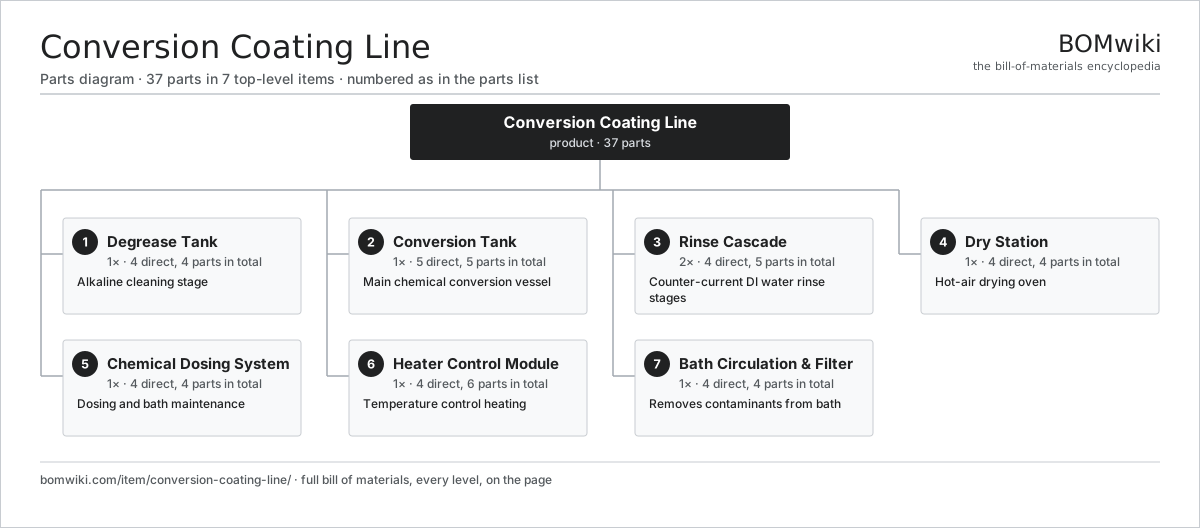
| # | Part | Qty | What it does |
|---|---|---|---|
| 1 | Degrease Tank 4 parts | 1× | Alkaline cleaning stage |
| 2 | Conversion Tank 5 parts | 1× | Main chemical conversion vessel |
| 3 | Rinse Cascade 4 parts | 2× | Counter-current DI water rinse stages |
| 4 | Dry Station 4 parts | 1× | Hot-air drying oven |
| 5 | Chemical Dosing System 4 parts | 1× | Dosing and bath maintenance |
| 6 | Heater Control Module 4 parts | 1× | Temperature control heating |
| 7 | Bath Circulation & Filter 4 parts | 1× | Removes contaminants from bath |
3D model
No 3D model yet. Have a CAD file of this? Add a 3D model. STL renders right on this page; STEP, FreeCAD, and OpenSCAD sources are welcome too (openly licensed, like all 3D models on BOMwiki).
Build & assembly graph
expand / collapse · shared sub-assemblies converge · links to related products · est. labourTap an assembly to expand/collapse · tap a part to open it · use “Open page” for any node · drag to pan, scroll to zoom.
Bill of materials for Conversion Coating Line
7 top-level lines · 36 rows shown · 37 parts total · indented to 3 levels| # | Item / sub-assembly | Part no. | Qty/assy | Ext. qty | Parts | Type |
|---|---|---|---|---|---|---|
| 1 | Degrease Tank 4 parts | conversion-coating-line-degrease-tank | 1× | 1 | 4 | assembly |
| 1.1 | Degrease Vessel | conversion-coating-line-degrease-vessel | 1× | 1 | · | part |
| 1.2 | Degrease Heater | conversion-coating-line-degrease-heater | 1× | 1 | · | part |
| 1.3 | Degrease Pump | conversion-coating-line-degrease-pump | 1× | 1 | · | part |
| 1.4 | Degrease Solenoid | conversion-coating-line-degrease-solenoid | 1× | 1 | · | part |
| 2 | Conversion Tank 5 parts | conversion-coating-line-conversion-tank | 1× | 1 | 5 | assembly |
| 2.1 | Conversion Vessel | conversion-coating-line-conversion-vessel | 1× | 1 | · | part |
| 2.2 | Conversion Heater | conversion-coating-line-conversion-heater | 1× | 1 | · | part |
| 2.3 | Bath Circulation Pump | conversion-coating-line-bath-circulation | 1× | 1 | · | part |
| 2.4 | pH Meter Probe | conversion-coating-line-ph-meter | 1× | 1 | · | part |
| 2.5 | Gravity Dripper | conversion-coating-line-gravity-dripper | 1× | 1 | · | part |
| 3 | Rinse Cascade 4 parts | conversion-coating-line-rinse-cascade | 2× | 2 | 5 | assembly |
| 3.1 | Rinse Tank | conversion-coating-line-rinse-tank | 1× | 2 | · | part |
| 3.2 | Cascade Overflow System | conversion-coating-line-cascade-overflow | 1× | 2 | · | part |
| 3.3 | Spray Header | conversion-coating-line-spray-headers | 2× | 4 | · | part |
| 3.4 | DI Water Supply | conversion-coating-line-di-supply | 1× | 2 | · | part |
| 4 | Dry Station 4 parts | conversion-coating-line-dry-station | 1× | 1 | 4 | assembly |
| 4.1 | Dry Oven | conversion-coating-line-dry-oven | 1× | 1 | · | part |
| 4.2 | Oven Heating Element | conversion-coating-line-heating-element | 1× | 1 | · | part |
| 4.3 | Oven Circulation Fan | conversion-coating-line-circulation-fan | 1× | 1 | · | part |
| 4.4 | Oven Exhaust | conversion-coating-line-oven-exhaust | 1× | 1 | · | part |
| 5 | Chemical Dosing System 4 parts | conversion-coating-line-chemical-system | 1× | 1 | 4 | assembly |
| 5.1 | Dosing Pump | conversion-coating-line-dosing-pump | 1× | 1 | · | part |
| 5.2 | Concentrate Tank | conversion-coating-line-concentrate-tank | 1× | 1 | · | part |
| 5.3 | Flow Meter | conversion-coating-line-flow-meter | 1× | 1 | · | part |
| 5.4 | Level Switch | conversion-coating-line-level-switch | 1× | 1 | · | part |
| 6 | Heater Control Module 4 parts | conversion-coating-line-immersion-heaters | 1× | 1 | 6 | assembly |
| 6.1 | Temperature Sensor | conversion-coating-line-temp-sensor | 2× | 2 | · | part |
| 6.2 | PID Temperature Controller | conversion-coating-line-pid-controller | 1× | 1 | · | part |
| 6.3 | Heater Contactor | conversion-coating-line-heater-contactor | 2× | 2 | · | part |
| 6.4 | Alarm Relay | conversion-coating-line-alarm-relay | 1× | 1 | · | part |
| 7 | Bath Circulation & Filter 4 parts | conversion-coating-line-circulation-filter | 1× | 1 | 4 | assembly |
| 7.1 | Filter Housing | conversion-coating-line-filter-housing | 1× | 1 | · | part |
| 7.2 | Filter Cartridge | conversion-coating-line-filter-media | 1× | 1 | · | part |
| 7.3 | Filter Pump | conversion-coating-line-filter-pump | 1× | 1 | · | part |
| 7.4 | Backflush Solenoid | conversion-coating-line-backflush-solenoid | 1× | 1 | · | part |
Something wrong in this list? Report a problem with this BOM.
Sourcing: possible vendors
Browse the supplier directory → Prices, MOQ, and lead times are algorithmic estimates, not quotes, and not claims about these companies. Company mappings are curated by keyword; est. price band $5k–$2M. How estimates work| Vendor | HQ | Specialty | MOQ | Lead time |
|---|---|---|---|---|
| atlascopco.com ↗ | Stockholm, SE | Compressors & industrial | 10 units | 12–20 wks |
|
🇦🇹Andritz
andritz.com ↗
|
Graz, AT | Process plants & machinery | 10 units | 12–20 wks |
| buhlergroup.com ↗ | Uzwil, CH | Food & materials processing | 10 units | 12–20 wks |
| gea.com ↗ | Düsseldorf, DE | Process technology | 10 units | 12–20 wks |
| mhi.com ↗ | Tokyo, JP | Heavy machinery | 10 units | 12–20 wks |
1,503-word article