Core Shooting Machine
ProductOverview
A core shooter is a specialized pneumatic machine that automates core production, the process of making hollow cavities and channels inside sand castings. Unlike the Sand Molding Machine, which produces external molds, the core shooter creates individual inserts (called cores) that are placed inside the mold cavity before metal is poured. The core defines interior passages for coolant channels, boss pockets, or draft angles that would be impossible to achieve with solid casting alone.
The core shooter works by rapidly injecting hot, binder-activated sand into a steel core box at high velocity (15–25 m/s). The impact and vibration pack the sand densely. Immediately after shooting, pressurized CO₂ or nitrogen gas is pulsed into the core interior, triggering chemical hardening of the binder and accelerating the cure from minutes to seconds. The operator then removes the solidified core from the box, and it is ready for placement in the main mold within one or two minutes.
Modern core shooters combine mechanical simplicity with precise pneumatic control, enabling a single operator to produce 100–200 cores per shift with uniform quality and minimal material waste.
How it works
The Sand Magazine System (a sealed, pressurized hopper) stores pre-mixed core sand maintained at 90–110 °C. This temperature range is critical: CO₂-bonded sands rely on the ester or phenolic resin to remain flowable and reactive at this temperature. The Vibrator Motor (mounted on the hopper) continuously agitates the sand, preventing settling and ensuring uniform temperature distribution.
When an operator places a core box into the shooting station and presses the start button, the PLC energizes two control circuits. First, the Air Acceleration Valve opens, releasing air stored in the Pneumatic Accumulator. This compressed air rapidly advances the Main Shoot Cylinder, pushing sand out through the Shoot Nozzle at high velocity into the core box. The sand nozzle is positioned to direct the jet straight into the box cavity, maximizing packing density and minimizing air traps.
The shoot stroke lasts only 0.3–0.5 seconds; the cylinder must then retract quickly to allow the Gas Injection Needle (a hypodermic probe inserted into the core) to deliver gas. The Main Pressure Regulator has been holding the magazine at 5–7 bar during the shoot phase; once the cylinder is retracted, the regulator depressurizes the magazine to prevent sand backflow.
Gas injection follows immediately: the Gas Switching Valve Block switches the gas selector to CO₂ (for initial set) and opens the injection solenoid. A burst of CO₂ (typically 0.5–2 seconds) penetrates the core interior, triggering an exothermic reaction with the sand binder resin. Heat and chemical cross-linking quickly harden a thin shell around the gas bubble. After the initial set, the valve may switch to nitrogen (non-reactive) to continue drying and driving off moisture without further hardening.
A Drying Timer Relay (adjustable 15–60 seconds) controls the total gas pulse duration. Once the timer expires, the injection solenoid closes, and the operator manually removes the core from the box (which is hinged or open-faced on one side). The core is now leather-hard and can be moved to a cooling conveyor or immediately placed into the main mold cavity.
Real-world operation
Foundries tune core shooters by adjusting:
- Magazine pressure (5–7 bar) to control sand density
- Accumulator pre-charge (2–3 bar) to control shoot velocity
- Gas pulse duration (15–60 seconds) based on core size and sand composition
- Sand temperature (90–110 °C) to match binder chemistry
Larger cores (300–500 g) require higher pressures and longer gas curing; smaller cores (50–100 g) need less gas and can be shot more rapidly. The quality of the final core depends on sand packing density during shoot (determined by nozzle velocity) and gas cure completeness (determined by gas pressure and duration).
Many modern core shooters integrate a Sand Level Sensor and automatic refill cycle: when the magazine level drops below a setpoint, the machine alarms and halts until an operator refills the hopper. Some facilities pair multiple core shooters with a centralized sand heater and pressure supply, reducing energy cost and improving consistency.
Material and design challenges
The Shoot Nozzle experiences extreme abrasion from silica sand particles; it is typically made of hardened steel (60–62 HRC) and must be replaced every 2,000–5,000 cores depending on sand hardness. The Main Shoot Cylinder rod must withstand repeated impact loads and is often nitrided or hard-chrome plated to extend life.
The Sand Magazine System pressure vessel is built to ASME Boiler and Pressure Vessel Code (Section VIII, Div. 1) and stamped accordingly. Seals (especially the large O-rings around the hopper lid) must handle both temperature (90–110 °C) and pressure (10 bar): nitrile (NBR) is unsuitable; fluorocarbon (FKM, Viton) or polyether-polyol (FFKM, Kalrez) is required.
Gas supply lines must be corrosion-resistant to CO₂ (stainless steel is preferred) and rated for sustained pressure (20 bar). The Gas Injection Needle, being fine-bore (1.2 mm), can become blocked by sand dust or resin residue; operators must periodically backflush with nitrogen and inspect for blockage.
Integration and automation
Single-cavity core shooters typically operate manually (operator loads box, presses start, removes core). Multi-cavity machines (4–16 cores per shot) use carousel indexing: the PLC triggers sequential shots to different boxes, each with its own gas-injection needle and timer. These can be integrated into robotic cell: a gantry arm places the full carousel of core boxes, the machine executes all shots and gas cures, then the arm removes the carousel, extracts the cores, and feeds it back to refill.
The Control Panel logs cycle times and pressure curves; this data helps predict maintenance needs (e.g., regulator wear if pressure creep occurs) and optimizes sand-consumption tracking. Advanced installations upload data to a factory MES (manufacturing execution system) for real-time core-inventory planning and scrap tracking.
Related processes
After core production, cores must be stored in a controlled-humidity environment (typically 40–60 % RH, 18–25 °C) to prevent moisture reabsorption and strength loss. Cores are then assembled into sand molds before casting. Post-casting, cores are removed from the solidified casting and sent to a Sand Reclamation System for thermal or attrition reclamation, recovering up to 95 % of the sand for reuse.
Core Shooting Machine parts and their functions
7 top-level parts · 45 parts in total · full bill of materials below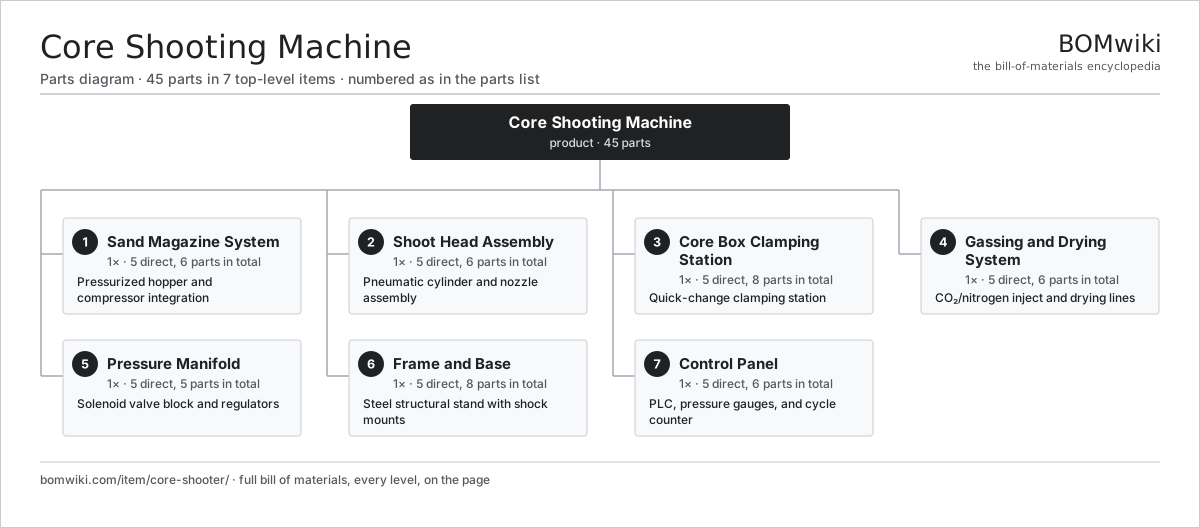
| # | Part | Qty | What it does |
|---|---|---|---|
| 1 | Sand Magazine System 5 parts | 1× | Pressurized hopper and compressor integration |
| 2 | Shoot Head Assembly 5 parts | 1× | Pneumatic cylinder and nozzle assembly |
| 3 | Core Box Clamping Station 5 parts | 1× | Quick-change clamping station |
| 4 | Gassing and Drying System 5 parts | 1× | CO₂/nitrogen inject and drying lines |
| 5 | Pressure Manifold 5 parts | 1× | Solenoid valve block and regulators |
| 6 | Frame and Base 5 parts | 1× | Steel structural stand with shock mounts |
| 7 | Control Panel 5 parts | 1× | PLC, pressure gauges, and cycle counter |
3D model
No 3D model yet. Have a CAD file of this? Add a 3D model. STL renders right on this page; STEP, FreeCAD, and OpenSCAD sources are welcome too (openly licensed, like all 3D models on BOMwiki).
Build & assembly graph
expand / collapse · shared sub-assemblies converge · links to related products · est. labourTap an assembly to expand/collapse · tap a part to open it · use “Open page” for any node · drag to pan, scroll to zoom.
Bill of materials for Core Shooting Machine
7 top-level lines · 42 rows shown · 45 parts total · indented to 3 levels| # | Item / sub-assembly | Part no. | Qty/assy | Ext. qty | Parts | Type |
|---|---|---|---|---|---|---|
| 1 | Sand Magazine System 5 parts | core-shooter-sand-magazine | 1× | 1 | 6 | assembly |
| 1.1 | Hopper Pressure Vessel | core-shooter-hopper-vessel | 1× | 1 | · | part |
| 1.2 | Sand Heating Element | core-shooter-sand-heater | 1× | 1 | · | part |
| 1.3 | Vibrator Motor | core-shooter-vibrator-motor | 1× | 1 | · | part |
| 1.4 | Sand Level Sensor | core-shooter-level-switch | 1× | 1 | · | part |
| 1.5 | O-Ring Set | oring-set | 2× | 2 | · | part |
| 2 | Shoot Head Assembly 5 parts | core-shooter-shoot-head | 1× | 1 | 6 | assembly |
| 2.1 | Main Shoot Cylinder | core-shooter-main-cylinder | 1× | 1 | · | part |
| 2.2 | Shoot Nozzle | core-shooter-shoot-nozzle | 1× | 1 | · | part |
| 2.3 | Air Acceleration Valve | core-shooter-air-acceleration-valve | 1× | 1 | · | part |
| 2.4 | Pneumatic Accumulator | core-shooter-accumulator-shuttle | 1× | 1 | · | part |
| 2.5 | Pilot Check Valve | core-shooter-check-valve | 2× | 2 | · | part |
| 3 | Core Box Clamping Station 5 parts | core-shooter-core-box-clamp | 1× | 1 | 8 | assembly |
| 3.1 | Clamp Cylinder | core-shooter-clamp-cylinder | 2× | 2 | · | part |
| 3.2 | Locating Pins | core-shooter-box-locating-pins | 2× | 2 | · | part |
| 3.3 | Core Box Support Frame | core-shooter-box-support-frame | 1× | 1 | · | part |
| 3.4 | Fastener Set | fastener-set | 1× | 1 | · | part |
| 3.5 | Connector | connector | 2× | 2 | · | part |
| 4 | Gassing and Drying System 5 parts | core-shooter-gassing-system | 1× | 1 | 6 | assembly |
| 4.1 | Gas Pressure Regulator | core-shooter-gas-regulator | 2× | 2 | · | part |
| 4.2 | Gas Switching Valve Block | core-shooter-gas-valve-block | 1× | 1 | · | part |
| 4.3 | Gas Injection Needle | core-shooter-gas-injection-needle | 1× | 1 | · | part |
| 4.4 | Injection Tubing | core-shooter-injection-hose | 1× | 1 | · | part |
| 4.5 | Drying Timer Relay | core-shooter-drying-timer-relay | 1× | 1 | · | part |
| 5 | Pressure Manifold 5 parts | core-shooter-pressure-manifold | 1× | 1 | 5 | assembly |
| 5.1 | Main Pressure Regulator | core-shooter-main-regulator | 1× | 1 | · | part |
| 5.2 | Solenoid Driver Relay | core-shooter-solenoid-driver-relay | 1× | 1 | · | part |
| 5.3 | Pilot Relief Cartridge | core-shooter-pilot-relief | 1× | 1 | · | part |
| 5.4 | Pressure Gauge | core-shooter-pressure-gauge | 1× | 1 | · | part |
| 5.5 | Fastener Set | fastener-set | 1× | 1 | · | part |
| 6 | Frame and Base 5 parts | core-shooter-frame-and-base | 1× | 1 | 8 | assembly |
| 6.1 | Main Frame | core-shooter-main-frame | 1× | 1 | · | part |
| 6.2 | Vibration Isolators | core-shooter-vibration-isolators | 4× | 4 | · | part |
| 6.3 | Base Plate | core-shooter-base-plate | 1× | 1 | · | part |
| 6.4 | Cable Tray | core-shooter-cable-tray | 1× | 1 | · | part |
| 6.5 | Fastener Set | fastener-set | 1× | 1 | · | part |
| 7 | Control Panel 5 parts | core-shooter-control-panel | 1× | 1 | 6 | assembly |
| 7.1 | Programmable Logic Controller | core-shooter-plc-module | 1× | 1 | · | part |
| 7.2 | Start-Stop Control Station | core-shooter-start-stop-station | 1× | 1 | · | part |
| 7.3 | Digital Pressure Module | core-shooter-pressure-display | 2× | 2 | · | part |
| 7.4 | Signal Light Stack | core-shooter-run-light-stack | 1× | 1 | · | part |
| 7.5 | Fastener Set | fastener-set | 1× | 1 | · | part |
Something wrong in this list? Report a problem with this BOM.
Related products
same domain, ranked by shared parts Brush Making Machine
50 parts · shares 2 with this page
Casting Fettling Machine
802 parts · shares 2 with this page
Brush Making Machine
50 parts · shares 2 with this page
Casting Fettling Machine
802 parts · shares 2 with this page
 Chalk Extrusion Machine
47 parts · shares 2 with this page
Crayon Molding Machine
56 parts · shares 2 with this page
Chalk Extrusion Machine
47 parts · shares 2 with this page
Crayon Molding Machine
56 parts · shares 2 with this page
Sourcing: possible vendors
Browse the supplier directory → Prices, MOQ, and lead times are algorithmic estimates, not quotes, and not claims about these companies. Company mappings are curated by keyword; est. price band $5k–$2M. How estimates work| Vendor | HQ | Specialty | MOQ | Lead time |
|---|---|---|---|---|
| atlascopco.com ↗ | Stockholm, SE | Compressors & industrial | 10 units | 12–20 wks |
|
🇦🇹Andritz
andritz.com ↗
|
Graz, AT | Process plants & machinery | 10 units | 12–20 wks |
| buhlergroup.com ↗ | Uzwil, CH | Food & materials processing | 10 units | 12–20 wks |
| gea.com ↗ | Düsseldorf, DE | Process technology | 10 units | 12–20 wks |
| mhi.com ↗ | Tokyo, JP | Heavy machinery | 10 units | 12–20 wks |
1,091-word article