Core Winding Machine
ProductOverview
The core winding machine spirals paper, plastic, or fabric ribbon around a rotating paper mandrel to produce tubes (cores) used in tape (masking, duct, packaging), label stock, thermal paper, and winding supplies. The process is continuous: ribbon feeds from a parent roll, adhesive is applied for structural bonding, and the spiral pattern builds outward with each revolution. When the core reaches target outside diameter, a ribbon cutoff severs the product, and pneumatic ejection removes the finished core.
Applications include:
- Tape cores: Masking tape (25 mm OD), duct tape (40–50 mm OD), packaging tape (76 mm OD).
- Label roll cores: Thermal label stock (50–100 mm OD), kraft label (100–150 mm OD).
- Specialty cores: Winding supplies, paper tube blanks for industrial use.
A typical core-winding machine produces 30–120 finished cores per hour, generating 20–100 tonnes/day of product depending on core diameter and material density.
How It Works
Ribbon Feed and Tension
Parent ribbon (typically 500–2000 mm wide, 0.1–0.5 mm thick) unwinds from a large roll mounted on the Ribbon Feed System system. The Feed Brake applies 5–20 kN back-tension via a disc friction brake, maintaining ribbon smoothness and preventing flutter. A Ribbon Guide ceramic or polymer guide aligns the ribbon at the precise pitch angle (typically 30–45°) to the rotating mandrel.
Adhesive Application
Before contacting the mandrel, the ribbon passes under or through a Adhesive Application System adhesive roller. The Glue Roller (rubber or metal) is immersed in a heated Glue Reservoir bath maintaining 50–80°C. As the roller rotates, it picks up a thin adhesive film and applies it uniformly to the ribbon back. The Adhesive Pump circulates adhesive at 10–50 L/min; Adhesive Temperature Control immersion heaters maintain ±5°C temperature accuracy.
Adhesive application (5–15 g/m² typical) bonds successive ribbon wraps and prevents slipping under tension. Too much adhesive creates sticky handling and wrapping; too little results in loose, separating layers.
Spiral Winding
The ribbon, now adhesive-coated, feeds onto a rotating Mandrel Spindle and Drive driven by a Winding Motor (5–20 kW). The mandrel rotates at 50–200 m/min surface speed. A Spiral Support Belt helical belt on the mandrel surface guides the ribbon at the correct pitch angle; the belt pitch is adjustable (typically 10–50 mm) to control spiral tightness and final core diameter.
A Tension Dancer air-powered pressure roller maintains constant ribbon wrapping tension (5–50 kN) during winding. A Tension Load Cell continuously measures actual tension; if tension drifts (e.g., due to ribbon edge lift or adhesive film variation), a Proportional Air Valve proportional solenoid adjusts dancer air pressure to restore setpoint. This closed-loop tension control ensures uniform core density and prevents loose or wrinkled wraps.
With each revolution of the mandrel, the ribbon spirals outward, building the core diameter at approximately 0.5–1 mm per wrap (depending on ribbon thickness and pitch). The process continues until the core reaches target outside diameter (40–150 mm typical).
Diameter Detection and Cutoff
When the core OD reaches target (detected either by rotation count or optional diameter sensor), the Control and Automation PLC triggers the Ribbon Cutoff and Finishing. A Cutoff Blade (tungsten carbide or hardened steel, 100–150 mm diameter, rotating at 1000–2000 rpm) severs the ribbon cleanly. A Trim Conveyor conveyor removes the severed ribbon waste.
The finished core, still on the mandrel, retains wrap tension briefly due to adhesive tack; as the mandrel continues rotating slowly, a final wrap locks the ribbon end in place. Pneumatic Core Ejection and Takeoff then engages: an Eject Cylinder (50–100 mm bore) extends at 2–3 m/s, pushing the core off the mandrel onto an Outfeed Conveyor for downstream wrapping, labeling, or packaging.
An Eject Sensor proximity switch detects core departure and signals the PLC to retract the eject arm and reset the mandrel to accept a fresh mandrel.
Control and Recipe Management
The Control and Automation PLC (Siemens S7-1200 or Beckhoff TwinCAT) executes winding recipes stored in memory. A recipe defines:
- Target core OD (e.g., 76 mm for standard tape core)
- Ribbon feed speed (synchronized with mandrel)
- Winding tension setpoint (kN)
- Adhesive temperature (±5°C)
- Spiral pitch (mm, determines wrap spacing)
- Number of cores per batch (for production tracking)
The operator selects a recipe from the HMI Touchscreen (7 inch touchscreen); the PLC automatically:
- Ramps mandrel motor to target speed via VFD Drive variable frequency drive
- Activates adhesive heater to reach setpoint
- Opens feed brake proportional valve to begin ribbon feed
- Engages Tension Dancer at setpoint
- Counts core rotations; when rotation count reaches target (calculated from mandrel speed and core OD), triggers ribbon cutoff
Quality Factors
Adhesive uniformity: Uneven adhesive application creates loose or stiff spots in the core; quality control measures include adhesive viscosity verification and daily roller cleaning.
Tension consistency: Tension variation >±5 kN can cause wrinkle formation or loose layers. Feedback from the Tension Load Cell helps maintain ±2 kN accuracy.
Ribbon linearity: Twisted or wrinkled ribbon creates off-center or barrel-shaped cores. Proper guide alignment and adequate back-tension prevent this.
Cutter sharpness: Dull Cutoff Blade causes edge fraying and misfeeds. Blade replacement (15–30 min) is monthly maintenance.
Production Efficiency
A typical core-winding machine producing 76 mm OD tape cores (standard width ~50 mm) at 100 m/min mandrel speed requires approximately 15–20 minutes per core (including ramp-up, winding, cutoff, and eject). This yields 3–4 cores per hour per mandrel station. Most production machines have dual or quad mandrel arrangements, producing 6–16 cores per hour.
Adhesive cost is typically USD 0.50–2.00 per core; mandrel (single-use, disposable paper tube) cost is USD 0.10–0.50. Total material cost (ribbon + adhesive + mandrel) is USD 2–5 per core depending on size and material grade.
Core Winding Machine parts and their functions
8 top-level parts · 37 parts in total · full bill of materials below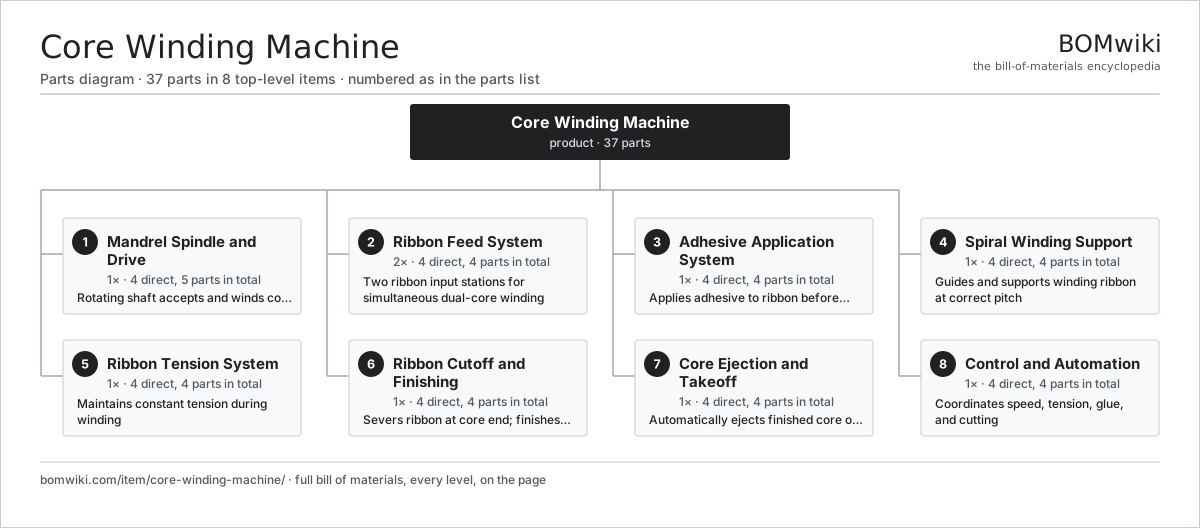
| # | Part | Qty | What it does |
|---|---|---|---|
| 1 | Mandrel Spindle and Drive 4 parts | 1× | Rotating shaft accepts and winds core mandrel |
| 2 | Ribbon Feed System 4 parts | 2× | Two ribbon input stations for simultaneous dual-core winding |
| 3 | Adhesive Application System 4 parts | 1× | Applies adhesive to ribbon before winding |
| 4 | Spiral Winding Support 4 parts | 1× | Guides and supports winding ribbon at correct pitch |
| 5 | Ribbon Tension System 4 parts | 1× | Maintains constant tension during winding |
| 6 | Ribbon Cutoff and Finishing 4 parts | 1× | Severs ribbon at core end; finishes core product |
| 7 | Core Ejection and Takeoff 4 parts | 1× | Automatically ejects finished core onto conveyor |
| 8 | Control and Automation 4 parts | 1× | Coordinates speed, tension, glue, and cutting |
3D model
No 3D model yet. Have a CAD file of this? Add a 3D model. STL renders right on this page; STEP, FreeCAD, and OpenSCAD sources are welcome too (openly licensed, like all 3D models on BOMwiki).
Build & assembly graph
expand / collapse · shared sub-assemblies converge · links to related products · est. labourTap an assembly to expand/collapse · tap a part to open it · use “Open page” for any node · drag to pan, scroll to zoom.
Bill of materials for Core Winding Machine
8 top-level lines · 40 rows shown · 37 parts total · indented to 3 levels| # | Item / sub-assembly | Part no. | Qty/assy | Ext. qty | Parts | Type |
|---|---|---|---|---|---|---|
| 1 | Mandrel Spindle and Drive 4 parts | core-winding-machine-mandrel-spindle | 1× | 1 | 5 | assembly |
| 1.1 | Winding Motor | core-winding-machine-drive-motor | 1× | 1 | · | part |
| 1.2 | Mandrel Shaft | core-winding-machine-mandrel-spindle-shaft | 1× | 1 | · | part |
| 1.3 | Spindle Bearings | core-winding-machine-spindle-bearings | 2× | 2 | · | part |
| 1.4 | Mandrel Chuck | core-winding-machine-mandrel-chuck | 1× | 1 | · | part |
| 2 | Ribbon Feed System 4 parts | core-winding-machine-ribbon-feed | 2× | 2 | 4 | assembly |
| 2.1 | Feed Roll | core-winding-machine-feed-roll | 1× | 2 | · | part |
| 2.2 | Feed Tension | core-winding-machine-feed-tension | 1× | 2 | · | part |
| 2.3 | Feed Brake | core-winding-machine-feed-brake | 1× | 2 | · | part |
| 2.4 | Ribbon Guide | core-winding-machine-ribbon-guide | 1× | 2 | · | part |
| 3 | Adhesive Application System 4 parts | core-winding-machine-glue-applicator | 1× | 1 | 4 | assembly |
| 3.1 | Glue Roller | core-winding-machine-glue-roller | 1× | 1 | · | part |
| 3.2 | Glue Reservoir | core-winding-machine-glue-reservoir | 1× | 1 | · | part |
| 3.3 | Adhesive Pump | core-winding-machine-glue-pump | 1× | 1 | · | part |
| 3.4 | Adhesive Temperature Control | core-winding-machine-glue-temperature-control | 1× | 1 | · | part |
| 4 | Spiral Winding Support 4 parts | core-winding-machine-spiral-belt | 1× | 1 | 4 | assembly |
| 4.1 | Spiral Support Belt | core-winding-machine-spiral-support-belt | 1× | 1 | · | part |
| 4.2 | Tension Roller | core-winding-machine-belt-tension-roller | 1× | 1 | · | part |
| 4.3 | Pitch Adjuster | core-winding-machine-pitch-adjuster | 1× | 1 | · | part |
| 4.4 | Axial Guide | core-winding-machine-guide-rail | 1× | 1 | · | part |
| 5 | Ribbon Tension System 4 parts | core-winding-machine-tension-control | 1× | 1 | 4 | assembly |
| 5.1 | Tension Dancer | core-winding-machine-tension-dancer | 1× | 1 | · | part |
| 5.2 | Tension Load Cell | core-winding-machine-load-cell | 1× | 1 | · | part |
| 5.3 | Proportional Air Valve | core-winding-machine-air-valve | 1× | 1 | · | part |
| 5.4 | Tension Feedback | core-winding-machine-tension-feedback | 1× | 1 | · | part |
| 6 | Ribbon Cutoff and Finishing 4 parts | core-winding-machine-cutoff-saw | 1× | 1 | 4 | assembly |
| 6.1 | Cutoff Blade | core-winding-machine-cutoff-blade | 1× | 1 | · | part |
| 6.2 | Saw Motor | core-winding-machine-saw-motor | 1× | 1 | · | part |
| 6.3 | Blade Guard | core-winding-machine-blade-guard | 1× | 1 | · | part |
| 6.4 | Trim Conveyor | core-winding-machine-trim-collection | 1× | 1 | · | part |
| 7 | Core Ejection and Takeoff 4 parts | core-winding-machine-core-ejection | 1× | 1 | 4 | assembly |
| 7.1 | Eject Cylinder | core-winding-machine-eject-cylinder | 1× | 1 | · | part |
| 7.2 | Eject Arm | core-winding-machine-eject-arm | 1× | 1 | · | part |
| 7.3 | Eject Sensor | core-winding-machine-eject-sensor | 1× | 1 | · | part |
| 7.4 | Outfeed Conveyor | core-winding-machine-outfeed-conveyor | 1× | 1 | · | part |
| 8 | Control and Automation 4 parts | core-winding-machine-control-system | 1× | 1 | 4 | assembly |
| 8.1 | Winding PLC | core-winding-machine-plc | 1× | 1 | · | part |
| 8.2 | HMI Touchscreen | core-winding-machine-hmi | 1× | 1 | · | part |
| 8.3 | VFD Drive | core-winding-machine-vfd | 1× | 1 | · | part |
| 8.4 | Sensor Suite | core-winding-machine-sensors | 1× | 1 | · | part |
Something wrong in this list? Report a problem with this BOM.
Sourcing: possible vendors
Browse the supplier directory → Prices, MOQ, and lead times are algorithmic estimates, not quotes, and not claims about these companies. Company mappings are curated by keyword; est. price band $5k–$2M. How estimates work| Vendor | HQ | Specialty | MOQ | Lead time |
|---|---|---|---|---|
| atlascopco.com ↗ | Stockholm, SE | Compressors & industrial | 10 units | 12–20 wks |
|
🇦🇹Andritz
andritz.com ↗
|
Graz, AT | Process plants & machinery | 10 units | 12–20 wks |
| buhlergroup.com ↗ | Uzwil, CH | Food & materials processing | 10 units | 12–20 wks |
| gea.com ↗ | Düsseldorf, DE | Process technology | 10 units | 12–20 wks |
| mhi.com ↗ | Tokyo, JP | Heavy machinery | 10 units | 12–20 wks |
1,055-word article