Corrugator Line
ProductOverview
The corrugator line manufactures corrugated cardboard by laminating flat linerboard sheets (upper and lower) to a wavy corrugating medium sandwiched between them. The resulting 3-ply structure provides high bending strength and light weight, making it ideal for shipping boxes, consumer packaging, and protective displays. A modern corrugator operates at 100–300 m/min and produces 10–40 tonnes/day depending on board grade and flute type (B=2.5 mm, C=3.5 mm, E=1.6 mm waves). The machine is among the most capital-intensive in the pulp and paper industry, with typical installations costing USD 5–20 million depending on width and automation.
Corrugated board comprises three layers: face liner (stronger, higher brightness), corrugating medium (wavy, absorbs shock), and back liner (lower quality, cost-optimized). The corrugating process bonds layers under heat and pressure using hot-melt adhesive; the wave pattern is formed simultaneously during corrugating roll engagement. Finished sheets are slit to width, scored for folding, cut to length, and stacked for shipment.
How It Works
Material Preparation and Feeding
Flat Slitter Blade linerboard (125–150 gsm, 1.2–2.5 m wide) and corrugating medium (100–140 gsm) arrive from the mill on parent rolls. These are unrolled and fed continuously into the corrugator. Before corrugating, Steam Supply (0.6 MPa steam injection) conditions the medium and liners to 8–12% moisture, softening fibers and improving glue adhesion.
Single Facer Section
The Single Facer bonds the corrugating medium to the first (face) linerboard. First, a glue unit applies hot-melt adhesive to both flanks (top and bottom) of the corrugating medium via rotating Glue Roller immersed in a heated Glue Tank at 170–180°C. The Adhesive Pump continuously circulates adhesive; temperature is maintained by immersion Glue Temperature Control heaters and proportional valves (±2°C accuracy).
The adhesive-coated medium then passes between the Lower Corrugating Roll (drive roll, 400–500 mm diameter, engraved with flute pattern) and Backing Roll (upper roller). The lower roll rotates against the medium, deforming it into precise wave shape (C-flute, 3.5 mm height typically). The upper backing roll presses gently, guiding the wave formation without excessive compression. Simultaneously, the first linerboard sheet (face liner) is positioned at the nip; the combination of heat, pressure, and adhesive bonds it firmly to the wave crests and flanks.
Exiting the corrugating rolls, the single-faced sheet passes through two Comber Rolls (comber rolls) that compress the laminate, expel trapped air, and ensure complete fiber-to-fiber contact for strong bonding.
Double Backer Section
The single-faced sheet immediately enters the Double Backer Section section, which mirrors the single facer layout. A second glue applicator applies adhesive to the back side of the medium flanks; the back linerboard (lower quality, cost-optimized) is positioned and fed into a second pair of corrugating rolls. Final Pressure Comber compress the 3-ply structure. The corrugated board exits consolidated and adhesive-set (cooled naturally or by air jets).
Flute Types and Strength
B-flute: 2.5 mm wave height; 150–160 flutes per linear meter. Provides edge crush strength and rigidity for display and small-box applications.
C-flute: 3.5 mm wave height; 110–120 flutes per meter. Most common for shipping boxes; good balance of strength, cushioning, and weight.
E-flute: 1.6 mm wave height; 270–280 flutes per meter. Lightweight, used for small items and folding-carton stock.
Corrugated (BC, BE): Double-wall; stacks two fluted mediums with liners outside. Provides 5 plies total; used for heavy boxes (50 lb+ shipments).
Slitting and Scoring
The finished corrugated board travels to the Slitter-Scorer Unit unit. Rotating Slitter Blade cutters (tungsten carbide, 200–300 mm diameter) slit the sheet widthwise, separating it into individual box blanks. Simultaneously, non-cutting Scorer Wheel rollers create pressure creases (score lines) where the box will fold (top, bottom, and side flaps). The Slitter-Scorer Motor (15–30 kW) drives all blades and scorers synchronously; Blade Spacing Adjuster hydraulic or mechanical wedges adjust spacing for different box widths (e.g., 200 mm, 250 mm, 300 mm).
Trimming and Lengthwise Cutting
The Cutoff Saw removes 10–50 mm of waste from left and right edges via Edge Trimmer Blade blades. A Length Sensor (photoelectric encoder) detects sheet position; when a trigger point is reached, the Cutoff Blade (circular or oscillating, 500–1500 rpm) cuts the sheet to final length (e.g., 800 mm for a standard box blank).
Stacking and Bundling
Cut and scored sheets accumulate on a Stacker and Bundler. A motorized Stack Cart platform raises and lowers in sync with arriving sheets, building the stack. Once the stack reaches target height (typically 40–60 sheets, equivalent to 20–30 kg), a Stack Height Sensor proximity sensor triggers the Strapping Motor, which applies a plastic or paper strapping band around the stack. A hydraulic Eject Cylinder then ejects the bundled stack onto an outfeed conveyor for transport to storage or shipping.
Process Parameters and Control
The Control System is critical to corrugator performance. A Main Drive Motor (50–150 kW) drives the entire line via the lower corrugating rolls; a VFD enables ramp-up from rest and speed matching during product changes. The Corrugator PLC (Siemens S7-1500 or Beckhoff TwinCAT) monitors:
- Adhesive temperature: ±2°C accuracy via immersion heater control
- Line speed: 100–300 m/min, coordinated between single facer and double backer
- Moisture content: 8–12% in linerboard and medium (conditioning steam)
- Blade spacing: For different box widths
- Stack height: Triggering timely ejection
The HMI Console (15 inch touchscreen) displays real-time production counters, adhesive consumption rate, and alarm diagnostics. Recipes are stored for rapid format changeovers (e.g., switching from C-flute 80×120 mm box blanks to B-flute 60×100 mm).
Adhesive and Economics
Hot-melt adhesives for corrugating are typically starch-based (15–30% price premium over solvent-based) or synthetic (polyethylene, EVA). Application rate is 50–120 g/m² (typically 70 g/m² for C-flute). Adhesive cost is 5–10% of total corrugated board production cost.
Waste edges (10–50 mm/side) and off-spec sheets (2–5% of production) are typically sold to recyclers at commodity kraft prices (USD 30–60/tonne), offsetting waste disposal costs. A 30 t/day corrugator generates 2–4 t/day of trim waste, worth USD 50–200/day.
Main downtime sources are blade dulling (2–4 hours per blade replacement per week), adhesive line plugging (1–2 hours clearing), and thermal drift (30–60 minutes to restabilize temperature). Modern predictive maintenance monitors adhesive viscosity trends and blade wear patterns to schedule proactive maintenance before faults occur.
Corrugator Line parts and their functions
8 top-level parts · 69 parts in total · full bill of materials below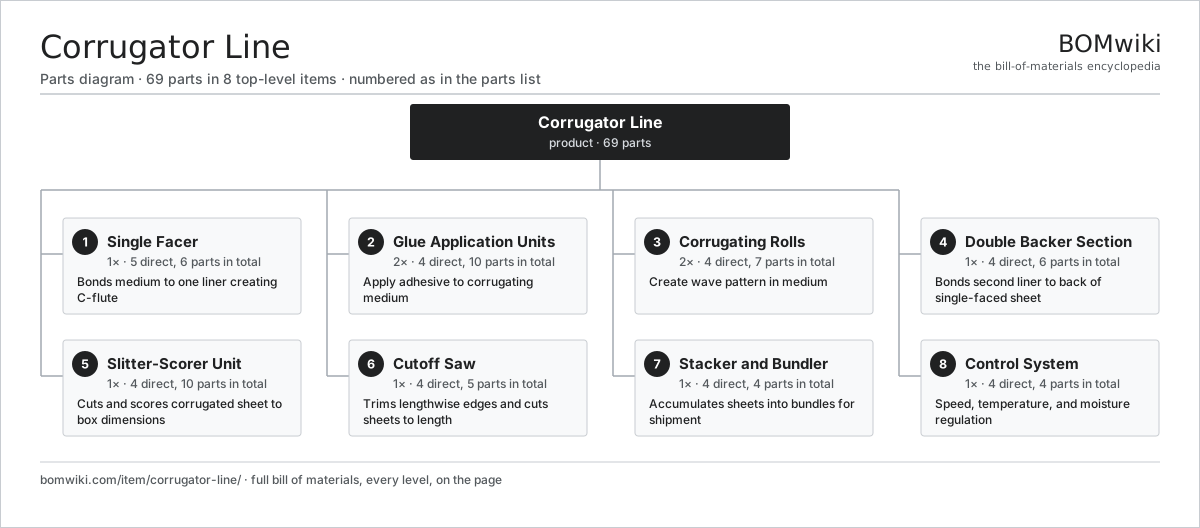
| # | Part | Qty | What it does |
|---|---|---|---|
| 1 | Single Facer 5 parts | 1× | Bonds medium to one liner creating C-flute |
| 2 | Glue Application Units 4 parts | 2× | Apply adhesive to corrugating medium |
| 3 | Corrugating Rolls 4 parts | 2× | Create wave pattern in medium |
| 4 | Double Backer Section 4 parts | 1× | Bonds second liner to back of single-faced sheet |
| 5 | Slitter-Scorer Unit 4 parts | 1× | Cuts and scores corrugated sheet to box dimensions |
| 6 | Cutoff Saw 4 parts | 1× | Trims lengthwise edges and cuts sheets to length |
| 7 | Stacker and Bundler 4 parts | 1× | Accumulates sheets into bundles for shipment |
| 8 | Control System 4 parts | 1× | Speed, temperature, and moisture regulation |
3D model
No 3D model yet. Have a CAD file of this? Add a 3D model. STL renders right on this page; STEP, FreeCAD, and OpenSCAD sources are welcome too (openly licensed, like all 3D models on BOMwiki).
Build & assembly graph
expand / collapse · shared sub-assemblies converge · links to related products · est. labourTap an assembly to expand/collapse · tap a part to open it · use “Open page” for any node · drag to pan, scroll to zoom.
Bill of materials for Corrugator Line
8 top-level lines · 41 rows shown · 69 parts total · indented to 3 levels| # | Item / sub-assembly | Part no. | Qty/assy | Ext. qty | Parts | Type |
|---|---|---|---|---|---|---|
| 1 | Single Facer 5 parts | corrugator-line-single-facer-section | 1× | 1 | 6 | assembly |
| 1.1 | Lower Corrugating Roll | corrugator-line-corrugating-roll-lower | 1× | 1 | · | part |
| 1.2 | Backing Roll | corrugator-line-backing-roll | 1× | 1 | · | part |
| 1.3 | Medium Inlet | corrugator-line-medium-web-inlet | 1× | 1 | · | part |
| 1.4 | Liner Feed Rollers | corrugator-line-liner-feed-rollers | 1× | 1 | · | part |
| 1.5 | Comber Rolls | corrugator-line-combating-rolls | 2× | 2 | · | part |
| 2 | Glue Application Units 4 parts | corrugator-line-glue-units | 2× | 2 | 10 | assembly |
| 2.1 | Glue Roller | corrugator-line-glue-applicator-roller | 4× | 8 | · | part |
| 2.2 | Glue Tank | corrugator-line-glue-tank | 2× | 4 | · | part |
| 2.3 | Adhesive Pump | corrugator-line-glue-pump | 2× | 4 | · | part |
| 2.4 | Glue Temperature Control | corrugator-line-glue-temperature-control | 2× | 4 | · | part |
| 3 | Corrugating Rolls 4 parts | corrugator-line-corrugating-rolls | 2× | 2 | 7 | assembly |
| 3.1 | Lower Corrugating Roll | corrugator-line-corrugating-roll-lower | 1× | 2 | · | part |
| 3.2 | Upper Backing Roll | corrugator-line-corrugating-roll-upper | 1× | 2 | · | part |
| 3.3 | Roll Bearing | corrugator-line-roll-bearings | 4× | 8 | · | part |
| 3.4 | Roll Alignment System | corrugator-line-roll-alignment | 1× | 2 | · | part |
| 4 | Double Backer Section 4 parts | corrugator-line-double-backer | 1× | 1 | 6 | assembly |
| 4.1 | Back Liner Inlet | corrugator-line-second-liner-inlet | 1× | 1 | · | part |
| 4.2 | Double Glue Applicator | corrugator-line-double-glue-applicator | 1× | 1 | · | part |
| 4.3 | Double Backer Roll | corrugator-line-double-backing-roll | 2× | 2 | · | part |
| 4.4 | Pressure Comber | corrugator-line-pressure-rolls | 2× | 2 | · | part |
| 5 | Slitter-Scorer Unit 4 parts | corrugator-line-slitter-scorer | 1× | 1 | 10 | assembly |
| 5.1 | Slitter Blade | corrugator-line-slitter-blade | 4× | 4 | · | part |
| 5.2 | Scorer Wheel | corrugator-line-scorer-wheel | 4× | 4 | · | part |
| 5.3 | Slitter-Scorer Motor | corrugator-line-blade-motor | 1× | 1 | · | part |
| 5.4 | Blade Spacing Adjuster | corrugator-line-blade-spacing-adjuster | 1× | 1 | · | part |
| 6 | Cutoff Saw 4 parts | corrugator-line-cutoff-saw | 1× | 1 | 5 | assembly |
| 6.1 | Edge Trimmer Blade | corrugator-line-edge-trimmer | 2× | 2 | · | part |
| 6.2 | Cutoff Blade | corrugator-line-cutoff-blade | 1× | 1 | · | part |
| 6.3 | Length Sensor | corrugator-line-length-sensor | 1× | 1 | · | part |
| 6.4 | Cutoff Motor | corrugator-line-saw-motor | 1× | 1 | · | part |
| 7 | Stacker and Bundler 4 parts | corrugator-line-stacker | 1× | 1 | 4 | assembly |
| 7.1 | Stack Cart | corrugator-line-stack-cart | 1× | 1 | · | part |
| 7.2 | Strapping Motor | corrugator-line-wrap-band-motor | 1× | 1 | · | part |
| 7.3 | Eject Cylinder | corrugator-line-eject-ram | 1× | 1 | · | part |
| 7.4 | Stack Height Sensor | corrugator-line-stack-height-sensor | 1× | 1 | · | part |
| 8 | Control System 4 parts | corrugator-line-control-system | 1× | 1 | 4 | assembly |
| 8.1 | Main Drive Motor | corrugator-line-main-motor | 1× | 1 | · | part |
| 8.2 | Corrugator PLC | corrugator-line-plc | 1× | 1 | · | part |
| 8.3 | HMI Console | corrugator-line-hmi-console | 1× | 1 | · | part |
| 8.4 | Steam Supply | corrugator-line-steam-system | 1× | 1 | · | part |
Something wrong in this list? Report a problem with this BOM.
Sourcing: possible vendors
Browse the supplier directory → Prices, MOQ, and lead times are algorithmic estimates, not quotes, and not claims about these companies. Company mappings are curated by keyword; est. price band $5k–$2M. How estimates work| Vendor | HQ | Specialty | MOQ | Lead time |
|---|---|---|---|---|
| atlascopco.com ↗ | Stockholm, SE | Compressors & industrial | 10 units | 12–20 wks |
|
🇦🇹Andritz
andritz.com ↗
|
Graz, AT | Process plants & machinery | 10 units | 12–20 wks |
| buhlergroup.com ↗ | Uzwil, CH | Food & materials processing | 10 units | 12–20 wks |
| gea.com ↗ | Düsseldorf, DE | Process technology | 10 units | 12–20 wks |
| mhi.com ↗ | Tokyo, JP | Heavy machinery | 10 units | 12–20 wks |
1,175-word article