Counter-Drone Detection System
ProductOverview
A counter-drone system detects, classifies, tracks, and, when authorized, defeats small unmanned aircraft. The targets are hard: a consumer quadcopter presents a radar cross-section near 0.01 m², flies at treetop height among birds at similar speeds, and may approach at 20 m/s, leaving minutes or seconds between first detection and arrival. No single sensor handles this, so fielded systems fuse three complementary layers: passive RF, active radar, and electro-optics, combined by the Processing and Fusion Unit into one air picture and connected to effectors through a Defeat Interface.
Detection layers
The RF Sensor Subsystem is the workhorse against commercial drones. Most consumer aircraft maintain a control link and a video downlink in the ISM bands (2.4 and 5.8 GHz) plus known proprietary frequencies; the Wideband Receiver sweeps 70 MHz to 6 GHz and matches hopping patterns and frame structures against the Protocol Library Unit, often identifying the exact model, and reading its broadcast Remote ID where present. The DF Antenna Array direction-finds both the aircraft and, critically, the pilot's transmitter, the only sensor in the stack that locates the operator. Detection ranges run 2–5 km. The blind spot is fundamental: a drone flying a pre-programmed waypoint mission with radios silent emits nothing.
That gap is the radar's job. The Surveillance Radar is a small X- or Ku-band 3D AESA, typically four fixed AESA Panel faces giving hemispheric coverage with no moving parts, detecting micro-drone targets at 1–5 km regardless of their emissions. The discrimination problem is birds, which match drones in RCS and speed. The Radar Processor separates them by micro-Doppler: spinning rotor blades modulate the return with a signature flapping wings do not produce, and the coherence of the Radar Exciter waveform is what makes that modulation measurable.
Neither RF nor radar gives an operator legal confidence about what is flying. The EO/IR Camera Turret does: cued onto a track, the Pan-Tilt Unit slews at over 100°/s and the Daylight Camera or Thermal Camera resolves the airframe, and whether it carries a payload, at beyond a kilometer. The Video Tracker then holds the gimbal locked in the image domain, surviving radar fades.
Fusion and command
The Fusion Server correlates plots across sensors so one aircraft produces one track instead of three disagreeing ones, and the Classifier Module scores each track as drone, bird, manned aircraft, or clutter from kinematics, micro-Doppler, RF signature, and imagery together. Operators work from the Operator Station: a map-based C2 display with geofenced alert zones, an Alert Unit that escalates by threat class, and track histories. Every detection and video frame is preserved time-synchronized in the Recording Unit, prosecution of a drone incursion and engineering tuning both depend on that record. End-to-end reaction time from first detection to operator alert runs under five seconds.
Defeat
The detection system itself does not jam or shoot; it cues effectors through the Defeat Interface. The Jammer Control Block commands band-selective RF inhibition, breaking the control link typically triggers the drone's return-to-home or land failsafe, while GNSS denial removes its navigation, with transmissions shaped to limit collateral denial of spectrum that legitimate users share. The Cue Converter turns fused track positions into pointing for directional effectors, and the Effector Gateway speaks the command protocols of third-party interceptors or guns. Engagement authority is hardware-enforced: the Authorization Module requires keyed human release, with arm/fire on the guarded hard keys of the Control Panel, physically separate from the map display. In most jurisdictions RF defeat is restricted to specific government agencies, so many installations run detection-only with defeat hardware absent.
Siting
Performance is set as much by siting as by hardware. Sensors mount on the Mast Assembly 6–20 m above local clutter, on surveyed Sensor Bracket that put radar, RF, and camera in one coordinate frame; mast sway under wind must stay within the boresight budget, hence the Guy Kit. The whole 1–3 kW load rides through the UPS Unit so the air picture never drops during generator transfer, coverage gaps are precisely what a deliberate attacker waits for.
Counter-Drone Detection System parts and their functions
8 top-level parts · 147 parts in total · full bill of materials below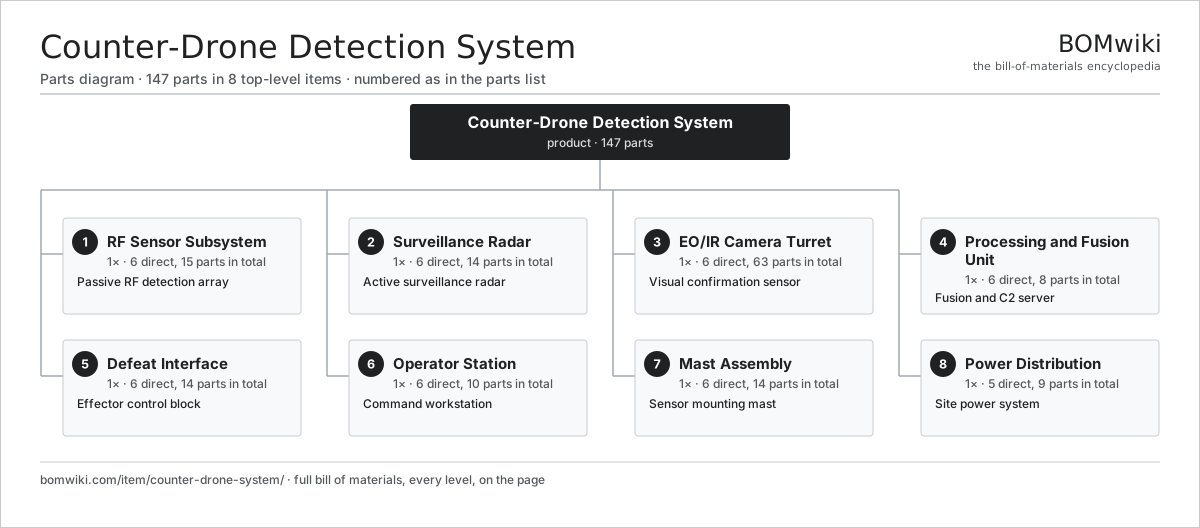
| # | Part | Qty | What it does |
|---|---|---|---|
| 1 | RF Sensor Subsystem 6 parts | 1× | Passive RF detection array |
| 2 | Surveillance Radar 6 parts | 1× | Active surveillance radar |
| 3 | EO/IR Camera Turret 6 parts | 1× | Visual confirmation sensor |
| 4 | Processing and Fusion Unit 6 parts | 1× | Fusion and C2 server |
| 5 | Defeat Interface 6 parts | 1× | Effector control block |
| 6 | Operator Station 6 parts | 1× | Command workstation |
| 7 | Mast Assembly 6 parts | 1× | Sensor mounting mast |
| 8 | Power Distribution 5 parts | 1× | Site power system |
3D model
No 3D model yet. Have a CAD file of this? Add a 3D model. STL renders right on this page; STEP, FreeCAD, and OpenSCAD sources are welcome too (openly licensed, like all 3D models on BOMwiki).
Build & assembly graph
expand / collapse · shared sub-assemblies converge · links to related products · est. labourTap an assembly to expand/collapse · tap a part to open it · use “Open page” for any node · drag to pan, scroll to zoom.
Bill of materials for Counter-Drone Detection System
8 top-level lines · 59 rows shown · 147 parts total · indented to 3 levels| # | Item / sub-assembly | Part no. | Qty/assy | Ext. qty | Parts | Type |
|---|---|---|---|---|---|---|
| 1 | RF Sensor Subsystem 6 parts | counter-drone-system-rf-sensor | 1× | 1 | 15 | assembly |
| 1.1 | DF Antenna Array | counter-drone-system-df-antenna-array | 1× | 1 | · | part |
| 1.2 | Wideband Receiver | counter-drone-system-wideband-receiver | 2× | 2 | · | part |
| 1.3 | Protocol Library Unit | counter-drone-system-protocol-library | 1× | 1 | · | part |
| 1.4 | RF Front End | counter-drone-system-rf-frontend | 1× | 1 | · | part |
| 1.5 | Bare PCB | pcb-bare | 2× | 2 | · | part |
| 1.6 | Connector | connector | 8× | 8 | · | part |
| 2 | Surveillance Radar 6 parts | counter-drone-system-radar | 1× | 1 | 14 | assembly |
| 2.1 | AESA Panel | counter-drone-system-radar-aesa-panel | 4× | 4 | · | part |
| 2.2 | Radar Exciter | counter-drone-system-radar-exciter | 1× | 1 | · | part |
| 2.3 | Radar Processor | counter-drone-system-radar-processor | 1× | 1 | · | part |
| 2.4 | Radar Enclosure | counter-drone-system-radar-enclosure | 1× | 1 | · | part |
| 2.5 | Power Supply | power-supply | 1× | 1 | · | part |
| 2.6 | Connector | connector | 6× | 6 | · | part |
| 3 | EO/IR Camera Turret 6 parts | counter-drone-system-eoir-turret | 1× | 1 | 63 | assembly |
| 3.1 | Daylight Camera | counter-drone-system-daylight-camera | 1× | 1 | · | part |
| 3.2 | Thermal Camera | counter-drone-system-thermal-camera | 1× | 1 | · | part |
| 3.3 | Pan-Tilt Unit 4 parts | counter-drone-system-pan-tilt-unit | 1× | 1 | 56 | assembly |
| 3.3.1 | Servo Motor 4 parts + deeper › | servo-motor | 2× | 2 | 24 | assembly |
| 3.3.2 | Encoder | encoder | 2× | 2 | · | part |
| 3.3.3 | Ball Bearing | ball-bearing | 4× | 4 | · | part |
| 3.3.4 | Oil Seal | oil-seal | 2× | 2 | · | part |
| 3.4 | Video Tracker | counter-drone-system-video-tracker | 1× | 1 | · | part |
| 3.5 | Lens Assembly | camera-lens | 2× | 2 | · | part |
| 3.6 | CMOS Image Sensor | image-sensor | 2× | 2 | · | part |
| 4 | Processing and Fusion Unit 6 parts | counter-drone-system-processing-unit | 1× | 1 | 8 | assembly |
| 4.1 | Fusion Server | counter-drone-system-fusion-server | 1× | 1 | · | part |
| 4.2 | Classifier Module | counter-drone-system-classifier-module | 1× | 1 | · | part |
| 4.3 | Recording Unit | counter-drone-system-recording-unit | 1× | 1 | · | part |
| 4.4 | Network Switch | counter-drone-system-network-switch | 1× | 1 | · | part |
| 4.5 | Compute SoC Module | soc-module | 2× | 2 | · | part |
| 4.6 | Power Supply | power-supply | 2× | 2 | · | part |
| 5 | Defeat Interface 6 parts | counter-drone-system-defeat-interface | 1× | 1 | 14 | assembly |
| 5.1 | Effector Gateway | counter-drone-system-effector-gateway | 1× | 1 | · | part |
| 5.2 | Jammer Control Block | counter-drone-system-jammer-control-block | 1× | 1 | · | part |
| 5.3 | Authorization Module | counter-drone-system-authorization-module | 1× | 1 | · | part |
| 5.4 | Cue Converter | counter-drone-system-cue-converter | 1× | 1 | · | part |
| 5.5 | Relay | relay | 4× | 4 | · | part |
| 5.6 | Connector | connector | 6× | 6 | · | part |
| 6 | Operator Station 6 parts | counter-drone-system-operator-station | 1× | 1 | 10 | assembly |
| 6.1 | C2 Software Host | counter-drone-system-c2-software-host | 1× | 1 | · | part |
| 6.2 | Alert Unit | counter-drone-system-alert-unit | 1× | 1 | · | part |
| 6.3 | LCD Panel | lcd-panel | 2× | 2 | · | part |
| 6.4 | Control Panel | counter-drone-system-control-panel | 1× | 1 | · | part |
| 6.5 | Power Supply | power-supply | 1× | 1 | · | part |
| 6.6 | Connector | connector | 4× | 4 | · | part |
| 7 | Mast Assembly 6 parts | counter-drone-system-mast-assembly | 1× | 1 | 14 | assembly |
| 7.1 | Mast Column | counter-drone-system-mast-column | 1× | 1 | · | part |
| 7.2 | Sensor Bracket | counter-drone-system-sensor-brackets | 4× | 4 | · | part |
| 7.3 | Guy Kit | counter-drone-system-guy-kit | 1× | 1 | · | part |
| 7.4 | Obstruction Light | counter-drone-system-obstruction-light | 1× | 1 | · | part |
| 7.5 | Fastener Set | fastener-set | 3× | 3 | · | part |
| 7.6 | Wire Bundle | wire-bundle | 4× | 4 | · | part |
| 8 | Power Distribution 5 parts | counter-drone-system-power-distribution | 1× | 1 | 9 | assembly |
| 8.1 | UPS Unit | counter-drone-system-ups-unit | 1× | 1 | · | part |
| 8.2 | Distribution Panel | counter-drone-system-distribution-panel | 1× | 1 | · | part |
| 8.3 | Site Cable Set | counter-drone-system-cable-set | 1× | 1 | · | part |
| 8.4 | 12 V Battery | lv-battery | 2× | 2 | · | part |
| 8.5 | Relay | relay | 4× | 4 | · | part |
Something wrong in this list? Report a problem with this BOM.
Related products
same domain, ranked by shared parts Optronic Periscope Mast
369 parts · shares 16 with this page
Military Reconnaissance UAV
123 parts · shares 16 with this page
Optronic Periscope Mast
369 parts · shares 16 with this page
Military Reconnaissance UAV
123 parts · shares 16 with this page
 EOD Robot
1,224 parts · shares 16 with this page
EOD Robot
1,224 parts · shares 16 with this page
 Military Transport Aircraft
3,060 parts · shares 16 with this page
Military Transport Aircraft
3,060 parts · shares 16 with this page
 CCTV Camera
288 parts · shares 12 with this page
CCTV Camera
288 parts · shares 12 with this page
 Ground Surveillance Radar
70 parts · shares 15 with this page
Ground Surveillance Radar
70 parts · shares 15 with this page
Sourcing: possible vendors
Browse the supplier directory → Prices, MOQ, and lead times are algorithmic estimates, not quotes, and not claims about these companies. Company mappings are curated by keyword; est. price band $200–$100M. How estimates work| Vendor | HQ | Specialty | MOQ | Lead time |
|---|---|---|---|---|
| smithsdetection.com ↗ | London, GB | Security screening | made to order | 24–52 wks |
|
🇺🇸Leidos
leidos.com ↗
|
Reston, US | Security & screening | made to order | 24–52 wks |
|
🇺🇸Rapiscan
rapiscansystems.com ↗
|
Torrance, US | X-ray screening | made to order | 24–52 wks |
|
🇫🇷Thales
thalesgroup.com ↗
|
Paris, FR | Defense electronics | made to order | 24–52 wks |
| baesystems.com ↗ | London, GB | Defense | made to order | 24–52 wks |
786-word article