Counterfeit Bill Detector
ProductOverview
The counterfeit bill detector is a specialized currency authentication device used in retail, banking, casinos, and high-volume cash environments to rapidly and objectively verify that banknotes are genuine. Modern currency incorporates multiple embedded security features, UV-reactive threads, magnetic inks, special watermarks, security holograms, and color-shifting pigments, that are difficult and expensive to counterfeit with conventional printing. A counterfeit detector uses multiple optical and magnetic sensors operating in the ultraviolet (UV), magnetic (MG), and infrared (IR) spectra to read these features and compare them against a stored database of known authentic bills.
When a cashier inserts a bill into the detector's slot, motorized rollers transport it through the sensor array at a controlled speed. The sensors read the security features, the microcontroller compares the signature against its firmware database, and within 2–5 seconds, an indicator light and optional display report PASS, FAIL, or SUSPECT.
How it works
Multi-Spectrum Detection: The sensor array contains three independent detection channels:
UV (Ultraviolet, 365 nm): Many currencies incorporate security threads or inks that fluoresce under UV light. A UV LED illuminates the bill, and a phototransistor measures the fluorescence intensity. Genuine bills exhibit characteristic fluorescence patterns; counterfeits either lack this feature or show it at the wrong intensity.
MG (Magnetic): Security threads and inks in modern banknotes contain ferromagnetic particles. A magnetic coil energizes these particles, and a flux sensor detects the induced magnetic field. The field strength and spatial distribution are unique to authentic bills.
IR (Infrared, 850 nm): Many currencies use special IR-absorbing inks in specific patterns. A near-infrared LED (850 nm) illuminates the bill, and an IR photodiode detects reflection. Genuine bills show characteristic dark and light patterns under IR; counterfeit materials respond differently.
Sensor Signal Processing: Each sensor output is weak and analog. The sensor conditioning board amplifies, filters, and converts the signals to digital values that the microcontroller can process.
Motorized Transport: When a bill is inserted, the motor automatically engages and feeds the bill through the sensor zone at a constant speed (e.g., 30 cm/s). This ensures consistent exposure time and consistent measurement conditions. Spring-loaded input rollers grip the bill without creasing or damage.
Signature Comparison: The microcontroller is programmed with the authentic security-feature signatures for every currency type and denomination it supports (typically 100+ currency/denomination combinations). As the bill passes through the sensors, the processor collects readings and compares them against the stored signatures using a statistical algorithm. If the readings match known authentic parameters, the bill is marked PASS. If readings fall outside acceptable ranges, it is marked FAIL. If readings are borderline or ambiguous, the unit may flag it as SUSPECT, requiring manual review.
Status Output: The result is displayed via:
- A tri-color LED array (green for PASS, red for FAIL, yellow for SUSPECT)
- An optional LCD display showing text like "ACCEPT," "REJECT," or "CHECK MANUAL"
- A piezo speaker that sounds a confirmation beep or error tone
Bill Ejection: After testing, the bill is released via the exit roller, which springs open to drop the bill into a collection tray or the operator's hand.
Currency Support
Counterfeit detectors are available in single-currency and multi-currency versions:
- Single-Currency Models: Optimized for a specific currency (e.g., USD only). These are typically lower cost and operate at higher speed because the processor only checks one set of signatures.
- Multi-Currency Models: Support 50–150 currencies and denominations. The operator selects the currency via buttons or a menu on the display. Firmware updates can add new currencies as new security features are introduced.
Common currencies supported include USD, EUR, GBP, JPY, AUD, CAD, and most others in active circulation.
Detection Limitations and Fraud Sophistication
No single detector is 100% foolproof against extremely sophisticated counterfeits (government-grade, government-printed using stolen plates). However, commercial counterfeit detectors are designed to catch the vast majority of counterfeits encountered in everyday commerce, which typically use:
- Offset printing on inkjet stock
- Photocopied security features
- Missing or incorrect magnetic inks
- UV features printed in ordinary ink
The U.S. Secret Service estimates that less than 0.01% of currency in circulation is counterfeit, and most of that is caught during banking-center processing or by trained personnel using multiple detection methods.
Operational Workflow
In high-volume environments (retail stores, casinos, currency exchanges), the typical workflow is:
- Cashier inserts a suspicious or high-value bill into the detector's slot.
- Motor automatically transports the bill through sensors (2–5 seconds).
- Detector lights up PASS, FAIL, or SUSPECT.
- If PASS, bill is accepted and transaction proceeds.
- If FAIL or SUSPECT, bill is set aside for secondary inspection or confiscated.
- Log entry is recorded for audit and fraud investigation.
Some high-end models support networked operation, logging every test result to a central database for aggregate fraud tracking and alerting.
Maintenance and Calibration
The feed rollers require periodic cleaning to remove dust and paper residue. A dry cloth or soft brush restores grip. The optical sensors should be checked for dust accumulation (a clear plastic window usually allows visual inspection without disassembly).
Many detectors are factory-calibrated and do not require user recalibration. However, if accuracy degrades over time (e.g., older optical coatings dim slightly), the manufacturer provides recalibration kits or swaps in new sensor modules. Some models support firmware updates to accommodate new currency designs or updated security features.
Regulatory Context
In many jurisdictions, cash handlers (especially in banking) are required to use counterfeit detectors as part of compliance with anti-counterfeiting laws. The U.S. Secret Service does not mandate detector use, but retailers, banks, and casinos routinely employ them as standard loss-prevention equipment. Some countries (e.g., Germany, UK) provide detailed security-feature guides and encourage or mandate detector use.
Counterfeit Bill Detector parts and their functions
6 top-level parts · 34 parts in total · full bill of materials below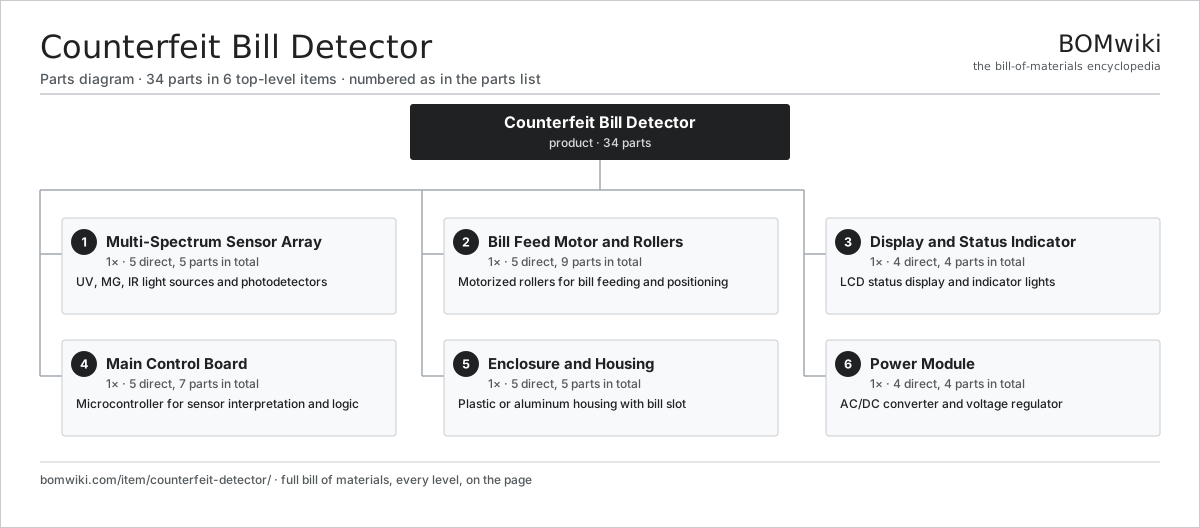
| # | Part | Qty | What it does |
|---|---|---|---|
| 1 | Multi-Spectrum Sensor Array 5 parts | 1× | UV, MG, IR light sources and photodetectors |
| 2 | Bill Feed Motor and Rollers 5 parts | 1× | Motorized rollers for bill feeding and positioning |
| 3 | Display and Status Indicator 4 parts | 1× | LCD status display and indicator lights |
| 4 | Main Control Board 5 parts | 1× | Microcontroller for sensor interpretation and logic |
| 5 | Enclosure and Housing 5 parts | 1× | Plastic or aluminum housing with bill slot |
| 6 | Power Module 4 parts | 1× | AC/DC converter and voltage regulator |
3D model
No 3D model yet. Have a CAD file of this? Add a 3D model. STL renders right on this page; STEP, FreeCAD, and OpenSCAD sources are welcome too (openly licensed, like all 3D models on BOMwiki).
Build & assembly graph
expand / collapse · shared sub-assemblies converge · links to related products · est. labourTap an assembly to expand/collapse · tap a part to open it · use “Open page” for any node · drag to pan, scroll to zoom.
Bill of materials for Counterfeit Bill Detector
6 top-level lines · 34 rows shown · 34 parts total · indented to 3 levels| # | Item / sub-assembly | Part no. | Qty/assy | Ext. qty | Parts | Type |
|---|---|---|---|---|---|---|
| 1 | Multi-Spectrum Sensor Array 5 parts | counterfeit-detector-sensor-array | 1× | 1 | 5 | assembly |
| 1.1 | UV Light Module | counterfeit-detector-uv-led | 1× | 1 | · | part |
| 1.2 | Magnetic Detector Coil | counterfeit-detector-mg-coil | 1× | 1 | · | part |
| 1.3 | Infrared Light Module | counterfeit-detector-ir-led | 1× | 1 | · | part |
| 1.4 | Sensor Conditioning Board | counterfeit-detector-sensor-pcb | 1× | 1 | · | part |
| 1.5 | Fastener Set | fastener-set | 1× | 1 | · | part |
| 2 | Bill Feed Motor and Rollers 5 parts | counterfeit-detector-transport-mechanism | 1× | 1 | 9 | assembly |
| 2.1 | Roller Drive Motor | counterfeit-detector-feed-motor | 1× | 1 | · | part |
| 2.2 | Soft Grip Roller | counterfeit-detector-feed-roller | 2× | 2 | · | part |
| 2.3 | Exit Roller Assembly | counterfeit-detector-exit-roller | 1× | 1 | · | part |
| 2.4 | Ball Bearing | ball-bearing | 4× | 4 | · | part |
| 2.5 | Fastener Set | fastener-set | 1× | 1 | · | part |
| 3 | Display and Status Indicator 4 parts | counterfeit-detector-display-unit | 1× | 1 | 4 | assembly |
| 3.1 | LCD Panel | lcd-panel | 1× | 1 | · | part |
| 3.2 | Status LED Indicators | counterfeit-detector-led-array | 1× | 1 | · | part |
| 3.3 | Speaker | speaker | 1× | 1 | · | part |
| 3.4 | Fastener Set | fastener-set | 1× | 1 | · | part |
| 4 | Main Control Board 5 parts | counterfeit-detector-processor-board | 1× | 1 | 7 | assembly |
| 4.1 | Microcontroller | mcu | 1× | 1 | · | part |
| 4.2 | Bare PCB | pcb-bare | 1× | 1 | · | part |
| 4.3 | SMD Passive (R/C/L) | smd-passives | 1× | 1 | · | part |
| 4.4 | Connector | connector | 3× | 3 | · | part |
| 4.5 | Fastener Set | fastener-set | 1× | 1 | · | part |
| 5 | Enclosure and Housing 5 parts | counterfeit-detector-case | 1× | 1 | 5 | assembly |
| 5.1 | Main Housing Shell | counterfeit-detector-body | 1× | 1 | · | part |
| 5.2 | Bill Input Slot | counterfeit-detector-bill-slot | 1× | 1 | · | part |
| 5.3 | Bill Output Port | counterfeit-detector-output-port | 1× | 1 | · | part |
| 5.4 | Fastener Set | fastener-set | 1× | 1 | · | part |
| 5.5 | Sheet Metal Panel | sheet-panel | 1× | 1 | · | part |
| 6 | Power Module 4 parts | counterfeit-detector-power-supply | 1× | 1 | 4 | assembly |
| 6.1 | Power Supply | power-supply | 1× | 1 | · | part |
| 6.2 | Connector | connector | 1× | 1 | · | part |
| 6.3 | Thermal Fuse | thermal-fuse | 1× | 1 | · | part |
| 6.4 | Fastener Set | fastener-set | 1× | 1 | · | part |
Something wrong in this list? Report a problem with this BOM.
Related products
same domain, ranked by shared parts Interactive Display Board
572 parts · shares 7 with this page
Queue Ticket Dispenser
307 parts · shares 7 with this page
Interactive Display Board
572 parts · shares 7 with this page
Queue Ticket Dispenser
307 parts · shares 7 with this page
 Pneumatic Tube Station
201 parts · shares 6 with this page
Pneumatic Tube Station
201 parts · shares 6 with this page
 Photocopier (MFP)
210 parts · shares 5 with this page
Photocopier (MFP)
210 parts · shares 5 with this page
 Key Cutting Machine
63 parts · shares 2 with this page
Key Cutting Machine
63 parts · shares 2 with this page
 POS Terminal
138 parts · shares 5 with this page
POS Terminal
138 parts · shares 5 with this page
Sourcing: possible vendors
Browse the supplier directory → Prices, MOQ, and lead times are algorithmic estimates, not quotes, and not claims about these companies. Company mappings are curated by keyword; est. price band $50–$15k. How estimates work| Vendor | HQ | Specialty | MOQ | Lead time |
|---|---|---|---|---|
|
🇯🇵Canon
canon.com ↗
|
Tokyo, JP | Imaging & optics | 500 units | 8–12 wks |
|
🇯🇵Ricoh
ricoh.com ↗
|
Tokyo, JP | Office imaging | 500 units | 8–12 wks |
|
🇺🇸Xerox
xerox.com ↗
|
Norwalk, US | Printers & copiers | 500 units | 8–12 wks |
|
🇯🇵Epson
epson.com ↗
|
Suwa, JP | Printers & projectors | 500 units | 8–12 wks |
|
🇯🇵Brother
brother.com ↗
|
Nagoya, JP | Printers & sewing | 500 units | 8–12 wks |
1,040-word article