Countertop Convection Oven
ProductOverview
A countertop convection oven is a toaster-oven-class appliance with a fan added to the cavity, sized to handle a 30 cm pizza or a small roast while drawing what a single wall socket can supply, 1500-1800 W. The cavity is the Cavity Liner, an aluminized-steel box of 20-25 L with embossed positions for two Wire Rack heights set by the Rack Guide rails. Against a full-size oven its advantages are preheat time (5-10 minutes versus 15-20) and energy per cook, since it heats a tenth of the volume.
Heating and convection
Four tubular Heating Element units, quartz or metal-sheathed, run front-to-back in upper and lower banks, each end held by a sprung Element Bracket that lets the tube grow when hot, with a polished Element Reflector trough behind each bank. The Function Switch routes power among them: lower elements for bake, upper for broil, all four for toast, and any of these plus the fan for convection modes.
The convection system is mechanically simple. A shaded-pole Convection Fan Motor hangs outside the rear wall, its shaft passing through to a steel Fan Impeller behind the perforated Fan Baffle. The fan does not heat anything; it strips away the stagnant boundary layer of cooled air and steam that clings to food in a still oven, raising the convective heat-transfer coefficient enough to cut cook times 20-30 percent or, equivalently, to match recipes at a setpoint about 15 degrees C lower. The baffle matters as much as the fan, turning a single jet into an even loop around both racks so multi-rack baking browns uniformly, which still ovens of this size cannot do.
Regulation and controls
The Cavity Thermostat, a capillary-bulb or bimetal unit sensing cavity air, cycles the elements around the dial setting between roughly 90 and 230 degrees C; the Indicator Lamp follows the element power, and its on-off rhythm is the visible regulation. A series Thermal Fuse protects against a welded thermostat. Cook duration is set on the Mechanical Timer, a spring-wound 60-minute mechanism that drops all power and rings at zero, a deliberately electricity-free design that cannot leave the oven running after a fault. Three matching Control Knob pointers cover thermostat, function and timer shafts. Digital versions of this product replace the three knobs with a board and membrane keys, but the power path through switch, thermostat and fuse is the same.
Door, shell and thermal design
The Door Assembly drops down on two sprung Door Hinge arms whose Coil Spring counterbalance holds intermediate angles, including the part-open broil position that vents steam while shielding the user from the upper elements. The Door Glass is tempered, double-glazed on better models to keep the outer pane touchable, and framed by the Door Frame with a spaced-off Door Handle.
Between the liner and the outer Sheet Metal Panel wrap sits a glass-fiber Insulation Batt; with only a couple of centimeters available, the outer skin of these ovens still reaches 60-80 degrees C in places, which is why standards govern handle and knob temperatures rather than the shell itself, and why the Standoff Foot standoffs hold the base off the counter. The Back Panel vents the fan motor compartment. The Crumb Tray slides out under the lower elements, the one cleaning point that prevents most smoke complaints, and the enameled Bake Pan catches drippings above them.
Wiring runs in a heat-rated Wire Bundle from the Cord Set, whose short 0.9 m cable is a deliberate safety choice for a 13-15 A appliance, through the switchgear to the ceramic Element Terminal Block. Typical service items are the thermal fuse, a burned-out element tube, and the door hinge springs, all replaceable with the Fastener Set removed and the wrap lifted off.
Performance notes
Toast is the hardest test the oven faces: it wants all four elements at full radiant output with the food close to them, and element type shows here. Quartz tubes reach working temperature in 2-3 seconds while metal-sheathed elements take 30 or more, so quartz models toast more evenly from a cold start. Baking exposes the opposite trait: the small cavity swings further around setpoint than a full-size oven because there is little thermal mass, typically plus or minus 10-15 degrees C across a thermostat cycle, and the convection fan narrows that swing by mixing the air the thermostat bulb samples. Running the fan also shifts browning from radiant to convective, which is why convection-baked items color evenly across the rack rather than darkening under each element line.
Countertop Convection Oven parts and their functions
9 top-level parts · 77 parts in total · full bill of materials below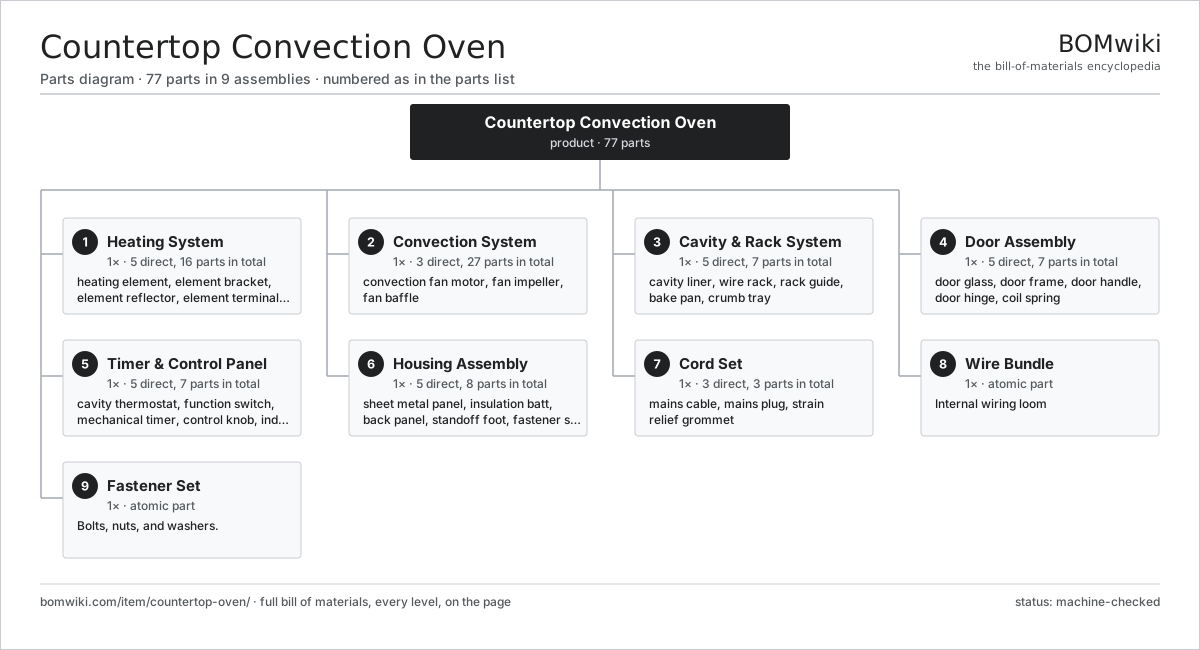
| # | Part | Qty | What it does |
|---|---|---|---|
| 1 | Heating System 5 parts | 1× | Upper and lower element banks that supply radiant heat, switched in combinations to give bake, toast and broil functions. |
| 2 | Convection System 3 parts | 1× | Rear-mounted fan that pulls cavity air through a baffle and throws it back over the food, cutting cook times roughly 20-30 percent versus still air. |
| 3 | Cavity & Rack System 5 parts | 1× | Cooking chamber liner with multiple rack heights and the trays that go in it. |
| 4 | Door Assembly 5 parts | 1× | Drop-down glazed door that seals the cavity front and shelves part-open for broiling. |
| 5 | Timer & Control Panel 5 parts | 1× | Thermostat, function selector and timer that set temperature, element combination and cook duration. |
| 6 | Housing Assembly 5 parts | 1× | Outer cabinet, insulation and feet around the hot cavity. |
| 7 | Cord Set 3 parts | 1× | Mains lead and its anchorage. |
| 8 | Wire Bundle | 1× | Internal wiring loom |
| 9 | Fastener Set | 1× | Bolts, nuts, and washers. |
3D model
No 3D model yet. Have a CAD file of this? Add a 3D model — STL renders right on this page; STEP, FreeCAD, and OpenSCAD sources are welcome too (openly licensed, like all 3D models on BOMwiki).
Build & assembly graph
expand / collapse · shared sub-assemblies converge · links to related products · est. labourTap an assembly to expand/collapse · tap a part to open it · use “Open page” for any node · drag to pan, scroll to zoom.
Bill of materials for Countertop Convection Oven
9 top-level lines · 44 rows shown · 77 parts total · indented to 3 levels| # | Item / sub-assembly | Part no. | Qty/assy | Ext. qty | Parts | Type |
|---|---|---|---|---|---|---|
| 1 | Heating System 5 parts | countertop-oven-heating | 1× | 1 | 16 | assembly |
| 1.1 | Heating Element | heating-element | 4× | 4 | · | part |
| 1.2 | Element Bracket | countertop-oven-element-bracket | 8× | 8 | · | part |
| 1.3 | Element Reflector | countertop-oven-reflector | 2× | 2 | · | part |
| 1.4 | Element Terminal Block | countertop-oven-terminal-block | 1× | 1 | · | part |
| 1.5 | Thermal Fuse | thermal-fuse | 1× | 1 | · | part |
| 2 | Convection System 3 parts | countertop-oven-convection | 1× | 1 | 27 | assembly |
| 2.1 | Convection Fan Motor 4 parts | countertop-oven-fan-motor | 1× | 1 | 25 | assembly |
| 2.1.1 | Stator Assembly 3 parts + deeper › | stator-assembly | 1× | 1 | 3 | assembly |
| 2.1.2 | Rotor Assembly 4 parts + deeper › | rotor-assembly | 1× | 1 | 19 | assembly |
| 2.1.3 | Motor Housing | motor-housing | 1× | 1 | · | part |
| 2.1.4 | Ball Bearing | ball-bearing | 2× | 2 | · | part |
| 2.2 | Fan Impeller | countertop-oven-fan-impeller | 1× | 1 | · | part |
| 2.3 | Fan Baffle | countertop-oven-fan-baffle | 1× | 1 | · | part |
| 3 | Cavity & Rack System 5 parts | countertop-oven-cavity | 1× | 1 | 7 | assembly |
| 3.1 | Cavity Liner | countertop-oven-cavity-liner | 1× | 1 | · | part |
| 3.2 | Wire Rack | countertop-oven-rack | 2× | 2 | · | part |
| 3.3 | Rack Guide | countertop-oven-rack-guide | 2× | 2 | · | part |
| 3.4 | Bake Pan | countertop-oven-bake-pan | 1× | 1 | · | part |
| 3.5 | Crumb Tray | countertop-oven-crumb-tray | 1× | 1 | · | part |
| 4 | Door Assembly 5 parts | countertop-oven-door | 1× | 1 | 7 | assembly |
| 4.1 | Door Glass | countertop-oven-door-glass | 1× | 1 | · | part |
| 4.2 | Door Frame | countertop-oven-door-frame | 1× | 1 | · | part |
| 4.3 | Door Handle | countertop-oven-door-handle | 1× | 1 | · | part |
| 4.4 | Door Hinge | countertop-oven-door-hinge | 2× | 2 | · | part |
| 4.5 | Coil Spring | coil-spring | 2× | 2 | · | part |
| 5 | Timer & Control Panel 5 parts | countertop-oven-control | 1× | 1 | 7 | assembly |
| 5.1 | Cavity Thermostat | countertop-oven-thermostat | 1× | 1 | · | part |
| 5.2 | Function Switch | countertop-oven-function-switch | 1× | 1 | · | part |
| 5.3 | Mechanical Timer | countertop-oven-timer | 1× | 1 | · | part |
| 5.4 | Control Knob | countertop-oven-knob | 3× | 3 | · | part |
| 5.5 | Indicator Lamp | countertop-oven-indicator-lamp | 1× | 1 | · | part |
| 6 | Housing Assembly 5 parts | countertop-oven-housing | 1× | 1 | 8 | assembly |
| 6.1 | Sheet Metal Panel | sheet-panel | 1× | 1 | · | part |
| 6.2 | Insulation Batt | countertop-oven-insulation-batt | 1× | 1 | · | part |
| 6.3 | Back Panel | countertop-oven-back-panel | 1× | 1 | · | part |
| 6.4 | Standoff Foot | countertop-oven-foot | 4× | 4 | · | part |
| 6.5 | Fastener Set | fastener-set | 1× | 1 | · | part |
| 7 | Cord Set 3 parts | countertop-oven-cord-set | 1× | 1 | 3 | assembly |
| 7.1 | Mains Cable | countertop-oven-cord | 1× | 1 | · | part |
| 7.2 | Mains Plug | countertop-oven-plug | 1× | 1 | · | part |
| 7.3 | Strain Relief Grommet | countertop-oven-strain-relief | 1× | 1 | · | part |
| 8 | Wire Bundle | wire-bundle | 1× | 1 | · | part |
| 9 | Fastener Set | fastener-set | 1× | 1 | · | part |
Related products
same domain, ranked by shared parts Chocolate Fondue Fountain
110 parts · shares 12 with this page
Chocolate Fondue Fountain
110 parts · shares 12 with this page
 Home Meat Slicer
78 parts · shares 11 with this page
Home Meat Slicer
78 parts · shares 11 with this page
 Compressor Ice Cream Maker
248 parts · shares 11 with this page
Compressor Ice Cream Maker
248 parts · shares 11 with this page
 Electric Carving Knife
54 parts · shares 11 with this page
Electric Carving Knife
54 parts · shares 11 with this page
Sourcing: possible vendors
Prices, MOQ, and lead times are algorithmic estimates, not quotes, and not claims about these companies. Company mappings are curated by keyword; est. price band $20–$600. How estimates work| Vendor | HQ | Specialty | MOQ | Lead time |
|---|---|---|---|---|
|
🇦🇺Breville
breville.com ↗
|
Sydney, AU | Kitchen appliances | 2,000 units | 6–10 wks |
| groupeseb.com ↗ | Écully, FR | Cookware & small appliances | 2,000 units | 6–10 wks |
| hamiltonbeach.com ↗ | Glen Allen, US | Small appliances | 2,000 units | 6–10 wks |
| panasonic.com ↗ | Osaka, JP | Electronics & appliances | 2,000 units | 6–10 wks |
|
🇨🇳Midea
midea.com ↗
|
Foshan, CN | Home appliances | 2,000 units | 6–10 wks |
823-word article