Crane Scale
ProductOverview
A crane scale is a portable weighing device suspended by the hoist of a crane or powered lift, designed to measure the weight of loads hanging from the scale's bottom hook. Capacities typically range from 10 to 50 metric tons. The device comprises a Load Cell Shackle (a forged steel U-frame with an embedded Compression Load Cell), a battery-powered Display Unit unit, and a Remote Control Unit so the operator can read the weight from a distance.
Unlike truck scales, crane scales are mobile and used for spot-checking weights on-site: verifying the mass of a suspended load before setting it down, measuring scrap metal by-the-ton at a recycling yard, or confirming the payload of a lifted pallet at a warehouse. Their key advantage is portability and immediate feedback without a dedicated platform.
How It Works
When a load is suspended from the Load Cell Shackle, the weight (force) is transmitted through the top Top Hook into the shackle body, which acts as a beam under compression. A Compression Load Cell bolted inside the shackle measures this compression using a resistive strain gauge bridge.
As the load increases, the strain gauge resistance changes; the load cell's amplifier (integrated into the shackle or fed to the display) converts this resistance change into a 4–20 mA analog current proportional to weight. This signal is transmitted either via a shielded Signal Cable to the nearby display, or wirelessly via RF if the scale uses a wireless Receiver Module.
The Display Unit CPU receives the 4–20 mA signal (or RF data), applies calibration coefficients, filters the signal to reject crane vibration harmonics, and displays the stable weight on its LCD Panel. The operator can press buttons on the display or use the Remote Control Unit to tare the weight (zero it out), lock the peak reading (Peak Hold), or change display units (kg, tons, pounds).
Mechanical Design
The Load Cell Shackle is the critical load-bearing component. Forged from alloy steel (typically Grade 80, a weldable spring steel), it is designed to withstand repeated lifting stresses with a 4:1 safety factor: a 50 MT scale shackle can safely suspend 200 MT without yielding. The load cell is compression-type, meaning the shackle body compresses slightly (a fraction of a millimeter) as the load increases, and this compression is precisely measured by strain gauges.
A hardened steel Shackle Pin Assembly with ball bearings allows the shackle to swivel freely (180° rotation capability) at the hook attachment points, preventing torsional stress from off-center loads. The pin is sealed with O-rings and dust caps to prevent water ingress.
Top and bottom Lifting Hooks are forged alloy steel with 25–50 mm bore holes. The top hook attaches to the hoist chain or sling; the bottom hook (typically a latch-type or open sling hook) connects to the load. Both hooks are rated to the same SWL (Safe Working Load) as the scale capacity, ensuring the weakest link is not the hooks.
Electrical & Control
Most modern crane scales are battery-powered for portability. The Display Unit houses a low-power ARM microcontroller, a small 4" LCD (monochrome or color), and a wireless Receiver Module or signal conditioning amplifier. The display is typically IP54 rated (splash-resistant but not submersible) and housed in a rubberized ABS or polycarbonate case.
Battery life is 48–72 hours of continuous operation before recharge. A Battery & Charging System with integrated Battery BMS (Battery Management System) protects against over-charge, over-current, and over-temperature faults. Charging is via a Charging Cradle with USB power input and LED status indicators.
For wireless models, a 2.4 GHz RF transceiver in the Remote Control Unit sends commands to the display up to 100–150 m away in open space. The RF link is crystal-locked and frequency-hopped to avoid interference from Wi-Fi or Bluetooth devices. For wired installations, a shielded Signal Cable runs from shackle to display, typically 50 m maximum length.
Calibration & Accuracy
Crane scales are calibrated using certified test masses supplied in the Calibration & Test Kit kit. A technician suspends known weights (typically 2, 5, 10, 25, 50 kg pieces) from the scale one at a time and records the displayed weight. Calibration coefficients are entered via the display buttons and stored in non-volatile memory.
Accuracy is typically ±0.5–1.0% of full scale (Class 2 or 3). For a 50 MT scale, this means a true 50 MT load will display between 49.75 and 50.25 MT. Repeatability is good (±0.3%) due to the direct measurement of load without intermediate mechanical conversion.
Maintenance & Safety
Load cells have no moving parts and require minimal maintenance. Annual visual inspection of the shackle for cracks or corrosion is recommended. The Sealing Components (O-rings and cable glands) should be checked for wear; environmental dust and moisture are the primary failure modes.
Operator training is essential: users must understand that the scale measures weight at the moment of reading, and suspended loads can swing or rotate unexpectedly. Peak Hold mode (which "freezes" the maximum weight reached during a lift) is useful for confirming the heaviest point of a swinging load.
Safety considerations:
- A loose pin or hook can cause catastrophic failure; pins must be locked with a safety lanyard.
- Overloading beyond rated capacity will damage the load cell and may rupture the shackle (resulting in dropped load).
- Wireless interference from nearby radio transmitters can cause signal loss; wired models are preferred in high-RF-noise environments.
- Regular inspection of hooks for cracks is mandatory; a cracked hook can fail suddenly.
Applications
Crane scales are used in:
- Recycling & Scrap Yards: Quick verification of metal scrap weight before processing.
- Mining & Quarrying: Weighing ore buckets or samples on-site without a fixed scale platform.
- Warehousing & Logistics: Checking pallet weights during loading to prevent over-loading trucks.
- Docks & Shipping: Verifying container or cargo mass before lashing.
- Construction & Heavy Equipment: Weighing structural materials and prefab modules during assembly.
- Manufacturing: Inspecting finished goods or sub-assemblies during production.
Related Reading: Load Cell Shackle, Display Unit, Remote Control Unit, Compression Load Cell.
Crane Scale parts and their functions
7 top-level parts · 24 parts in total · full bill of materials below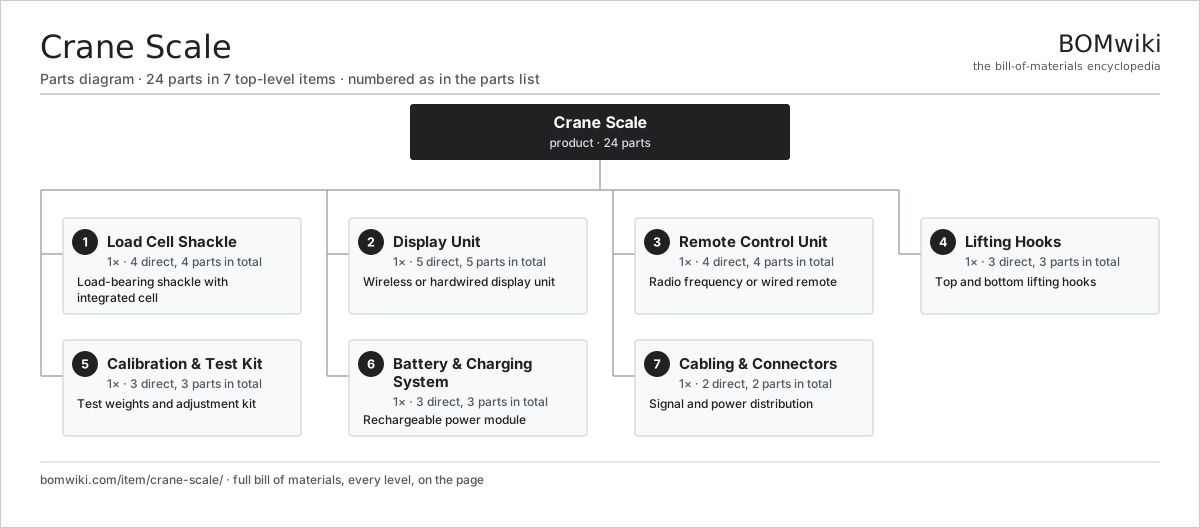
| # | Part | Qty | What it does |
|---|---|---|---|
| 1 | Load Cell Shackle 4 parts | 1× | Load-bearing shackle with integrated cell |
| 2 | Display Unit 5 parts | 1× | Wireless or hardwired display unit |
| 3 | Remote Control Unit 4 parts | 1× | Radio frequency or wired remote |
| 4 | Lifting Hooks 3 parts | 1× | Top and bottom lifting hooks |
| 5 | Calibration & Test Kit 3 parts | 1× | Test weights and adjustment kit |
| 6 | Battery & Charging System 3 parts | 1× | Rechargeable power module |
| 7 | Cabling & Connectors 2 parts | 1× | Signal and power distribution |
3D model
No 3D model yet. Have a CAD file of this? Add a 3D model. STL renders right on this page; STEP, FreeCAD, and OpenSCAD sources are welcome too (openly licensed, like all 3D models on BOMwiki).
Build & assembly graph
expand / collapse · shared sub-assemblies converge · links to related products · est. labourTap an assembly to expand/collapse · tap a part to open it · use “Open page” for any node · drag to pan, scroll to zoom.
Bill of materials for Crane Scale
7 top-level lines · 31 rows shown · 24 parts total · indented to 3 levels| # | Item / sub-assembly | Part no. | Qty/assy | Ext. qty | Parts | Type |
|---|---|---|---|---|---|---|
| 1 | Load Cell Shackle 4 parts | crane-scale-shackle | 1× | 1 | 4 | assembly |
| 1.1 | Shackle Body | crane-scale-shackle-body | 1× | 1 | · | part |
| 1.2 | Compression Load Cell | crane-scale-load-cell-element | 1× | 1 | · | part |
| 1.3 | Shackle Pin Assembly | crane-scale-shackle-pin | 1× | 1 | · | part |
| 1.4 | Sealing Components | crane-scale-sealing-kit | 1× | 1 | · | part |
| 2 | Display Unit 5 parts | crane-scale-display | 1× | 1 | 5 | assembly |
| 2.1 | Display Enclosure | crane-scale-display-enclosure | 1× | 1 | · | part |
| 2.2 | LCD Panel | crane-scale-lcd-panel | 1× | 1 | · | part |
| 2.3 | Display Microcontroller | crane-scale-display-cpu | 1× | 1 | · | part |
| 2.4 | Receiver Module | crane-scale-receiver-module | 1× | 1 | · | part |
| 2.5 | Control Buttons | crane-scale-button-array | 1× | 1 | · | part |
| 3 | Remote Control Unit 4 parts | crane-scale-remote-control | 1× | 1 | 4 | assembly |
| 3.1 | Remote Housing | crane-scale-remote-housing | 1× | 1 | · | part |
| 3.2 | Remote Buttons | crane-scale-remote-buttons | 1× | 1 | · | part |
| 3.3 | RF Transmitter | crane-scale-remote-transmitter | 1× | 1 | · | part |
| 3.4 | Remote Battery Pack | crane-scale-remote-battery | 1× | 1 | · | part |
| 4 | Lifting Hooks 3 parts | crane-scale-hooks | 1× | 1 | 3 | assembly |
| 4.1 | Top Hook | crane-scale-top-hook | 1× | 1 | · | part |
| 4.2 | Bottom Hook | crane-scale-bottom-hook | 1× | 1 | · | part |
| 4.3 | Safety Pin & Lanyard | crane-scale-hook-safety-pin | 1× | 1 | · | part |
| 5 | Calibration & Test Kit 3 parts | crane-scale-calibration | 1× | 1 | 3 | assembly |
| 5.1 | Test Masses | crane-scale-test-masses | 1× | 1 | · | part |
| 5.2 | Trim Weights | crane-scale-trim-weights | 1× | 1 | · | part |
| 5.3 | Certification Document | crane-scale-cert-doc | 1× | 1 | · | part |
| 6 | Battery & Charging System 3 parts | crane-scale-battery-pack | 1× | 1 | 3 | assembly |
| 6.1 | Li-ion Battery Pack | crane-scale-li-ion-pack | 1× | 1 | · | part |
| 6.2 | Battery BMS | crane-scale-battery-bms | 1× | 1 | · | part |
| 6.3 | Charging Cradle | crane-scale-charger-cradle | 1× | 1 | · | part |
| 7 | Cabling & Connectors 2 parts | crane-scale-cabling | 1× | 1 | 2 | assembly |
| 7.1 | Signal Cable | crane-scale-signal-cable | 1× | 1 | · | part |
| 7.2 | Cable Connectors | crane-scale-connectors | 1× | 1 | · | part |
Something wrong in this list? Report a problem with this BOM.
Sourcing: possible vendors
Browse the supplier directory → Prices, MOQ, and lead times are algorithmic estimates, not quotes, and not claims about these companies. Company mappings are curated by keyword; est. price band $2k–$300k. How estimates work| Vendor | HQ | Specialty | MOQ | Lead time |
|---|---|---|---|---|
| toyota-industries.com ↗ | Kariya, JP | Forklifts & logistics | 20 units | 10–16 wks |
| kiongroup.com ↗ | Frankfurt, DE | Forklifts (Linde, STILL) | 20 units | 10–16 wks |
| jungheinrich.com ↗ | Hamburg, DE | Warehouse trucks | 20 units | 10–16 wks |
| crown.com ↗ | New Bremen, US | Forklifts | 20 units | 10–16 wks |
|
🇨🇳Hangcha
hcforklift.com ↗
|
Hangzhou, CN | Forklifts & material handling | 20 units | 10–16 wks |
1,063-word article