Cream Separator
ProductOverview
A cream separator is a centrifuge that exploits the density difference between fat globules and water to split Milk Cooling Tank milk into two streams: cream (with most of the fat) and skim milk (mostly water, protein, and lactose). Before mechanical separators, farmers relied on time and gravity, milk sat in shallow pans overnight, and the lighter fat rose to the surface as a cream layer that could be skimmed off. The process took 12-18 hours and yielded only 80-90 % of the available fat. A mechanical separator does the same job in 2-3 minutes and recovers 98-99 % of the fat, turning a day's milk into butter, yogurt, cheese, or sale-ready cream by lunchtime.
The Cream Separator works by spinning milk at 5000-8000 RPM in a narrow, rotating space where the centrifugal force is 8000-12000 g. Light fat moves inward, heavy milk moves outward. Two static spouts at different radii inside the bowl catch the separated fractions before they remix. The efficiency gain over gravity is dramatic: a single operator can process 100+ liters of milk per hour, compared to 20-30 liters per day by gravity alone.
The disc-bowl rotor
The heart of the separator is the Disc-Bowl Rotor, a conical rotating chamber filled with a Disc Stack, typically 150-400 thin stainless steel discs stacked with 0.5-1 mm spacing. Each disc is conical, matching the bowl angle. As milk enters the bottom of the spinning bowl, it flows upward through the narrow gaps between discs. The milk path is so thin and tortuous that even tiny fat globules (5-50 µm) rapidly settle outward under the 8000+ g field. Light fat concentrates near the axis; water and proteins concentrate at the outer wall.
The Bowl Shell is thin-walled stainless (0.5-1 mm), rotating on Ball Bearing journals at top and bottom. It is sealed by an Oil Seal at each bearing to prevent milk contamination of the bearing lubrication. Bearing failure is rare but catastrophic, once worn, friction heats milk and denatures protein, and the machine becomes a source of off-flavors rather than a tool.
Drive and speed control
The Drive System motor (typically 0.5-1.5 HP at 220/380 VAC) is coupled via a Pulley Assembly and Drive Belt to a Speed Gearbox. Most small separators use a Reeves conical friction drive: two truncated cones with a V-belt between them. Widening one cone and narrowing the other shifts the belt to a different radius, changing the speed ratio. A Governor Lever on the Frame Assembly allows the operator to adjust speed while running, which is essential because the optimal RPM depends on the desired cream richness (higher speed favors cream; lower speed favors skim milk recovery).
The Tension Spring provides constant belt tension despite wear and temperature changes.
Supply and float chamber
Milk enters through the Feed Tube at the top, flowing into the Floating Chamber, a small vertical funnel hanging above the bowl. The float chamber is not rigidly attached; it floats on the inlet guide, allowing the milk to self-regulate its entry into the bowl below. This floating design prevents splashing and vortexing inside the bowl, which would degrade separation. The Regulating Valve on the supply line is adjusted (manually or with a ball valve) to deliver milk at 3-5 L/min, a rate that fills the float chamber without overflow.
Separation outlets
Inside the Disc-Bowl Rotor, two concentric cream-separator-spout tubes hang from the fixed Spout Collector. The inner, lower spout taps light cream (the innermost layer, typically 45-50 % fat). The outer, higher spout taps skim milk or low-fat milk (the outermost layer, typically <0.5 % residual fat). The exact balance point depends on speed, feed rate, and milk composition. A hand-operated diverter valve on the cream outlet allows the operator to adjust where the separation line occurs: turning the valve clockwise increases cream richness (more fat goes to the cream outlet, less to skim) at the cost of losing some fat to the skim outlet.
Separation efficiency and residual fat
Industrial separators routinely achieve <0.05 % residual butterfat in skim milk, but older or smaller machines often yield 0.1-0.3 %. The difference is a combination of disc stack condition (scaled or damaged discs do not pack tightly), feed temperature (cold milk separates better than warm), and speed (higher speed favors cleaner separation, but increases power draw and vibration). A separator that leaves 0.5 % fat in the skim is wasting 25-30 % of the potential cream harvest.
Temperature and feed conditions
Milk separates best between 35-40 °C. Cold milk (< 20 °C) is viscous and separates poorly; hot milk (> 50 °C) encourages fouling of the disc surfaces with denatured protein. A separator installed next to a milk cooler works well if the milk is warmed gently before separation. Old separators often sat directly on milk coolers and let their own friction heating warm the feed, but modern machines are insulated, so the operator must sometimes add a small immersion heater to the supply line.
Disc stack maintenance
The disc stack is the most critical wear item. Over months of use, milk proteins (casein and whey) gradually accumulate on the disc surfaces, a process called fouling. The deposits reduce flow area, cause the disc stack to clog, and eventually cause milk to back up into the supply line. Weekly cleaning is mandatory: the bowl is disassembled (15-20 bolts, 10 minutes of work), the disc stack is removed as a unit, and the discs are soaked in hot water with detergent (e.g., Tek-Tro or CIP detergent) for 30 minutes, then rinsed and reassembled.
Failure to clean regularly can reduce throughput by 50 % and cause the separator to stall entirely. In commercial dairies with high-volume throughput, separators are often CIP-cleaned (clean-in-place) automatically overnight, but small-scale farms do it by hand.
Why separators matter on the farm
A butter or cheese maker can add cream to fluid milk to raise fat content, but cannot easily remove fat, separation is irreversible in that direction. Separators allow a farmer to:
- Sell cream and skim milk separately (cream fetches 3-5x the price of whole milk).
- Keep milk consistent in fat content despite seasonal variation (winter milk is naturally fattier than summer).
- Make butter or ghee on-farm without buying expensive cream transport.
- Feed skim milk back to calves or pigs (rich in protein, lactose, and minerals).
A small dairy with 20-30 cows can run a separator for 1-2 hours per day, processing the morning and evening milk, and triple the value of milk sold as cream. The machine costs USD 2000-5000 new, amortizes over 15-20 years, and is the single highest-ROI piece of equipment on many small dairies.
Cream Separator parts and their functions
6 top-level parts · 35 parts in total · full bill of materials below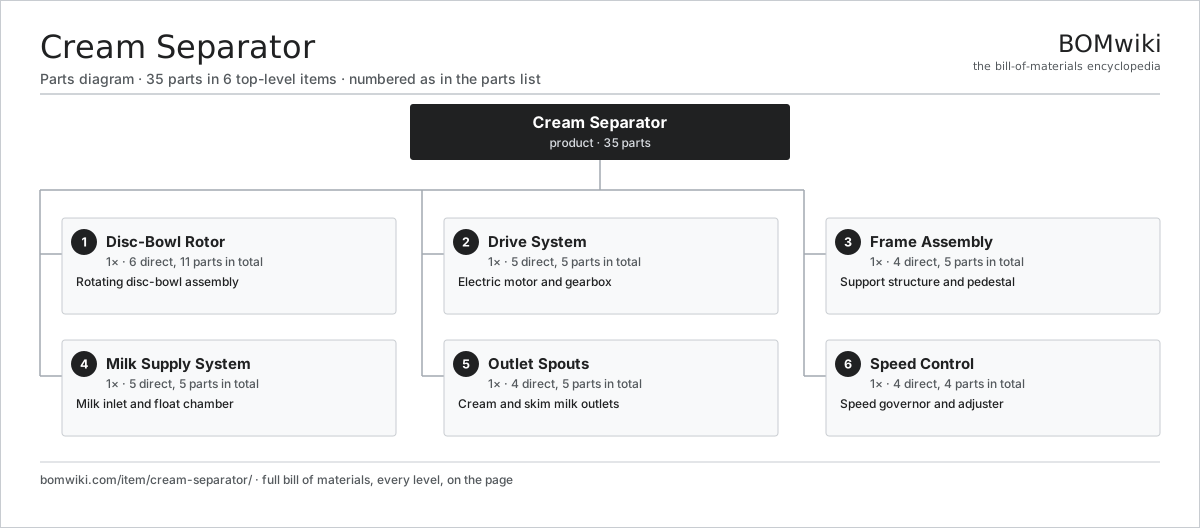
| # | Part | Qty | What it does |
|---|---|---|---|
| 1 | Disc-Bowl Rotor 6 parts | 1× | Rotating disc-bowl assembly |
| 2 | Drive System 5 parts | 1× | Electric motor and gearbox |
| 3 | Frame Assembly 4 parts | 1× | Support structure and pedestal |
| 4 | Milk Supply System 5 parts | 1× | Milk inlet and float chamber |
| 5 | Outlet Spouts 4 parts | 1× | Cream and skim milk outlets |
| 6 | Speed Control 4 parts | 1× | Speed governor and adjuster |
3D model
No 3D model yet. Have a CAD file of this? Add a 3D model. STL renders right on this page; STEP, FreeCAD, and OpenSCAD sources are welcome too (openly licensed, like all 3D models on BOMwiki).
Build & assembly graph
expand / collapse · shared sub-assemblies converge · links to related products · est. labourTap an assembly to expand/collapse · tap a part to open it · use “Open page” for any node · drag to pan, scroll to zoom.
Bill of materials for Cream Separator
6 top-level lines · 34 rows shown · 35 parts total · indented to 3 levels| # | Item / sub-assembly | Part no. | Qty/assy | Ext. qty | Parts | Type |
|---|---|---|---|---|---|---|
| 1 | Disc-Bowl Rotor 6 parts | cream-separator-bowl | 1× | 1 | 11 | assembly |
| 1.1 | Bowl Shell | cream-separator-bowl-shell | 1× | 1 | · | part |
| 1.2 | Disc Stack | cream-separator-disc-stack | 1× | 1 | · | part |
| 1.3 | Bearing Housing | cream-separator-bearing-housing | 2× | 2 | · | part |
| 1.4 | Ball Bearing | ball-bearing | 4× | 4 | · | part |
| 1.5 | Oil Seal | oil-seal | 2× | 2 | · | part |
| 1.6 | Fastener Set | fastener-set | 1× | 1 | · | part |
| 2 | Drive System 5 parts | cream-separator-drive | 1× | 1 | 5 | assembly |
| 2.1 | Drive Motor | cream-separator-motor | 1× | 1 | · | part |
| 2.2 | Pulley Assembly | cream-separator-pulley | 1× | 1 | · | part |
| 2.3 | Drive Belt | cream-separator-belt | 1× | 1 | · | part |
| 2.4 | Speed Gearbox | cream-separator-gearbox | 1× | 1 | · | part |
| 2.5 | Relay | relay | 1× | 1 | · | part |
| 3 | Frame Assembly 4 parts | cream-separator-frame | 1× | 1 | 5 | assembly |
| 3.1 | Base Plate | cream-separator-base-plate | 1× | 1 | · | part |
| 3.2 | Pedestal Tube | cream-separator-pedestal | 1× | 1 | · | part |
| 3.3 | Motor Bracket | cream-separator-motor-mount | 1× | 1 | · | part |
| 3.4 | Fastener Set | fastener-set | 2× | 2 | · | part |
| 4 | Milk Supply System 5 parts | cream-separator-supply | 1× | 1 | 5 | assembly |
| 4.1 | Feed Tube | cream-separator-inlet-tube | 1× | 1 | · | part |
| 4.2 | Floating Chamber | cream-separator-float-chamber | 1× | 1 | · | part |
| 4.3 | Float Guide | cream-separator-float-bowl | 1× | 1 | · | part |
| 4.4 | Regulating Valve | cream-separator-regulating-valve | 1× | 1 | · | part |
| 4.5 | Connector | connector | 1× | 1 | · | part |
| 5 | Outlet Spouts 4 parts | cream-separator-spouts | 1× | 1 | 5 | assembly |
| 5.1 | Cream Spout | cream-separator-cream-spout | 1× | 1 | · | part |
| 5.2 | Skim Spout | cream-separator-skim-spout | 1× | 1 | · | part |
| 5.3 | Spout Collector | cream-separator-spout-collector | 1× | 1 | · | part |
| 5.4 | Connector | connector | 2× | 2 | · | part |
| 6 | Speed Control 4 parts | cream-separator-controls | 1× | 1 | 4 | assembly |
| 6.1 | Governor Lever | cream-separator-governor-lever | 1× | 1 | · | part |
| 6.2 | Tension Spring | cream-separator-governor-spring | 1× | 1 | · | part |
| 6.3 | Conical Pulley Adjuster | cream-separator-pulley-adjuster | 1× | 1 | · | part |
| 6.4 | Relay | relay | 1× | 1 | · | part |
Something wrong in this list? Report a problem with this BOM.
Related products
same domain, ranked by shared parts Agricultural Tractor
306 parts · shares 2 with this page
Agricultural Tractor
306 parts · shares 2 with this page
 Articulated Tractor
1,229 parts · shares 2 with this page
Articulated Tractor
1,229 parts · shares 2 with this page
 Beet Cleaner Loader
228 parts · shares 2 with this page
Beet Cleaner Loader
228 parts · shares 2 with this page
 Cane Harvester
287 parts · shares 2 with this page
Cane Harvester
287 parts · shares 2 with this page
 Center-Pivot Irrigator
945 parts · shares 2 with this page
Center-Pivot Irrigator
945 parts · shares 2 with this page
 Combine Harvester
203 parts · shares 2 with this page
Combine Harvester
203 parts · shares 2 with this page
Sourcing: possible vendors
Browse the supplier directory → Prices, MOQ, and lead times are algorithmic estimates, not quotes, and not claims about these companies. Company mappings are curated by keyword; est. price band $5k–$800k. How estimates work| Vendor | HQ | Specialty | MOQ | Lead time |
|---|---|---|---|---|
| deere.com ↗ | Moline, US | Agriculture & turf | made to order | 14–24 wks |
| cnh.com ↗ | Basildon, GB | Agriculture (Case IH, New Holland) | made to order | 14–24 wks |
|
🇺🇸AGCO
agcocorp.com ↗
|
Duluth, US | Agriculture (Fendt, Massey Ferguson) | made to order | 14–24 wks |
|
🇩🇪Claas
claas.com ↗
|
Harsewinkel, DE | Harvesters & tractors | made to order | 14–24 wks |
|
🇯🇵Kubota
kubota.com ↗
|
Osaka, JP | Compact tractors & equipment | made to order | 14–24 wks |
1,174-word article