Cremated Remains Processor
ProductOverview
A cremated remains processor is a specialized automated grinding and sorting device used in crematory facilities to pulverize post-cremation bone fragments into fine ash suitable for urn placement, while simultaneously removing ferrous metal implants (surgical steel, titanium fasteners) from the remains. The device combines high-speed grinding with magnetic separation, producing a uniform fine powder (200–400 microns) from crematory calcine, coarser bone fragments typically 10–50 mm in size output from the Cremation Furnace.
Every commercial crematory uses a processor; it is standard equipment in any facility performing more than a few cremations monthly. The device is operated 1–10 times daily depending on volume. Remains processing occurs post-cremation, typically while the cremation furnace is cooling; the processed ash is transferred to a chosen urn or temporarily stored in a plastic or cardboard urn pending family collection.
Core components include the Processing Chamber steel vessel, the Grinding Mechanism high-speed rotor with blades, the Drive Motor & Speed Control variable-speed electric drive, the Metal Detection & Removal for ferrous implant removal, the Ash Collection & Separation catching processed ash, the Control & Interlock System for cycle automation, and the Dust Control & HEPA Filtration HEPA filtration system.
How It Works
After a cremation cycle completes in the Cremation Furnace, the operator allows the furnace to cool slightly (to ~300°C) and uses a long metal tool to rake bone fragments from the furnace hearth into a collection pan. This calcine is initially coarse, 5–50 mm fragments of ivory-colored bone with occasional unburned fragments and stray metal pieces (surgical implants, grave goods, bullet casings, etc.).
The crematory operator transfers the collected calcine into the Processing Chamber through the Access Door access port. The door is closed and latched, activating the Door Safety Interlock safety switch. The operator sets the desired parameters on the Control & Interlock System: typically a 5–8 minute grind cycle at medium speed (1000–1500 rpm, set via the Speed Adjustment Control).
Pressing start activates the Drive Motor, which drives the Rotor Shaft Assembly at the selected RPM. The rotor's Cutting Blade Element knives rotate at high speed, striking bone fragments against the fixed Stationary Impact Ring impact surface. Bone is progressively reduced to fine fragments and powder through repeated impact. The Processing Chamber cooling jacket keeps the internal temperature below 60°C, preventing ash oxidation or discoloration.
The Dust Control & HEPA Filtration system activates concurrently. The Dust Extraction Fan creates negative pressure in the Dust Containment Hood, drawing bone dust and ash particles toward the HEPA Filter Element. This prevents airborne ash from escaping into the crematory facility, which is important for worker health (respirable silica, calcium phosphate, lead, and mercury from crematory calcine pose inhalation hazards).
Once the timer expires, the motor shuts off and the rotor decelerates. The operator opens the Access Door and carefully pours the processed ash from the chamber into a chute leading to the Ash Collection & Separation. As ash falls, it passes through the Metal Detection & Removal, a powerful permanent Separation Magnet or electromagnet mounted above the drawer. Ferrous particles (surgical steel plates, hip implant fragments, joint replacements) are magnetically pulled upward and caught in a separate Ferrous Metal Tray. Non-ferrous ash (the vast majority) continues downward into the Collection Pan collection drawer below.
The operator removes the ash-filled Collection Pan from below the unit and transfers the fine ash into the family-selected urn (ceramic, metal, or biodegradable). The ferrous implants in the magnet tray are discarded as medical waste or, at some facilities, returned to the family or disposed separately.
Grinding Mechanism & Blade Design
The Rotor Shaft Assembly is a stainless steel shaft rotating at 500–2000 rpm, bearing multiple replaceable Cutting Blade Element knife elements. Blades are typically high-speed steel (HSS) or ceramic, bolted in a spiral or radial pattern around the rotor. As the rotor spins inside the fixed Processing Chamber, blades impact bone fragments continuously, creating a tumbling, grinding, and shearing action.
The Stationary Impact Ring is a fixed impact surface (hardened steel or ceramic) bolted inside the chamber opposite the rotor. Bone fragments caught between the rotating blades and stationary ring undergo repeated shearing and crushing, progressively reducing from 50 mm chunks to 1–2 mm granules to 200–400 micron powder. Fineness is controlled by:
- Grinding time (longer = finer)
- Rotor RPM (higher = more energetic impacts, finer faster)
- Rotor blade geometry (different designs produce different particle size distributions)
Blade wear is inevitable; they are replaced annually or after 1000+ cycles, whichever comes first. A full set costs $500–1000. The Rotor Journal Bearing high-speed ball bearings support the rotor shaft at 2000 rpm without significant friction or heat.
Magnetic Separation
The Metal Detection & Removal is critical for quality and family satisfaction. Cremated remains often contain surgical implants: titanium femoral head and stem prosthetics, stainless steel pedicle screws from spinal fusion, cobalt-chromium knee replacements, surgical plates and fasteners, and occasionally dental crowns (non-magnetic). Additionally, grave goods (jewelry, metal casket fittings, bullets) and metal objects inadvertently placed with the deceased may be present.
A powerful permanent Separation Magnet (typically neodymium, 1000–5000 gauss pull) is mounted 50–100 mm above the Collection Pan collection drawer. As processed ash falls through the magnet, ferrous particles are attracted and held in a separate Ferrous Metal Tray. Modern systems may include a rotating or sweep magnet to increase capture efficiency.
Non-ferrous materials (gold, titanium, aluminum, copper) pass through unaffected, so titanium implants proceed into the urn alongside ash, this is acceptable to most families. Some crematories return ferrous implants to families; others document implant removal and discard them as medical waste.
Control & Safety Interlocks
The Control & Interlock System is intuitive and safety-focused. A digital or rotary Cycle Timer Control (0–10 minutes) allows the operator to select grind duration. The Speed Adjustment Control potentiometer or keypad adjusts rotor RPM from 500–2000 rpm. A Status Display Panel LED or LCD panel shows cycle progress and time remaining.
The Door Safety Interlock is critical: a mechanical or magnetic switch prevents motor start if the Access Door is not fully closed and latched. This prevents accidental contact with the high-speed rotor blades.
An Emergency Stop Button red emergency stop button cuts power immediately, halting the rotor and dust extraction fan. Operators are trained to press e-stop if anything seems amiss (unusual noise, vibration, or smoke from the chamber).
Dust Control & Worker Safety
Crematory calcine poses significant dust inhalation hazard. Bone dust contains respirable silica (SiO2), calcium phosphate (CaPO4), lead (from bullets or industrial contamination), and mercury (from dental amalgam). OSHA and state occupational health regulations require dust capture and filtration.
The Dust Control & HEPA Filtration system is integral. A Dust Containment Hood stainless steel enclosure surrounds the grinding chamber. The Dust Extraction Fan fan (0.25–0.5 kW) draws air downward and outward from the chamber into the Filter Cartridge Housing. A HEPA Filter Element high-efficiency pleated filter element (99.97% capture of 0.3 micron particles) removes ash and dust. Filtered air exits to the building's main exhaust stack at roof level.
The HEPA filter is replaced annually or when visual clogging indicators show saturation (typically after 100–200 hours operation). Used filters are disposed as medical/biohazard waste. Some facilities employ activated charcoal pre-filters to capture mercury vapor, providing additional worker protection.
Mechanical Characteristics
The Mobile Frame & Isolation is a vibration-isolated steel structure. High-speed grinding creates significant vibration, at 2000 rpm, the rotor generates 33 Hz fundamental frequencies and harmonics. Vibration Isolation Mount rubber or spring mounts under the frame's four corners isolate this vibration from the facility floor, preventing annoying resonance in adjacent rooms. The frame itself is bolted securely; Mobile Caster Wheel locking casters allow repositioning if needed for maintenance or replacement.
Noise is moderate, 75–85 dB(A) at 1 m during full-speed grinding. Operators wear hearing protection during processing. The Cooling Jacket Tubing water or air cooling circulates around the Stainless Steel Vessel, maintaining internal temperature below 60°C and preventing thermal damage to residual proteins or polymers remaining in calcine.
Maintenance & Lifecycle
Annual maintenance includes:
- HEPA filter inspection and replacement
- Grinding blade sharpness assessment and replacement (every 1000 cycles or 12 months)
- Rotor bearing lubrication and play check
- Magnet strength verification (neodymium magnets lose 0.1% strength per year)
- Cooling system flushing (water-cooled units) or air filter cleaning (air-cooled units)
A well-maintained processor operates reliably for 10–15 years. Blade and bearing replacement costs are modest ($500–1500 annually) compared to the device value ($20,000–40,000), making it economical for even small crematories processing 300+ remains yearly.
Variations
Advanced processors may include:
- Automated loading/unloading: Hoppers feeding bone fragments and augers collecting ash (rare, high-cost).
- Stainless or ceramic chamber linings: For ultra-high-volume facilities (1000+ cycles/year) reducing blade wear.
- Dual-magnet systems: Permanent magnet for ferrous, electromagnetic sweep for improved capture.
- Mercury vapor abatement: Activated carbon filter in dust hood reducing mercury vapor in facility air.
Some crematories use multiple processors in sequence: a rough grinder (high speed, short duration) reducing large fragments, then a fine grinder (lower speed, longer duration) achieving uniform fineness. This two-stage approach reduces overall grind time while improving consistency.
Cremated Remains Processor parts and their functions
8 top-level parts · 43 parts in total · full bill of materials below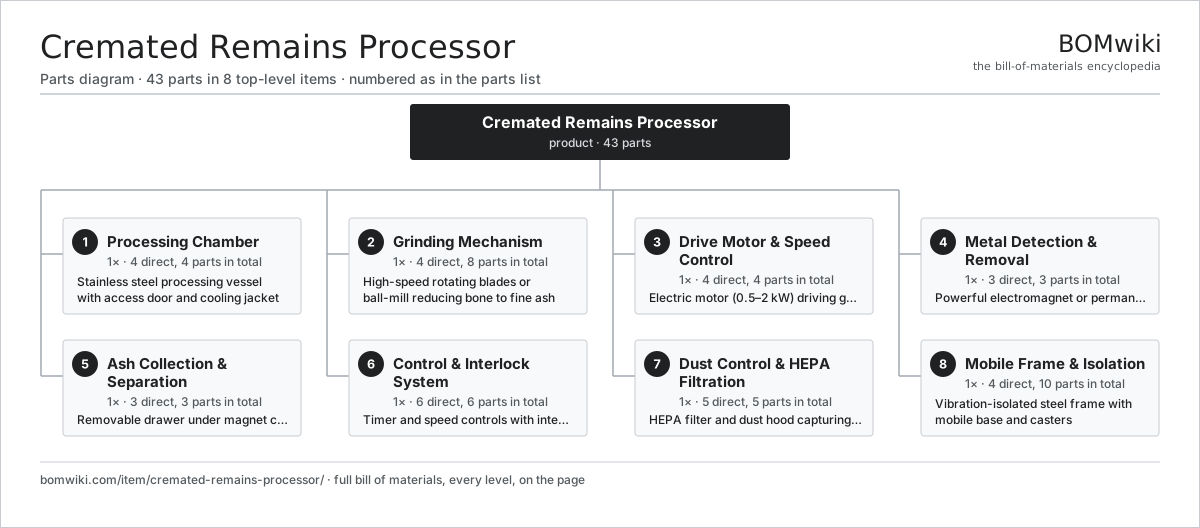
| # | Part | Qty | What it does |
|---|---|---|---|
| 1 | Processing Chamber 4 parts | 1× | Stainless steel processing vessel with access door and cooling jacket |
| 2 | Grinding Mechanism 4 parts | 1× | High-speed rotating blades or ball-mill reducing bone to fine ash |
| 3 | Drive Motor & Speed Control 4 parts | 1× | Electric motor (0.5–2 kW) driving grinding mechanism at 500–2000 rpm |
| 4 | Metal Detection & Removal 3 parts | 1× | Powerful electromagnet or permanent magnet capturing ferrous implants |
| 5 | Ash Collection & Separation 3 parts | 1× | Removable drawer under magnet catching non-ferrous ash for urn |
| 6 | Control & Interlock System 6 parts | 1× | Timer and speed controls with interlock safety switches |
| 7 | Dust Control & HEPA Filtration 5 parts | 1× | HEPA filter and dust hood capturing airborne ash during processing |
| 8 | Mobile Frame & Isolation 4 parts | 1× | Vibration-isolated steel frame with mobile base and casters |
3D model
No 3D model yet. Have a CAD file of this? Add a 3D model. STL renders right on this page; STEP, FreeCAD, and OpenSCAD sources are welcome too (openly licensed, like all 3D models on BOMwiki).
Build & assembly graph
expand / collapse · shared sub-assemblies converge · links to related products · est. labourTap an assembly to expand/collapse · tap a part to open it · use “Open page” for any node · drag to pan, scroll to zoom.
Bill of materials for Cremated Remains Processor
8 top-level lines · 41 rows shown · 43 parts total · indented to 3 levels| # | Item / sub-assembly | Part no. | Qty/assy | Ext. qty | Parts | Type |
|---|---|---|---|---|---|---|
| 1 | Processing Chamber 4 parts | cremated-remains-processor-chamber | 1× | 1 | 4 | assembly |
| 1.1 | Stainless Steel Vessel | cremated-remains-processor-chamber-body | 1× | 1 | · | part |
| 1.2 | Chamber Top Lid | cremated-remains-processor-chamber-lid | 1× | 1 | · | part |
| 1.3 | Access Door | cremated-remains-processor-chamber-door | 1× | 1 | · | part |
| 1.4 | Cooling Jacket Tubing | cremated-remains-processor-cooling-jacket | 1× | 1 | · | part |
| 2 | Grinding Mechanism 4 parts | cremated-remains-processor-grinding-mechanism | 1× | 1 | 8 | assembly |
| 2.1 | Rotor Shaft Assembly | cremated-remains-processor-grinding-rotor | 1× | 1 | · | part |
| 2.2 | Cutting Blade Element | cremated-remains-processor-grinding-blade | 4× | 4 | · | part |
| 2.3 | Stationary Impact Ring | cremated-remains-processor-stator-ring | 1× | 1 | · | part |
| 2.4 | Rotor Journal Bearing | cremated-remains-processor-rotor-bearing | 2× | 2 | · | part |
| 3 | Drive Motor & Speed Control 4 parts | cremated-remains-processor-motor-drive | 1× | 1 | 4 | assembly |
| 3.1 | Drive Motor | cremated-remains-processor-motor | 1× | 1 | · | part |
| 3.2 | Variable-Frequency Drive | cremated-remains-processor-vfd | 1× | 1 | · | part |
| 3.3 | Motor Coupling | cremated-remains-processor-drive-coupling | 1× | 1 | · | part |
| 3.4 | Vibration Isolator Mount | cremated-remains-processor-vibration-damper | 1× | 1 | · | part |
| 4 | Metal Detection & Removal 3 parts | cremated-remains-processor-magnet-system | 1× | 1 | 3 | assembly |
| 4.1 | Separation Magnet | cremated-remains-processor-magnet | 1× | 1 | · | part |
| 4.2 | Magnet Mount Housing | cremated-remains-processor-magnet-housing | 1× | 1 | · | part |
| 4.3 | Magnet Sweep Mechanism | cremated-remains-processor-magnet-sweep | 1× | 1 | · | part |
| 5 | Ash Collection & Separation 3 parts | cremated-remains-processor-collection-drawer | 1× | 1 | 3 | assembly |
| 5.1 | Collection Pan | cremated-remains-processor-drawer-pan | 1× | 1 | · | part |
| 5.2 | Ferrous Metal Tray | cremated-remains-processor-magnet-collection-tray | 1× | 1 | · | part |
| 5.3 | Pan Handle | cremated-remains-processor-drawer-handle | 1× | 1 | · | part |
| 6 | Control & Interlock System 6 parts | cremated-remains-processor-control-panel | 1× | 1 | 6 | assembly |
| 6.1 | Control Microcontroller | cremated-remains-processor-mcu | 1× | 1 | · | part |
| 6.2 | Cycle Timer Control | cremated-remains-processor-timer-dial | 1× | 1 | · | part |
| 6.3 | Speed Adjustment Control | cremated-remains-processor-speed-control | 1× | 1 | · | part |
| 6.4 | Door Safety Interlock | cremated-remains-processor-door-interlock | 1× | 1 | · | part |
| 6.5 | Emergency Stop Button | cremated-remains-processor-e-stop | 1× | 1 | · | part |
| 6.6 | Status Display Panel | cremated-remains-processor-status-display | 1× | 1 | · | part |
| 7 | Dust Control & HEPA Filtration 5 parts | cremated-remains-processor-dust-containment | 1× | 1 | 5 | assembly |
| 7.1 | Dust Containment Hood | cremated-remains-processor-dust-hood | 1× | 1 | · | part |
| 7.2 | HEPA Filter Element | cremated-remains-processor-hepa-filter | 1× | 1 | · | part |
| 7.3 | Filter Cartridge Housing | cremated-remains-processor-filter-housing | 1× | 1 | · | part |
| 7.4 | Dust Extraction Fan | cremated-remains-processor-exhaust-blower | 1× | 1 | · | part |
| 7.5 | Exhaust Duct | cremated-remains-processor-exhaust-duct | 1× | 1 | · | part |
| 8 | Mobile Frame & Isolation 4 parts | cremated-remains-processor-frame | 1× | 1 | 10 | assembly |
| 8.1 | Base Frame Structure | cremated-remains-processor-frame-base | 1× | 1 | · | part |
| 8.2 | Vibration Isolation Mount | cremated-remains-processor-vibration-isolator | 4× | 4 | · | part |
| 8.3 | Mobile Caster Wheel | cremated-remains-processor-wheel-caster | 4× | 4 | · | part |
| 8.4 | Cable & Tubing Conduit | cremated-remains-processor-cable-routing | 1× | 1 | · | part |
Something wrong in this list? Report a problem with this BOM.
Sourcing: possible vendors
Browse the supplier directory → Prices, MOQ, and lead times are algorithmic estimates, not quotes, and not claims about these companies. Company mappings are curated by keyword; est. price band $5k–$2M. How estimates work| Vendor | HQ | Specialty | MOQ | Lead time |
|---|---|---|---|---|
| atlascopco.com ↗ | Stockholm, SE | Compressors & industrial | 10 units | 12–20 wks |
|
🇦🇹Andritz
andritz.com ↗
|
Graz, AT | Process plants & machinery | 10 units | 12–20 wks |
| buhlergroup.com ↗ | Uzwil, CH | Food & materials processing | 10 units | 12–20 wks |
| gea.com ↗ | Düsseldorf, DE | Process technology | 10 units | 12–20 wks |
| mhi.com ↗ | Tokyo, JP | Heavy machinery | 10 units | 12–20 wks |
1,661-word article