Cryosurgery Unit
ProductOverview
Cryosurgery delivers controlled tissue destruction by rapid freezing, inducing cellular death through intracellular ice crystal formation, osmotic dehydration, and vascular thrombosis. The modality is broadly applied: dermatologists remove warts, molluscum contagiosum, and keratosis; gynecologists treat cervical dysplasia; surgeons ablate hepatic and renal tumors; and urologists destroy prostate tissue. The cryosurgery unit is the bench-top or cart-mounted system enabling this capability.
The core principle is dehydration and cell death. When tissue temperature drops below −20°C, intracellular water freezes into ice crystals that rupture cell membranes. Additionally, slow rewarming allows ice recrystallization, which further damages cells. Vascular ice formation causes thrombosis and tissue hypoxia. The net result is a sharply demarcated zone of necrosis. Clinical efficacy is dose-dependent, deeper freezes and longer freeze times kill larger volumes, but excessive cold can damage underlying structures.
How it Works
The operator selects a cryoprobe from the probe set (2–6 mm diameter) and attaches it to the console via a quick-disconnect coupling carrying the cryogen supply line, return line, and thermocouple. The cryogen tank holds 10–25 liters of liquid nitrogen at −196°C.
Before treatment, the surgeon applies anesthetic (topical, local infiltration, or general depending on lesion size and location). The probe tip is then applied to the lesion surface. The operator depresses the foot pedal, which modulates the proportional valve. Cryogenic liquid rushes through the supply line and into the hollow probe, where it rapidly evaporates. This Joule-Thomson expansion and evaporative cooling drop the probe tip to −196°C within seconds.
The thermocouple embedded in the probe tip continuously measures temperature, feeding millivolt signals through the signal conditioner and ADC board to the console microcontroller. The operator observes the tissue temperature and freeze zone expansion on the display panel. At the desired freeze time (typically 10–60 seconds depending on lesion size and depth), the operator releases the pedal.
Tissue rewarming occurs passively at room temperature, or the surgeon accelerates it by applying warm saline via the warming module. For more aggressive ablation, a second freeze-thaw-freeze cycle is performed: once the tissue has warmed, the probe is reapplied and the freeze repeated. This double-cycle approach maximizes cell death at the lesion margins.
Exhaust cryogen gas returns through the return line to atmosphere. The main valve isolates the tank when the unit is not in use, conserving cryogen and reducing boil-off losses.
Clinical Protocols
Dermatologic cryosurgery for warts and keratosis typically uses a single 10–20 second freeze. Cervical ablation for dysplasia may employ 3–5 minute freeze times to destroy the transformation zone. Larger tumors in solid organs (liver, kidney) require multiple probe placements and longer freeze durations, sometimes 10–15 minutes, to create confluent iceballs that encompass the entire lesion plus a 5–10 mm margin.
Temperature targets vary: −20°C kills most cells, but −40 to −60°C is preferred for margin security. Modern systems with thermocouple feedback allow the surgeon to monitor in real time and halt the freeze when the desired temperature profile is achieved.
Safety and Limitations
The pressure relief valve set to 1.5 bar prevents tank over-pressurization from boiling. The vacuum-insulated outer jacket minimizes cryogen evaporation loss to 0.5–1% per day, extending tank refill intervals.
Complications are rare but include frostbite to surrounding healthy tissue (mitigated by careful probe sizing and placement), nerve injury if the freeze zone extends into adjacent nerves, and infection if sterile technique is not maintained. Contraindications include hemoglobinopathy or cryoglobulinemia (cold-precipitating antibodies), which make cryotherapy dangerous.
Cryosurgery is not suitable for all lesions. Pigmented lesions (melanoma) require histopathology confirmation pre-treatment. Large, deep tumors are better served by formal surgical excision, as cryosurgery yields no tissue specimen for margin assessment. However, for benign and precancerous lesions, cryosurgery offers speed, low cost, and good cosmetic outcomes.
Cryosurgery Unit parts and their functions
7 top-level parts · 33 parts in total · full bill of materials below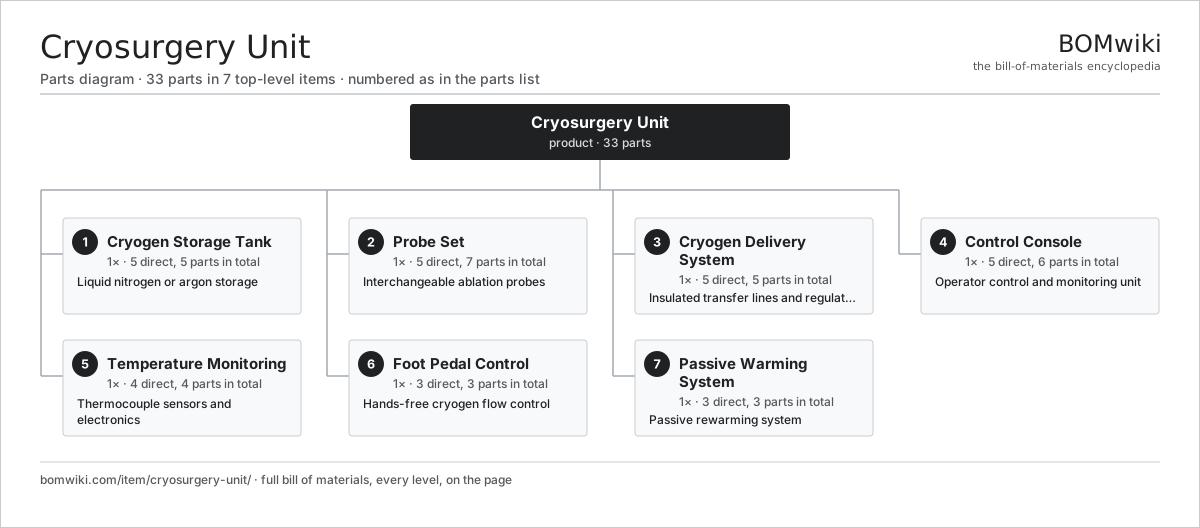
| # | Part | Qty | What it does |
|---|---|---|---|
| 1 | Cryogen Storage Tank 5 parts | 1× | Liquid nitrogen or argon storage |
| 2 | Probe Set 5 parts | 1× | Interchangeable ablation probes |
| 3 | Cryogen Delivery System 5 parts | 1× | Insulated transfer lines and regulators |
| 4 | Control Console 5 parts | 1× | Operator control and monitoring unit |
| 5 | Temperature Monitoring 4 parts | 1× | Thermocouple sensors and electronics |
| 6 | Foot Pedal Control 3 parts | 1× | Hands-free cryogen flow control |
| 7 | Passive Warming System 3 parts | 1× | Passive rewarming system |
3D model
No 3D model yet. Have a CAD file of this? Add a 3D model. STL renders right on this page; STEP, FreeCAD, and OpenSCAD sources are welcome too (openly licensed, like all 3D models on BOMwiki).
Build & assembly graph
expand / collapse · shared sub-assemblies converge · links to related products · est. labourTap an assembly to expand/collapse · tap a part to open it · use “Open page” for any node · drag to pan, scroll to zoom.
Bill of materials for Cryosurgery Unit
7 top-level lines · 37 rows shown · 33 parts total · indented to 3 levels| # | Item / sub-assembly | Part no. | Qty/assy | Ext. qty | Parts | Type |
|---|---|---|---|---|---|---|
| 1 | Cryogen Storage Tank 5 parts | cryosurgery-unit-cryogen-tank | 1× | 1 | 5 | assembly |
| 1.1 | Inner Flask | cryosurgery-unit-inner-flask | 1× | 1 | · | part |
| 1.2 | Outer Jacket | cryosurgery-unit-outer-jacket | 1× | 1 | · | part |
| 1.3 | Fill Port | cryosurgery-unit-fill-port | 1× | 1 | · | part |
| 1.4 | Pressure Relief Valve | cryosurgery-unit-pressure-relief | 1× | 1 | · | part |
| 1.5 | Pressure Sensor | pressure-sensor | 1× | 1 | · | part |
| 2 | Probe Set 5 parts | cryosurgery-unit-probe-set | 1× | 1 | 7 | assembly |
| 2.1 | 2mm Cryoprobe | cryosurgery-unit-probe-2mm | 1× | 1 | · | part |
| 2.2 | 4mm Cryoprobe | cryosurgery-unit-probe-4mm | 1× | 1 | · | part |
| 2.3 | 6mm Cryoprobe | cryosurgery-unit-probe-6mm | 1× | 1 | · | part |
| 2.4 | Probe Handle | cryosurgery-unit-probe-handle | 3× | 3 | · | part |
| 2.5 | Sheath Kit | cryosurgery-unit-sheath-kit | 1× | 1 | · | part |
| 3 | Cryogen Delivery System 5 parts | cryosurgery-unit-delivery-system | 1× | 1 | 5 | assembly |
| 3.1 | Supply Line | cryosurgery-unit-supply-line | 1× | 1 | · | part |
| 3.2 | Return Line | cryosurgery-unit-return-line | 1× | 1 | · | part |
| 3.3 | Main Valve | cryosurgery-unit-main-valve | 1× | 1 | · | part |
| 3.4 | Proportional Valve | cryosurgery-unit-proportional-valve | 1× | 1 | · | part |
| 3.5 | Pressure Regulator | cryosurgery-unit-regulator | 1× | 1 | · | part |
| 4 | Control Console 5 parts | cryosurgery-unit-console | 1× | 1 | 6 | assembly |
| 4.1 | Display Panel | cryosurgery-unit-display-panel | 1× | 1 | · | part |
| 4.2 | Keypad | cryosurgery-unit-keypad | 1× | 1 | · | part |
| 4.3 | Power Supply | cryosurgery-unit-power-supply | 1× | 1 | · | part |
| 4.4 | Microcontroller | mcu | 1× | 1 | · | part |
| 4.5 | Relay | relay | 2× | 2 | · | part |
| 5 | Temperature Monitoring 4 parts | cryosurgery-unit-temperature-monitoring | 1× | 1 | 4 | assembly |
| 5.1 | Thermocouple | cryosurgery-unit-thermocouple-probe | 1× | 1 | · | part |
| 5.2 | Signal Conditioner | cryosurgery-unit-signal-conditioner | 1× | 1 | · | part |
| 5.3 | ADC Board | cryosurgery-unit-adc-board | 1× | 1 | · | part |
| 5.4 | Connector | connector | 1× | 1 | · | part |
| 6 | Foot Pedal Control 3 parts | cryosurgery-unit-foot-pedal | 1× | 1 | 3 | assembly |
| 6.1 | Pedal Potentiometer | cryosurgery-unit-pedal-potentiometer | 1× | 1 | · | part |
| 6.2 | Pedal Housing | cryosurgery-unit-pedal-housing | 1× | 1 | · | part |
| 6.3 | Connector | connector | 1× | 1 | · | part |
| 7 | Passive Warming System 3 parts | cryosurgery-unit-warming-module | 1× | 1 | 3 | assembly |
| 7.1 | Saline Bottle | cryosurgery-unit-warm-saline-bottle | 1× | 1 | · | part |
| 7.2 | Gravity Drip | cryosurgery-unit-gravity-drip | 1× | 1 | · | part |
| 7.3 | Connector | connector | 1× | 1 | · | part |
Something wrong in this list? Report a problem with this BOM.
Related products
same domain, ranked by shared parts Apheresis Machine
199 parts · shares 2 with this page
Apheresis Machine
199 parts · shares 2 with this page
 Dermatology Laser
58 parts · shares 2 with this page
Endoscope Washer-Disinfector
87 parts · shares 2 with this page
Heart-Lung Machine
298 parts · shares 2 with this page
Dermatology Laser
58 parts · shares 2 with this page
Endoscope Washer-Disinfector
87 parts · shares 2 with this page
Heart-Lung Machine
298 parts · shares 2 with this page
 Heart-Lung Perfusion Pump
201 parts · shares 2 with this page
Infant Radiant Warmer
142 parts · shares 2 with this page
Heart-Lung Perfusion Pump
201 parts · shares 2 with this page
Infant Radiant Warmer
142 parts · shares 2 with this page
Sourcing: possible vendors
Browse the supplier directory → Prices, MOQ, and lead times are algorithmic estimates, not quotes, and not claims about these companies. Company mappings are curated by keyword; est. price band $500–$3M. How estimates work| Vendor | HQ | Specialty | MOQ | Lead time |
|---|---|---|---|---|
| gehealthcare.com ↗ | Chicago, US | Medical imaging & devices | 100 units | 12–20 wks |
| siemens-healthineers.com ↗ | Erlangen, DE | Medical systems | 100 units | 12–20 wks |
|
🇳🇱Philips
philips.com ↗
|
Amsterdam, NL | Health technology | 100 units | 12–20 wks |
| medtronic.com ↗ | Minneapolis, US | Medical devices | 100 units | 12–20 wks |
|
🇨🇳Mindray
mindray.com ↗
|
Shenzhen, CN | Medical devices | 100 units | 12–20 wks |
700-word article