CubeSat Power Module
ProductOverview
The CubeSat power module is a self-contained power system for small satellites adhering to the CubeSat standard (10 cm × 10 cm × n cm form factor). Unlike large spacecraft, which have dedicated teams managing power, thermal, and attitude subsystems, a CubeSat must integrate all these functions into a single module occupying just 1–2 cm height and 200–400 g mass.
The CubeSat Power Module comprises four functional blocks: the Battery Cell Stack rechargeable energy storage, the Charge Regulator Board solar array charging controller, the Distribution Switch Module load switch distribution, and the Battery Management System battery management system. All are integrated onto a single printed circuit board (PCB) or stacked PCB assembly, with integrated Protection and Fusing for fault protection.
Battery cell architecture
The Battery Cell Stack form the energy reservoir, typically comprising four to eight lithium-ion 18650 cells (standard industrial rechargeable batteries). Each 18650 cell has a nominal voltage of 3.7 V and capacity of 2500–3500 mAh, depending on manufacturer and chemistry.
Cells are connected in series-parallel configurations:
- 2S (two cells in series): Produces 7.4 V nominal voltage. Suitable for CubeSats with low power budgets or where external regulators drop voltage.
- 4S (four cells in series): Produces 14.8 V nominal voltage. Preferred when the payload requires higher voltage (e.g., RF amplifiers operating at 10–15 V).
- 2S2P (two parallel strings of two cells in series): Produces 7.4 V with double the capacity. Used when energy storage is the limiting factor.
The Cell Interconnect Tab tabs are welded or friction-bonded (not soldered) to prevent thermal damage to cells during assembly. A Cell Holder mechanical fixture positions cells for low electrical resistance and thermal contact.
Energy capacity is typically 5–15 Wh. For a 1U CubeSat executing a 30-second payload acquisition every 10 minutes, with 5 W payload power, that's 150 seconds × 5 W = 750 Ws = 0.21 Wh per orbit. Over a 90-minute orbit, this 15 Wh battery provides about 70 orbits of continuous operation before depletion, acceptable for a 3–5 day mission or for night-time eclipse operation on longer missions.
Charge regulation and MPPT
The Charge Regulator Board manage energy transfer from the solar array to the battery. Solar panels on a CubeSat are typically thin-film or rigid Silicon solar cells rated for 5–20 V open-circuit voltage, depending on the number of cells in series and the panel area.
The key innovation is the MPPT Converter Chip maximum power point tracking converter. Solar panel output voltage and current vary with sun angle, temperature, and load demand. The panel's maximum power point (MPP) occurs at a specific voltage where the product V × I is maximized. A naive constant-voltage charger might operate the panel away from its MPP, wasting significant power.
An MPPT converter constantly samples the solar panel voltage and current, computes the panel's current power output, and adjusts the converter duty cycle to shift the panel operating voltage toward the MPP. Modern MPPT algorithms (often using perturb-and-observe or incremental conductance) achieve 90–98% of theoretical maximum power extraction.
The Regulator PCB implements a DC-DC converter (often a buck or boost topology) using MOSFETs and a low-loss inductor. During daylight (sun-facing the array), the converter sources charge current to the battery at a controlled rate (typically 2–5 A). During eclipse (passing through Earth's shadow), the converter disengages, and the battery supplies load power.
Power distribution and load switching
The Distribution Switch Module module provides selective powering of CubeSat payloads. A typical CubeSat has 3–5 distinct power domains (radio transmitter, payload CPU, magnetometer sensor, etc.), each needing independent on/off control. The Distribution PCB contains individual Relay solid-state switches (or MOSFETs) for each load. The Microcontroller microcontroller can command these switches on/off based on mission timeline or payload requirements.
Soft-start circuits limit inrush current when a load is suddenly switched on, preventing voltage sag that might reset the CubeSat's computer.
Battery management and cell balancing
Lithium-ion cells suffer from voltage imbalance if charged unevenly. The Battery Management System battery management system monitors each cell's voltage and implements passive or active balancing:
Passive balancing. Each cell has a Cell Shunt Resistor resistor in parallel. When a cell reaches full charge (4.2 V), its balancing resistor shunt is energized by the BMS IC, discharging the cell through the resistor. This brings the cell voltage down, allowing other cells to continue charging. Passive balancing is simple and low-cost but slow and wasteful (power is dissipated as heat).
Active balancing. An active system uses switched capacitor or inductor circuits to transfer charge between cells, maintaining voltage equality while minimizing heat. Active systems are more efficient but add cost and complexity.
Cell balancing is critical for safety: if one cell is significantly overcharged (above 4.3 V) while others are undercharged, the overcharged cell risks thermal runaway or venting. Balancing keeps all cells within the safe operating window (3.0–4.2 V).
Thermal management and protection
The Thermal Management subsystem monitors battery and converter temperatures via a Pressure Sensor thermistor. Lithium-ion cells are rated for 0–45 °C operation; operation outside this range degrades capacity and cycle lifetime, and high temperatures (>60 °C) trigger battery management cutoffs.
The Protection and Fusing include:
- Overcurrent protection: A Polyfuse resettable fuse on each load output trips if current exceeds a threshold (e.g., 5 A), preventing damage from short circuits.
- Overvoltage protection: A TVS Diode transient voltage suppressor on the solar input clamps input voltage spikes, protecting the converter.
- Reverse polarity protection: A Protection Diode Schottky diode on the solar and load connections prevents backfeeding power in the wrong direction.
Typical power budget
A 1U CubeSat with a 10 Wh battery and continuous 2 W payload operates for 5 hours before battery depletion. In practice, CubeSats operate intermittently:
- Daylight phase (45 minutes): Solar array supplies 5–10 W; battery charges at 3 W (excess power). Payload consumes 1 W, net +2 W stored.
- Eclipse phase (45 minutes): Battery supplies 1 W payload. Consumes 45 Wh / 60 = 0.75 Wh during eclipse.
- Net over one orbit (90 min): Gain 2 Wh during daylight, lose 0.75 Wh during eclipse. Over 14 orbits per day, the battery gains 14 × 1.25 = 17.5 Wh, but the module can only store 10 Wh, so the battery reaches full charge and stays charged.
Integration with payloads
The External Power Interface interface to the CubeSat bus provides:
- Solar input: Raw solar panel voltage (5–20 V unregulated), typically on a 2-pin connector.
- Battery output / load bus: Regulated or unregulated battery voltage (7.4 or 14.8 V), with independent current paths for different payloads.
- Secondary regulated supplies: Optional 3.3 V or 5 V outputs generated by additional buck converters (not shown in the core module), serving low-voltage digital and RF components.
A CubeSat bus standard (e.g., CubeSat Kit standard) defines connector pinouts, enabling plug-and-play integration of payloads.
Radiation tolerance
CubeSats operating in space experience ionizing radiation (protons and electrons from Earth's magnetosphere). Electronic components can undergo:
- Single-event upset (SEU): A charged particle strikes a transistor or memory cell, flipping a bit. SEU is usually temporary and recovers after a logic reset.
- Single-event latchup (SEL): A particle creates a low-resistance path, causing high current and potential permanent damage.
Most commercial-grade CubeSat power modules use standard components and are susceptible to SEU. For longer-duration missions in harsh radiation environments (e.g., beyond Earth's magnetic field or in Earth's inner radiation belts), mission teams can select Battery Management System radiation-hardened BMS chips and Power MOSFET rad-hard MOSFETs, at 2–5× the cost.
Modularity and evolution
The CubeSat power module has evolved over 20+ years, from discrete battery packs and external regulators to today's integrated modules. Modern modules incorporate MPPT, active cell balancing, and integrated fault protection in a single 1–2 cm-tall PCB. Future generations may add wireless power transfer, higher energy density (solid-state batteries), or integrated energy-harvesting (piezoelectric, thermal).
The beauty of the modular CubeSat standard is that a mission can upgrade the power module independently of the payload or bus, adopting new battery chemistry or more efficient converters as they become available.
CubeSat Power Module parts and their functions
8 top-level parts · 36 parts in total · full bill of materials below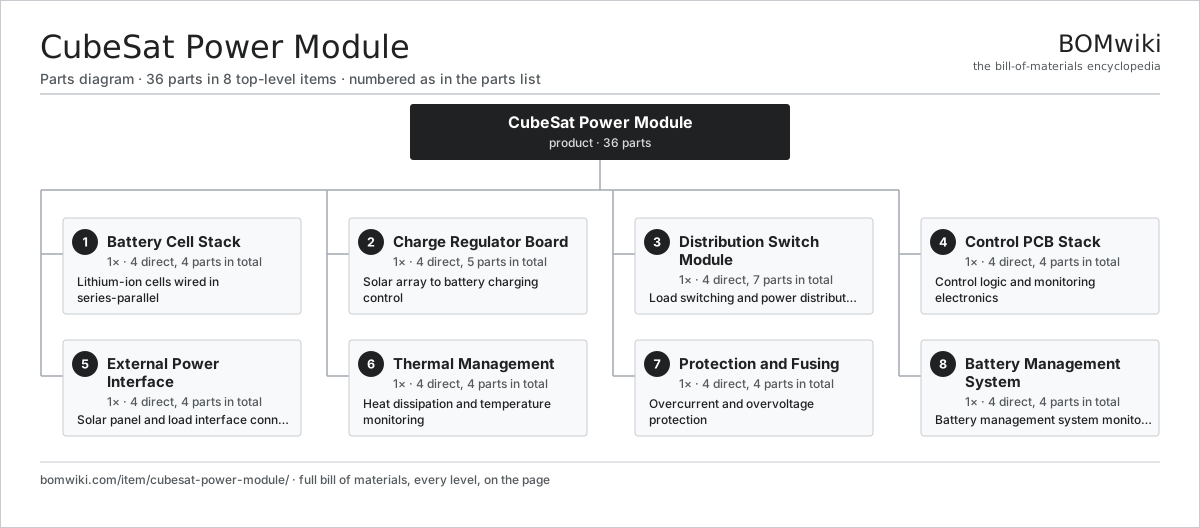
| # | Part | Qty | What it does |
|---|---|---|---|
| 1 | Battery Cell Stack 4 parts | 1× | Lithium-ion cells wired in series-parallel |
| 2 | Charge Regulator Board 4 parts | 1× | Solar array to battery charging control |
| 3 | Distribution Switch Module 4 parts | 1× | Load switching and power distribution |
| 4 | Control PCB Stack 4 parts | 1× | Control logic and monitoring electronics |
| 5 | External Power Interface 4 parts | 1× | Solar panel and load interface connector |
| 6 | Thermal Management 4 parts | 1× | Heat dissipation and temperature monitoring |
| 7 | Protection and Fusing 4 parts | 1× | Overcurrent and overvoltage protection |
| 8 | Battery Management System 4 parts | 1× | Battery management system monitoring cell health |
3D model
No 3D model yet. Have a CAD file of this? Add a 3D model. STL renders right on this page; STEP, FreeCAD, and OpenSCAD sources are welcome too (openly licensed, like all 3D models on BOMwiki).
Build & assembly graph
expand / collapse · shared sub-assemblies converge · links to related products · est. labourTap an assembly to expand/collapse · tap a part to open it · use “Open page” for any node · drag to pan, scroll to zoom.
Bill of materials for CubeSat Power Module
8 top-level lines · 40 rows shown · 36 parts total · indented to 3 levels| # | Item / sub-assembly | Part no. | Qty/assy | Ext. qty | Parts | Type |
|---|---|---|---|---|---|---|
| 1 | Battery Cell Stack 4 parts | cubesat-power-module-battery-cells | 1× | 1 | 4 | assembly |
| 1.1 | Li-ion Cell, 18650 | li-cell-18650 | 1× | 1 | · | part |
| 1.2 | Cell Holder | cubesat-power-module-cell-holder | 1× | 1 | · | part |
| 1.3 | Cell Interconnect Tab | cubesat-power-module-cell-interconnect | 1× | 1 | · | part |
| 1.4 | Fastener Set | fastener-set | 1× | 1 | · | part |
| 2 | Charge Regulator Board 4 parts | cubesat-power-module-charge-regulators | 1× | 1 | 5 | assembly |
| 2.1 | MPPT Converter Chip | cubesat-power-module-mppt-chip | 1× | 1 | · | part |
| 2.2 | Regulator PCB | cubesat-power-module-regulator-pcb | 1× | 1 | · | part |
| 2.3 | Power MOSFET | mosfet | 2× | 2 | · | part |
| 2.4 | SMD Passive (R/C/L) | smd-passives | 1× | 1 | · | part |
| 3 | Distribution Switch Module 4 parts | cubesat-power-module-distribution-switches | 1× | 1 | 7 | assembly |
| 3.1 | Relay | relay | 4× | 4 | · | part |
| 3.2 | Distribution PCB | cubesat-power-module-distribution-pcb | 1× | 1 | · | part |
| 3.3 | Power MOSFET | mosfet | 1× | 1 | · | part |
| 3.4 | Connector | connector | 1× | 1 | · | part |
| 4 | Control PCB Stack 4 parts | cubesat-power-module-pcb-stack | 1× | 1 | 4 | assembly |
| 4.1 | Microcontroller | mcu | 1× | 1 | · | part |
| 4.2 | Bare PCB | pcb-bare | 1× | 1 | · | part |
| 4.3 | SMD Passive (R/C/L) | smd-passives | 1× | 1 | · | part |
| 4.4 | Pressure Sensor | pressure-sensor | 1× | 1 | · | part |
| 5 | External Power Interface 4 parts | cubesat-power-module-connector | 1× | 1 | 4 | assembly |
| 5.1 | Connector | connector | 1× | 1 | · | part |
| 5.2 | Connector Body | cubesat-power-module-connector-body | 1× | 1 | · | part |
| 5.3 | Fastener Set | fastener-set | 1× | 1 | · | part |
| 5.4 | Wire Bundle | wire-bundle | 1× | 1 | · | part |
| 6 | Thermal Management 4 parts | cubesat-power-module-thermal-management | 1× | 1 | 4 | assembly |
| 6.1 | Pressure Sensor | pressure-sensor | 1× | 1 | · | part |
| 6.2 | Heatsink | cubesat-power-module-heatsink | 1× | 1 | · | part |
| 6.3 | Fastener Set | fastener-set | 1× | 1 | · | part |
| 6.4 | Wire Bundle | wire-bundle | 1× | 1 | · | part |
| 7 | Protection and Fusing 4 parts | cubesat-power-module-protection-circuits | 1× | 1 | 4 | assembly |
| 7.1 | Polyfuse | cubesat-power-module-polyfuse | 1× | 1 | · | part |
| 7.2 | Protection Diode | cubesat-power-module-diode | 1× | 1 | · | part |
| 7.3 | TVS Diode | cubesat-power-module-tvs-diode | 1× | 1 | · | part |
| 7.4 | Fastener Set | fastener-set | 1× | 1 | · | part |
| 8 | Battery Management System 4 parts | cubesat-power-module-battery-bms | 1× | 1 | 4 | assembly |
| 8.1 | BMS IC | cubesat-power-module-bms-chip | 1× | 1 | · | part |
| 8.2 | BMS PCB | cubesat-power-module-bms-pcb | 1× | 1 | · | part |
| 8.3 | Cell Shunt Resistor | cubesat-power-module-cell-shunt | 1× | 1 | · | part |
| 8.4 | SMD Passive (R/C/L) | smd-passives | 1× | 1 | · | part |
Something wrong in this list? Report a problem with this BOM.
Related products
same domain, ranked by shared parts GPS Navigation Satellite
2,640 parts · shares 3 with this page
GPS Navigation Satellite
2,640 parts · shares 3 with this page
 Lunar Lander
1,803 parts · shares 3 with this page
Lunar Lander
1,803 parts · shares 3 with this page
 Rocket Upper Stage
1,459 parts · shares 3 with this page
Rocket Upper Stage
1,459 parts · shares 3 with this page
 Weather Satellite
1,765 parts · shares 3 with this page
Weather Satellite
1,765 parts · shares 3 with this page
 Cargo Resupply Spacecraft
574 parts · shares 2 with this page
Cargo Resupply Spacecraft
574 parts · shares 2 with this page
 EVA Space Suit
181 parts · shares 2 with this page
EVA Space Suit
181 parts · shares 2 with this page
Sourcing: possible vendors
Browse the supplier directory → Prices, MOQ, and lead times are algorithmic estimates, not quotes, and not claims about these companies. Company mappings are curated by keyword; est. price band $50k–$500M. How estimates work| Vendor | HQ | Specialty | MOQ | Lead time |
|---|---|---|---|---|
|
🇺🇸SpaceX
spacex.com ↗
|
Hawthorne, US | Launch & spacecraft | made to order | 52–104 wks |
| northropgrumman.com ↗ | Falls Church, US | Space & defense | made to order | 52–104 wks |
|
🇫🇷Airbus
airbus.com ↗
|
Toulouse, FR | Aerospace OEM | made to order | 52–104 wks |
| rocketlabusa.com ↗ | Long Beach, US | Launch & spacecraft | made to order | 52–104 wks |
| thalesaleniaspace.com ↗ | Cannes, FR | Satellites | made to order | 52–104 wks |
1,448-word article