Cupola Furnace
ProductOverview
The cupola furnace is the most economical and widely used melting equipment for gray and ductile iron casting. It is a simple vertical shaft furnace alternately charged with layers of coke (fuel), metallic scrap, and limestone (flux). Preheated blast air is injected through tuyeres at the base, igniting the coke and heating metal to 1450–1500 °C. Molten iron flows down to the tap hole, where it is periodically drawn off into a waiting ladle; slag (a byproduct of flux reaction with impurities) overflows at a slag notch higher up the shaft.
A well-maintained cupola can melt 5–15 tons of iron per hour with 25–35 % coke consumption and produce metal chemistry tuned for gray or ductile iron. The simplicity of the process, no electric power needed for melting, rapid warm-up, and immediate response to production demand, makes cupolas ideal for small to mid-sized foundries and backup melting when electric furnaces are offline.
How it works
The Charging System begins with the Skip Hoist Motor and Drum raising a Charging Bucket loaded with a layer of coke (3–5 cm), then metal scrap (10–15 cm), then another layer of coke. This alternating pattern is carefully balanced: too much coke wastes energy and overheats the refractory; too little coke leaves the metal cold and unmelted. A small amount of limestone (1–2 %) is typically mixed with each metal charge to combine with silica and alumina impurities, forming a fluid slag that separates from the iron.
Once the charge bucket is at the furnace top, the operator pulls the primary bell valve, dropping the charge into the furnace cavity. The Secondary Bell and Drip Spout opens simultaneously to prevent pressure buildup and vacuum collapse. The charge drops onto the already-burning coke bed below.
Blast air is continuously injected from the centrifugal blower through the Wind Box and distributed by the Air Distribution Manifold to four tuyeres at the base of the furnace. This air ignites and sustains the coke combustion, producing CO and CO₂ gases. The carbon monoxide rises through the charge, preheating incoming metal and coke layers, and exits at the top of the furnace with a column of heat and flame, the visible sign of active melting.
In the refractory zone, metal droplets fall through the burning coke, absorbing heat. The molten metal collects in a pool (the hearth, typically 0.5–1 m deep) where it rests on a permeable coke bed called the "coke-breast." This bed prevents premature drainage while allowing slag to drain separately.
Slag, being lighter than molten iron, floats atop the metal pool. It is drawn off passively through the slag notch, a fixed opening positioned ~1 m above the tap hole. When slag flow begins, it signals that the furnace is fully molten and ready to tap.
The molten iron is withdrawn periodically (every 15–30 minutes) by an operator using a tap rod to knock out the ceramic plug from the tap-hole block. Metal flows down the spout into a preheated ladle. The tap is immediately resealed with a new plug to prevent uncontrolled flow.
Real-world operation
Temperature control is maintained by adjusting the blast damper, which restricts airflow: increasing blast pressure raises metal temperature and melting rate; decreasing it lowers both. The operator monitors metal temperature using the thermocouple reading on the control-booth display. Target temperature for gray iron is 1400–1450 °C; higher temperatures increase fluidity for thin-wall castings but increase gas absorption and brittleness.
Modern cupolas include water jackets around the tuyere zone to extend refractory life. The Cooling Water Pump constantly circulates cooling water through copper tubing immediately below each tuyere, preventing localized overheating and refractory burnout. This cooling system increases furnace longevity from ~200 heats (air-cooled cupola) to 400–600 heats before relining.
The refractory lining experiences thermal cycling: each time the furnace is ramped up from cold start, the brick heats unevenly; each time it cools at day's end, contraction stress develops. Over 400–600 heats, the mortar joints fail and bricks crack, necessitating a complete relining (a major maintenance event requiring 1–2 weeks and significant cost). Some advanced foundries monitor refractory wear via repeated ultrasonic thickness measurements, replacing sections proactively.
Metallurgy and chemistry
Iron melted in a cupola dissolves carbon from the coke (~3.5–4.0 % C is typical for casting grade) and absorbs some oxygen and nitrogen from the blast air. Impurities from scrap (copper, tin, arsenic) concentrate in the iron; slag (calcium silicate, formed from flux and impurities) carries off some tramp elements but cannot remove copper or tin once dissolved. Careful scrap selection is critical: foundries segregate clean, low-tramp scrap for cupola melting, reserving high-copper scrap for induction furnaces where chemistry can be more closely controlled.
Slag chemistry (specifically the Al₂O₃/SiO₂ ratio, typically 0.5–0.7) determines slag fluidity. Too acidic (high SiO₂) and slag is stiff, blocking metal flow and raising furnace temperature uncontrollably. Too basic (high Al₂O₃) and slag is too fluid, carrying iron into the slag notch and increasing metal loss. Limestone (CaCO₂) additions during charging adjust slag basicity dynamically.
Comparison with other melting systems
A cupola excels at melting large volumes of homogeneous iron at low cost. However, it cannot hold metal as effectively as an induction furnace (metal temperature drifts during a long hold), and chemistry control is less precise. For ductile iron production (which requires strict magnesium and rare-earth additions), most foundries melt base metal in a cupola, then transfer to an induction furnace for final composition adjustment and degassing before pouring.
Some modern foundries have eliminated cupolas entirely, switching to coreless induction furnaces for full chemistry control, but the economic penalty (2–3× higher energy cost) means small foundries and gray-iron producers still rely on cupolas as their primary melting tool.
Related equipment
The molten iron from the cupola flows into foundry ladles for transport to molding stations or to casting machines. A backup VAR furnace or secondary electric furnace is often used for scrap or alloy additions. Cores and molds are filled from ladles filled from the cupola.
Cupola Furnace parts and their functions
8 top-level parts · 54 parts in total · full bill of materials below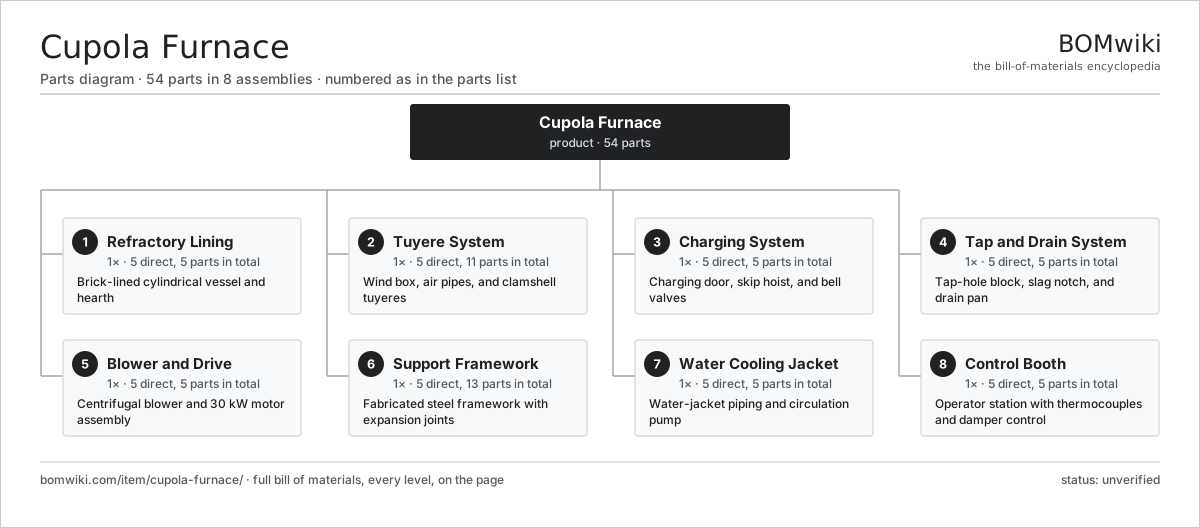
| # | Part | Qty | What it does |
|---|---|---|---|
| 1 | Refractory Lining 5 parts | 1× | Brick-lined cylindrical vessel and hearth |
| 2 | Tuyere System 5 parts | 1× | Wind box, air pipes, and clamshell tuyeres |
| 3 | Charging System 5 parts | 1× | Charging door, skip hoist, and bell valves |
| 4 | Tap and Drain System 5 parts | 1× | Tap-hole block, slag notch, and drain pan |
| 5 | Blower and Drive 5 parts | 1× | Centrifugal blower and 30 kW motor assembly |
| 6 | Support Framework 5 parts | 1× | Fabricated steel framework with expansion joints |
| 7 | Water Cooling Jacket 5 parts | 1× | Water-jacket piping and circulation pump |
| 8 | Control Booth 5 parts | 1× | Operator station with thermocouples and damper control |
3D model
No 3D model yet. Have a CAD file of this? Add a 3D model — STL renders right on this page; STEP, FreeCAD, and OpenSCAD sources are welcome too (openly licensed, like all 3D models on BOMwiki).
Build & assembly graph
expand / collapse · shared sub-assemblies converge · links to related products · est. labourTap an assembly to expand/collapse · tap a part to open it · use “Open page” for any node · drag to pan, scroll to zoom.
Bill of materials for Cupola Furnace
8 top-level lines · 48 rows shown · 54 parts total · indented to 3 levels| # | Item / sub-assembly | Part no. | Qty/assy | Ext. qty | Parts | Type |
|---|---|---|---|---|---|---|
| 1 | Refractory Lining 5 parts | cupola-furnace-refractory-shell | 1× | 1 | 5 | assembly |
| 1.1 | Hearth Brick Layer | cupola-furnace-hearth-brick | 1× | 1 | · | part |
| 1.2 | Sidewall Refractory | cupola-furnace-sidewall-brick | 1× | 1 | · | part |
| 1.3 | Arch Lining | cupola-furnace-arch-brick | 1× | 1 | · | part |
| 1.4 | Refractory Cement | cupola-furnace-refractory-cement | 1× | 1 | · | part |
| 1.5 | Ceramic Fiber Insulation | cupola-furnace-refractory-blanket | 1× | 1 | · | part |
| 2 | Tuyere System 5 parts | cupola-furnace-tuyere-system | 1× | 1 | 11 | assembly |
| 2.1 | Wind Box | cupola-furnace-wind-box | 1× | 1 | · | part |
| 2.2 | Clamshell Tuyere | cupola-furnace-clamshell-tuyere | 4× | 4 | · | part |
| 2.3 | Tuyere Water-Cooled Standpipe | cupola-furnace-tuyere-pipe | 1× | 1 | · | part |
| 2.4 | Tuyere Seal Ring | cupola-furnace-tuyere-seal-ring | 4× | 4 | · | part |
| 2.5 | Air Distribution Manifold | cupola-furnace-air-inlet-manifold | 1× | 1 | · | part |
| 3 | Charging System 5 parts | cupola-furnace-charging-system | 1× | 1 | 5 | assembly |
| 3.1 | Charging Door | cupola-furnace-charging-door | 1× | 1 | · | part |
| 3.2 | Skip Hoist Motor and Drum | cupola-furnace-skip-hoist | 1× | 1 | · | part |
| 3.3 | Charging Bucket | cupola-furnace-charge-bucket | 1× | 1 | · | part |
| 3.4 | Primary Charging Bell Valve | cupola-furnace-bell-valve-top | 1× | 1 | · | part |
| 3.5 | Secondary Bell and Drip Spout | cupola-furnace-secondary-bell | 1× | 1 | · | part |
| 4 | Tap and Drain System 5 parts | cupola-furnace-tap-and-drain | 1× | 1 | 5 | assembly |
| 4.1 | Tap-Hole Refractory Block | cupola-furnace-tap-hole-block | 1× | 1 | · | part |
| 4.2 | Ceramic Tap Stopper | cupola-furnace-ceramic-plug | 1× | 1 | · | part |
| 4.3 | Tap Rod | cupola-furnace-tap-iron | 1× | 1 | · | part |
| 4.4 | Slag Notch Refractory | cupola-furnace-slag-notch-block | 1× | 1 | · | part |
| 4.5 | Metal Drain Spout | cupola-furnace-drain-pan | 1× | 1 | · | part |
| 5 | Blower and Drive 5 parts | cupola-furnace-blower-and-motor | 1× | 1 | 5 | assembly |
| 5.1 | Centrifugal Blower Impeller | cupola-furnace-centrifugal-blower | 1× | 1 | · | part |
| 5.2 | Blower Drive Motor | cupola-furnace-motor-base | 1× | 1 | · | part |
| 5.3 | Belt and Pulley Drive | cupola-furnace-belt-drive | 1× | 1 | · | part |
| 5.4 | Blast Damper Valve | cupola-furnace-damper-valve | 1× | 1 | · | part |
| 5.5 | Blower Air Silencer | cupola-furnace-silencer | 1× | 1 | · | part |
| 6 | Support Framework 5 parts | cupola-furnace-support-frame | 1× | 1 | 13 | assembly |
| 6.1 | Main Support Column | cupola-furnace-main-column | 2× | 2 | · | part |
| 6.2 | Base Ring Foundation | cupola-furnace-base-ring | 1× | 1 | · | part |
| 6.3 | Hoop Tension Tie-Rods | cupola-furnace-tie-rods | 4× | 4 | · | part |
| 6.4 | Thermal Expansion Joint | cupola-furnace-expansion-joint | 2× | 2 | · | part |
| 6.5 | Vibration Isolation Pad | cupola-furnace-vibration-pad | 4× | 4 | · | part |
| 7 | Water Cooling Jacket 5 parts | cupola-furnace-cooling-system | 1× | 1 | 5 | assembly |
| 7.1 | Water Jacket Coil | cupola-furnace-water-jacket-coil | 1× | 1 | · | part |
| 7.2 | Cooling Water Pump | cupola-furnace-circulation-pump | 1× | 1 | · | part |
| 7.3 | Cooling Tower Heat Exchanger | cupola-furnace-cooling-tower | 1× | 1 | · | part |
| 7.4 | Inlet Water Filter | cupola-furnace-water-filter | 1× | 1 | · | part |
| 7.5 | Water Supply Hose | cupola-furnace-supply-hose | 1× | 1 | · | part |
| 8 | Control Booth 5 parts | cupola-furnace-control-booth | 1× | 1 | 5 | assembly |
| 8.1 | Temperature Probe | cupola-furnace-thermocouple-probe | 1× | 1 | · | part |
| 8.2 | Digital Temperature Display | cupola-furnace-temperature-meter | 1× | 1 | · | part |
| 8.3 | Manual Damper Control Linkage | cupola-furnace-damper-linkage | 1× | 1 | · | part |
| 8.4 | Wind Box Pressure Gauge | cupola-furnace-pressure-gauge | 1× | 1 | · | part |
| 8.5 | Control Enclosure | cupola-furnace-control-panel-box | 1× | 1 | · | part |
Sourcing: possible vendors
Prices, MOQ, and lead times are algorithmic estimates, not quotes, and not claims about these companies. Company mappings are curated by keyword; est. price band $5k–$2M. How estimates work| Vendor | HQ | Specialty | MOQ | Lead time |
|---|---|---|---|---|
| atlascopco.com ↗ | Stockholm, SE | Compressors & industrial | 10 units | 12–20 wks |
|
🇦🇹Andritz
andritz.com ↗
|
Graz, AT | Process plants & machinery | 10 units | 12–20 wks |
| buhlergroup.com ↗ | Uzwil, CH | Food & materials processing | 10 units | 12–20 wks |
| gea.com ↗ | Düsseldorf, DE | Process technology | 10 units | 12–20 wks |
| mhi.com ↗ | Tokyo, JP | Heavy machinery | 10 units | 12–20 wks |
1,133-word article