Curved Manual Treadmill
ProductOverview
A curved manual treadmill has no motor: the runner is the drive. The deck of the Slat Belt is concave, and when a foot lands on the front of the curve, the downhill component of body weight pushes the belt rearward. Run further up the curve and the tangential force grows, so the belt accelerates; drift toward the bottom of the curve and it slows. Speed is therefore controlled by foot placement alone, with no buttons and no lag, the belt does whatever the runner does, instantly, which is why the format dominates sprint training and HIIT programming. The machine plugs into nothing; the Console powers itself from belt motion.
How the curve drives the belt
On the concave deck (radius roughly 1.5-2 m, set by the Guide Rail pair) the running surface at the front of the deck is inclined upward. A footstrike there applies force normal to the local surface; the component tangent to the deck points rearward and does work on the belt. The belt's resistance comes from bearing friction plus the optional brake, so equilibrium speed is where footstrike propulsion balances drag. The runner unconsciously regulates this the way they regulate overground speed, by where and how hard they strike. Studies consistently measure 25-30% higher oxygen cost than motorised running at the same pace, because the runner now supplies the work a motor normally does; coaches treat curved-treadmill paces as roughly 2 min/km slower-equivalent.
Slat belt and bearings
Rather than a friction belt sliding over a waxed deck, the surface is 50-60 individual Running Slat crossbars, each with a vulcanised Slat Tread, clipped at both ends to two Side Timing Belt loops by Belt Clip pairs. Each slat end rides on its own sealed Ball Bearing roller, over a hundred per machine, rolling along the curved rails. Rolling contact is the enabling detail: sliding-belt friction would be far too high for a human to drive. It also changes the maintenance picture, there is no belt to lubricate or re-tension weekly, and slat machines routinely survive contract-gym duty cycles; worn slats or bearings are replaced individually. The loop returns around a toothed End Drum at each end, with rear Belt Tensioner screws setting timing-belt tension and the front Drum Shaft taking off drive for the brake and speed sensor.
Brake resistance
Free-running drag suits sprinting, but the Brake Resistance System adds programmable load. It is a contactless eddy-current brake: Neodymium Magnet poles on a pivoting Magnet Yoke face an aluminium Brake Disc on the front drum shaft, and the Resistance Lever swings the yoke through 5-10 detents to change the air gap. Higher levels turn the machine into a sled-push trainer, at maximum resistance, walking pace can demand several hundred watts. Because eddy-current drag scales with speed, the brake also self-limits: it adds little at a crawl and bites progressively as the belt speeds up, with no friction parts to wear.
Frame, console, and use
Footstrike forces of 3-4× body weight land repeatedly mid-span, so the Main Frame uses laser-cut Side Frame plates carrying the rails, tied by Cross Member tubes, with Sheet Metal Panel shrouds closing the sides. Fixed Side Step platforms let the user straddle the belt between intervals, important because the belt moves the moment it is stepped on, which is also why the Handrail Set runs the full deck length.
The Speed Sensor counts front-drum revolutions; the Console Board converts pulse rate to belt speed, integrates distance, and estimates power from speed and the selected brake level, showing everything on the LCD Panel. A small LiPo Cell buffer, charged by belt motion, keeps the display alive between strides and through short rests, so the machine needs no mains outlet, a practical reason curved treadmills appear in outdoor and container gyms. Two Wheel Assembly transport wheels under the front and Levelling Foot adjusters at the rear handle moving and siting the 130-160 kg machine.
The trade-off versus a motorised treadmill is the absence of pace enforcement: a manual belt cannot hold a runner at a target speed for tempo work, and the curve geometry slightly alters footstrike mechanics. In exchange the machine offers instant sprint response, zero electrical consumption, and a drivetrain with no motor, controller, or deck wax to service.
Curved Manual Treadmill parts and their functions
8 top-level parts · 411 parts in total · full bill of materials below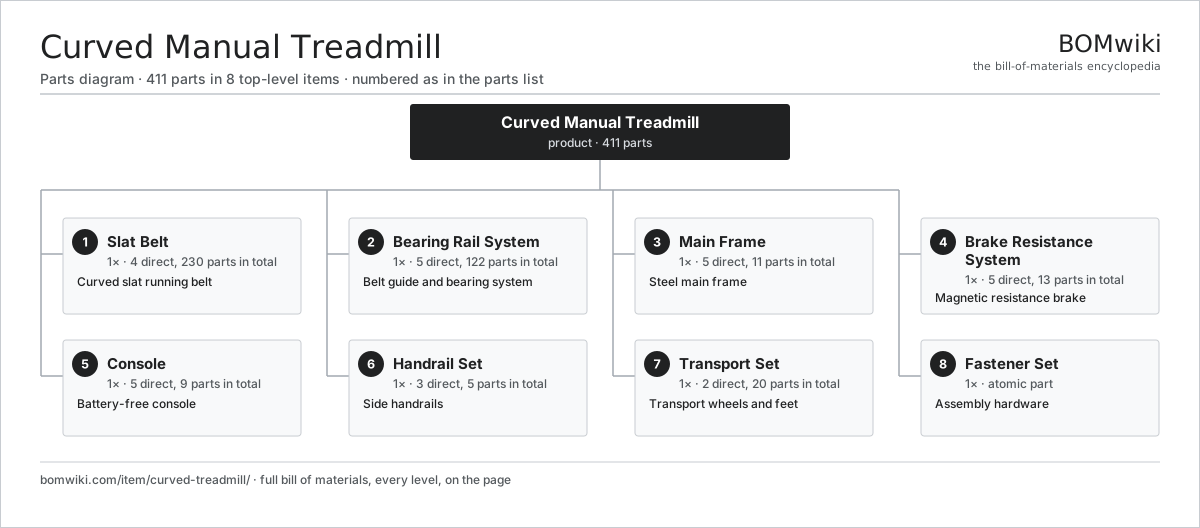
| # | Part | Qty | What it does |
|---|---|---|---|
| 1 | Slat Belt 4 parts | 1× | Curved slat running belt |
| 2 | Bearing Rail System 5 parts | 1× | Belt guide and bearing system |
| 3 | Main Frame 5 parts | 1× | Steel main frame |
| 4 | Brake Resistance System 5 parts | 1× | Magnetic resistance brake |
| 5 | Console 5 parts | 1× | Battery-free console |
| 6 | Handrail Set 3 parts | 1× | Side handrails |
| 7 | Transport Set 2 parts | 1× | Transport wheels and feet |
| 8 | Fastener Set | 1× | Assembly hardware |
3D model
No 3D model yet. Have a CAD file of this? Add a 3D model. STL renders right on this page; STEP, FreeCAD, and OpenSCAD sources are welcome too (openly licensed, like all 3D models on BOMwiki).
Build & assembly graph
expand / collapse · shared sub-assemblies converge · links to related products · est. labourTap an assembly to expand/collapse · tap a part to open it · use “Open page” for any node · drag to pan, scroll to zoom.
Bill of materials for Curved Manual Treadmill
8 top-level lines · 46 rows shown · 411 parts total · indented to 3 levels| # | Item / sub-assembly | Part no. | Qty/assy | Ext. qty | Parts | Type |
|---|---|---|---|---|---|---|
| 1 | Slat Belt 4 parts | curved-treadmill-slat-belt | 1× | 1 | 230 | assembly |
| 1.1 | Running Slat | curved-treadmill-slat | 57× | 57 | · | part |
| 1.2 | Side Timing Belt | curved-treadmill-timing-belt | 2× | 2 | · | part |
| 1.3 | Slat Tread | curved-treadmill-slat-tread | 57× | 57 | · | part |
| 1.4 | Belt Clip | curved-treadmill-belt-clip | 114× | 114 | · | part |
| 2 | Bearing Rail System 5 parts | curved-treadmill-bearing-rails | 1× | 1 | 122 | assembly |
| 2.1 | Guide Rail | curved-treadmill-guide-rail | 2× | 2 | · | part |
| 2.2 | Ball Bearing | ball-bearing | 114× | 114 | · | part |
| 2.3 | End Drum | curved-treadmill-end-drum | 2× | 2 | · | part |
| 2.4 | Drum Shaft | curved-treadmill-drum-shaft | 2× | 2 | · | part |
| 2.5 | Belt Tensioner | curved-treadmill-tensioner | 2× | 2 | · | part |
| 3 | Main Frame 5 parts | curved-treadmill-frame | 1× | 1 | 11 | assembly |
| 3.1 | Side Frame | curved-treadmill-side-frame | 2× | 2 | · | part |
| 3.2 | Cross Member | curved-treadmill-cross-member | 4× | 4 | · | part |
| 3.3 | Side Step | curved-treadmill-side-step | 2× | 2 | · | part |
| 3.4 | Sheet Metal Panel | sheet-panel | 2× | 2 | · | part |
| 3.5 | Fastener Set | fastener-set | 1× | 1 | · | part |
| 4 | Brake Resistance System 5 parts | curved-treadmill-brake-system | 1× | 1 | 13 | assembly |
| 4.1 | Brake Disc | curved-treadmill-brake-disc | 1× | 1 | · | part |
| 4.2 | Neodymium Magnet | neodymium-magnet | 8× | 8 | · | part |
| 4.3 | Magnet Yoke | curved-treadmill-magnet-yoke | 1× | 1 | · | part |
| 4.4 | Resistance Lever | curved-treadmill-resistance-lever | 1× | 1 | · | part |
| 4.5 | Ball Bearing | ball-bearing | 2× | 2 | · | part |
| 5 | Console 5 parts | curved-treadmill-console | 1× | 1 | 9 | assembly |
| 5.1 | Console Board 4 parts | curved-treadmill-console-board | 1× | 1 | 5 | assembly |
| 5.1.1 | Bare PCB | pcb-bare | 1× | 1 | · | part |
| 5.1.2 | Microcontroller | mcu | 1× | 1 | · | part |
| 5.1.3 | SMD Passive (R/C/L) | smd-passives | 1× | 1 | · | part |
| 5.1.4 | Connector | connector | 2× | 2 | · | part |
| 5.2 | LCD Panel | lcd-panel | 1× | 1 | · | part |
| 5.3 | Speed Sensor | curved-treadmill-speed-sensor | 1× | 1 | · | part |
| 5.4 | Console Mast | curved-treadmill-console-mast | 1× | 1 | · | part |
| 5.5 | LiPo Cell | lipo-cell | 1× | 1 | · | part |
| 6 | Handrail Set 3 parts | curved-treadmill-handrail-set | 1× | 1 | 5 | assembly |
| 6.1 | Handrail | curved-treadmill-handrail | 2× | 2 | · | part |
| 6.2 | Rail Grip | curved-treadmill-rail-grip | 2× | 2 | · | part |
| 6.3 | Fastener Set | fastener-set | 1× | 1 | · | part |
| 7 | Transport Set 2 parts | curved-treadmill-transport-set | 1× | 1 | 20 | assembly |
| 7.1 | Wheel Assembly 5 parts | wheel-assembly | 2× | 2 | 9 | assembly |
| 7.1.1 | Alloy Wheel | alloy-wheel | 1× | 2 | · | part |
| 7.1.2 | Tire | tire | 1× | 2 | · | part |
| 7.1.3 | TPMS Sensor | tpms-sensor | 1× | 2 | · | part |
| 7.1.4 | Lug Nut | lug-nut | 5× | 10 | · | part |
| 7.1.5 | Valve Stem | valve-stem | 1× | 2 | · | part |
| 7.2 | Levelling Foot | curved-treadmill-level-foot | 2× | 2 | · | part |
| 8 | Fastener Set | fastener-set | 1× | 1 | · | part |
Something wrong in this list? Report a problem with this BOM.
Related products
same domain, ranked by shared parts Baseball Pitching Machine
144 parts · shares 12 with this page
Baseball Pitching Machine
144 parts · shares 12 with this page
 Anti-Gravity Treadmill
96 parts · shares 6 with this page
Percussion Massage Gun
71 parts · shares 5 with this page
Ski Ergometer
43 parts · shares 5 with this page
Anti-Gravity Treadmill
96 parts · shares 6 with this page
Percussion Massage Gun
71 parts · shares 5 with this page
Ski Ergometer
43 parts · shares 5 with this page
 Elliptical Trainer
111 parts · shares 5 with this page
Elliptical Trainer
111 parts · shares 5 with this page
 Exercise Bike
93 parts · shares 5 with this page
Exercise Bike
93 parts · shares 5 with this page
Sourcing: possible vendors
Browse the supplier directory → Prices, MOQ, and lead times are algorithmic estimates, not quotes, and not claims about these companies. Company mappings are curated by keyword; est. price band $100–$10k. How estimates work| Vendor | HQ | Specialty | MOQ | Lead time |
|---|---|---|---|---|
| lifefitness.com ↗ | Rosemont, US | Fitness equipment | 200 units | 8–14 wks |
| technogym.com ↗ | Cesena, IT | Fitness equipment | 200 units | 8–14 wks |
|
🇺🇸Peloton
onepeloton.com ↗
|
New York, US | Connected fitness | 200 units | 8–14 wks |
| johnsonhealthtech.com ↗ | Taichung, TW | Fitness (Matrix) | 200 units | 8–14 wks |
|
🇺🇸Precor
precor.com ↗
|
Woodinville, US | Fitness equipment | 200 units | 8–14 wks |
770-word article