Cylinder Hone Machine
ProductOverview
A cylinder hone is a precision finishing machine for creating a crosshatch honing pattern inside cylinder bores. The honing process removes approximately 0.005–0.015" of material from the bore wall, correcting slight taper, out-of-roundness, or surface irregularities left by the drilling process. More importantly, honing produces a controlled micro-roughness (crosshatch pattern) that helps piston rings seat quickly, improves oil retention, and ensures proper compression.
The rotating honing head contains four abrasive stones that expand outward via springs to contact the bore wall. As the head rotates (300–1000 rpm) and reciprocates up and down (40–80 strokes per minute), the stones create a precise diamond-pattern on the bore surface. A coolant pump supplies honing fluid, which cools the bore, carries away swarf (stone and metal particles), and provides lubrication.
Engine rebuilders use hones as a final step before assembly. A freshly bored or worn cylinder might be as much as 0.020" oversized or distorted; honing corrects this to within micrometers. The result is a bore ready for ring seating without lengthy break-in periods.
Honing head and stone mechanics
The honing head is a rotating steel body containing four radially-mounted abrasive stones. Each stone is mounted on a calibrated spring that pushes the stone outward against the bore wall with a force of 50–200 lbs. The operator adjusts this force via a tapered sleeve that compresses the springs; increased compression tightens the stones against the bore, increasing cutting pressure.
The honing stones are rectangular blocks of aluminum oxide or silicon carbide bonded to a steel backing. Typical grit is #400 (medium) or #600 (fine). As the spindle rotates at 500–800 rpm and the head reciprocates up and down, the four stones working in unison cut the bore surface evenly. The reciprocating motion (40–80 cycles per minute) ensures that the stone passes over every point on the bore wall multiple times, creating the characteristic crosshatch pattern.
The crosshatch angle is typically 20–45° from vertical, created by the combination of rotational and reciprocating motion. This angle is engineered: a pattern too steep or too shallow allows excess oil to drain past the piston rings, reducing compression and increasing blowby. The coolant system is essential, without coolant, friction heat can exceed 600°F, dulling the stones and potentially damaging the bore.
Drive systems: rotation and reciprocation
The spindle drive uses a variable-speed motor (0.75 hp, 1800 rpm base) connected to the rotating head via a V-belt and flexible coupling. A variable-pitch pulley allows the operator to adjust spindle speed from 300–1000 rpm without changing belts. Softer, cast iron bores often hone better at lower speeds (400–600 rpm), while harder materials like aluminum benefit from higher speeds (700–1000 rpm).
The reciprocating stroke is driven by a separate 0.5 hp motor connected to a crank arm via gears. The crank arm rotates at constant speed, moving a connecting rod up and down. A mechanical stop limits the stroke length, typically 2–4 inches. The stroke rate is tied to the crank speed: if the drive motor runs at 1800 rpm with a 2:1 reduction, the stroke rate is 60 cycles per minute.
Both the rotation and reciprocation must be precisely centered on the bore axis. The precision guide rails with sealed linear bearing blocks ensure the honing head travels vertically without lateral drift. Misalignment of even 0.01" will produce a bore that is out-of-round or tapered, requiring rehoning.
Coolant system and lubrication
The coolant system comprises a 20 gallon reservoir, a 1/2 hp pump (5–10 gpm displacement), and a valve manifold with check valves and flow control orifices. Coolant is drawn from the tank by the pump and delivered through a flexible hose with a flow control valve to the rotating honing head.
The coolant enters the center of the rotating honing head via a swivel coupling (allowing the head to rotate while coolant flows), spreads across the four stones, and cascades down the bore walls. Used coolant and swarf drain from the bore through the return hose back to the tank. A 100 micron filter in the return line removes stone dust and metal particles, which would otherwise clog the flow passages.
Most shops use soluble oil coolant (honing oil), which is a mineral oil with detergent and rust-inhibitor additives. The coolant serves three critical functions: (1) cooling the bore and stones (typically absorbs 3–5 kW of heat), (2) carrying away swarf that would otherwise blind the stones, and (3) lubricating the stones and bore to reduce friction. Honing without adequate coolant is nearly impossible, friction heat causes the stones to glaze (lose cutting ability) within seconds.
Pressure control and stone expansion
The pressure regulator controls the force with which the stones press against the bore wall. As stone expansion pressure increases (50–200 psi on the spring side), the stones cut more aggressively, removing more material per pass. However, excessive pressure damages stones (breaking them), and the hone becomes unstable (stones chatter).
The operator adjusts the tapered sleeve holding the springs to set the desired pressure, then monitors the pressure gauge (0–600 psi range, reading the spring-side pressure). A pilot-operated relief valve set to 500 psi prevents accidental over-pressurization. Most skilled operators run at 100–150 psi, which is a good balance between cutting rate and stone life.
Mounting and positioning
The mounting bracket allows the machine to clamp to a drill press table, engine block stand, or fixed bench. A quick-release C-clamp secures the hone to the mounting surface. An adjustable base plate with fine-pitch leveling screws ensures the honing head is perfectly vertical and centered on the bore.
Setup is critical: if the hone is tilted even slightly, the bore will be tapered. Most shops use a depth micrometer or bore gauge to verify bore diameter at top, middle, and bottom before and after honing, confirming that the final bore is within tolerance. A typical production honing run for a 3.5" bore might take 10–20 minutes, producing a bore accurate to ±0.0005" and a crosshatch finish of Ra 10–20 microinches (very smooth, nearly mirror-like under magnification).
Honing workflow and quality control
A typical engine rebuild honing process: (1) Engine block is placed in a stand and the bore is measured with a precision bore gauge at three heights (top, middle, bottom) and two diameters (front-back and side-side). (2) The hone is positioned over the bore and clamped. (3) Coolant pump is started and flow is adjusted to 6–8 gpm. (4) Spindle speed is set to 500 rpm and stroke rate to 60 rpm. (5) Stone pressure is adjusted to 120 psi. (6) Hone is lowered into the bore and manual honing begins, stroking the hone in and out of the bore over 10–15 minutes. (7) Bore is extracted and re-measured. If still out of spec (e.g., 0.002" too large), the hone is rerun for 5 more minutes. (8) Once correct, the bore is cleaned (honing oil and swarf removed with compressed air and solvent) and inspected under magnification for crosshatch pattern.
Experienced rebuilders can achieve bore tolerances of ±0.0003" on repeat, meaning all four cylinders in an engine will have identical bore diameters within a few ten-thousandths of an inch. This uniformity is key to engine durability: uneven bore sizes cause uneven ring tension and gaps, leading to compression loss and blowby.
Stone types and bore materials
Different stones suit different materials:
- Aluminum Oxide (#400–#600): General-purpose stone, works on cast iron, steel, and aluminum bores. Standard choice for most rebuilding.
- Silicon Carbide: More aggressive, used on hard materials like ductile iron or plasma-coated bores.
- Specialty Stones: Some shops use proprietary stone formulations for specific applications (e.g., lightweight aluminum engine blocks).
A fresh stone set costs $50–$150 and lasts for 50–100 bore honing cycles before becoming dull and requiring replacement. Some high-volume shops re-dress (sharpen) stones using a special dressing tool rather than replacing them, extending life. Dressing removes a thin glaze from the stone surface, exposing fresh cutting edges underneath.
Common mistakes and limitations
Honing cannot fix major bore damage: if a bore is severely cracked, stepped (worn more at one end), or severely tapered, honing may not achieve specification. In such cases, boring (removing a thin layer of material with a boring bar) is required before honing. Honing is a finishing step, not a stock removal operation, it removes at most 0.015–0.020" of material.
Inadequate coolant flow causes glaze and heat damage. Excessive stone pressure causes chatter (vibration) and stone breakage. Misaligned setup produces tapered bores. Most experienced rebuilders develop a feel for the machine through hundreds of hours of use, adjusting speed, pressure, and hone movement based on sound, feel, and bore measurement feedback.
Cylinder Hone Machine parts and their functions
8 top-level parts · 46 parts in total · full bill of materials below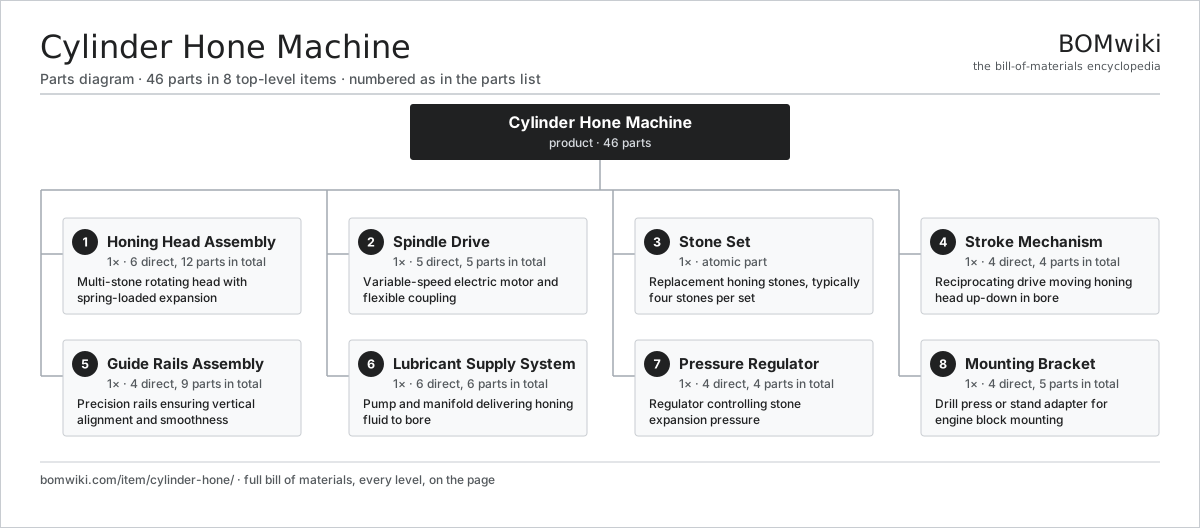
| # | Part | Qty | What it does |
|---|---|---|---|
| 1 | Honing Head Assembly 6 parts | 1× | Multi-stone rotating head with spring-loaded expansion |
| 2 | Spindle Drive 5 parts | 1× | Variable-speed electric motor and flexible coupling |
| 3 | Stone Set | 1× | Replacement honing stones, typically four stones per set |
| 4 | Stroke Mechanism 4 parts | 1× | Reciprocating drive moving honing head up-down in bore |
| 5 | Guide Rails Assembly 4 parts | 1× | Precision rails ensuring vertical alignment and smoothness |
| 6 | Lubricant Supply System 6 parts | 1× | Pump and manifold delivering honing fluid to bore |
| 7 | Pressure Regulator 4 parts | 1× | Regulator controlling stone expansion pressure |
| 8 | Mounting Bracket 4 parts | 1× | Drill press or stand adapter for engine block mounting |
3D model
No 3D model yet. Have a CAD file of this? Add a 3D model. STL renders right on this page; STEP, FreeCAD, and OpenSCAD sources are welcome too (openly licensed, like all 3D models on BOMwiki).
Build & assembly graph
expand / collapse · shared sub-assemblies converge · links to related products · est. labourTap an assembly to expand/collapse · tap a part to open it · use “Open page” for any node · drag to pan, scroll to zoom.
Bill of materials for Cylinder Hone Machine
8 top-level lines · 41 rows shown · 46 parts total · indented to 3 levels| # | Item / sub-assembly | Part no. | Qty/assy | Ext. qty | Parts | Type |
|---|---|---|---|---|---|---|
| 1 | Honing Head Assembly 6 parts | cylinder-hone-honing-head | 1× | 1 | 12 | assembly |
| 1.1 | Head Body | cylinder-hone-head-body | 1× | 1 | · | part |
| 1.2 | Spindle Bore | cylinder-hone-head-spindle-bore | 1× | 1 | · | part |
| 1.3 | Honing Stone | cylinder-hone-honing-stone | 4× | 4 | · | part |
| 1.4 | Expander Spring | cylinder-hone-spring-expander | 4× | 4 | · | part |
| 1.5 | Holder Sleeve | cylinder-hone-stone-holder-sleeve | 1× | 1 | · | part |
| 1.6 | Seal Ring | cylinder-hone-seal-ring | 1× | 1 | · | part |
| 2 | Spindle Drive 5 parts | cylinder-hone-spindle-drive | 1× | 1 | 5 | assembly |
| 2.1 | AC Motor | cylinder-hone-motor-ac | 1× | 1 | · | part |
| 2.2 | Motor Pulley | cylinder-hone-motor-pulley | 1× | 1 | · | part |
| 2.3 | Drive Belt | cylinder-hone-motor-belt | 1× | 1 | · | part |
| 2.4 | Flexible Coupling | cylinder-hone-flex-coupling | 1× | 1 | · | part |
| 2.5 | Spindle Shaft | cylinder-hone-spindle-shaft | 1× | 1 | · | part |
| 3 | Stone Set | cylinder-hone-stone-set | 1× | 1 | · | part |
| 4 | Stroke Mechanism 4 parts | cylinder-hone-stroke-mechanism | 1× | 1 | 4 | assembly |
| 4.1 | Crank Arm | cylinder-hone-crank-arm | 1× | 1 | · | part |
| 4.2 | Connecting Rod | cylinder-hone-connecting-rod | 1× | 1 | · | part |
| 4.3 | Stroke Adjuster | cylinder-hone-stroke-adjustment | 1× | 1 | · | part |
| 4.4 | Stroke Motor | cylinder-hone-drive-motor-small | 1× | 1 | · | part |
| 5 | Guide Rails Assembly 4 parts | cylinder-hone-guide-rails | 1× | 1 | 9 | assembly |
| 5.1 | Guide Rail | cylinder-hone-rail-outer | 2× | 2 | · | part |
| 5.2 | Bearing Block | cylinder-hone-rail-bearing-block | 4× | 4 | · | part |
| 5.3 | Support Bracket | cylinder-hone-rail-support-bracket | 2× | 2 | · | part |
| 5.4 | Alignment Pin | cylinder-hone-rail-alignment-pin | 1× | 1 | · | part |
| 6 | Lubricant Supply System 6 parts | cylinder-hone-lubricant-system | 1× | 1 | 6 | assembly |
| 6.1 | Coolant Pump | cylinder-hone-fluid-pump | 1× | 1 | · | part |
| 6.2 | Coolant Tank | cylinder-hone-fluid-tank | 1× | 1 | · | part |
| 6.3 | Flow Manifold | cylinder-hone-flow-manifold | 1× | 1 | · | part |
| 6.4 | Supply Hose | cylinder-hone-supply-hose | 1× | 1 | · | part |
| 6.5 | Return Hose | cylinder-hone-suction-hose | 1× | 1 | · | part |
| 6.6 | Return Filter | cylinder-hone-suction-filter | 1× | 1 | · | part |
| 7 | Pressure Regulator 4 parts | cylinder-hone-pressure-control | 1× | 1 | 4 | assembly |
| 7.1 | Relief Valve | cylinder-hone-regulator-valve | 1× | 1 | · | part |
| 7.2 | Pressure Gauge | cylinder-hone-regulator-gauge | 1× | 1 | · | part |
| 7.3 | Isolation Solenoid | cylinder-hone-regulator-solenoid | 1× | 1 | · | part |
| 7.4 | SAE Port | cylinder-hone-regulator-hose-connections | 1× | 1 | · | part |
| 8 | Mounting Bracket 4 parts | cylinder-hone-mounting-bracket | 1× | 1 | 5 | assembly |
| 8.1 | C-Clamp | cylinder-hone-bracket-clamp | 1× | 1 | · | part |
| 8.2 | Base Plate | cylinder-hone-bracket-base | 1× | 1 | · | part |
| 8.3 | Adjuster Screw | cylinder-hone-bracket-adj-screw | 2× | 2 | · | part |
| 8.4 | Safety Pin | cylinder-hone-bracket-safety-pin | 1× | 1 | · | part |
Something wrong in this list? Report a problem with this BOM.
Sourcing: possible vendors
Browse the supplier directory → Prices, MOQ, and lead times are algorithmic estimates, not quotes, and not claims about these companies. Company mappings are curated by keyword; est. price band $0.50–$100. How estimates work| Vendor | HQ | Specialty | MOQ | Lead time |
|---|
1,636-word article