Deck Barge
ProductOverview
A deck barge is the workhorse of short-sea and river transport: a steel box capable of carrying 3,000–4,500 tonnes of containerised or breakbulk cargo, designed to be towed at 6–8 knots by a powerful tug. Unlike a self-propelled general-cargo ship, the barge is unpowered and unmanned (or carries a skeleton crew of one), making it cheaper to build and operate per tonne of cargo moved. The Hull Structure is simple, subdivided by Internal Frame for structural strength, with Ballast System compartments for trim and stability control. The Deck Arrangement is entirely open or semi-enclosed, lacking passenger or crew amenities except for a small Wheelhouse Structure and Personnel Quarters for the master on long voyages.
Barges serve all points of the North European shoreline, feeding container terminals, steel mills and car-manufacturing plants. A barge costs 10–20 million EUR to build, a tug another 5–10 million EUR; the pair moves 15,000 m³ or 4,000 TEUs of cargo per month per vessel at a unit cost far below truck or train.
Barge types and operation
This deck barge is a general-purpose platform capable of carrying anything that stacks: 20 and 40 ft containers, breakbulk cargo (bagged, cartons, bundles), even finished vehicles if lashed down. A tug lashes the barge on the Towing Bitts and hauls it at the end of a bridle line, towing Bollard Pull typically 40–60 tonnes. The barge offers no active manoeuvrability: the tug steers, accelerates, decelerates and holds position against wind and current. The barge is trimmed and balanced by flooding or pumping Ballast Tank as cargo is loaded, maintaining the optimal Ballast System throughout a voyage.
Most barges are towed in pairs or trains: one or two barges ahead of a push-tug or astern of a pulling tug. A tow of two 4,000 tonne barges (8,000 tonnes total) is considered a standard unit for North European short-sea shipping.
Hull structure and buoyancy
The Hull Structure is an all-welded mild steel box, typically 90–130 m long and 17–20 m wide. The Side Shell plating is 8–12 mm thick; the Bottom Shell is similar. The Double Bottom Plate creates a space between the cargo and the sea, serving as additional buoyancy and also housing the Ballast System. The interior is subdivided by Internal Frame, ring-shaped stiffeners every 1–2 m running the full width of the barge, which prevent buckling under the weight of cargo and the strains of towing.
Longitudinal Stiffener angle or channel sections run fore-aft along the inner hull surface, adding stiffness and reducing the plate thickness required. The Keel Plate is a vertical plate extending from port to starboard at the very bottom, acting as a centerline spine. The End Bulkhead at the bow and stern close the hull, with the stern bulkhead usually featuring a notch or recess to accept the tug's pushing knees during push-tug operations.
Dead weight is 3,000–5,000 tonnes, meaning the barge sinks 2.5–3 m when fully loaded. A light barge displaces only 800–1,000 tonnes.
Deck arrangement and cargo handling
The Weather Deck is a flat, open steel plate, sloped very slightly aft (1–2°) for drainage. It is subdivided by Cargo Hatch Frame and Hatch Cover openings, typically 4–6 large rectangular hatches providing access to hold spaces below. Hatches are either hinged or removable covers, secured by clips and gaskets to keep water out during rough weather transit.
A small Wheelhouse Structure and Personnel Quarters occupy the after end of the deck, housing the master on long voyages (12–48 h). On short trips (under 12 h) the barge may be left unmanned, under the tug's supervision.
The Deck Riser is a small structure (typically 2 m × 2 m × 1.5 m tall) housing the Ballast Pump, Ballast Manifold and valve panel for ballast operations. All cargo is loaded and discharged by shoreside cranes or container spreaders; the barge provides only the platform.
Mooring and towing
The Mooring System consists of heavy welded Bow Bitts and Stern Bitts at the extreme ends, and Towing Bitts amidships or forward of amidships. The tug's bridle (a pair of wires or lines) is shackled to the Towing Bitts which can sustain pullloads of 50–100 tonnes. The Pad Eye installed everywhere on the deck edge serve dual purposes: during transit, they are anchor points for Cargo Securing System lashing wires; during mooring, they accept vessel moorings. Side Cleat and Fairlead are installed on the sides to guide lines to a dock. Mooring Post reinforce the corners, preventing rail deflection under load.
All fittings are mild steel and are painted with two-part epoxy or tar-based coating to resist rust in the sea environment. Surface preparation by grit blasting and regular touch-up painting are required.
Ballast and trim
The Ballast System allows the master to trim the barge fore-aft and adjust overall draught. Ballast compartments are located in the double bottom (fore, mid and aft sections, typically port and starboard tanks, 6 tanks total) and are filled via a single Ballast Pump driven by a small diesel or electric motor. The Ballast Manifold on deck is operated manually using valve levers; a skilled master can adjust ballast in 20–30 minutes per tonne change.
Tank capacity is checked using Sounding Pipe, a small tube inserted into each tank with a hand-held tape measure or weighted sounding rod. Modern barges may have electronic level gauges, but mechanical sounding remains the backup.
Cargo securing
Cargo is prevented from shifting in rough weather by Cargo Securing System, Wire Rope lashed from cargo container corner fittings to Pad Eye on the deck, tightened by Turnbuckle to a pre-tension of 5–10 tonnes per lashing. Spreader Bar are placed between the wire and container corner to prevent the wire from cutting into the container. Shackle connect the wire ends to the pad-eyes; Bottle Screw are sometimes used instead of turnbuckles for heavy loads.
Standard lashing rules require containers to be secured at corners and, for taller stacks, at intermediate points. A fully loaded barge with 48–60 containers will require 80–150 lashing wires.
Ventilation
The Ventilation System system is minimal: Hatch Ventilator cowls (mushroom-shaped fittings on the hatch covers) allow air to flow naturally into the hold while shedding spray and rain. On long passages or with moisture-sensitive cargo, a Hold Fan may be powered by a small diesel engine, drawing air through the hatches and venting through Air Duct. Relief Valve prevent hold overpressure if the vessel is in rough weather and spray is continuously hitting the hatch openings.
Safety and seaworthiness
The Railing System is a simple safety barrier around the cargo deck, Rail Post at intervals connected by Rail Tube (typically two horizontals at 1.1 m and 1.7 m height). Rail Gate in the railing provide access gates for cargo operations. The railing is NOT designed to stop a vehicle in motion; it is purely a personnel safety feature to prevent stepping or falling off the deck edge during normal operations.
Seaworthiness is primarily determined by hull strength and ballast control. A barge with an overfull cargo and under-ballasted will have a high centre of gravity and reduced freeboard, leading to instability in a seaway. Improper ballasting is a common cause of barge damage or loss.
Deck Barge parts and their functions
7 top-level parts · 320 parts in total · full bill of materials below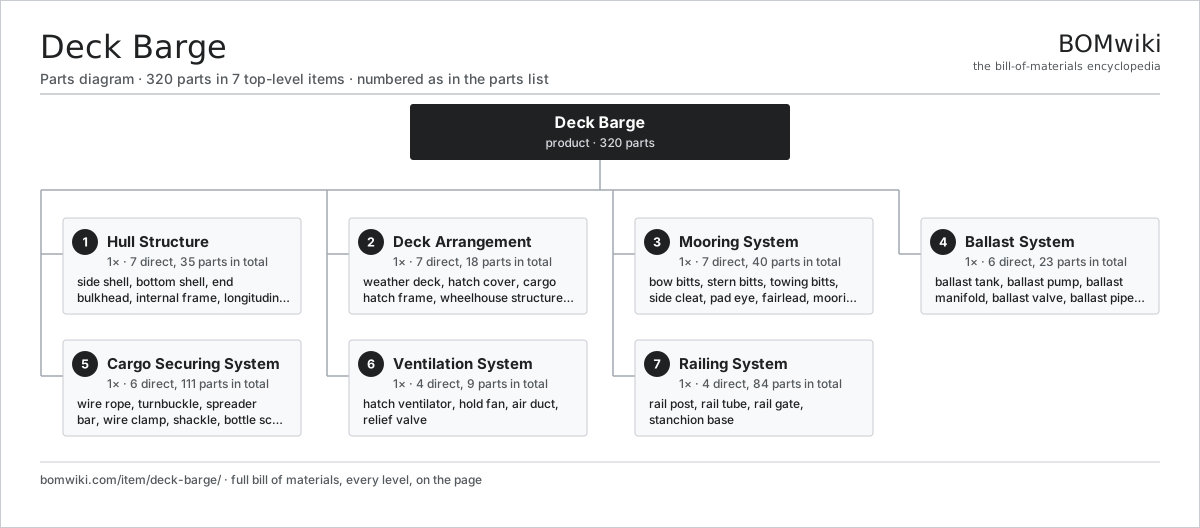
| # | Part | Qty | What it does |
|---|---|---|---|
| 1 | Hull Structure 7 parts | 1× | Welded steel hull subdivided by internal frames and longitudinal stiffeners, with double bottom and void spaces. |
| 2 | Deck Arrangement 7 parts | 1× | Open cargo deck with hatch covers, small wheelhouse and personnel facilities. |
| 3 | Mooring System 7 parts | 1× | Bitts, cleats and pad-eyes for securing towing lines and docking to quays. |
| 4 | Ballast System 6 parts | 1× | Segregated seawater ballast tanks and pumping for cargo trim and stability control. |
| 5 | Cargo Securing System 6 parts | 1× | Lashing wires, turnbuckles and spreader bars preventing cargo shift in rough weather. |
| 6 | Ventilation System 4 parts | 1× | Natural and powered air circulation through cargo holds and machinery spaces. |
| 7 | Railing System 4 parts | 1× | Safety railing and gates around cargo deck perimeter. |
3D model
No 3D model yet. Have a CAD file of this? Add a 3D model. STL renders right on this page; STEP, FreeCAD, and OpenSCAD sources are welcome too (openly licensed, like all 3D models on BOMwiki).
Build & assembly graph
expand / collapse · shared sub-assemblies converge · links to related products · est. labourTap an assembly to expand/collapse · tap a part to open it · use “Open page” for any node · drag to pan, scroll to zoom.
Bill of materials for Deck Barge
7 top-level lines · 48 rows shown · 320 parts total · indented to 3 levels| # | Item / sub-assembly | Part no. | Qty/assy | Ext. qty | Parts | Type |
|---|---|---|---|---|---|---|
| 1 | Hull Structure 7 parts | deck-barge-hull-structure | 1× | 1 | 35 | assembly |
| 1.1 | Side Shell | deck-barge-side-shell | 2× | 2 | · | part |
| 1.2 | Bottom Shell | deck-barge-bottom-shell | 1× | 1 | · | part |
| 1.3 | End Bulkhead | deck-barge-end-bulkhead | 2× | 2 | · | part |
| 1.4 | Internal Frame | deck-barge-internal-frame | 16× | 16 | · | part |
| 1.5 | Longitudinal Stiffener | deck-barge-longitudinal-stiffener | 12× | 12 | · | part |
| 1.6 | Double Bottom Plate | deck-barge-double-bottom-plate | 1× | 1 | · | part |
| 1.7 | Keel Plate | deck-barge-keel-plate | 1× | 1 | · | part |
| 2 | Deck Arrangement 7 parts | deck-barge-deck-arrangement | 1× | 1 | 18 | assembly |
| 2.1 | Weather Deck | deck-barge-weather-deck | 1× | 1 | · | part |
| 2.2 | Hatch Cover | deck-barge-hatch-cover | 4× | 4 | · | part |
| 2.3 | Cargo Hatch Frame | deck-barge-cargo-hatch-frame | 4× | 4 | · | part |
| 2.4 | Wheelhouse Structure | deck-barge-wheelhouse-structure | 1× | 1 | · | part |
| 2.5 | Personnel Quarters | deck-barge-personnel-quarters | 1× | 1 | · | part |
| 2.6 | Deck Riser | deck-barge-deck-riser | 1× | 1 | · | part |
| 2.7 | Sheet Metal Panel | sheet-panel | 6× | 6 | · | part |
| 3 | Mooring System 7 parts | deck-barge-mooring-system | 1× | 1 | 40 | assembly |
| 3.1 | Bow Bitts | deck-barge-bow-bitts | 2× | 2 | · | part |
| 3.2 | Stern Bitts | deck-barge-stern-bitts | 2× | 2 | · | part |
| 3.3 | Towing Bitts | deck-barge-towing-bitts | 2× | 2 | · | part |
| 3.4 | Side Cleat | deck-barge-side-cleat | 8× | 8 | · | part |
| 3.5 | Pad Eye | deck-barge-pad-eye | 16× | 16 | · | part |
| 3.6 | Fairlead | deck-barge-fairlead | 6× | 6 | · | part |
| 3.7 | Mooring Post | deck-barge-mooring-post | 4× | 4 | · | part |
| 4 | Ballast System 6 parts | deck-barge-ballast-system | 1× | 1 | 23 | assembly |
| 4.1 | Ballast Tank | deck-barge-ballast-tank | 6× | 6 | · | part |
| 4.2 | Ballast Pump | deck-barge-ballast-pump | 1× | 1 | · | part |
| 4.3 | Ballast Manifold | deck-barge-ballast-manifold | 1× | 1 | · | part |
| 4.4 | Ballast Valve | deck-barge-ballast-valve | 6× | 6 | · | part |
| 4.5 | Ballast Pipe | deck-barge-ballast-pipe | 1× | 1 | · | part |
| 4.6 | Sounding Pipe | deck-barge-sounding-pipe | 8× | 8 | · | part |
| 5 | Cargo Securing System 6 parts | deck-barge-cargo-securing | 1× | 1 | 111 | assembly |
| 5.1 | Wire Rope | deck-barge-wire-rope | 1× | 1 | · | part |
| 5.2 | Turnbuckle | deck-barge-turnbuckle | 20× | 20 | · | part |
| 5.3 | Spreader Bar | deck-barge-spreader-bar | 8× | 8 | · | part |
| 5.4 | Wire Clamp | deck-barge-wire-clamp | 40× | 40 | · | part |
| 5.5 | Shackle | deck-barge-shackle | 30× | 30 | · | part |
| 5.6 | Bottle Screw | deck-barge-bottle-screw | 12× | 12 | · | part |
| 6 | Ventilation System 4 parts | deck-barge-ventilation | 1× | 1 | 9 | assembly |
| 6.1 | Hatch Ventilator | deck-barge-hatch-ventilator | 4× | 4 | · | part |
| 6.2 | Hold Fan | deck-barge-hold-fan | 2× | 2 | · | part |
| 6.3 | Air Duct | deck-barge-air-duct | 1× | 1 | · | part |
| 6.4 | Relief Valve | deck-barge-relief-valve | 2× | 2 | · | part |
| 7 | Railing System 4 parts | deck-barge-railing-system | 1× | 1 | 84 | assembly |
| 7.1 | Rail Post | deck-barge-rail-post | 20× | 20 | · | part |
| 7.2 | Rail Tube | deck-barge-rail-tube | 40× | 40 | · | part |
| 7.3 | Rail Gate | deck-barge-rail-gate | 4× | 4 | · | part |
| 7.4 | Stanchion Base | deck-barge-stanchion-base | 20× | 20 | · | part |
Something wrong in this list? Report a problem with this BOM.
Related products
same domain, ranked by shared parts Boat Davit Crane
94 parts · shares 1 with this page
Boat Davit Crane
94 parts · shares 1 with this page
 Bow Thruster
47 parts · shares 1 with this page
Bow Thruster
47 parts · shares 1 with this page
 Bulk Carrier
357,978 parts · shares 1 with this page
Car Carrier Ship
266,341 parts · shares 1 with this page
Bulk Carrier
357,978 parts · shares 1 with this page
Car Carrier Ship
266,341 parts · shares 1 with this page
 Catamaran Ferry
4,765 parts · shares 1 with this page
Catamaran Ferry
4,765 parts · shares 1 with this page
Sourcing: possible vendors
Browse the supplier directory → Prices, MOQ, and lead times are algorithmic estimates, not quotes, and not claims about these companies. Company mappings are curated by keyword; est. price band $2k–$500M. How estimates work| Vendor | HQ | Specialty | MOQ | Lead time |
|---|---|---|---|---|
| hd.com ↗ | Ulsan, KR | Shipbuilder | made to order | 52–104 wks |
| fincantieri.com ↗ | Trieste, IT | Shipbuilder | made to order | 52–104 wks |
| damen.com ↗ | Gorinchem, NL | Shipbuilder | made to order | 52–104 wks |
| brunswick.com ↗ | Mettawa, US | Marine & boats | made to order | 52–104 wks |
|
🇨🇳CSSC
cssc.net.cn ↗
|
Shanghai, CN | Shipbuilding conglomerate | made to order | 52–104 wks |
1,358-word article