Marine Deck Crane
ProductOverview
A marine deck crane is a ship-mounted cargo-handling crane capable of loading and discharging general cargo, containers, and project cargo. Unlike shore-based gantry cranes, the deck crane must fit within the confines of the vessel and deal with ship motion in heavy seas. The crane comprises an articulated (knuckle-boom) or telescopic boom, a slewing pedestal allowing 360-degree rotation, dual hoist winches, and a proportional control system that allows the deck crew to operate multiple motions simultaneously with smooth, continuous control.
Modern deck cranes can hoist 30–250 tonnes depending on boom configuration and model, with boom reach extending 20–40 meters when fully deployed. Knuckle-boom cranes (multiple articulated boom sections) are preferred for their flexibility in reaching different deck areas and offshore supply locations. Telescopic cranes extend the main boom tube hydraulically, allowing rapid reach adjustment without moving the pedestal.
The system is powered by a central hydraulic power pack (variable displacement pump at 280 bar) that supplies the main hoist, auxiliary hoist, boom luff, slew drive, and all proportional control circuits. Modern installations feature load cells integrated into the boom tip shackle, providing real-time load feedback to the bridge, and proportional wireless pendants allowing the deck officer to position cargo with precision.
How it works
Boom articulation (knuckle-boom). A knuckle-boom crane has two or three boom sections connected by luffing (pivot) joints. The lower boom is fixed to the slewing pedestal via a lower luffing cylinder; the upper boom is connected to the lower boom via a knuckle pin and hydraulic luffing cylinder. As the operator moves a proportional joystick upward, pilot pressure from the control manifold flows to the lower luff cylinder, extending it and rotating the lower boom upward. Simultaneously, proportional flow to the upper luff cylinder extends that cylinder, rotating the upper boom further upward. The dual-luff design allows the boom to fold during stowage (compact footprint) and then fully extend in an "S" curve during cargo operations for maximum reach while maintaining structural efficiency.
Slewing (rotation). The slewing pedestal incorporates a large turntable bearing (1.5–2.5 meter pitch diameter) with integral spur ring gear. A hydraulic motor (15–30 kW) is coupled to a hardened steel pinion that meshes with the slew ring teeth. As the operator commands slew rotation, proportional directional valve ports pump pressure to the slew motor. The slew speed is infinitely variable from zero to full speed (~1 rpm), allowing the operator to position the suspended cargo over hatch openings with precision.
Hoist systems (dual winches). Two independent electric or hydraulic winches are mounted on the boom. The main hoist winch (larger motor, 30–75 kW) raises and lowers heavy cargo. The auxiliary hoist (smaller motor, 10–30 kW) handles light cargo and the empty hook lowering. Each winch has its own planetary gearbox (10:1 to 20:1 ratio) and a spring-applied service brake for load holding. The two winches can operate independently (main lifting cargo, auxiliary lowering empty gear) or together (if the operator demands it, both can contribute to hoisting a particularly heavy piece).
Proportional control integration. A central proportional control manifold routes pilot pressure to the luff cylinders, slew motor, and hoist motor winches. The operator on the deck holds a wireless proportional pendant with three joysticks: (1) left joystick for luff up/down (boom angle), (2) right joystick for slew left/right (boom rotation), and (3) center joystick for hoist up/down. Each joystick is proportional, pushing harder commands faster motion, and releasing the joystick to neutral instantly stops the motion. This proportional control enables smooth, coordinated cargo positioning.
Load cell feedback. A load cell shackle at the boom tip measures suspended load and transmits a 4–20 mA signal to a bridge-mounted load indicator display. As cargo is hoisted, the display shows increasing load in real-time. When load reaches 80% of safe working load (SWL), the display sounds a warning horn and flashes an amber light. At 100% SWL, the proportional hoist valve automatically vents to tank, preventing further upward motion and protecting against overload.
Coordinated motion example. A typical container loading scenario: The crane is slewed over hatch #2. The operator uses the luff joystick to lower the boom tip to the container level on the quay. The operator then uses the slew joystick to position the hook over the container lashing eye. Once the hook is directly above the container corner, the longshoreman below signals readiness. The operator pulls the hoist joystick upward, raising the container. As the container rises, the load cell feedback shows the load increasing. When load reaches 28 tonnes (the container weight), the operator reduces hoist speed and carefully watches the motion. Once the container clears the quay edge, the operator uses the luff joystick to raise the boom tip, swinging the container over the ship. The operator then slews the boom over the hatch and lowers the container into the hold using coordinated hoist-down and luff-down motions.
Accumulators for shock damping. Large accumulators (10–20 liters each) on the boom luff and hoist circuits absorb shock energy when load suddenly changes (container swinging, mooring line shock). If the boom hits an obstacle and stops suddenly, the accumulator bladder absorbs the kinetic energy, preventing sudden pressure spikes that could blow seals or crack welds.
Operational safety and limits
Wind and sea state limits. Deck cranes cannot operate safely in high wind (>45 knots). In a seaway with wave heights exceeding 5 meters, the boom swinging combined with ship heave creates unpredictable load swings. Modern cranes include an anemometer (wind speed sensor) and motion sensor package; if wind speed or ship motion exceeds a threshold, the crane control system automatically reduces maximum hoist speed or locks out the crane entirely.
Boom geometry and reach diagram. Each crane model has a certified reach diagram showing safe working load versus boom angle and extension. At full boom extension and full luff-up angle, load capacity is minimum (~50 tonnes). At short reach and mid-boom angle, capacity is maximum (~150 tonnes). The deck officer consults the reach diagram before commencing cargo operations to verify the crane can safely lift the item.
Boatswain and deck crew communication. During cargo operations, the crane operator must be in radio communication with a spotter on deck (boatswain) who watches the cargo approach and tells the operator to slow down, stop, or reverse if collision risk is detected. The operator has limited visibility from the control position and relies on the boatswain's real-time guidance.
Shock load control. When a container bottom clears the quay and the load transitions from support by the quay to suspension by the crane, the load cell suddenly measures the full weight. At that instant, if the operator does not reduce hoist speed, the load can swing and shock-load the boom. Training emphasizes that the operator must reduce speed during container breakaway to allow smooth load transition.
Maintenance and inspection
Hydraulic fluid management. Mineral ISO VG 46 oil is used in the main system. Fluid is sampled quarterly and analyzed for water content, particle count, and acid number. If particle count exceeds ISO 4406 18/16/13, the system is flushed and fluid changed. Water concentration is critical: >500 ppm indicates seal leakage or water ingress and requires investigation.
Boom and structural inspection. Every 2 years during dry-dock, the boom tube is ultrasonic-tested at key stress points (lower boom root, knuckle pin area, boom tip) to detect fatigue cracks. If a crack is found, the boom section is sent to a specialist for electron-beam welding repair and stress-relief heat treatment. Bolted connections (boom-to-boom, boom-to-pedestal) are inspected for looseness; any loose bolt is torqued to specification using a calibrated wrench.
Hoist brake and sheave inspection. The spring-applied hoist brakes are inspected annually. If brake holding force (measured using a load cell during proof load testing) drops below 125% of maximum hoist load, the brake is overhauled or replaced. Sheave pulleys are inspected for groove wear; if groove depth increases beyond specification, the sheave is replaced to prevent rope damage.
Cylinder seals and rod condition. Luff and telescope cylinders are examined for external leakage. Minor weeping is acceptable; significant leakage indicates seal failure. The rod is inspected for scoring or corrosion. If rod surface is corroded or scored, the cylinder is removed and the rod is hard-chrome re-plated and ground to size.
Load cell verification. Load cell sensors are proof-tested annually against a calibrated reference load cell. If the crane load cell reading drifts more than ±5% from reference, the load cell is replaced. All load cell wiring and connectors are visually inspected for corrosion or damage.
Class survey proof load testing. Every 5 years (or annually for heavily used cranes), DNV or ABS witnesses a proof load test: a static test load of 125% of SWL is suspended from the boom tip at maximum reach and held for 10 minutes. All structural connections, hydraulic seals, and pivot pins are visually inspected for plastic deformation, leakage, or cracking. The boom is then swung 50 times while under 50% load to verify dynamic performance.
Standards and certification
DNV-GL deck crane standard. All deck cranes on DNV-classed ships are designed per DNV-GL Rules for Classification and Construction of Vessels, Part 5, Chapter 5 (Cargo Handling Cranes). The class notation includes:
- Crane class: Based on safe working load (SWL). Class 50 cranes can safely lift 50 tonnes; Class 200 cranes can lift 200 tonnes.
- Duty cycle: Intermittent vs. continuous. Intermittent cranes (typical general cargo ship) have lower fatigue design factors. Continuous cranes (offshore supply vessels) have higher safety factors.
IMCA offshore crane standard. Offshore cranes (used on supply boats and heavy-lift vessels) are also certified per International Marine Contractors Association (IMCA) standards, which impose additional testing for shock loads, dynamic heave compensation, and fail-safe brake performance.
Load cell accuracy (NRMCA standard): Load cell sensors must be certified per National Retail Merchant's Association (NRMCA) standards or equivalent, ensuring 0.1% accuracy minimum.
Safe working load certification. Each crane model is certified by the builder with a specific SWL at rated working conditions. Any modification to the boom (lengthening, adding ballast, changing motor) requires re-certification and may reduce SWL. The ship's flag state maintains updated certification documentation in the crane file.
Marine Deck Crane parts and their functions
8 top-level parts · 138 parts in total · full bill of materials below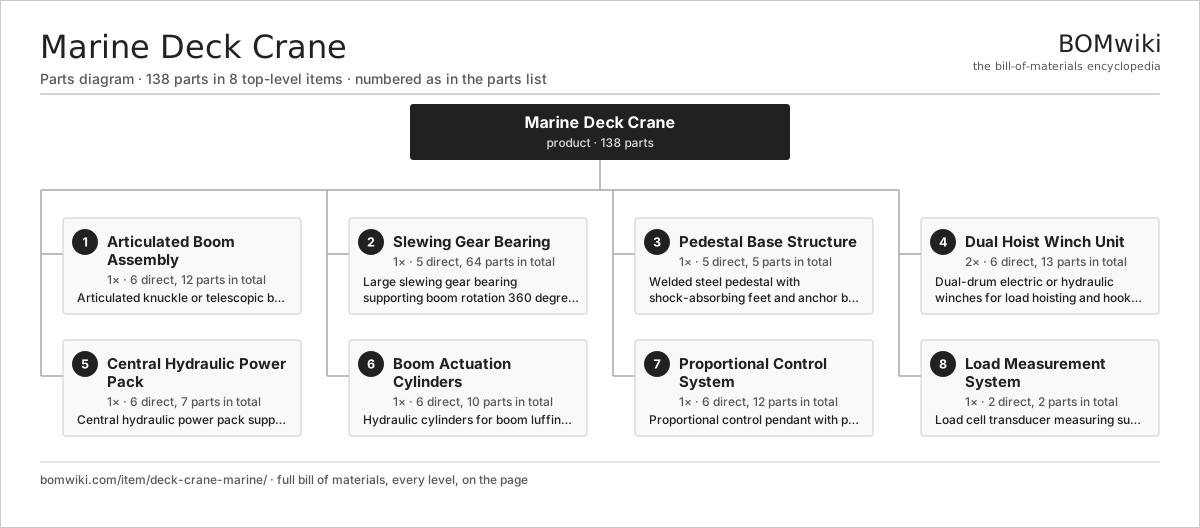
| # | Part | Qty | What it does |
|---|---|---|---|
| 1 | Articulated Boom Assembly 6 parts | 1× | Articulated knuckle or telescopic boom with integral winches and sheaves |
| 2 | Slewing Gear Bearing 5 parts | 1× | Large slewing gear bearing supporting boom rotation 360 degrees |
| 3 | Pedestal Base Structure 5 parts | 1× | Welded steel pedestal with shock-absorbing feet and anchor bolt base |
| 4 | Dual Hoist Winch Unit 6 parts | 2× | Dual-drum electric or hydraulic winches for load hoisting and hook movement |
| 5 | Central Hydraulic Power Pack 6 parts | 1× | Central hydraulic power pack supplying boom and winch circuits |
| 6 | Boom Actuation Cylinders 6 parts | 1× | Hydraulic cylinders for boom luffing (up/down) and telescoping |
| 7 | Proportional Control System 6 parts | 1× | Proportional control pendant with proportional joysticks for all motions |
| 8 | Load Measurement System 2 parts | 1× | Load cell transducer measuring suspended load for bridge display |
3D model
No 3D model yet. Have a CAD file of this? Add a 3D model. STL renders right on this page; STEP, FreeCAD, and OpenSCAD sources are welcome too (openly licensed, like all 3D models on BOMwiki).
Build & assembly graph
expand / collapse · shared sub-assemblies converge · links to related products · est. labourTap an assembly to expand/collapse · tap a part to open it · use “Open page” for any node · drag to pan, scroll to zoom.
Bill of materials for Marine Deck Crane
8 top-level lines · 50 rows shown · 138 parts total · indented to 3 levels| # | Item / sub-assembly | Part no. | Qty/assy | Ext. qty | Parts | Type |
|---|---|---|---|---|---|---|
| 1 | Articulated Boom Assembly 6 parts | deck-crane-marine-boom | 1× | 1 | 12 | assembly |
| 1.1 | Lower Boom Tube | deck-crane-marine-boom-lower | 1× | 1 | · | part |
| 1.2 | Upper Boom Tube | deck-crane-marine-boom-upper | 1× | 1 | · | part |
| 1.3 | Knuckle Luffing Pin | deck-crane-marine-boom-knuckle-pin | 1× | 1 | · | part |
| 1.4 | Boom Tip Sheave Block | deck-crane-marine-sheave-blocks | 2× | 2 | · | part |
| 1.5 | Ball Bearing | ball-bearing | 6× | 6 | · | part |
| 1.6 | Fastener Set | fastener-set | 1× | 1 | · | part |
| 2 | Slewing Gear Bearing 5 parts | deck-crane-marine-slew-bearing | 1× | 1 | 64 | assembly |
| 2.1 | Slew Bearing Ring | deck-crane-marine-slew-ring | 1× | 1 | · | part |
| 2.2 | Ball Bearing | ball-bearing | 60× | 60 | · | part |
| 2.3 | Slew Motor | deck-crane-marine-slew-drive | 1× | 1 | · | part |
| 2.4 | Slew Pinion Gear | deck-crane-marine-slew-pinion | 1× | 1 | · | part |
| 2.5 | Fastener Set | fastener-set | 1× | 1 | · | part |
| 3 | Pedestal Base Structure 5 parts | deck-crane-marine-pedestal | 1× | 1 | 5 | assembly |
| 3.1 | Pedestal Structure | deck-crane-marine-pedestal-steel | 1× | 1 | · | part |
| 3.2 | Central Pivot Pin | deck-crane-marine-central-pivot | 1× | 1 | · | part |
| 3.3 | Isolation Pads | deck-crane-marine-neoprene-pads | 1× | 1 | · | part |
| 3.4 | Fastener Set | fastener-set | 1× | 1 | · | part |
| 3.5 | Sheet Metal Panel | sheet-panel | 1× | 1 | · | part |
| 4 | Dual Hoist Winch Unit 6 parts | deck-crane-marine-hoist-winch | 2× | 2 | 13 | assembly |
| 4.1 | Hoist Motor | deck-crane-marine-hoist-motor | 2× | 4 | · | part |
| 4.2 | Hoist Gearbox | deck-crane-marine-hoist-gearbox | 2× | 4 | · | part |
| 4.3 | Hoist Drum | deck-crane-marine-hoist-drum | 2× | 4 | · | part |
| 4.4 | Ball Bearing | ball-bearing | 4× | 8 | · | part |
| 4.5 | Load Holding Brake | deck-crane-marine-hoist-brake | 2× | 4 | · | part |
| 4.6 | Fastener Set | fastener-set | 1× | 2 | · | part |
| 5 | Central Hydraulic Power Pack 6 parts | deck-crane-marine-hydraulic-power | 1× | 1 | 7 | assembly |
| 5.1 | Main Hydraulic Pump | deck-crane-marine-main-pump | 1× | 1 | · | part |
| 5.2 | Main Hydraulic Reservoir | deck-crane-marine-reservoir | 1× | 1 | · | part |
| 5.3 | Hydraulic Accumulator | deck-crane-marine-accumulator | 2× | 2 | · | part |
| 5.4 | Pressure Filter | deck-crane-marine-pressure-filter | 1× | 1 | · | part |
| 5.5 | Relief Valve | deck-crane-marine-relief-valve | 1× | 1 | · | part |
| 5.6 | Hydraulic Cooler | deck-crane-marine-cooler | 1× | 1 | · | part |
| 6 | Boom Actuation Cylinders 6 parts | deck-crane-marine-boom-hydraulics | 1× | 1 | 10 | assembly |
| 6.1 | Luff Hydraulic Cylinder | deck-crane-marine-luff-cylinder | 1× | 1 | · | part |
| 6.2 | Telescope Cylinder | deck-crane-marine-telescope-cylinder | 1× | 1 | · | part |
| 6.3 | Cylinder End Cap | deck-crane-marine-cylinder-heads | 2× | 2 | · | part |
| 6.4 | Boom Cylinder Piston | deck-crane-marine-piston | 2× | 2 | · | part |
| 6.5 | O-Ring Set | oring-set | 3× | 3 | · | part |
| 6.6 | Fastener Set | fastener-set | 1× | 1 | · | part |
| 7 | Proportional Control System 6 parts | deck-crane-marine-controls | 1× | 1 | 12 | assembly |
| 7.1 | Control Pendant | deck-crane-marine-control-pendant | 1× | 1 | · | part |
| 7.2 | Control Panel | deck-crane-marine-control-panel | 1× | 1 | · | part |
| 7.3 | Proportional Directional Valve | deck-crane-marine-proportional-valves | 2× | 2 | · | part |
| 7.4 | Relay | relay | 3× | 3 | · | part |
| 7.5 | Pressure Sensor | pressure-sensor | 2× | 2 | · | part |
| 7.6 | Connector | connector | 3× | 3 | · | part |
| 8 | Load Measurement System 2 parts | deck-crane-marine-load-cell | 1× | 1 | 2 | assembly |
| 8.1 | Load Indicator Display | deck-crane-marine-display-console | 1× | 1 | · | part |
| 8.2 | Connector | connector | 1× | 1 | · | part |
Something wrong in this list? Report a problem with this BOM.
Related products
same domain, ranked by shared parts Boat Davit Crane
94 parts · shares 4 with this page
Boat Davit Crane
94 parts · shares 4 with this page
 Bulk Carrier
357,978 parts · shares 4 with this page
Car Carrier Ship
266,341 parts · shares 4 with this page
Bulk Carrier
357,978 parts · shares 4 with this page
Car Carrier Ship
266,341 parts · shares 4 with this page
 Cement Carrier
45,498 parts · shares 4 with this page
Cement Carrier
45,498 parts · shares 4 with this page
 Chemical Tanker
227,765 parts · shares 4 with this page
Chemical Tanker
227,765 parts · shares 4 with this page
Sourcing: possible vendors
Browse the supplier directory → Prices, MOQ, and lead times are algorithmic estimates, not quotes, and not claims about these companies. Company mappings are curated by keyword; est. price band $2k–$500M. How estimates work| Vendor | HQ | Specialty | MOQ | Lead time |
|---|---|---|---|---|
| hd.com ↗ | Ulsan, KR | Shipbuilder | made to order | 52–104 wks |
| fincantieri.com ↗ | Trieste, IT | Shipbuilder | made to order | 52–104 wks |
| damen.com ↗ | Gorinchem, NL | Shipbuilder | made to order | 52–104 wks |
| brunswick.com ↗ | Mettawa, US | Marine & boats | made to order | 52–104 wks |
|
🇨🇳CSSC
cssc.net.cn ↗
|
Shanghai, CN | Shipbuilding conglomerate | made to order | 52–104 wks |
1,742-word article