DECT Base Station
ProductOverview
A DECT base station is the radio that gives cordless desk and warehouse phones their freedom of movement. DECT is a dedicated cordless-telephony standard, separate from Wi-Fi, with its own slice of spectrum and a protocol built specifically for clean, low-latency voice. An IP-DECT base like this one bridges that radio link to a telephone system over the data network, so handsets roam through a building while their calls travel as IP packets back to the PBX.
The DECT Mainboard is the core, carrying the DECT chipset that manages the air link, an application processor running the SIP signaling, and a codec converting between the two. The Radio Module is the RF section: a transceiver, a power amplifier, and a diversity antenna pair that give the base its reach. A single cable to the Network Port both carries the voice traffic and powers the unit over PoE. The Enclosure is an RF-transparent shell, the Status LED reports registration, and the Wall Mount Kit fixes it to a wall.
How it works
DECT divides time into frames of twenty-four slots, twelve down and twelve up, and a handset reserves a matched pair for the duration of a call. Because every base on a site shares the same few carrier frequencies, the chipset constantly measures the channels and the handset hops to a cleaner slot if interference rises, all without dropping the call. The diversity antennas counter fading: the radio samples both and uses whichever gives the stronger signal moment to moment, which is what lets a phone work in the dead spots of a steel-framed building.
On the network side the base is a small VoIP gateway. When a call connects, the codec packetizes the DECT voice into RTP and the application processor signals the PBX over SIP, so to the phone system the cordless handset looks like any other extension. Registration data for each handset is held in flash, and the whole unit, radio and gateway alike, runs from the power delivered over its one Ethernet cable, which keeps installation to a single drop per coverage cell.
DECT Base Station parts and their functions
8 top-level parts · 192 parts in total · full bill of materials below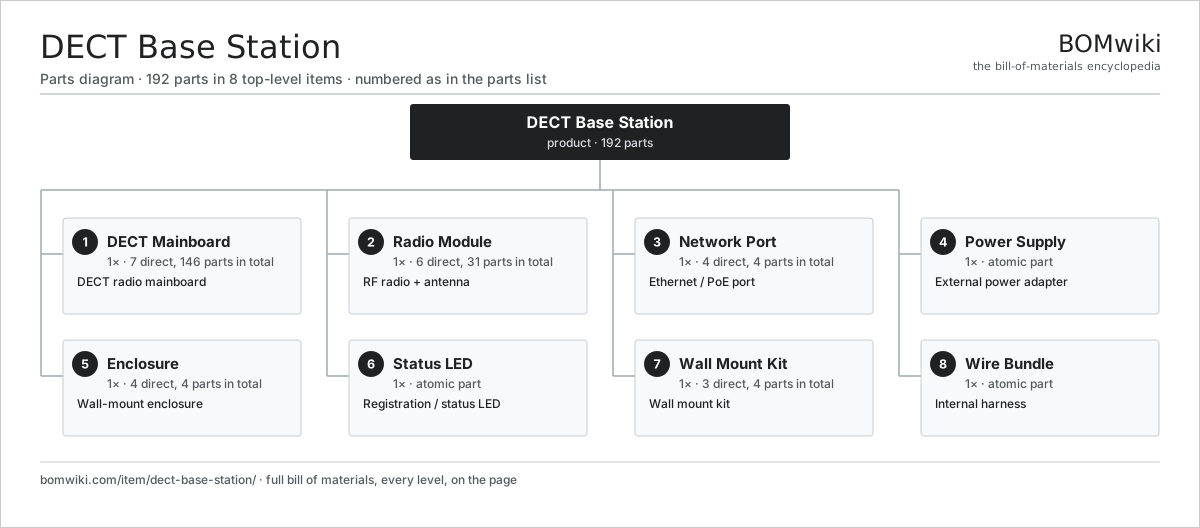
| # | Part | Qty | What it does |
|---|---|---|---|
| 1 | DECT Mainboard 7 parts | 1× | DECT radio mainboard |
| 2 | Radio Module 6 parts | 1× | RF radio + antenna |
| 3 | Network Port 4 parts | 1× | Ethernet / PoE port |
| 4 | Power Supply | 1× | External power adapter |
| 5 | Enclosure 4 parts | 1× | Wall-mount enclosure |
| 6 | Status LED | 1× | Registration / status LED |
| 7 | Wall Mount Kit 3 parts | 1× | Wall mount kit |
| 8 | Wire Bundle | 1× | Internal harness |
3D model
No 3D model yet. Have a CAD file of this? Add a 3D model. STL renders right on this page; STEP, FreeCAD, and OpenSCAD sources are welcome too (openly licensed, like all 3D models on BOMwiki).
Build & assembly graph
expand / collapse · shared sub-assemblies converge · links to related products · est. labourTap an assembly to expand/collapse · tap a part to open it · use “Open page” for any node · drag to pan, scroll to zoom.
Bill of materials for DECT Base Station
8 top-level lines · 32 rows shown · 192 parts total · indented to 3 levels| # | Item / sub-assembly | Part no. | Qty/assy | Ext. qty | Parts | Type |
|---|---|---|---|---|---|---|
| 1 | DECT Mainboard 7 parts | dect-mainboard | 1× | 1 | 146 | assembly |
| 1.1 | Bare PCB | pcb-bare | 1× | 1 | · | part |
| 1.2 | Compute SoC Module | soc-module | 1× | 1 | · | part |
| 1.3 | DECT Chipset | dect-chipset | 1× | 1 | · | part |
| 1.4 | Microcontroller | mcu | 1× | 1 | · | part |
| 1.5 | Firmware Flash | dect-flash | 1× | 1 | · | part |
| 1.6 | Voice Codec | dect-codec | 1× | 1 | · | part |
| 1.7 | SMD Passive (R/C/L) | smd-passives | 140× | 140 | · | part |
| 2 | Radio Module 6 parts | dect-radio-module | 1× | 1 | 31 | assembly |
| 2.1 | RF Transceiver | dect-rf-transceiver | 1× | 1 | · | part |
| 2.2 | Power Amplifier | dect-pa | 1× | 1 | · | part |
| 2.3 | SAW Filter | dect-saw-filter | 1× | 1 | · | part |
| 2.4 | Diversity Antenna | dect-antenna | 2× | 2 | · | part |
| 2.5 | Antenna Coax | dect-rf-cable | 2× | 2 | · | part |
| 2.6 | SMD Passive (R/C/L) | smd-passives | 24× | 24 | · | part |
| 3 | Network Port 4 parts | dect-network-port | 1× | 1 | 4 | assembly |
| 3.1 | RJ45 Jack | dect-rj45-jack | 1× | 1 | · | part |
| 3.2 | Ethernet Magnetics | dect-magnetics | 1× | 1 | · | part |
| 3.3 | PD Controller | dect-pd-controller | 1× | 1 | · | part |
| 3.4 | Connector | connector | 1× | 1 | · | part |
| 4 | Power Supply | power-supply | 1× | 1 | · | part |
| 5 | Enclosure 4 parts | dect-enclosure | 1× | 1 | 4 | assembly |
| 5.1 | Top Cover | dect-top-cover | 1× | 1 | · | part |
| 5.2 | Base Shell | dect-base-shell | 1× | 1 | · | part |
| 5.3 | LED Light Pipe | dect-light-pipe | 1× | 1 | · | part |
| 5.4 | Fastener Set | fastener-set | 1× | 1 | · | part |
| 6 | Status LED | dect-status-led | 1× | 1 | · | part |
| 7 | Wall Mount Kit 3 parts | dect-mount-kit | 1× | 1 | 4 | assembly |
| 7.1 | Wall Plate | dect-wall-plate | 1× | 1 | · | part |
| 7.2 | Wall Anchor | dect-wall-anchor | 2× | 2 | · | part |
| 7.3 | Fastener Set | fastener-set | 1× | 1 | · | part |
| 8 | Wire Bundle | wire-bundle | 1× | 1 | · | part |
Something wrong in this list? Report a problem with this BOM.
Related products
same domain, ranked by shared parts 5G Base Station
436 parts · shares 4 with this page
 Firewall Appliance
82 parts · shares 4 with this page
 Network Switch
1,367 parts · shares 4 with this page
 OTDR Fiber Tester
393 parts · shares 4 with this page
 Mesh Wi-Fi Node
70 parts · shares 3 with this page
 Microwave Backhaul Radio
369 parts · shares 3 with this page
Sourcing: possible vendors
Browse the supplier directory → Prices, MOQ, and lead times are algorithmic estimates, not quotes, and not claims about these companies. Company mappings are curated by keyword; est. price band $30–$50k. How estimates work| Vendor | HQ | Specialty | MOQ | Lead time |
|---|---|---|---|---|
|
🇺🇸Cisco
cisco.com ↗
|
San Jose, US | Networking | 500 units | 8–14 wks |
|
🇺🇸Juniper
juniper.net ↗
|
Sunnyvale, US | Networking | 500 units | 8–14 wks |
| arista.com ↗ | Santa Clara, US | Networking | 500 units | 8–14 wks |
|
🇫🇮Nokia
nokia.com ↗
|
Espoo, FI | Telecom equipment | 500 units | 8–14 wks |
|
🇨🇳Huawei
huawei.com ↗
|
Shenzhen, CN | Networking & telecom | 500 units | 8–14 wks |
359-word article