Deinking Flotation Cell
ProductOverview
The deinking flotation cell separates ink and hydrophobic contaminants from recycled paper fiber using aeration and bubble adhesion. In a typical mill processing newspaper or magazine waste, hydrapulped slurry contains 2–5% ink particles by weight. The flotation cell collects these particles on rising air bubbles, floats them to the surface as froth (reject), and withdraws clean fiber (accept) from the bottom. Removal efficiency is 60–85%, depending on fiber origin, ink type, and operating conditions.
A single flotation cell (2–4 m diameter, 1–2 m height) processes 50–200 m³/h of pulp slurry and generates 5–20 t/day of dry reject material (deinking sludge). Most mills operate 2–4 cells in parallel or series to achieve target ink removal; flotation is often followed by a secondary cleaner and fine screen to further reduce ink and contaminants before the pulp enters the paper machine headbox.
How It Works
Inlet and Slurry Preparation
Hydrapulped pulp slurry (4–6% consistency, containing 2–5% ink particles) enters the Flotation Cell Vessel through a feed port. The pulp slurry is distributed evenly across the cell; a Mixing and Bubble Distribution (slow-speed rotor, 15–60 rpm) maintains fiber suspension and prevents settling of heavy particles (which would bypass flotation).
Bubble Injection and Particle Capture
The Aeration and Bubble Injection supplies air via a Air Compressor (50–100 kPa, 5–20 m³/min). Air flows through a Air Diffuser (ceramic or titanium porous stone at the cell bottom), generating 50–200 micron bubbles uniformly across the cell cross-section. A Air Valve Control proportional valve maintains steady bubble flow (typically 0.5–2.0 m³/min), with an Air Flowmeter confirming actual flow rate.
Rising bubbles encounter ink particles and hydrophobic contaminants (wax, sizing, adhesive fragments). Chemical Dosing System injects surfactant collector (2–10 kg/t pulp) that coats ink particle surfaces, making them water-repellent and attractive to air bubbles. Frother chemical (1–5 kg/t) stabilizes foam at the cell surface. Ink-laden bubbles aggregate and rise to the top as a stable, buoyant froth (reject).
Froth Collection and Removal
As bubbles and ink reach the cell surface, a Froth Rake (slowly rotating arm, 0.5–2 rpm) continuously scrapes the froth layer, directing collected material into a Froth Chute. The rake blade moves gently (low shear) to avoid breaking bubbles and re-entraining ink into the cell. Alternative designs use a stationary Overflow Weir (V-notch or rectangular) at the cell top; froth naturally overflows into a collection channel.
Accept Fiber Discharge
Clean fiber (deinking pulp, 0.5–1.0% residual ink) is withdrawn from the Flotation Cell Vessel bottom via an Accept Valve gate or ball valve. The Reject Weir maintains cell depth and sets the accept stream hydrostatic pressure. Accept fiber (typically 4–6% consistency, same as inlet) flows to a Outlet Pipe connected to a secondary cleaner or fine screen. An optional Accept Pump (Optional) boosts pressure if downstream equipment is elevated or at distance.
Reject Froth Dewatering
Collected froth (40–60% water, 2–3% ink solids) overflows into a Froth Thickener, a simple gravity settler that removes excess water over 15–30 minutes. The Scavenger Cell (Optional) (secondary flotation, optional) recovers residual fiber from thickener underflow before reject is sent to disposal. Final reject (dry cake, ~10% moisture) is discharged via Reject Pump to a Reject Container dumpster or incinerator feed line.
Flotation Chemistry and Mechanism
Ink particles are typically 0.1–10 micron carbon-based pigment agglomerates (in newsprint) or 5–50 micron coated mineral particles (in magazines). They are naturally hydrophilic (water-loving) but become hydrophobic in the presence of surfactant collectors.
Collector chemical (surfactant): Anionic (e.g., sodium dodecyl sulfate) or cationic surfactants adsorb onto ink particle surfaces, orienting hydrophobic tails outward. This makes the particle water-repellent and bubble-attractive. Typical dosage is 2–10 kg/tonne pulp depending on ink type (newsprint requires less than glossy magazine ink).
Frother chemical: Proteins or synthetic compounds (e.g., pine oil derivatives) stabilize small bubbles and promote bubble coalescence at the cell surface. Typical dosage is 1–5 kg/t. Excessive frother produces overly stable foam that's difficult to compact; too little allows rapid bubble coalescence and loss of flotation capacity.
Residence time: Optimal flotation occurs at 8–15 minutes. Longer residence allows ink to fully float but increases cell size (cost); shorter residence increases through-put but reduces removal efficiency.
Ink Removal Efficiency
First-stage flotation removes 60–85% of ink, reducing ink content from 2–5% to 0.5–1.0%. A second-stage flotation (common in modern mills) removes an additional 40–60% of residual ink, achieving final ink of 0.1–0.3%. A fine screen following flotation removes fiber dirt and incompletely floated particles.
Removal efficiency depends on:
- Fiber type: Mechanical pulp (TMP/RMP) has higher ink adhesion and requires longer residence (12–15 min); kraft fibers release ink easily (8–10 min).
- Ink type: Newsprint ink (carbon + soy-based binder) floats easily; glossy magazine ink (mineral coatings + synthetic binders) requires higher collector dosage.
- Pulp consistency: 4–6% is optimal; <3% dilutes chemicals and reduces flotation efficiency, >8% increases viscosity and traps particles.
- Temperature: Warmer pulp (40–50°C) improves flotation; cold pulp (<20°C) slows bubble rise and chemical diffusion.
Operational Control
The Control and Monitoring monitors:
- Air flow: Air Flowmeter ensures steady bubble generation (0.5–2.0 m³/min). If flow drops, diffuser likely clogged (requiring cleaning or replacement).
- Cell level: Level Sensor prevents overfill (which washes away froth) or underfill (which exposes impeller, causing cavitation).
- Consistency: Consistency Controller maintains 4–6% inlet solids; too dilute reduces efficiency, too thick increases load on mixer.
- Chemical dosage: Deinking PLC adjusts collector and frother injection rate based on inlet ink content (estimated from mill records or titration) and residence time.
Economics and Reliability
A single flotation cell typically costs USD 150,000–300,000 installed. Operating cost is approximately USD 5–15/tonne of pulp processed (chemicals USD 2–5, energy USD 2–3, labor USD 1–5). Deinking sludge (dried reject, ~10% moisture) is either incinerated in a recovery boiler (typical in mills with black liquor recovery) or sent to landfill (USD 20–50/tonne gate fee).
Main failure modes:
- Diffuser plugging: Precipitated minerals or fiber fragments block porous stone; requires chemical cleaning or replacement every 3–6 months (USD 1,000–3,000).
- Rake jamming: If foam becomes too stiff (excessive frother), rake motor torque spikes and can stall; operator must manually free rake and reduce frother dosage.
- Mixer cavitation: If cell level drops below impeller, air is sucked in, causing cavitation noise and vibration; Level Sensor prevents this by triggering alarm if level drops below setpoint.
Flotation is sensitive to operating variables; even ±10% variation in chemical dosage or residence time can reduce ink removal efficiency by 5–10%, affecting downstream paper quality.
Deinking Flotation Cell parts and their functions
8 top-level parts · 33 parts in total · full bill of materials below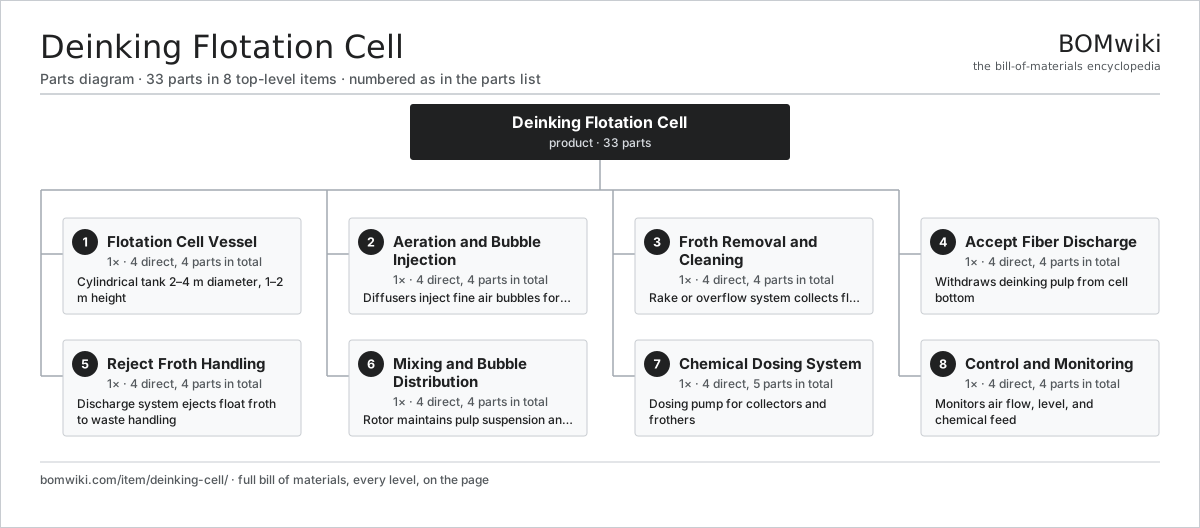
| # | Part | Qty | What it does |
|---|---|---|---|
| 1 | Flotation Cell Vessel 4 parts | 1× | Cylindrical tank 2–4 m diameter, 1–2 m height |
| 2 | Aeration and Bubble Injection 4 parts | 1× | Diffusers inject fine air bubbles for flotation |
| 3 | Froth Removal and Cleaning 4 parts | 1× | Rake or overflow system collects floating contaminants |
| 4 | Accept Fiber Discharge 4 parts | 1× | Withdraws deinking pulp from cell bottom |
| 5 | Reject Froth Handling 4 parts | 1× | Discharge system ejects float froth to waste handling |
| 6 | Mixing and Bubble Distribution 4 parts | 1× | Rotor maintains pulp suspension and bubble distribution |
| 7 | Chemical Dosing System 4 parts | 1× | Dosing pump for collectors and frothers |
| 8 | Control and Monitoring 4 parts | 1× | Monitors air flow, level, and chemical feed |
3D model
No 3D model yet. Have a CAD file of this? Add a 3D model. STL renders right on this page; STEP, FreeCAD, and OpenSCAD sources are welcome too (openly licensed, like all 3D models on BOMwiki).
Build & assembly graph
expand / collapse · shared sub-assemblies converge · links to related products · est. labourTap an assembly to expand/collapse · tap a part to open it · use “Open page” for any node · drag to pan, scroll to zoom.
Bill of materials for Deinking Flotation Cell
8 top-level lines · 40 rows shown · 33 parts total · indented to 3 levels| # | Item / sub-assembly | Part no. | Qty/assy | Ext. qty | Parts | Type |
|---|---|---|---|---|---|---|
| 1 | Flotation Cell Vessel 4 parts | deinking-cell-vessel | 1× | 1 | 4 | assembly |
| 1.1 | Steel Shell | deinking-cell-steel-shell | 1× | 1 | · | part |
| 1.2 | Bottom Drain Outlet | deinking-cell-bottom-drain | 1× | 1 | · | part |
| 1.3 | Reject Outlet | deinking-cell-reject-outlet | 1× | 1 | · | part |
| 1.4 | Access Hatch | deinking-cell-access-manhole | 1× | 1 | · | part |
| 2 | Aeration and Bubble Injection 4 parts | deinking-cell-aeration-system | 1× | 1 | 4 | assembly |
| 2.1 | Air Compressor | deinking-cell-air-compressor | 1× | 1 | · | part |
| 2.2 | Air Diffuser | deinking-cell-air-diffuser | 1× | 1 | · | part |
| 2.3 | Air Flowmeter | deinking-cell-air-flowmeter | 1× | 1 | · | part |
| 2.4 | Air Valve Control | deinking-cell-bubble-regulation | 1× | 1 | · | part |
| 3 | Froth Removal and Cleaning 4 parts | deinking-cell-froth-removal | 1× | 1 | 4 | assembly |
| 3.1 | Froth Rake | deinking-cell-froth-rake | 1× | 1 | · | part |
| 3.2 | Rake Motor | deinking-cell-rake-motor | 1× | 1 | · | part |
| 3.3 | Froth Chute | deinking-cell-froth-chute | 1× | 1 | · | part |
| 3.4 | Overflow Weir | deinking-cell-overflow-weir | 1× | 1 | · | part |
| 4 | Accept Fiber Discharge 4 parts | deinking-cell-accept-piping | 1× | 1 | 4 | assembly |
| 4.1 | Accept Valve | deinking-cell-accept-valve | 1× | 1 | · | part |
| 4.2 | Accept Pump (Optional) | deinking-cell-accept-pump | 1× | 1 | · | part |
| 4.3 | Reject Weir | deinking-cell-reject-weir | 1× | 1 | · | part |
| 4.4 | Outlet Pipe | deinking-cell-outlet-pipe | 1× | 1 | · | part |
| 5 | Reject Froth Handling 4 parts | deinking-cell-reject-removal | 1× | 1 | 4 | assembly |
| 5.1 | Froth Thickener | deinking-cell-froth-thickener | 1× | 1 | · | part |
| 5.2 | Scavenger Cell (Optional) | deinking-cell-scavenger-tank | 1× | 1 | · | part |
| 5.3 | Reject Pump | deinking-cell-reject-pump | 1× | 1 | · | part |
| 5.4 | Reject Container | deinking-cell-reject-bin | 1× | 1 | · | part |
| 6 | Mixing and Bubble Distribution 4 parts | deinking-cell-mixing-impeller | 1× | 1 | 4 | assembly |
| 6.1 | Mixing Motor | deinking-cell-impeller-motor | 1× | 1 | · | part |
| 6.2 | Impeller Blade | deinking-cell-impeller-blade | 1× | 1 | · | part |
| 6.3 | Impeller Shaft | deinking-cell-impeller-shaft | 1× | 1 | · | part |
| 6.4 | Torque Monitor | deinking-cell-mixing-torque-monitor | 1× | 1 | · | part |
| 7 | Chemical Dosing System 4 parts | deinking-cell-chemical-system | 1× | 1 | 5 | assembly |
| 7.1 | Collector Tank | deinking-cell-collector-tank | 1× | 1 | · | part |
| 7.2 | Frother Tank | deinking-cell-frother-tank | 1× | 1 | · | part |
| 7.3 | Chemical Pump | deinking-cell-chemical-pump | 2× | 2 | · | part |
| 7.4 | Dosage Controller | deinking-cell-dosage-controller | 1× | 1 | · | part |
| 8 | Control and Monitoring 4 parts | deinking-cell-control-system | 1× | 1 | 4 | assembly |
| 8.1 | Air Flowmeter | deinking-cell-air-flowmeter | 1× | 1 | · | part |
| 8.2 | Level Sensor | deinking-cell-level-sensor | 1× | 1 | · | part |
| 8.3 | Consistency Controller | deinking-cell-consistency-controller | 1× | 1 | · | part |
| 8.4 | Deinking PLC | deinking-cell-plc | 1× | 1 | · | part |
Something wrong in this list? Report a problem with this BOM.
Sourcing: possible vendors
Browse the supplier directory → Prices, MOQ, and lead times are algorithmic estimates, not quotes, and not claims about these companies. Company mappings are curated by keyword; est. price band $5k–$2M. How estimates work| Vendor | HQ | Specialty | MOQ | Lead time |
|---|---|---|---|---|
| atlascopco.com ↗ | Stockholm, SE | Compressors & industrial | 10 units | 12–20 wks |
|
🇦🇹Andritz
andritz.com ↗
|
Graz, AT | Process plants & machinery | 10 units | 12–20 wks |
| buhlergroup.com ↗ | Uzwil, CH | Food & materials processing | 10 units | 12–20 wks |
| gea.com ↗ | Düsseldorf, DE | Process technology | 10 units | 12–20 wks |
| mhi.com ↗ | Tokyo, JP | Heavy machinery | 10 units | 12–20 wks |
1,189-word article