Dental CAD/CAM Mill
ProductOverview
Dental CAD/CAM mills are computer-controlled precision milling machines that shape pre-milled ceramic or composite blanks into final restorations, crowns, inlays, onlays, and bridges, directly from digital scans and design files. Unlike manually machined restorations, CAD/CAM mills operate in closed-loop feedback with motion controllers, achieving submicron positioning accuracy and repeatable fit. They sit at the intersection of scanners and furnaces in the digital dental workflow.
The machine combines a high-speed rotating Milling Spindle (typically 20,000–60,000 rpm) with a rigid Multi-Axis Stage that moves workpieces through three linear axes and sometimes a rotary axis. A Tool Changer Assembly magazine holds multiple burs and mills, allowing the controller to swap tools mid-cycle without operator intervention. Cooling and Evacuation System delivers coolant directly to the cutting edge, removing chips and heat; a Vacuum and Chip Recovery system then separates chips from coolant for reuse or disposal.
The Motion Controller interprets CAM toolpaths generated from design software and converts them to stepper or servo motor commands, managing spindle speed, feed rates, and tool changes in real time. Closed-loop Encoder feedback on Axis Motor ensures positioning repeatability even as tool wear accumulates.
How It Works
Blank Preparation. A ceramic or composite disc (blank) is seated in the Blank Clamp Assembly and clamped pneumatically. The blank originates from an industrial press or 3D printer and is typically pre-sintered to near-final density.
Digital Toolpath. A technician imports a scan (intraoral scan, lab scanner, or CBCT) into design software, traces the missing tooth anatomy, and generates a toolpath. The software calculates depth of cut, feed rate, and tool changes to minimize milling time while avoiding blank chipping.
Spindle and Tool Swap. The Spindle Motor spins up to the commanded speed. The Tool Changer Assembly arm retrieves the first tool from the magazine and inserts it into the Spindle Collet. Inductive Tool Sensor feedback confirms tool presence before milling begins.
Milling Cycle. The Multi-Axis Stage moves the clamped blank under the spinning tool following the CAM toolpath. Ball Bearing carriages enable smooth motion; Ball Screw drives convert motor rotation to linear displacement. Feedback Encoder signals close the loop, correcting any position drift. The Coolant Pump sprays coolant mist, and the Chip Separator separator continuously drains chips, keeping coolant clean.
Tool Changes. When the toolpath calls for a new tool, the spindle retracts, slows, and the Tool Changer Assembly swaps burs. The carousel rotates to index the next tool; the gripper arm retrieves and inserts it in under 10 seconds.
Finishing. Once milling is complete, the Milling Frame enclosure opens (after spindle halt), and the milled restoration is unloaded. If sintering is required (zirconia), the restoration moves to a Zirconia Sintering Furnace for full-density conversion. If already fired, it goes directly to Dental Porcelain Furnace staining and glaze.
Material Science
Dental milling blanks are engineered for machinability and strength. Zirconia blanks (yttria-tetragonal zirconia polycrystalline, Y-TZP) are pre-sintered to ~90% density, allowing milling before final sintering; this avoids tool wear from fully dense zirconia. Lithium disilicate (glass-ceramic) blanks are fully sintered and can be milled directly to final form. Polymer and composite blanks are softer and mill faster but generate more heat, requiring faster feed rates and frequent coolant circulation.
Tool wear is the primary limiting factor. Carbide and diamond-coated burs remain sharp for hundreds of restorations under wet cooling; dry milling reduces tool life by 50–70%. The Cooling and Evacuation System system is not optional, it extends spindle and tool life and dramatically improves surface finish.
Clinical Workflow
In a dental lab, a single CAD/CAM mill may produce 30–50 restorations per day, depending on complexity. An intraoral scanner or cone-beam CT generates the digital design in minutes; milling takes 5–15 minutes per unit. In chairside systems (less common), a milling unit sits in the operatory, and a restoration is milled during a single appointment, reducing patient wait time to under an hour.
Integration Points
- Input: Dental 3D Printer scanners and intraoral scan data (STL format)
- Output: Milled blank → Dental Porcelain Furnace for stain/glaze or Zirconia Sintering Furnace for full density
- Consumables: Coolant, ceramic blanks, burs, and replacement Vice Jaws
Precision and Limits
Positioning accuracy of ±0.025 mm is sufficient for crowns and bridges, where occlusal contact tolerance is ±0.1 mm. Smaller units achieve ±0.01 mm, but diminishing returns apply, dental fit is limited by scan registration error and underlying tooth anatomy, not milling precision. Larger units may relax tolerance to ±0.05 mm to maximize spindle life and reduce cycle time.
Dental CAD/CAM Mill parts and their functions
8 top-level parts · 50 parts in total · full bill of materials below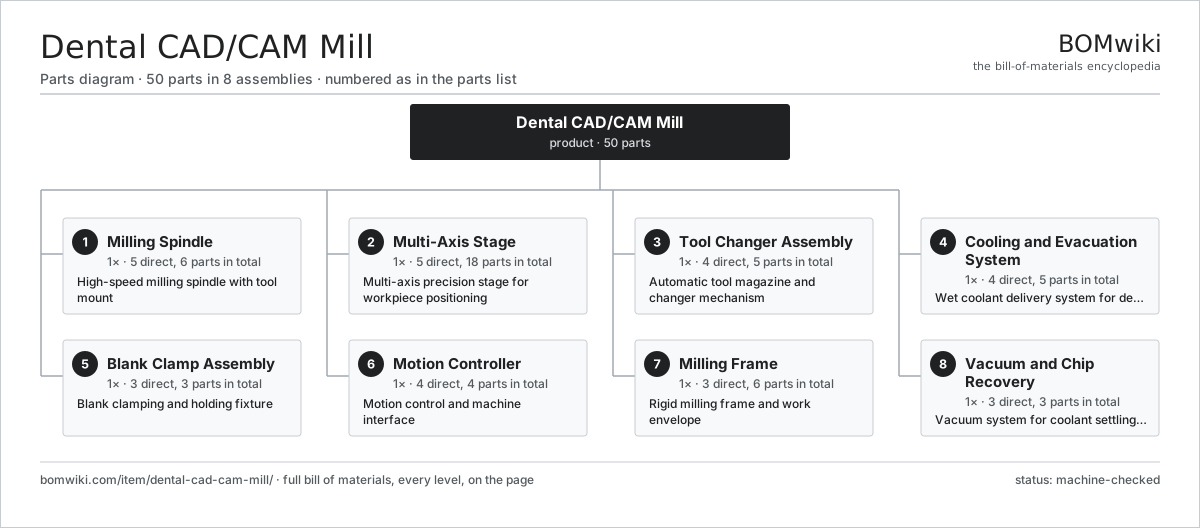
| # | Part | Qty | What it does |
|---|---|---|---|
| 1 | Milling Spindle 5 parts | 1× | High-speed milling spindle with tool mount |
| 2 | Multi-Axis Stage 5 parts | 1× | Multi-axis precision stage for workpiece positioning |
| 3 | Tool Changer Assembly 4 parts | 1× | Automatic tool magazine and changer mechanism |
| 4 | Cooling and Evacuation System 4 parts | 1× | Wet coolant delivery system for debris removal |
| 5 | Blank Clamp Assembly 3 parts | 1× | Blank clamping and holding fixture |
| 6 | Motion Controller 4 parts | 1× | Motion control and machine interface |
| 7 | Milling Frame 3 parts | 1× | Rigid milling frame and work envelope |
| 8 | Vacuum and Chip Recovery 3 parts | 1× | Vacuum system for coolant settling and chip collection |
3D model
No 3D model yet. Have a CAD file of this? Add a 3D model — STL renders right on this page; STEP, FreeCAD, and OpenSCAD sources are welcome too (openly licensed, like all 3D models on BOMwiki).
Build & assembly graph
expand / collapse · shared sub-assemblies converge · links to related products · est. labourTap an assembly to expand/collapse · tap a part to open it · use “Open page” for any node · drag to pan, scroll to zoom.
Bill of materials for Dental CAD/CAM Mill
8 top-level lines · 39 rows shown · 50 parts total · indented to 3 levels| # | Item / sub-assembly | Part no. | Qty/assy | Ext. qty | Parts | Type |
|---|---|---|---|---|---|---|
| 1 | Milling Spindle 5 parts | dental-cad-cam-mill-spindle | 1× | 1 | 6 | assembly |
| 1.1 | Spindle Motor | dental-cad-cam-mill-spindle-motor | 1× | 1 | · | part |
| 1.2 | Spindle Bearing Pair | dental-cad-cam-mill-spindle-bearings | 2× | 2 | · | part |
| 1.3 | Spindle Collet | dental-cad-cam-mill-spindle-collet | 1× | 1 | · | part |
| 1.4 | Spindle Drive Transmission | dental-cad-cam-mill-spindle-drive | 1× | 1 | · | part |
| 1.5 | Thermal Fuse | thermal-fuse | 1× | 1 | · | part |
| 2 | Multi-Axis Stage 5 parts | dental-cad-cam-mill-xy-stage | 1× | 1 | 18 | assembly |
| 2.1 | Stage Base Plate | dental-cad-cam-mill-xy-stage-base | 1× | 1 | · | part |
| 2.2 | Ball Screw Assembly | dental-cad-cam-mill-xy-stage-screws | 3× | 3 | · | part |
| 2.3 | Axis Motor | dental-cad-cam-mill-xy-stage-motors | 3× | 3 | · | part |
| 2.4 | Ball Bearing | ball-bearing | 8× | 8 | · | part |
| 2.5 | Encoder | encoder | 3× | 3 | · | part |
| 3 | Tool Changer Assembly 4 parts | dental-cad-cam-mill-tool-changer | 1× | 1 | 5 | assembly |
| 3.1 | Tool Magazine | dental-cad-cam-mill-tool-changer-magazine | 1× | 1 | · | part |
| 3.2 | Gripper Arm | dental-cad-cam-mill-tool-changer-arm | 1× | 1 | · | part |
| 3.3 | Solenoid Valve | dental-cad-cam-mill-tool-changer-solenoid | 2× | 2 | · | part |
| 3.4 | Tool Sensor | dental-cad-cam-mill-tool-changer-sensor | 1× | 1 | · | part |
| 4 | Cooling and Evacuation System 4 parts | dental-cad-cam-mill-cooling | 1× | 1 | 5 | assembly |
| 4.1 | Coolant Pump | dental-cad-cam-mill-cooling-pump | 1× | 1 | · | part |
| 4.2 | Coolant Nozzle Assembly | dental-cad-cam-mill-cooling-nozzles | 2× | 2 | · | part |
| 4.3 | Coolant Tank | dental-cad-cam-mill-cooling-tank | 1× | 1 | · | part |
| 4.4 | Chip Separator | dental-cad-cam-mill-cooling-recovery | 1× | 1 | · | part |
| 5 | Blank Clamp Assembly 3 parts | dental-cad-cam-mill-vise | 1× | 1 | 3 | assembly |
| 5.1 | Vice Jaws | dental-cad-cam-mill-vise-jaws | 1× | 1 | · | part |
| 5.2 | Clamping Cylinder | dental-cad-cam-mill-vise-cylinder | 1× | 1 | · | part |
| 5.3 | Quick-Change Plate | dental-cad-cam-mill-vise-quick-release | 1× | 1 | · | part |
| 6 | Motion Controller 4 parts | dental-cad-cam-mill-controller | 1× | 1 | 4 | assembly |
| 6.1 | Milling Controller PC | dental-cad-cam-mill-controller-pc | 1× | 1 | · | part |
| 6.2 | Motor Driver Board | dental-cad-cam-mill-controller-drivers | 1× | 1 | · | part |
| 6.3 | Control I/O Board | dental-cad-cam-mill-controller-io | 1× | 1 | · | part |
| 6.4 | Power Supply | power-supply | 1× | 1 | · | part |
| 7 | Milling Frame 3 parts | dental-cad-cam-mill-frame | 1× | 1 | 6 | assembly |
| 7.1 | Frame Casting | dental-cad-cam-mill-frame-casting | 1× | 1 | · | part |
| 7.2 | Safety Enclosure | dental-cad-cam-mill-frame-cover | 1× | 1 | · | part |
| 7.3 | Isolation Feet | dental-cad-cam-mill-frame-feet | 4× | 4 | · | part |
| 8 | Vacuum and Chip Recovery 3 parts | dental-cad-cam-mill-vacuum | 1× | 1 | 3 | assembly |
| 8.1 | Vacuum Motor | dental-cad-cam-mill-vacuum-motor | 1× | 1 | · | part |
| 8.2 | Vacuum Tank | dental-cad-cam-mill-vacuum-tank | 1× | 1 | · | part |
| 8.3 | Vacuum Tubing Assembly | dental-cad-cam-mill-vacuum-lines | 1× | 1 | · | part |
Related products
same domain, ranked by shared parts Panoramic Dental X-Ray
507 parts · shares 4 with this page
Veterinary Surgical Table
286 parts · shares 4 with this page
Veterinary Hydrotherapy Treadmill
249 parts · shares 2 with this page
Veterinary Clipper
178 parts · shares 3 with this page
Panoramic Dental X-Ray
507 parts · shares 4 with this page
Veterinary Surgical Table
286 parts · shares 4 with this page
Veterinary Hydrotherapy Treadmill
249 parts · shares 2 with this page
Veterinary Clipper
178 parts · shares 3 with this page
 Dental Diode Laser
441 parts · shares 2 with this page
Pet Incubator
41 parts · shares 2 with this page
Dental Diode Laser
441 parts · shares 2 with this page
Pet Incubator
41 parts · shares 2 with this page
Sourcing: possible vendors
Prices, MOQ, and lead times are algorithmic estimates, not quotes, and not claims about these companies. Company mappings are curated by keyword; est. price band $200–$200k. How estimates work| Vendor | HQ | Specialty | MOQ | Lead time |
|---|---|---|---|---|
| dentsplysirona.com ↗ | Charlotte, US | Dental equipment | 100 units | 10–16 wks |
|
🇺🇸Envista
envistaco.com ↗
|
Brea, US | Dental (KaVo, Nobel) | 100 units | 10–16 wks |
|
🇫🇮Planmeca
planmeca.com ↗
|
Helsinki, FI | Dental units & imaging | 100 units | 10–16 wks |
|
🇺🇸A-dec
a-dec.com ↗
|
Newberg, US | Dental chairs & delivery | 100 units | 10–16 wks |
|
🇺🇸Midmark
midmark.com ↗
|
Versailles, US | Medical & veterinary equipment | 100 units | 10–16 wks |
828-word article