Dental Oil-Free Compressor
ProductOverview
Compressed air drives almost everything at a dental chair: turbine handpieces spin on it, the air-water syringe sprays with it, and suction venturis and instrument chip-blow draw from it. Because this air is discharged into the patient's open mouth and into surgical sites, it is treated as a medical consumable. EN ISO 22052 requires it to be oil-free, dry, and filtered, a trace of compressor oil in the airstream ruins composite and cement adhesion and contaminates the mucosa, and moist air corrodes handpiece bearings and grows biofilm in the unit's tubing. The dental compressor therefore differs from an industrial workshop unit in three ways: dry-running pump heads with no oil anywhere in the machine, an integrated dryer holding the pressure dewpoint near −20 °C, and an internally coated receiver.
The architecture is two independent Oil-Free Pump Unit heads feeding one Receiver Tank through the Membrane Drying System, all governed by the Control & Monitoring and packaged in a Soundproof Cabinet quiet enough to install inside the practice.
Oil-free compression
Each pump unit is a twin-cylinder reciprocating compressor driven directly by its Pump Drive Motor. There is no oil sump: the Dry-Running Piston carries self-lubricating PTFE-compound rings running on the hard-anodized bore of the Coated Cylinder, and the crankshaft turns in sealed grease-for-life Ball Bearings inside the Crankcase. Air enters through the Intake Air Filter and Intake Silencer, is compressed in one stroke per cylinder through the reed-type Valve Plate, and leaves at up to 180 °C. Dry-running rings tolerate no help from oil films, so thermal management is strict: the Cooling Fan Wheel on the motor shaft blows across the cylinder fins, the Discharge Cooling Line finned line drops the discharge temperature ahead of the dryer, and a Head Temperature Probe on each head lets the controller stop a pump that exceeds its limit. Ring wear sets the overhaul interval, typically 2,500–5,000 run hours, tracked by the Run-Hour Meter.
Drying
Cooling compressed air condenses its moisture, and a receiver full of warm condensate is a corrosion and microbiology problem, so drying happens before storage. The membrane dryer is passive and silent: after the Coalescing Pre-Filter removes liquid droplets and particles down to 0.01 µm, the air flows through the Hollow-Fiber Membrane Cartridge, a bundle of hollow fibers whose walls pass water vapor far more readily than air. A Purge Sweep Orifice bleeds 10–15% of the dried product air back along the outside of the fibers as a low-pressure sweep that carries the permeated moisture out of the cabinet. The result is a pressure dewpoint around −20 °C, no liquid water can form anywhere downstream at room temperature, at the cost of the purge flow, which is why dental compressors are rated by net delivery after drying. The Condensate Trap drains what the pre-filter catches; alternative designs use a twin-tower adsorption dryer, but the membrane type has no desiccant to replace.
Storage, control, delivery
Dry air accumulates in the Coated Tank Shell, a 50-liter welded vessel certified under the Pressure Equipment Directive and internally epoxy-coated so the wall can neither rust nor harbor growth. A Safety Relief Valve relieves just above the 10 bar maximum, the Tank Pressure Gauge gives indication independent of the electronics, and a Condensate Drain Valve at the low point handles any residual condensate.
The Compressor Control Board cycles the heads in a 6–8 bar band read from the tank Pressure Sensor, starting both for fast recovery and alternating lead duty so the two Oil-Free Pump Units accumulate hours evenly, and so the practice keeps running, at reduced capacity, if one head fails. A mechanical Mechanical Pressure Switch backs up the electronics with a hard cut-out, and Relay contactors switch the motors. Sizing follows demand: roughly 50 NL/min per treatment unit, so the twin-head 130 NL/min machine carries two to three chairs at a 60–70% duty cycle.
Air leaves through the Outlet & Delivery group: the Outlet Pressure Regulator sets the ring main to 5–5.5 bar, the Final Sterile Filter adds a final 0.01 µm membrane barrier, and the Outlet Isolation Valve isolates the machine for service.
Noise
A bare twin-head piston compressor radiates about 70 dB(A), unacceptable next to an operatory. The Cabinet Shell, lined with Acoustic Foam Lining and ventilated by a Blower Motor through baffled Labyrinth Vent Ducts that pass air but not the direct sound path, brings this to roughly 52 dB(A), conversation level. The pumps sit on Vibration Isolator Mounts so structure-borne noise does not bypass the acoustic treatment through the floor.
Dental Oil-Free Compressor parts and their functions
7 top-level parts · 208 parts in total · full bill of materials below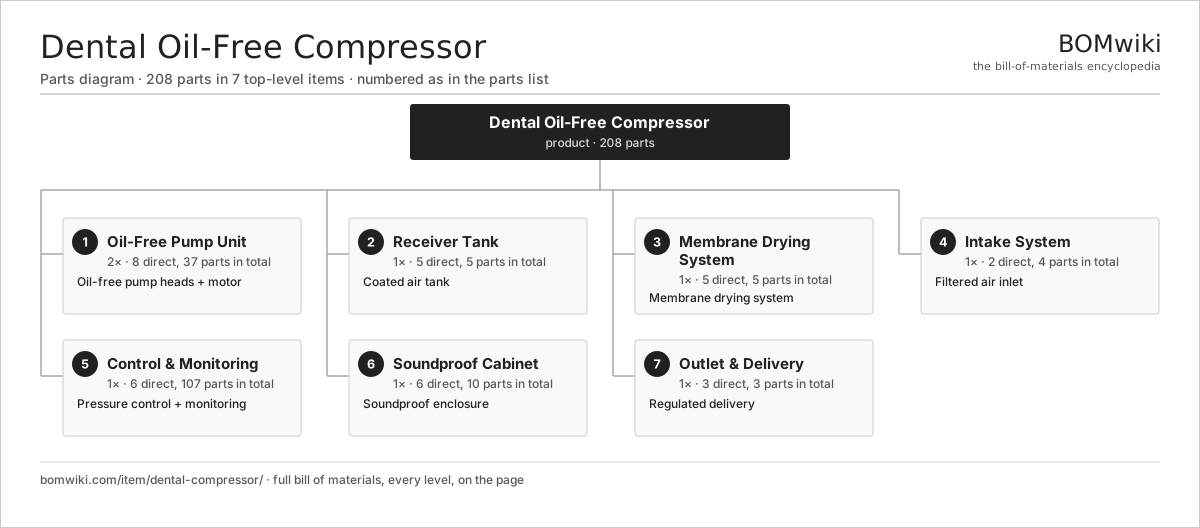
| # | Part | Qty | What it does |
|---|---|---|---|
| 1 | Oil-Free Pump Unit 8 parts | 2× | Oil-free pump heads + motor |
| 2 | Receiver Tank 5 parts | 1× | Coated air tank |
| 3 | Membrane Drying System 5 parts | 1× | Membrane drying system |
| 4 | Intake System 2 parts | 1× | Filtered air inlet |
| 5 | Control & Monitoring 6 parts | 1× | Pressure control + monitoring |
| 6 | Soundproof Cabinet 6 parts | 1× | Soundproof enclosure |
| 7 | Outlet & Delivery 3 parts | 1× | Regulated delivery |
3D model
No 3D model yet. Have a CAD file of this? Add a 3D model. STL renders right on this page; STEP, FreeCAD, and OpenSCAD sources are welcome too (openly licensed, like all 3D models on BOMwiki).
Build & assembly graph
expand / collapse · shared sub-assemblies converge · links to related products · est. labourTap an assembly to expand/collapse · tap a part to open it · use “Open page” for any node · drag to pan, scroll to zoom.
Bill of materials for Dental Oil-Free Compressor
7 top-level lines · 51 rows shown · 208 parts total · indented to 3 levels| # | Item / sub-assembly | Part no. | Qty/assy | Ext. qty | Parts | Type |
|---|---|---|---|---|---|---|
| 1 | Oil-Free Pump Unit 8 parts | dental-compressor-pump-unit | 2× | 2 | 37 | assembly |
| 1.1 | Coated Cylinder | dental-compressor-cylinder | 2× | 4 | · | part |
| 1.2 | Dry-Running Piston | dental-compressor-piston | 2× | 4 | · | part |
| 1.3 | Valve Plate | dental-compressor-valve-plate | 2× | 4 | · | part |
| 1.4 | Crankcase | dental-compressor-crankcase | 1× | 2 | · | part |
| 1.5 | Pump Drive Motor 5 parts | dental-compressor-pump-motor | 1× | 2 | 26 | assembly |
| 1.5.1 | Stator Assembly 3 parts + deeper › | stator-assembly | 1× | 2 | 3 | assembly |
| 1.5.2 | Rotor Assembly 4 parts + deeper › | rotor-assembly | 1× | 2 | 19 | assembly |
| 1.5.3 | Motor Housing | motor-housing | 1× | 2 | · | part |
| 1.5.4 | Ball Bearing | ball-bearing | 2× | 4 | · | part |
| 1.5.5 | Cooling Fan Wheel | dental-compressor-fan-wheel | 1× | 2 | · | part |
| 1.6 | Discharge Cooling Line | dental-compressor-head-cooler | 1× | 2 | · | part |
| 1.7 | Ball Bearing | ball-bearing | 2× | 4 | · | part |
| 1.8 | Fastener Set | fastener-set | 1× | 2 | · | part |
| 2 | Receiver Tank 5 parts | dental-compressor-receiver | 1× | 1 | 5 | assembly |
| 2.1 | Coated Tank Shell | dental-compressor-tank-shell | 1× | 1 | · | part |
| 2.2 | Safety Relief Valve | dental-compressor-safety-valve | 1× | 1 | · | part |
| 2.3 | Condensate Drain Valve | dental-compressor-drain-valve | 1× | 1 | · | part |
| 2.4 | Tank Pressure Gauge | dental-compressor-tank-gauge | 1× | 1 | · | part |
| 2.5 | Pressure Sensor | pressure-sensor | 1× | 1 | · | part |
| 3 | Membrane Drying System 5 parts | dental-compressor-dryer | 1× | 1 | 5 | assembly |
| 3.1 | Hollow-Fiber Membrane Cartridge | dental-compressor-membrane-cartridge | 1× | 1 | · | part |
| 3.2 | Coalescing Pre-Filter | dental-compressor-coalescing-filter | 1× | 1 | · | part |
| 3.3 | Purge Sweep Orifice | dental-compressor-purge-orifice | 1× | 1 | · | part |
| 3.4 | Condensate Trap | dental-compressor-condensate-trap | 1× | 1 | · | part |
| 3.5 | O-Ring Set | oring-set | 1× | 1 | · | part |
| 4 | Intake System 2 parts | dental-compressor-intake | 1× | 1 | 4 | assembly |
| 4.1 | Intake Air Filter | dental-compressor-intake-filter | 2× | 2 | · | part |
| 4.2 | Intake Silencer | dental-compressor-intake-silencer | 2× | 2 | · | part |
| 5 | Control & Monitoring 6 parts | dental-compressor-controls | 1× | 1 | 107 | assembly |
| 5.1 | Compressor Control Board 4 parts | dental-compressor-control-board | 1× | 1 | 100 | assembly |
| 5.1.1 | Bare PCB | pcb-bare | 1× | 1 | · | part |
| 5.1.2 | Microcontroller | mcu | 1× | 1 | · | part |
| 5.1.3 | SMD Passive (R/C/L) | smd-passives | 90× | 90 | · | part |
| 5.1.4 | Connector | connector | 8× | 8 | · | part |
| 5.2 | Mechanical Pressure Switch | dental-compressor-pressure-switch | 1× | 1 | · | part |
| 5.3 | Relay | relay | 2× | 2 | · | part |
| 5.4 | Head Temperature Probe | dental-compressor-temp-probe | 2× | 2 | · | part |
| 5.5 | Run-Hour Meter | dental-compressor-hour-meter | 1× | 1 | · | part |
| 5.6 | Wire Bundle | wire-bundle | 1× | 1 | · | part |
| 6 | Soundproof Cabinet 6 parts | dental-compressor-cabinet | 1× | 1 | 10 | assembly |
| 6.1 | Cabinet Shell | dental-compressor-cabinet-shell | 1× | 1 | · | part |
| 6.2 | Acoustic Foam Lining | dental-compressor-acoustic-foam | 1× | 1 | · | part |
| 6.3 | Blower Motor | blower-motor | 1× | 1 | · | part |
| 6.4 | Labyrinth Vent Duct | dental-compressor-vent-duct | 2× | 2 | · | part |
| 6.5 | Vibration Isolator Mount | dental-compressor-vibration-mount | 4× | 4 | · | part |
| 6.6 | Fastener Set | fastener-set | 1× | 1 | · | part |
| 7 | Outlet & Delivery 3 parts | dental-compressor-outlet | 1× | 1 | 3 | assembly |
| 7.1 | Outlet Pressure Regulator | dental-compressor-outlet-regulator | 1× | 1 | · | part |
| 7.2 | Final Sterile Filter | dental-compressor-sterile-filter | 1× | 1 | · | part |
| 7.3 | Outlet Isolation Valve | dental-compressor-outlet-valve | 1× | 1 | · | part |
Something wrong in this list? Report a problem with this BOM.
Related products
same domain, ranked by shared parts Dental Suction Pump
58 parts · shares 14 with this page
Veterinary Hydrotherapy Treadmill
249 parts · shares 13 with this page
Dental Milling Machine
443 parts · shares 13 with this page
Veterinary Anesthesia Machine
357 parts · shares 13 with this page
Dental Suction Pump
58 parts · shares 14 with this page
Veterinary Hydrotherapy Treadmill
249 parts · shares 13 with this page
Dental Milling Machine
443 parts · shares 13 with this page
Veterinary Anesthesia Machine
357 parts · shares 13 with this page
 Dental Chair Unit
202 parts · shares 13 with this page
Dental Chair Unit
202 parts · shares 13 with this page
Sourcing: possible vendors
Browse the supplier directory → Prices, MOQ, and lead times are algorithmic estimates, not quotes, and not claims about these companies. Company mappings are curated by keyword; est. price band $200–$200k. How estimates work| Vendor | HQ | Specialty | MOQ | Lead time |
|---|---|---|---|---|
| dentsplysirona.com ↗ | Charlotte, US | Dental equipment | 100 units | 10–16 wks |
|
🇺🇸Envista
envistaco.com ↗
|
Brea, US | Dental (KaVo, Nobel) | 100 units | 10–16 wks |
|
🇫🇮Planmeca
planmeca.com ↗
|
Helsinki, FI | Dental units & imaging | 100 units | 10–16 wks |
|
🇺🇸A-dec
a-dec.com ↗
|
Newberg, US | Dental chairs & delivery | 100 units | 10–16 wks |
|
🇺🇸Midmark
midmark.com ↗
|
Versailles, US | Medical & veterinary equipment | 100 units | 10–16 wks |
832-word article