Zirconia Sintering Furnace
ProductOverview
A zirconia sintering furnace is a specialized high-temperature kiln for completing the conversion of zirconia dental restorations from partially sintered blanks (90% density, milled at the Dental CAD/CAM Mill) to fully sintered, ultra-strong crowns and bridges (99.5%+ density) at 1400–1600°C. This is the final firing step after Dental CAD/CAM Mill milling and before Dental Porcelain Furnace staining.
The furnace operates at temperatures far higher than a Dental Porcelain Furnace. At these extreme temperatures, zirconia atoms diffuse across grain boundaries and bond at the atomic scale, a process called solid-state sintering. This eliminates porosity, increases density by 10%, and boosts strength by 40–50% compared to pre-sintered blanks. MoSi2 or tungsten Heating Element Assembly elements withstand 1600°C in pure oxygen; a controlled Atmosphere Control System prevents rapid oxidation and thermal shock. The Controlled Cool-Down System system ensures slow, predictable cool-down, avoiding cracks.
How It Works
Blank Preparation. Pre-sintered zirconia crowns or bridges from the Dental CAD/CAM Mill are placed on Ceramic Stilts inside a high-purity alumina Crucible Bowl. The crucible may hold 10–30 restorations. A Crucible Lid covers the crucible to minimize surface oxidation.
Program Selection. The Advanced Temperature Controller is set to a sintering program, typically:
- Ramp 8°C/min to 1450°C
- Hold 3 hours at 1450°C
- Cool 2°C/min down to 1000°C (passive and active)
- Cool to room temperature (overnight passive cooling)
Heating Phase. The MoSi2 Heating Coil MoSi2 resistor is energized via a Thyristor Power Module high-voltage switch. The Type R Thermocouple Type R sensor feeds back to the Control Processor, which uses PID feedback to modulate power, ramping temperature at the programmed rate. Oxygen from the Oxygen Regulator flows through the High-Temp Muffle Chamber at low pressure (0.5–5 bar gauge).
Sintering Dwell. Once 1450°C is reached, the Advanced Temperature Controller holds this temperature for 2–4 hours. Atoms in the zirconia lattice migrate slowly across grain boundaries. Smaller pores collapse and disappear. Grain growth occurs as larger grains consume neighbors, reducing surface area. Density increases from 90% to 99%+ of theoretical zirconia density (6.1 g/cm³).
Controlled Cool-Down. After the hold completes, the heating element is switched off. The Cooling Baffle initially limits natural convection. As temperature drops below 1000°C, the Air Damper Valve opens and the Cool-Down Blower engages, accelerating cool-down. The controller maintains a slow cool-down rate (2–3°C/min) to avoid rapid contraction, which would induce tensile stress and cracking. This phase takes 2–4 hours to reach room temperature.
Removal and Use. Once cool (checked by touch), the restorations are removed and inspected for warping or surface defects. Fully sintered zirconia is now hard enough to withstand milling (light re-finishing), grinding, and final seating with cement.
Material Science
Zirconia (zirconium dioxide, ZrO₂) transforms from a monoclinic crystal phase at room temperature to tetragonal at ~1170°C. The transformation changes density, which normally causes cracking (transformation toughening is lost). In yttria-stabilized zirconia (Y-TZP), small yttria (Y₂O₃) dopants suppress the transformation, locking the tetragonal phase throughout cooling. This metastable tetragonal phase is denser and stronger than monoclinic zirconia.
Pre-sintered blanks (machined from industrial presses) are ~90% density because they are fired at lower temperature (1000–1200°C) before shipping to labs. Milling at this density preserves tool life. Final sintering at 1400–1600°C completes the densification without dramatically shrinking (shrinkage is ~20% linear, pre-calculated by manufacturers).
Oxygen Atmosphere
Zirconia surfaces oxidize slightly at 1400°C in air, forming a thin surface film. For esthetic anterior restorations, pure oxygen (or air) is preferred, as it promotes a uniform, bright white surface. For posterior restorations, air (21% O₂) is acceptable and lower-cost. The Atmosphere Monitor monitors partial pressure; feedback to the controller adjusts gas flow.
Thermal Shock Prevention
Rapid cooling from 1600°C to room temperature induces thermal stress. Zirconia has a thermal expansion coefficient of ~10 × 10⁻⁶ K⁻¹; uncontrolled quenching creates tensile stress exceeding the fracture strength (~500 MPa bending stress), causing catastrophic failure. The controlled cool-down system ensures stress remains below 100–150 MPa, high enough for structural strength, low enough to avoid cracking.
Density and Strength
Pre-sintered blanks: ~4 GPa flexural modulus, ~600 MPa strength. Fully sintered Y-TZP: ~210 GPa modulus, ~1000+ MPa strength.
The strength boost is proportional to density; denser zirconia has fewer pores for stress concentration.
Cycle Time and Economics
A sintering cycle takes 10–16 hours total. In a busy lab, furnaces may run overnight and weekends, allowing 5–7 cycles per week per unit. A single furnace can complete 50–150 restorations per week, depending on batch size and furnace capacity.
Integration Points
- Input: Pre-sintered zirconia blanks from Dental CAD/CAM Mill milling
- Output: Fully sintered crowns and bridges → Dental Porcelain Furnace for staining and glaze, or directly to Dental Articulator for occlusal checking
- Reuse: Specimen Support Crucible and Ceramic Stilts are reused 50–100 times before disposal
Quality Control
Advanced furnaces log temperature and time to an SD card via the Data Logger Module. This traceability ensures each batch was fired to specification, critical for FDA compliance and patient confidence.
Safety
Operating furnace doors reach 100–200°C during cycling. Heavy insulation reduces exterior temperatures, but skin contact is still risky. All units include:
- Interlock door switch disabling heating when open
- Audible alarm for cycle completion
- Indicator light for heating status
- Emergency shutdown button
Operators are trained to allow specimens to cool at least 30 minutes before touching.
Zirconia Sintering Furnace parts and their functions
7 top-level parts · 35 parts in total · full bill of materials below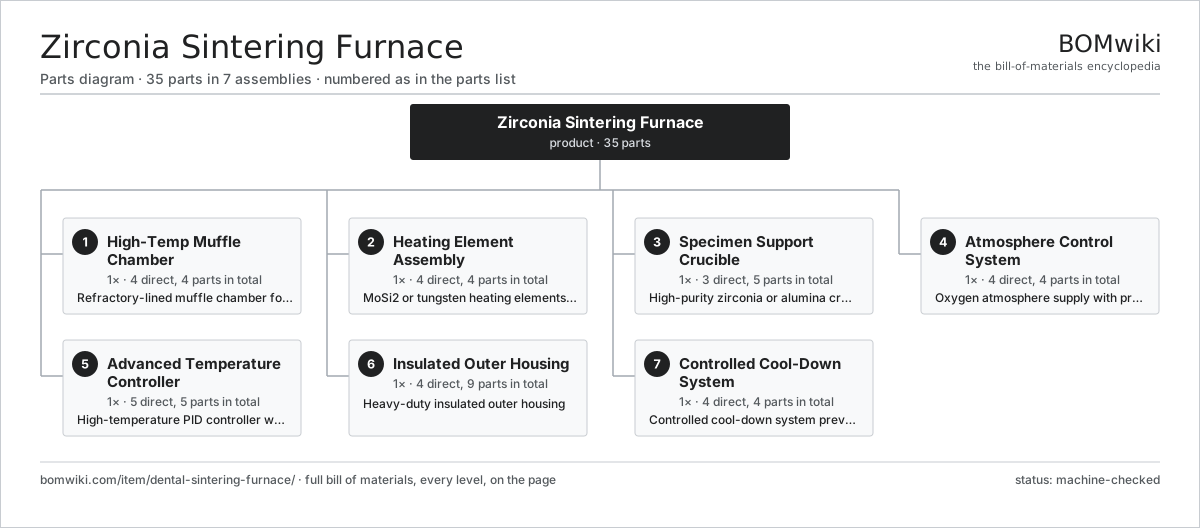
| # | Part | Qty | What it does |
|---|---|---|---|
| 1 | High-Temp Muffle Chamber 4 parts | 1× | Refractory-lined muffle chamber for 1400–1600°C operation |
| 2 | Heating Element Assembly 4 parts | 1× | MoSi2 or tungsten heating elements for ultra-high temperature |
| 3 | Specimen Support Crucible 3 parts | 1× | High-purity zirconia or alumina crucible for specimen support |
| 4 | Atmosphere Control System 4 parts | 1× | Oxygen atmosphere supply with pressure control |
| 5 | Advanced Temperature Controller 5 parts | 1× | High-temperature PID controller with advanced ramp profiles |
| 6 | Insulated Outer Housing 4 parts | 1× | Heavy-duty insulated outer housing |
| 7 | Controlled Cool-Down System 4 parts | 1× | Controlled cool-down system preventing thermal shock |
3D model
No 3D model yet. Have a CAD file of this? Add a 3D model — STL renders right on this page; STEP, FreeCAD, and OpenSCAD sources are welcome too (openly licensed, like all 3D models on BOMwiki).
Build & assembly graph
expand / collapse · shared sub-assemblies converge · links to related products · est. labourTap an assembly to expand/collapse · tap a part to open it · use “Open page” for any node · drag to pan, scroll to zoom.
Bill of materials for Zirconia Sintering Furnace
7 top-level lines · 35 rows shown · 35 parts total · indented to 3 levels| # | Item / sub-assembly | Part no. | Qty/assy | Ext. qty | Parts | Type |
|---|---|---|---|---|---|---|
| 1 | High-Temp Muffle Chamber 4 parts | dental-sintering-furnace-chamber | 1× | 1 | 4 | assembly |
| 1.1 | Muffle Tube | dental-sintering-furnace-chamber-muffle | 1× | 1 | · | part |
| 1.2 | Refractory Stack | dental-sintering-furnace-chamber-insulation | 1× | 1 | · | part |
| 1.3 | High-Temp Door | dental-sintering-furnace-chamber-door | 1× | 1 | · | part |
| 1.4 | Door Gasket Seal | dental-sintering-furnace-chamber-gasket | 1× | 1 | · | part |
| 2 | Heating Element Assembly 4 parts | dental-sintering-furnace-heating-element | 1× | 1 | 4 | assembly |
| 2.1 | MoSi2 Heating Coil | dental-sintering-furnace-heating-element-element | 1× | 1 | · | part |
| 2.2 | Element Support Frame | dental-sintering-furnace-heating-element-support | 1× | 1 | · | part |
| 2.3 | Lead Wire Terminal | dental-sintering-furnace-heating-element-terminal | 1× | 1 | · | part |
| 2.4 | Type R Thermocouple | dental-sintering-furnace-heating-element-thermocouple | 1× | 1 | · | part |
| 3 | Specimen Support Crucible 3 parts | dental-sintering-furnace-crucible | 1× | 1 | 5 | assembly |
| 3.1 | Crucible Bowl | dental-sintering-furnace-crucible-bowl | 1× | 1 | · | part |
| 3.2 | Ceramic Stilts | dental-sintering-furnace-crucible-stilts | 3× | 3 | · | part |
| 3.3 | Crucible Lid | dental-sintering-furnace-crucible-lid | 1× | 1 | · | part |
| 4 | Atmosphere Control System 4 parts | dental-sintering-furnace-atmosphere | 1× | 1 | 4 | assembly |
| 4.1 | Oxygen Regulator | dental-sintering-furnace-atmosphere-regulator | 1× | 1 | · | part |
| 4.2 | Gas Delivery Lines | dental-sintering-furnace-atmosphere-lines | 1× | 1 | · | part |
| 4.3 | Exhaust Vent | dental-sintering-furnace-atmosphere-vent | 1× | 1 | · | part |
| 4.4 | Atmosphere Monitor | dental-sintering-furnace-atmosphere-sensor | 1× | 1 | · | part |
| 5 | Advanced Temperature Controller 5 parts | dental-sintering-furnace-controller | 1× | 1 | 5 | assembly |
| 5.1 | Control Processor | dental-sintering-furnace-controller-processor | 1× | 1 | · | part |
| 5.2 | Thyristor Power Module | dental-sintering-furnace-controller-thyristor | 1× | 1 | · | part |
| 5.3 | Touchscreen Display | dental-sintering-furnace-controller-display | 1× | 1 | · | part |
| 5.4 | I/O Control Board | dental-sintering-furnace-controller-io | 1× | 1 | · | part |
| 5.5 | Data Logger Module | dental-sintering-furnace-controller-data-logger | 1× | 1 | · | part |
| 6 | Insulated Outer Housing 4 parts | dental-sintering-furnace-frame | 1× | 1 | 9 | assembly |
| 6.1 | Steel Chassis | dental-sintering-furnace-frame-steel | 1× | 1 | · | part |
| 6.2 | Exterior Insulation Wrap | dental-sintering-furnace-frame-insulation | 1× | 1 | · | part |
| 6.3 | Support Feet | dental-sintering-furnace-frame-feet | 6× | 6 | · | part |
| 6.4 | Door Handle Assembly | dental-sintering-furnace-frame-handle | 1× | 1 | · | part |
| 7 | Controlled Cool-Down System 4 parts | dental-sintering-furnace-cooling | 1× | 1 | 4 | assembly |
| 7.1 | Cooling Baffle | dental-sintering-furnace-cooling-baffle | 1× | 1 | · | part |
| 7.2 | Cool-Down Blower | dental-sintering-furnace-cooling-fan | 1× | 1 | · | part |
| 7.3 | Air Damper Valve | dental-sintering-furnace-cooling-damper | 1× | 1 | · | part |
| 7.4 | Cool-Down Trigger Sensor | dental-sintering-furnace-cooling-sensor | 1× | 1 | · | part |
Sourcing: possible vendors
Prices, MOQ, and lead times are algorithmic estimates, not quotes, and not claims about these companies. Company mappings are curated by keyword; est. price band $200–$200k. How estimates work| Vendor | HQ | Specialty | MOQ | Lead time |
|---|---|---|---|---|
| dentsplysirona.com ↗ | Charlotte, US | Dental equipment | 100 units | 10–16 wks |
|
🇺🇸Envista
envistaco.com ↗
|
Brea, US | Dental (KaVo, Nobel) | 100 units | 10–16 wks |
|
🇫🇮Planmeca
planmeca.com ↗
|
Helsinki, FI | Dental units & imaging | 100 units | 10–16 wks |
|
🇺🇸A-dec
a-dec.com ↗
|
Newberg, US | Dental chairs & delivery | 100 units | 10–16 wks |
|
🇺🇸Midmark
midmark.com ↗
|
Versailles, US | Medical & veterinary equipment | 100 units | 10–16 wks |
978-word article