Deployable Solar Array Wing
ProductOverview
A deployable solar array is the primary power generation system for most space platforms, from small satellites to large space stations. The system faces a fundamental constraint: launch vehicle fairings and structural envelopes severely limit the size and shape of cargo. A spacecraft requiring 20 kW of solar power cannot fit a stationary 80 m² panel inside a 3–4 m diameter fairing. The solution is to design the array to compress into a small stowed footprint, then unfold in orbit via deployment mechanisms.
The Deployable Solar Array Wing comprises two symmetric wings, each containing dozens to hundreds of individual photovoltaic cells wired in series-parallel strings. Each wing is mechanically stowed by Stowage and Restraint System launch locks, then deployed on orbit by a Deployment Drive Motor that extends a Deployment Boom and unfolds the Panel Hinges and Gears accordion-folded panel segments. Once deployed, the entire array is mounted on a Gimbal Yoke Assembly gimbal that tracks the sun on two axes, maximizing incident solar power throughout the mission.
Mechanical architecture: stowage and deployment
In the stowed configuration, each solar array wing is folded into an accordion-like bundle, with the outermost panel segments lying face-to-face along the boom. The panel bundle is held in this compressed state by Stowage and Restraint System, typically a mechanical Launch Lock pin and a Restraint Strap band that cinches the panels together.
The Deployment Boom is a telescoping or multi-segment structure (usually aluminum or carbon-composite tubing) that is retracted and latched by a mechanical Boom Latch during launch. A Boom Extension Spring is pre-compressed within the boom, storing elastic energy to assist extension.
On orbit, following the spacecraft's main antenna deployment and other critical early sequencing, the flight computer sends a deployment command to the Deployment Drive Motor. This Drive Motor (typically a brushless DC motor) is connected to a Motor Gearbox that reduces speed and increases torque by 50:1 to 200:1. The motor winds a Motor Drive Cable (high-strength stainless steel or Kevlar) that pulls the boom extension mechanism. As the boom extends, the spring force assists, and the boom latch disengages as the boom reaches its fully extended length (typically 2–5 meters).
Simultaneously, the boom extension pulls on cable-link mechanisms connected to the panel accordion. The Panel Hinges and Gears (low-friction rotary joints with Ball Bearing elements) allow each panel segment to fold and unfold in sequence, similar to a accordion. The entire deployment sequence is monitored by Deployment and Gimbal Sensors, typically Encoder feedback on the motor and Hall Sensor limit switches at key deployment endpoints, to ensure full extension.
Deployment time is typically 10–30 minutes per wing, with safeguards preventing inadvertent re-deployment or partial deployment. Once deployed and locked, the array structure is rigid and load-rated for micrometeorite impacts and thermal stress.
Electrical architecture: series-parallel panel strings
The Solar Panel Strings subsystem consists of multiple independent Solar Cell String branches, each containing dozens of individual photovoltaic cells connected in series. A typical string might have 30–50 silicon cells, producing ~120–150 V when illuminated and generating 3–5 A at full sun.
Individual cells are soldered together using Interconnect Ribbon, soft copper ribbon that accommodates thermal expansion and micrometeorite damage without catastrophic failure of the entire string. Each cell is tested for leakage current, and weak cells are binned out.
To protect against partial shading (caused by the spacecraft body, antenna, or external shade cast by the moon), each string is equipped with a Bypass Diode, a Schottky diode, that shorts the string if its voltage drops below a threshold. This prevents the shaded string from drawing reverse current (and absorbing power) from the rest of the array. Modern arrays use embedded bypass diodes bonded into the panel laminate itself.
Multiple strings are wired in parallel to increase output current. For example, two parallel branches of 30-cell strings produce ~120 V at ~10 A (1.2 kW) per square meter under standard Earth solar spectrum (AM0, 1361 W/m² at Earth orbit). Panel efficiency is typically 28–32% for silicon, 32–40% for gallium-arsenide, and up to 45% for triple-junction cells.
Gimbal and sun tracking
The Gimbal Yoke Assembly is a precision-machined ring or frame that supports the entire deployed array and rotates on a low-friction Gimbal Bearing, a double-row angular contact bearing rated for vacuum and thermal extremes. The yoke is driven by a separate brushless motor (integrated into Motor Housing) on two axes (alpha and beta), enabling sun-tracking.
The spacecraft's star-tracker or sun-sensor provides the sun vector to the flight computer. The computer calculates the desired gimbal angles (alpha = angle about the yaw axis, beta = angle about the pitch axis) that point the array normal toward the sun. The gimbal motors slew at rates of ±0.5°/min, maintaining the array within ±2° of the sun throughout the spacecraft's orbit.
As the gimbal rotates the array, continuous electrical power must flow from the array through the rotating yoke to the spacecraft's power bus. This is accomplished by the Power Slip Ring, a rotating contact ring with gold-plated surfaces and matching brush contacts. The array power harness is routed to the brushes (fixed to the spacecraft), and the ring rotates beneath them, maintaining electrical continuity even through full 360° rotation. Typical slip ring systems are rated for 10,000+ rotations and can handle 100–300 A at voltages up to 150 VDC.
Position feedback on gimbal angle is provided by a Gimbal Potentiometer or resolver mounted on the gimbal axis, supplying a continuous analog feedback signal to the flight computer's attitude controller.
Radiation and thermal environment
In low-Earth orbit, the solar spectrum outside Earth's atmosphere (Air Mass 0, or AM0) is ~1361 W/m². Silicon solar cells degrade under the harsh radiation environment of space, with displacement damage from protons and electrons creating defects in the silicon lattice. Over a 15-year mission, a silicon array may lose 25–35% of its initial power output. Gallium-arsenide and multi-junction cells (GaAs/Ge, InGaP/InGaAs/Ge) are radiation-hardened and lose only 10–15% over the same period, justifying their higher cost for long-duration missions.
The Sheet Metal Panel substrate backing the array (typically borosilicate glass or kapton film) provides thermal isolation and structural support. The panel is typically coated with a deployable-solar-array-thermal-interface multi-layer insulation (MLI) blanket on the back side, reducing radiative heat loss to space and stabilizing the array temperature. Array operating temperature ranges from −120 °C in Earth's shadow to +85 °C when fully illuminated, with peak thermal stress at terminator regions where rapid heating or cooling occurs.
Redundancy and fault tolerance
Most operational spacecraft implement two separate Deployable Solar Array Wing wings, each with independent Deployment Drive Motor drive electronics. If one wing fails to deploy, the second wing still provides sufficient power for mission continuation (though at reduced capability). Similarly, the Power Slip Ring has redundant brush-ring contacts; loss of one brush contact degrades power quality but does not eliminate power transmission.
Micrometeorite protection is incorporated into the array design: the Sheet Metal Panel substrate is sufficiently thick (2–4 mm borosilicate glass) to withstand impacts from particles up to ~1 mm diameter without penetration. Larger impacts (rare, but possible) may puncture a cell or string, causing localized power loss but not catastrophic array failure due to the Bypass Diode isolation.
Deployable Solar Array Wing parts and their functions
8 top-level parts · 37 parts in total · full bill of materials below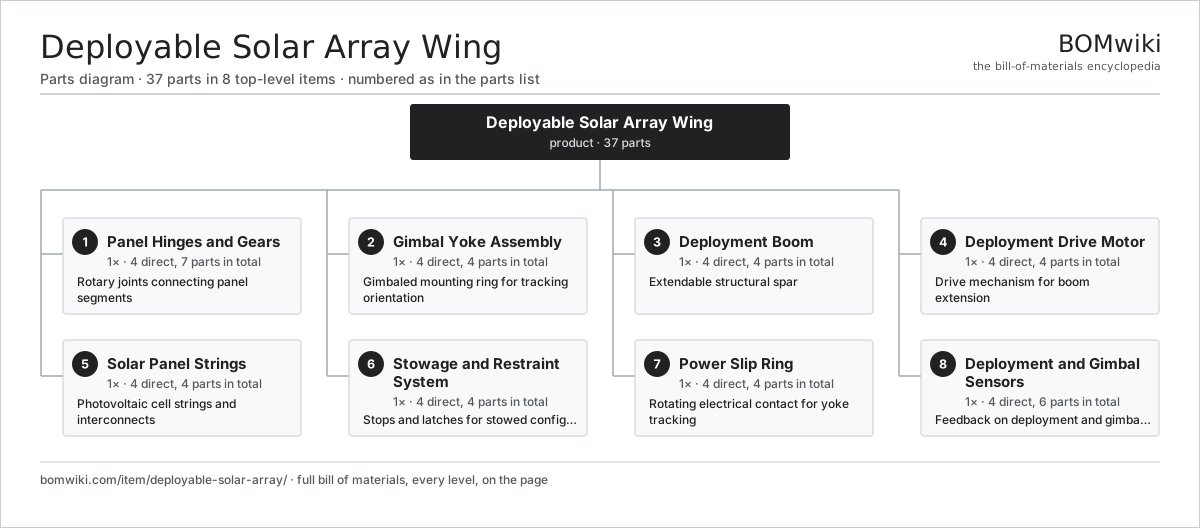
| # | Part | Qty | What it does |
|---|---|---|---|
| 1 | Panel Hinges and Gears 4 parts | 1× | Rotary joints connecting panel segments |
| 2 | Gimbal Yoke Assembly 4 parts | 1× | Gimbaled mounting ring for tracking orientation |
| 3 | Deployment Boom 4 parts | 1× | Extendable structural spar |
| 4 | Deployment Drive Motor 4 parts | 1× | Drive mechanism for boom extension |
| 5 | Solar Panel Strings 4 parts | 1× | Photovoltaic cell strings and interconnects |
| 6 | Stowage and Restraint System 4 parts | 1× | Stops and latches for stowed configuration |
| 7 | Power Slip Ring 4 parts | 1× | Rotating electrical contact for yoke tracking |
| 8 | Deployment and Gimbal Sensors 4 parts | 1× | Feedback on deployment and gimbal angle |
3D model
No 3D model yet. Have a CAD file of this? Add a 3D model. STL renders right on this page; STEP, FreeCAD, and OpenSCAD sources are welcome too (openly licensed, like all 3D models on BOMwiki).
Build & assembly graph
expand / collapse · shared sub-assemblies converge · links to related products · est. labourTap an assembly to expand/collapse · tap a part to open it · use “Open page” for any node · drag to pan, scroll to zoom.
Bill of materials for Deployable Solar Array Wing
8 top-level lines · 40 rows shown · 37 parts total · indented to 3 levels| # | Item / sub-assembly | Part no. | Qty/assy | Ext. qty | Parts | Type |
|---|---|---|---|---|---|---|
| 1 | Panel Hinges and Gears 4 parts | deployable-solar-array-panel-hinges | 1× | 1 | 7 | assembly |
| 1.1 | Hinge Pin | deployable-solar-array-hinge-pin | 1× | 1 | · | part |
| 1.2 | Ball Bearing | ball-bearing | 4× | 4 | · | part |
| 1.3 | Hinge Bracket | deployable-solar-array-hinge-bracket | 1× | 1 | · | part |
| 1.4 | Fastener Set | fastener-set | 1× | 1 | · | part |
| 2 | Gimbal Yoke Assembly 4 parts | deployable-solar-array-yoke-frame | 1× | 1 | 4 | assembly |
| 2.1 | Yoke Ring | deployable-solar-array-yoke-ring | 1× | 1 | · | part |
| 2.2 | Gimbal Bearing | deployable-solar-array-gimbal-bearing | 1× | 1 | · | part |
| 2.3 | Motor Housing | motor-housing | 1× | 1 | · | part |
| 2.4 | Gimbal Potentiometer | deployable-solar-array-drive-potentiometer | 1× | 1 | · | part |
| 3 | Deployment Boom 4 parts | deployable-solar-array-deployment-boom | 1× | 1 | 4 | assembly |
| 3.1 | Boom Segment | deployable-solar-array-boom-segment | 1× | 1 | · | part |
| 3.2 | Boom Latch | deployable-solar-array-boom-latch | 1× | 1 | · | part |
| 3.3 | Boom Extension Spring | deployable-solar-array-boom-spring | 1× | 1 | · | part |
| 3.4 | Fastener Set | fastener-set | 1× | 1 | · | part |
| 4 | Deployment Drive Motor 4 parts | deployable-solar-array-deployment-motor | 1× | 1 | 4 | assembly |
| 4.1 | Drive Motor | deployable-solar-array-motor-drive | 1× | 1 | · | part |
| 4.2 | Motor Gearbox | deployable-solar-array-motor-gearbox | 1× | 1 | · | part |
| 4.3 | Motor Drive Cable | deployable-solar-array-motor-cable | 1× | 1 | · | part |
| 4.4 | Fastener Set | fastener-set | 1× | 1 | · | part |
| 5 | Solar Panel Strings 4 parts | deployable-solar-array-solar-panels | 1× | 1 | 4 | assembly |
| 5.1 | Solar Cell String | deployable-solar-array-cell-string | 1× | 1 | · | part |
| 5.2 | Interconnect Ribbon | deployable-solar-array-interconnect-ribbon | 1× | 1 | · | part |
| 5.3 | Bypass Diode | deployable-solar-array-bypass-diode | 1× | 1 | · | part |
| 5.4 | Sheet Metal Panel | sheet-panel | 1× | 1 | · | part |
| 6 | Stowage and Restraint System 4 parts | deployable-solar-array-restraint-mechanisms | 1× | 1 | 4 | assembly |
| 6.1 | Launch Lock | deployable-solar-array-launch-lock | 1× | 1 | · | part |
| 6.2 | Restraint Strap | deployable-solar-array-restraint-strap | 1× | 1 | · | part |
| 6.3 | Fastener Set | fastener-set | 1× | 1 | · | part |
| 6.4 | Relay | relay | 1× | 1 | · | part |
| 7 | Power Slip Ring 4 parts | deployable-solar-array-power-slip-ring | 1× | 1 | 4 | assembly |
| 7.1 | Slip Ring Contact | deployable-solar-array-slip-ring-contact | 1× | 1 | · | part |
| 7.2 | Slip Ring Housing | deployable-solar-array-slip-ring-housing | 1× | 1 | · | part |
| 7.3 | Wire Bundle | wire-bundle | 1× | 1 | · | part |
| 7.4 | Fastener Set | fastener-set | 1× | 1 | · | part |
| 8 | Deployment and Gimbal Sensors 4 parts | deployable-solar-array-position-sensors | 1× | 1 | 6 | assembly |
| 8.1 | Encoder | encoder | 2× | 2 | · | part |
| 8.2 | Hall Sensor | hall-sensor | 2× | 2 | · | part |
| 8.3 | Bare PCB | pcb-bare | 1× | 1 | · | part |
| 8.4 | Connector | connector | 1× | 1 | · | part |
Something wrong in this list? Report a problem with this BOM.
Related products
same domain, ranked by shared parts GPS Navigation Satellite
2,640 parts · shares 4 with this page
GPS Navigation Satellite
2,640 parts · shares 4 with this page
 Reaction Wheel Assembly
39 parts · shares 4 with this page
Reaction Wheel Assembly
39 parts · shares 4 with this page
 Weather Satellite
1,765 parts · shares 4 with this page
Weather Satellite
1,765 parts · shares 4 with this page
 Spacecraft Docking Adapter
41 parts · shares 3 with this page
Spacecraft Docking Adapter
41 parts · shares 3 with this page
 Lunar Lander
1,803 parts · shares 3 with this page
Lunar Lander
1,803 parts · shares 3 with this page
 Rocket Upper Stage
1,459 parts · shares 3 with this page
Rocket Upper Stage
1,459 parts · shares 3 with this page
Sourcing: possible vendors
Browse the supplier directory → Prices, MOQ, and lead times are algorithmic estimates, not quotes, and not claims about these companies. Company mappings are curated by keyword; est. price band $50k–$500M. How estimates work| Vendor | HQ | Specialty | MOQ | Lead time |
|---|---|---|---|---|
|
🇺🇸SpaceX
spacex.com ↗
|
Hawthorne, US | Launch & spacecraft | made to order | 52–104 wks |
| northropgrumman.com ↗ | Falls Church, US | Space & defense | made to order | 52–104 wks |
|
🇫🇷Airbus
airbus.com ↗
|
Toulouse, FR | Aerospace OEM | made to order | 52–104 wks |
| rocketlabusa.com ↗ | Long Beach, US | Launch & spacecraft | made to order | 52–104 wks |
| thalesaleniaspace.com ↗ | Cannes, FR | Satellites | made to order | 52–104 wks |
1,323-word article