DI Box
ProductOverview
The DI box (direct input box) is a passive, transformer-coupled audio interface that converts unbalanced high-impedance instrument signals into balanced low-impedance signals suitable for mixing console microphone preamplifiers. The device solves a fundamental impedance mismatch: electric guitars, keyboards, and other instruments generate weak, high-impedance signals (typically 50 mV to 1 V at 1 MΩ) delivered via single-ended (unbalanced) 1/4-inch connectors. Mixing consoles expect balanced, low-impedance signals on their microphone inputs (approximately 50 Ω balanced, 48 V phantom power available). The DI box's Audio Isolation Transformer bridges this gap while providing galvanic isolation, eliminating ground loop hum.
How it Works
Transformer Isolation
The Audio Isolation Transformer is a 1:1 (unity) isolation transformer, not a step-up or step-down device. Its Ferrite Core Assembly ferrite E-I lamination exhibits high permeability, permitting efficient coupling even at 20 Hz (problematic for smaller iron cores). The Copper Winding primary connects to the unbalanced input jack; the secondary couples to the balanced XLR output. Because transformer isolation severs the DC connection between input and output grounds, it breaks ground loop hum paths, the primary safety advantage for live sound.
The transformer's 1:1 ratio means voltage is nominally preserved (minus slight losses): a 100 mV input signal appears as approximately 95 mV at the output. The impedance transformation occurs naturally due to coupling: the high-impedance input jack presents minimal load to the instrument, while the low-impedance secondary drives the 50 Ω microphone input without crosstalk.
Input Stage
The Input Connector Assembly assembly offers a Input Jack (typically 1/4-inch Neutrik Speakon) accepting the instrument. An optional Input XLR Female female connector and Input Selector Switch toggle permit dual-input operation, either jack or balanced XLR can feed the transformer without switching cables. A Input Coupling Capacitor AC-couples the signal, removing DC offset and subsonic rumble below 20 Hz.
Pad Attenuation
Hot keyboard outputs (synthesizers, drum machines, samplers) often exceed the transformer's headroom. The Pad Switch and Circuit circuit provides a -20 dB Pad Toggle Switch that inserts a Pad Resistor Network divider network, reducing +10 dBu input to -10 dBu (safely within microphone preamp range without distortion).
Ground Lift
A Ground Lift Switch breaks the connection between transformer pin 1 (shield) and the Aluminum Enclosure ground plane. This switch is toggled to eliminate hum loops: if the input instrument is connected to the same power distribution as the mixing console, and both are grounded through separate earth paths, a 50 or 60 Hz current circulates in the shield, creating audible hum. Engaging the ground-lift switch floats the shield, stopping the current. The switch is toggled until hum disappears.
Passive Design
The DI box is entirely passive, no batteries, no phantom power drain. This simplicity makes it field-reliable: drop the unit, and it still functions (transformer and resistors have no failure modes beyond mechanical damage). Some professional DI boxes include a phantom-powered active stage to boost weak passive transformer levels, but the transformer isolation benefit (hum elimination) remains the primary function.
Microphone Preamp Interaction
When the balanced XLR output (typically -10 dBu) feeds a microphone preamp (designed for -40 dBu mic signal), the preamp's input stage must operate at reduced gain to avoid clipping. Consoles typically allow the operator to pad the mic input by 20 dB, reducing preamp gain and dropping the signal into the sweet spot of lowest noise and headroom.
Live Sound Application
In live sound reinforcement, DI boxes permit electric guitar players to connect wireless bodypack transmitters to the mixing console without running long XLR cables across the stage. A guitarist carries the wireless receiver output (unbalanced 1/4-inch jack) to a DI box, which outputs balanced XLR to the console. This eliminates cable hum, RF interference, and capacitive loading on high-impedance instrument outputs.
Transformer Shielding
The Transformer Shield Can Faraday enclosure surrounds the transformer, preventing external electromagnetic fields (AC power cables, lighting dimmers, RF broadcasts) from coupling into the signal. Without shielding, a transformer coil in a high-RF environment can pick up audio-frequency interference. The shielding is connected to chassis ground on one end only, preventing the shield from itself becoming an unwanted antenna.
Passive vs. Active DI
Passive DI boxes rely entirely on transformer coupling. Active DI boxes add an amplifier stage powered by phantom power or batteries, allowing additional gain (up to +40 dB) and output impedance buffering. Passive boxes offer simplicity, reliability, and the definitive ground-loop elimination that transformer isolation provides. Active boxes add noise gain capability but cannot achieve the same galvanic isolation without a transformer in the signal path (some active boxes include a transformer after the preamp).
Specifications Verification
Professional DI boxes specify transformer frequency response to 20 kHz with <1 dB deviation, high-impedance input (>1 MΩ) to minimize loading on guitars, and output impedance <50 Ω to drive microphone preamp inputs reliably. Maximum input handling before pad is typically +10 dBu unbalanced; with the -20 dB pad engaged, +30 dBu inputs can be accommodated.
DI Box parts and their functions
8 top-level parts · 30 parts in total · full bill of materials below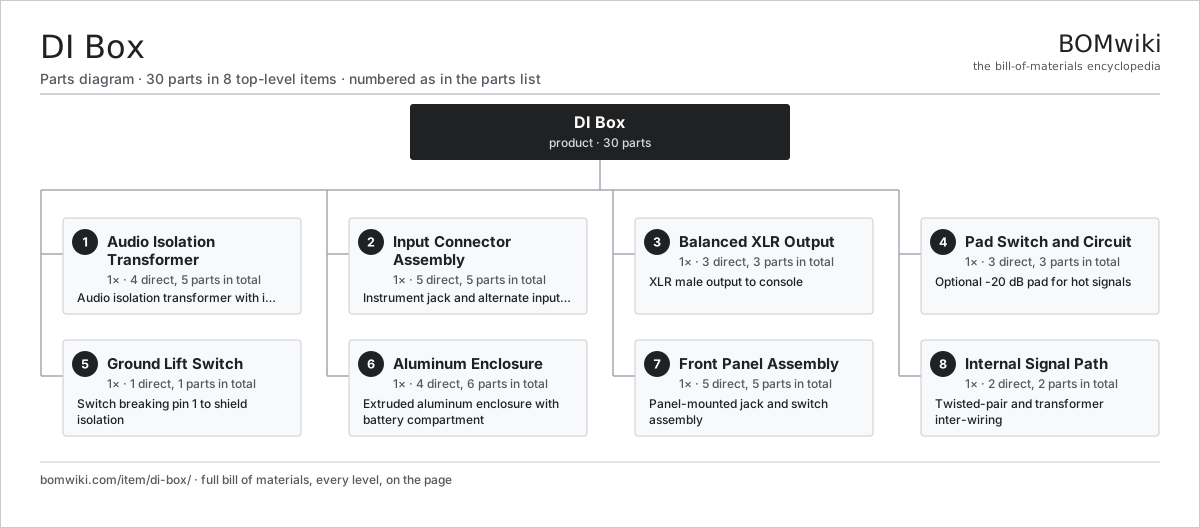
| # | Part | Qty | What it does |
|---|---|---|---|
| 1 | Audio Isolation Transformer 4 parts | 1× | Audio isolation transformer with impedance matching |
| 2 | Input Connector Assembly 5 parts | 1× | Instrument jack and alternate input options |
| 3 | Balanced XLR Output 3 parts | 1× | XLR male output to console |
| 4 | Pad Switch and Circuit 3 parts | 1× | Optional -20 dB pad for hot signals |
| 5 | Ground Lift Switch 1 parts | 1× | Switch breaking pin 1 to shield isolation |
| 6 | Aluminum Enclosure 4 parts | 1× | Extruded aluminum enclosure with battery compartment |
| 7 | Front Panel Assembly 5 parts | 1× | Panel-mounted jack and switch assembly |
| 8 | Internal Signal Path 2 parts | 1× | Twisted-pair and transformer inter-wiring |
3D model
No 3D model yet. Have a CAD file of this? Add a 3D model. STL renders right on this page; STEP, FreeCAD, and OpenSCAD sources are welcome too (openly licensed, like all 3D models on BOMwiki).
Build & assembly graph
expand / collapse · shared sub-assemblies converge · links to related products · est. labourTap an assembly to expand/collapse · tap a part to open it · use “Open page” for any node · drag to pan, scroll to zoom.
Bill of materials for DI Box
8 top-level lines · 36 rows shown · 30 parts total · indented to 3 levels| # | Item / sub-assembly | Part no. | Qty/assy | Ext. qty | Parts | Type |
|---|---|---|---|---|---|---|
| 1 | Audio Isolation Transformer 4 parts | di-box-transformer | 1× | 1 | 5 | assembly |
| 1.1 | Ferrite Core Assembly | di-box-transformer-core | 1× | 1 | · | part |
| 1.2 | Copper Winding | copper-winding | 2× | 2 | · | part |
| 1.3 | Transformer Shield Can | di-box-transformer-can | 1× | 1 | · | part |
| 1.4 | Fastener Set | fastener-set | 1× | 1 | · | part |
| 2 | Input Connector Assembly 5 parts | di-box-input-connectors | 1× | 1 | 5 | assembly |
| 2.1 | Input Jack | di-box-input-jack | 1× | 1 | · | part |
| 2.2 | Input XLR Female | di-box-input-xlr | 1× | 1 | · | part |
| 2.3 | Input Selector Switch | di-box-input-selector | 1× | 1 | · | part |
| 2.4 | Input Coupling Capacitor | di-box-input-blocking-capacitor | 1× | 1 | · | part |
| 2.5 | Connector | connector | 1× | 1 | · | part |
| 3 | Balanced XLR Output 3 parts | di-box-output-connector | 1× | 1 | 3 | assembly |
| 3.1 | Connector | connector | 1× | 1 | · | part |
| 3.2 | Transformer Secondary | di-box-output-transformer-secondary | 1× | 1 | · | part |
| 3.3 | Fastener Set | fastener-set | 1× | 1 | · | part |
| 4 | Pad Switch and Circuit 3 parts | di-box-pad-attenuation | 1× | 1 | 3 | assembly |
| 4.1 | Pad Toggle Switch | di-box-pad-switch | 1× | 1 | · | part |
| 4.2 | Pad Resistor Network | di-box-pad-resistors | 1× | 1 | · | part |
| 4.3 | Fastener Set | fastener-set | 1× | 1 | · | part |
| 5 | Ground Lift Switch 1 parts | di-box-ground-lift-switch | 1× | 1 | 1 | assembly |
| 5.1 | Fastener Set | fastener-set | 1× | 1 | · | part |
| 6 | Aluminum Enclosure 4 parts | di-box-chassis | 1× | 1 | 6 | assembly |
| 6.1 | Aluminum Main Body | di-box-aluminum-body | 1× | 1 | · | part |
| 6.2 | Aluminum Endplate | di-box-aluminum-endplate | 2× | 2 | · | part |
| 6.3 | Sheet Metal Panel | sheet-panel | 1× | 1 | · | part |
| 6.4 | Fastener Set | fastener-set | 2× | 2 | · | part |
| 7 | Front Panel Assembly 5 parts | di-box-connector-block | 1× | 1 | 5 | assembly |
| 7.1 | Input Jack | di-box-input-jack | 1× | 1 | · | part |
| 7.2 | Pad Toggle Switch | di-box-pad-switch | 1× | 1 | · | part |
| 7.3 | Ground Lift Switch 1 parts | di-box-ground-lift-switch | 1× | 1 | 1 | assembly |
| 7.3.1 | Fastener Set | fastener-set | 1× | 1 | · | part |
| 7.4 | Connector | connector | 1× | 1 | · | part |
| 7.5 | Fastener Set | fastener-set | 1× | 1 | · | part |
| 8 | Internal Signal Path 2 parts | di-box-internal-wiring | 1× | 1 | 2 | assembly |
| 8.1 | Wire Bundle | wire-bundle | 1× | 1 | · | part |
| 8.2 | Fastener Set | fastener-set | 1× | 1 | · | part |
Something wrong in this list? Report a problem with this BOM.
Related products
same domain, ranked by shared parts Studio Monitor Speaker
53 parts · shares 3 with this page
Studio Monitor Speaker
53 parts · shares 3 with this page
 Broadcast Pedestal
83 parts · shares 2 with this page
Broadcast Pedestal
83 parts · shares 2 with this page
 Megaphone
36 parts · shares 2 with this page
Megaphone
36 parts · shares 2 with this page
 PTZ Camera
499 parts · shares 2 with this page
PTZ Camera
499 parts · shares 2 with this page
 Record Player
215 parts · shares 2 with this page
Studio Jib Arm
106 parts · shares 2 with this page
Record Player
215 parts · shares 2 with this page
Studio Jib Arm
106 parts · shares 2 with this page
Sourcing: possible vendors
Browse the supplier directory → Prices, MOQ, and lead times are algorithmic estimates, not quotes, and not claims about these companies. Company mappings are curated by keyword; est. price band $50–$3k. How estimates work| Vendor | HQ | Specialty | MOQ | Lead time |
|---|---|---|---|---|
|
🇯🇵Sony
sony.com ↗
|
Tokyo, JP | Consumer electronics | 1,000 units | 8–12 wks |
| samsung.com ↗ | Suwon, KR | Electronics & displays | 1,000 units | 8–12 wks |
|
🇺🇸Harman
harman.com ↗
|
Stamford, US | Audio (JBL, AKG) | 1,000 units | 8–12 wks |
|
🇺🇸Bose
bose.com ↗
|
Framingham, US | Audio | 1,000 units | 8–12 wks |
| yamaha.com ↗ | Hamamatsu, JP | Audio & instruments | 1,000 units | 8–12 wks |
859-word article