Digital Desk Clock
ProductOverview
The digital desk clock is the minimum viable computer: one microcontroller, one crystal, a numeric display, and a beeper, packaged to sit on a nightstand and wake its owner. The architecture has been stable since LED clocks displaced clock radios' mechanical flip displays in the late 1970s; what has changed is integration, functions that once took an MM5314 clock chip plus discrete drivers now fit in a four-cent MCU, and the power inlet, which has converged on USB.
The block structure is plain: the Mainboard keeps time and runs everything, the Display Module shows it, the Alarm Audio enforces it, the Controls set it, the Power System system feeds it, and the Housing angles it toward the pillow. Self-setting models add the Radio Sync Receiver receiver.
Timekeeping
The Microcontroller counts time from the RTC Crystal, the same 32,768 Hz tuning fork used in wristwatches; 2^15 Hz divides to 1 Hz with a plain binary counter. Crystal tolerance of ±20 ppm works out to about a minute per month of drift. Mains-powered clocks historically did better by counting the 50/60 Hz line, which utilities steer to be exact over the long term, but USB supplies carry no usable frequency reference, so modern units lean on the crystal, or on radio.
The radio path is the interesting part. National laboratories broadcast time codes on longwave: WWVB at 60 kHz from Colorado, DCF77 at 77.5 kHz from Germany, MSF at 60 kHz from the UK, JJY at 40/60 kHz from Japan. The Ferrite Antenna picks up the carrier and the Receiver IC, a micropower AM receiver drawing under 100 µA, demodulates a code that sends one bit per second; a complete frame of minute, hour, date, and DST flags takes a full minute. Reception works best at night when the ionosphere lowers path loss, so the firmware tries a sync in the small hours and disciplines the RTC. A synced clock is accurate to the second indefinitely and handles daylight saving transitions on its own.
Display
The LED Digit Array are not driven statically. The Display Driver multiplexes them, lighting one digit at a time at several hundred sweeps per second, fast enough that the eye integrates it as steady, which cuts pin count and lets one current-setting resistor serve all segments. Brightness control is PWM duty within each digit's time slot. The Light Sensor closes the loop: full brightness in a lit room, a dim glow at night, roughly a 100:1 range, because an LED display bright enough for daytime is bright enough to light the ceiling at 3 am. The Display Lens is tinted to the LED's wavelength, which roughly doubles contrast by absorbing ambient light twice while passing emitted light once.
Alarm and controls
Alarm logic lives entirely in firmware. At the set minute the MCU gates a tone, typically 2–4 kHz, near the resonance of small sounders, through the Power MOSFET into the Speaker, usually in an escalating pattern: slow beeps, then faster, then continuous, reaching 70–85 dB through the Acoustic Port. The Snooze Bar spans most of the top surface and buys nine minutes per press, a number inherited from 1950s clockwork snooze cams and never revisited. The Tact Switches handle setting; the Slide Switches latch alarm enable and 12/24-hour format, and many designs poll a Temperature Sensor to fill the spare display corner with the room temperature.
Power
The clock draws well under half a watt: the USB Jack takes 5 V, the LED array runs from it directly, and the Regulator derives 3.3 V for logic. The design problem is the blackout. A clock that forgets its alarm in a power cut fails at its one job, so the Backup Cell, a CR2032, keeps the RTC counting with the display dark. RTC current in backup mode is around a microamp, so the 220 mAh coin cell covers years of cumulative outage; the classic blinking 12:00 now mostly means the coin cell finally died.
Construction
Everything mounts in a two-shell ABS case, the Case Front tilting the display 10–15° upward and the Case Back carrying ports and the battery door, joined by a Fastener Set and steadied by Rubber Feet sticky enough to survive the snooze slap. The entire bill of materials of a basic unit is a few dollars, which is why the category persists against the smartphone: it is cheaper than a charging cable, never needs unlocking, and its alarm works when the phone is in another room, which sleep researchers recommend anyway.
Digital Desk Clock parts and their functions
7 top-level parts · 33 parts in total · full bill of materials below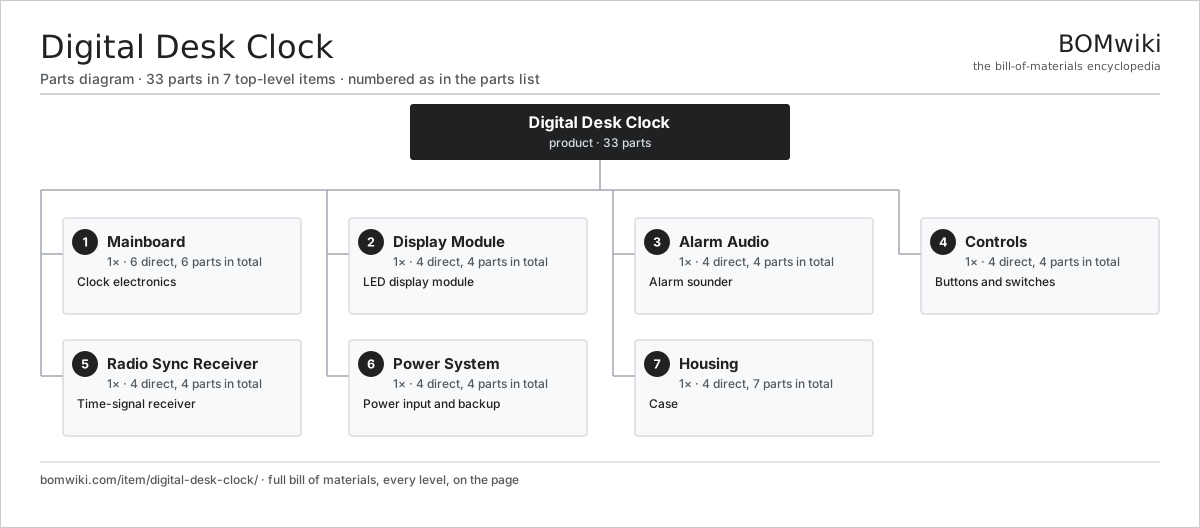
| # | Part | Qty | What it does |
|---|---|---|---|
| 1 | Mainboard 6 parts | 1× | Clock electronics |
| 2 | Display Module 4 parts | 1× | LED display module |
| 3 | Alarm Audio 4 parts | 1× | Alarm sounder |
| 4 | Controls 4 parts | 1× | Buttons and switches |
| 5 | Radio Sync Receiver 4 parts | 1× | Time-signal receiver |
| 6 | Power System 4 parts | 1× | Power input and backup |
| 7 | Housing 4 parts | 1× | Case |
3D model
No 3D model yet. Have a CAD file of this? Add a 3D model. STL renders right on this page; STEP, FreeCAD, and OpenSCAD sources are welcome too (openly licensed, like all 3D models on BOMwiki).
Build & assembly graph
expand / collapse · shared sub-assemblies converge · links to related products · est. labourTap an assembly to expand/collapse · tap a part to open it · use “Open page” for any node · drag to pan, scroll to zoom.
Bill of materials for Digital Desk Clock
7 top-level lines · 37 rows shown · 33 parts total · indented to 3 levels| # | Item / sub-assembly | Part no. | Qty/assy | Ext. qty | Parts | Type |
|---|---|---|---|---|---|---|
| 1 | Mainboard 6 parts | digital-desk-clock-mainboard | 1× | 1 | 6 | assembly |
| 1.1 | Bare PCB | pcb-bare | 1× | 1 | · | part |
| 1.2 | Microcontroller | mcu | 1× | 1 | · | part |
| 1.3 | RTC Crystal | digital-desk-clock-rtc-crystal | 1× | 1 | · | part |
| 1.4 | Light Sensor | digital-desk-clock-light-sensor | 1× | 1 | · | part |
| 1.5 | Temperature Sensor | digital-desk-clock-temp-sensor | 1× | 1 | · | part |
| 1.6 | SMD Passive (R/C/L) | smd-passives | 1× | 1 | · | part |
| 2 | Display Module 4 parts | digital-desk-clock-display | 1× | 1 | 4 | assembly |
| 2.1 | LED Digit Array | digital-desk-clock-led-digits | 1× | 1 | · | part |
| 2.2 | Display Driver | digital-desk-clock-display-driver | 1× | 1 | · | part |
| 2.3 | Display Lens | digital-desk-clock-display-lens | 1× | 1 | · | part |
| 2.4 | Connector | connector | 1× | 1 | · | part |
| 3 | Alarm Audio 4 parts | digital-desk-clock-alarm-audio | 1× | 1 | 4 | assembly |
| 3.1 | Speaker | speaker | 1× | 1 | · | part |
| 3.2 | Power MOSFET | mosfet | 1× | 1 | · | part |
| 3.3 | Acoustic Port | digital-desk-clock-acoustic-port | 1× | 1 | · | part |
| 3.4 | Wire Bundle | wire-bundle | 1× | 1 | · | part |
| 4 | Controls 4 parts | digital-desk-clock-controls | 1× | 1 | 4 | assembly |
| 4.1 | Snooze Bar | digital-desk-clock-snooze-bar | 1× | 1 | · | part |
| 4.2 | Tact Switches | digital-desk-clock-tact-switches | 1× | 1 | · | part |
| 4.3 | Slide Switches | digital-desk-clock-slide-switches | 1× | 1 | · | part |
| 4.4 | Connector | connector | 1× | 1 | · | part |
| 5 | Radio Sync Receiver 4 parts | digital-desk-clock-radio-sync | 1× | 1 | 4 | assembly |
| 5.1 | Ferrite Antenna | digital-desk-clock-ferrite-antenna | 1× | 1 | · | part |
| 5.2 | Receiver IC | digital-desk-clock-receiver-ic | 1× | 1 | · | part |
| 5.3 | SMD Passive (R/C/L) | smd-passives | 1× | 1 | · | part |
| 5.4 | Connector | connector | 1× | 1 | · | part |
| 6 | Power System 4 parts | digital-desk-clock-power | 1× | 1 | 4 | assembly |
| 6.1 | Power Supply | power-supply | 1× | 1 | · | part |
| 6.2 | USB Jack | digital-desk-clock-usb-jack | 1× | 1 | · | part |
| 6.3 | Regulator | digital-desk-clock-regulator | 1× | 1 | · | part |
| 6.4 | Backup Cell | digital-desk-clock-backup-cell | 1× | 1 | · | part |
| 7 | Housing 4 parts | digital-desk-clock-housing | 1× | 1 | 7 | assembly |
| 7.1 | Case Front | digital-desk-clock-case-front | 1× | 1 | · | part |
| 7.2 | Case Back | digital-desk-clock-case-back | 1× | 1 | · | part |
| 7.3 | Rubber Feet | digital-desk-clock-feet | 4× | 4 | · | part |
| 7.4 | Fastener Set | fastener-set | 1× | 1 | · | part |
Something wrong in this list? Report a problem with this BOM.
Related products
same domain, ranked by shared parts Watch Winder
39 parts · shares 7 with this page
Watch Winder
39 parts · shares 7 with this page
 Chess Clock
47 parts · shares 6 with this page
GPS NTP Time Server
37 parts · shares 5 with this page
Chess Clock
47 parts · shares 6 with this page
GPS NTP Time Server
37 parts · shares 5 with this page
 Railway Station Clock
43 parts · shares 5 with this page
Railway Station Clock
43 parts · shares 5 with this page
 Radio-Controlled Atomic Clock
130 parts · shares 5 with this page
Radio-Controlled Atomic Clock
130 parts · shares 5 with this page
 Carriage Clock
49 parts · shares 1 with this page
Carriage Clock
49 parts · shares 1 with this page
Sourcing: possible vendors
Browse the supplier directory → Prices, MOQ, and lead times are algorithmic estimates, not quotes, and not claims about these companies. Company mappings are curated by keyword; est. price band $20–$50k. How estimates work| Vendor | HQ | Specialty | MOQ | Lead time |
|---|---|---|---|---|
|
🇯🇵Seiko
seikowatches.com ↗
|
Tokyo, JP | Watches | 500 units | 8–14 wks |
|
🇯🇵Citizen
citizenwatch-global.com ↗
|
Tokyo, JP | Watches | 500 units | 8–14 wks |
|
🇯🇵Casio
casio.com ↗
|
Tokyo, JP | Watches & electronics | 500 units | 8–14 wks |
| swatchgroup.com ↗ | Biel, CH | Watches (Omega, Tissot) | 500 units | 8–14 wks |
| titancompany.in ↗ | Bengaluru, IN | Watches & timepieces | 500 units | 8–14 wks |
838-word article