Digital/Bar-Code Level
ProductOverview
A digital level, also called a bar-code level or electronic staff reader, automates the tedious manual staff reading process by using a linear CCD image sensor to optically scan a bar-code pattern printed on a leveling staff (rod). The instrument's internal processor decodes the bar-code and instantly displays the staff reading on an LCD screen, eliminating human error in reading graduated marks and enabling rapid, high-precision leveling surveys. The combination of automatic gravity-based pendulum compensation and photoelectric bar-code recognition allows a single operator to rapidly collect elevation data with centimeter or better accuracy, making digital levels the standard for modern civil engineering surveys, utility mapping, and structural monitoring where speed and consistency are paramount.
Digital levels maintain the simple, robust optical design of traditional mechanical levels (no servo motors, no complex alignment) while adding electronics for automation. They have become dominant in countries with large infrastructure datasets, where batch leveling surveys of thousands of points are conducted annually.
How it works
The telescope's objective lens focuses light from a leveling staff held by an assistant at a distant point (2–60 m away). Instead of the observer reading the staff's graduation marks through the eyepiece, the focused image is projected onto a linear CCD array (2048 pixels, 7 μm pitch). The CCD is mounted at the telescope's focal plane, replacing the traditional reticle crosshair.
The infrared LED illuminator at 880 nm is modulated at 1 kHz and illuminates the staff. The bar-code pattern on the staff (alternating black and white bars representing digits) reflects and absorbs this infrared light in a specific sequence. The CCD sensor captures the reflected pattern line-by-line, building a high-contrast image of the bar-code.
The onboard firmware uses pattern-recognition algorithms to:
- Locate the staff: Find the staff's horizontal bar-code pattern in the CCD image.
- Decode the bar-code: Convert the black/white bar pattern into a numeric value (the staff reading).
- Measure the image height: Calculate which pixel row the staff appears at, corresponding to staff height (elevation).
- Calculate elevation: Using the known height of the instrument above ground, compute the staff point's elevation relative to a reference datum.
All this occurs in <0.5 seconds. The reading is displayed on the LCD screen showing elevation in meters (or feet, if selected), along with standard deviation from multiple shots and a "height of instrument" (HI) value.
Bar-code staff and pattern decoding
The staff used with digital levels is not a traditional graduated rod with numbers printed on paper. Instead, it is a precisely manufactured bar-code staff:
- Material: Aluminum or fiberglass tube with a printed or epoxied bar-code pattern.
- Pattern: A series of black and white vertical bars representing Binary Coded Decimal (BCD) or Hamming-coded digits. Each digit is 1–2 cm wide; the staff reads from 0 to 99.999 m in 1 mm increments.
- Accuracy: Bar positions are maintained to ±0.5 mm during manufacturing, enabling sub-millimeter reading repeatability.
Typical bar-code staff patterns:
- BCD (Binary Coded Decimal): Each digit is represented by four bars (binary bits). The firmware reads the bit pattern to recover the digit. Simple but prone to errors if one bar is smudged.
- Hamming code: Each digit is encoded with error-correction bits; if one bar is misread, the firmware can still recover the correct digit. More robust in dirty or rainy conditions.
The CCD sensor captures the entire bar-code pattern in a single integration period (10–20 milliseconds). The firmware then scans for the highest-contrast rows (where the bar pattern is sharpest) and performs maximum-likelihood decoding: which digit pattern in the bar-code best matches the observed image?
Automatic leveling and measurement speed
Unlike manual stadia readings where the observer must align a bubble and read three marks (upper stadia, center, lower stadia) taking 30+ seconds per shot, the digital level's gravity-based compensator ensures the line of sight is always horizontal, and the CCD reading is instantaneous. A trained crew can complete 20–30 shots per hour (compared to 5–10 per hour with manual optical levels).
The firmware offers several measurement modes:
- Single shot: One measurement, instant display.
- Averaging: Take 5–10 shots at the same backsight/foresight location; compute mean and standard deviation. Typical SD for bar-code reading is ±1–2 mm, indicating high repeatability.
- Multiple ranges: Auto-ranging feature adjusts optical focus and sensor gain for staffs at varying distances (2–60 m).
The automatic pendulum compensator keeps the line of sight horizontal within ±2° of tripod tilt; no manual bubble-checking is required (though a spirit bubble is present as a backup). Settling time is <2 seconds; the operator can take a measurement immediately after setting up the tripod.
CCD sensor and pixel resolution
The 2048-pixel linear CCD array with 7 μm pixel pitch covers a field ~14 mm at the telescope's focal plane. With 32× magnification, this corresponds to a 450 mm span on the staff at 10 m distance, sufficient to capture 3–4 digits of the staff reading, providing redundancy and fault detection.
Pixel resolution at the staff is (7 μm / 32 magnification) ≈ 0.22 mm per pixel. Because the bar-code pattern is ~10–15 mm per digit, each digit spans ~50–70 pixels on the CCD. This over-sampling allows sub-millimeter decoding accuracy even if the image is slightly defocused or the staff tilts ±2°.
Infrared illumination (880 nm) is used rather than visible light because:
- Bar-code patterns are typically printed with infrared-absorbing inks (carbon, not visible-spectrum pigments).
- Infrared is less sensitive to ambient sunlight, improving daytime readability.
- 1 kHz modulation allows synchronous demodulation, rejecting slow ambient light and flickering fluorescent lamps.
Data logging and field workflow
The onboard EEPROM stores 1000+ measurement records, each with:
- Timestamp.
- Backsight and foresight staff readings.
- Calculated elevation.
- Standard deviation of averaging (if multiple shots).
- Operator-entered point code (e.g., "B1" for benchmark 1).
Field workflow:
- Setup: Place level on tripod over a known point or arbitrary origin. Note the instrument height (distance from ground to center of telescope).
- Backsight: Assistant holds bar-code staff at the starting point. Operator aims the telescope and presses "Read"; the LCD displays the staff reading.
- Foresight: Assistant walks to the next point, holds the staff. Operator repeats the measurement. The processor automatically calculates elevation change = backsight reading − foresight reading.
- Move forward: Operator relocates the level midway between the foresight and the next point. Repeat.
Leveling runs of 10–20 stations (spanning 500–1000 m) can be completed in 1–2 hours, compared to 4–6 hours with manual optical levels. Automated data logging eliminates transcription errors; the memory card is downloaded to a laptop at the office for QA and network adjustment.
Accuracy and error sources
Theoretical accuracy: With a bar-code resolution of 1 mm and CCD pixel pitch of 0.22 mm, measurement repeatability is ±1–2 mm (one standard deviation). This translates to leveling accuracy of ±2–3 mm per km (double run), competitive with high-end manual optical levels.
Practical limitations:
- Bar-code wear: After 5–10 years of field use, bar-code contrast degrades due to UV exposure and dust abrasion. Readings become noisier; standard deviation increases to ±5–10 mm. Replacement staffs are expensive ($2000–5000 each).
- Staff tilt: If the staff is tilted >5°, the CCD image becomes distorted and decoding fails. Bubble levels on the staff are essential; operator must verify plumbness before every shot.
- Atmospheric refraction: Over distances >50 m, turbulence and thermal gradients cause ray bending, degrading accuracy to ±5–10 mm. Digital levels handle this no better than optical levels; classical leveling networks limit foresight distances to 50 m.
- Temperature: CCD sensors have temperature-dependent dark current and gain; cold operations (−10 °C) reduce sensitivity by 20%. Warm-up time (10 minutes) is recommended.
Leveling networks and deformation monitoring
Digital levels enable rapid establishment of vertical reference networks: a grid of benchmarks spaced 1–2 km apart can be established in days. Reoccupation of this network annually or monthly detects:
- Building settlement: Multi-story buildings settle 10–50 mm over 10 years; differential settlement across a building can cause cracking. Digital-level surveys detect settlement >5 mm.
- Dam and levee seepage: Phreatic surface changes cause differential settlement; monthly leveling surveys track this.
- Utility infrastructure: Sewer, water, and gas mains subsidence due to ground water pumping.
Precision leveling (±1–2 mm per km) is achieved through:
- Minimizing foresight distance: 20–30 m per shot (not 50 m).
- Double running: Each leveling line is run forward and reverse; discrepancies >5 mm per km trigger remeasurement.
- Temperature control: Surveys conducted in stable conditions (early morning, no direct sun on staff).
Some jurisdictions require legal leveling networks to be re-established every 10 years for cadastral (property boundary) work, ensuring consistency in height definitions.
Practical deployment and maintenance
Setup time: 5 minutes (level tripod, rough plumbing with bubble, optical plummet over benchmark).
Measurement time: 1–2 minutes per setup (depending on average shot distance and number of shots averaged).
Staff care: Bar-code staffs are precision instruments. Protective cases, careful transport, and annual inspection for bar-code contrast loss are essential. Staffs should not be dropped or left in direct sun for extended periods (accelerates fade).
Level maintenance: The compensator and CCD sensor require no user servicing. Once per year, verify that the automatic compensator settles properly (bubble centered within 2 seconds of setup). Clean the objective lens and CCD window with lens paper and alcohol.
Limitations vs. total stations: Digital levels measure only elevation, not angles or horizontal distance. For comprehensive surveys requiring 3D coordinates, total stations or GNSS are preferred. However, where vertical accuracy and simplicity are paramount (utility mapping, deformation monitoring), digital levels remain faster and cheaper than electronic instruments.
Digital/Bar-Code Level parts and their functions
6 top-level parts · 28 parts in total · full bill of materials below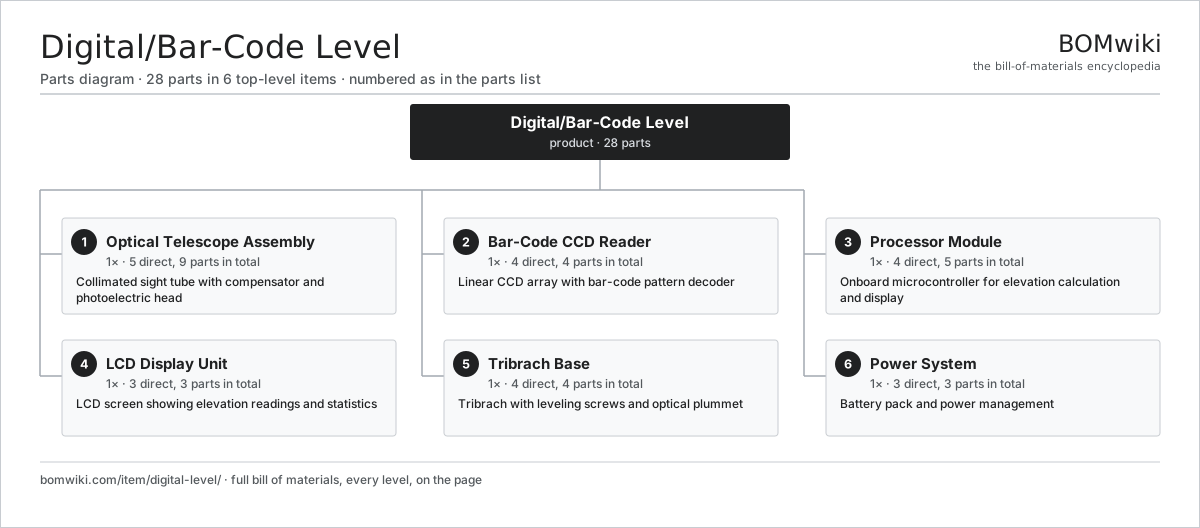
| # | Part | Qty | What it does |
|---|---|---|---|
| 1 | Optical Telescope Assembly 5 parts | 1× | Collimated sight tube with compensator and photoelectric head |
| 2 | Bar-Code CCD Reader 4 parts | 1× | Linear CCD array with bar-code pattern decoder |
| 3 | Processor Module 4 parts | 1× | Onboard microcontroller for elevation calculation and display |
| 4 | LCD Display Unit 3 parts | 1× | LCD screen showing elevation readings and statistics |
| 5 | Tribrach Base 4 parts | 1× | Tribrach with leveling screws and optical plummet |
| 6 | Power System 3 parts | 1× | Battery pack and power management |
3D model
No 3D model yet. Have a CAD file of this? Add a 3D model. STL renders right on this page; STEP, FreeCAD, and OpenSCAD sources are welcome too (openly licensed, like all 3D models on BOMwiki).
Build & assembly graph
expand / collapse · shared sub-assemblies converge · links to related products · est. labourTap an assembly to expand/collapse · tap a part to open it · use “Open page” for any node · drag to pan, scroll to zoom.
Bill of materials for Digital/Bar-Code Level
6 top-level lines · 33 rows shown · 28 parts total · indented to 3 levels| # | Item / sub-assembly | Part no. | Qty/assy | Ext. qty | Parts | Type |
|---|---|---|---|---|---|---|
| 1 | Optical Telescope Assembly 5 parts | digital-level-telescope | 1× | 1 | 9 | assembly |
| 1.1 | Lens Assembly | camera-lens | 1× | 1 | · | part |
| 1.2 | Eyepiece Lens | digital-level-eyepiece | 1× | 1 | · | part |
| 1.3 | Automatic Compensator 4 parts | optical-level-compensator | 1× | 1 | 5 | assembly |
| 1.3.1 | Pendulum Wedge | optical-level-pendulum-prism | 1× | 1 | · | part |
| 1.3.2 | Coil Spring | coil-spring | 2× | 2 | · | part |
| 1.3.3 | Magnetic Damper | optical-level-damper | 1× | 1 | · | part |
| 1.3.4 | Neodymium Magnet | neodymium-magnet | 1× | 1 | · | part |
| 1.4 | Prism Erection System | digital-level-prism-train | 1× | 1 | · | part |
| 1.5 | Coil Spring | coil-spring | 1× | 1 | · | part |
| 2 | Bar-Code CCD Reader 4 parts | digital-level-sensor | 1× | 1 | 4 | assembly |
| 2.1 | CMOS Image Sensor | image-sensor | 1× | 1 | · | part |
| 2.2 | CCD Timing IC | digital-level-ccd-driver | 1× | 1 | · | part |
| 2.3 | Infrared Illuminator | digital-level-ir-led | 1× | 1 | · | part |
| 2.4 | SMD Passive (R/C/L) | smd-passives | 1× | 1 | · | part |
| 3 | Processor Module 4 parts | digital-level-processor | 1× | 1 | 5 | assembly |
| 3.1 | Microcontroller | mcu | 1× | 1 | · | part |
| 3.2 | Bare PCB | pcb-bare | 1× | 1 | · | part |
| 3.3 | SMD Passive (R/C/L) | smd-passives | 2× | 2 | · | part |
| 3.4 | Non-Volatile Memory | digital-level-flash-memory | 1× | 1 | · | part |
| 4 | LCD Display Unit 3 parts | digital-level-display | 1× | 1 | 3 | assembly |
| 4.1 | LCD Panel | lcd-panel | 1× | 1 | · | part |
| 4.2 | LCD Controller | digital-level-display-driver | 1× | 1 | · | part |
| 4.3 | SMD Passive (R/C/L) | smd-passives | 1× | 1 | · | part |
| 5 | Tribrach Base 4 parts | digital-level-base | 1× | 1 | 4 | assembly |
| 5.1 | Tribrach Casting | digital-level-tribrach-body | 1× | 1 | · | part |
| 5.2 | Leveling Thumb Screws | digital-level-level-screws | 1× | 1 | · | part |
| 5.3 | Optical Plummet | optical-level-plummet-lens | 1× | 1 | · | part |
| 5.4 | Fastener Set | fastener-set | 1× | 1 | · | part |
| 6 | Power System 3 parts | digital-level-battery | 1× | 1 | 3 | assembly |
| 6.1 | Battery Case | digital-level-battery-holder | 1× | 1 | · | part |
| 6.2 | Battery Monitor IC | digital-level-voltage-monitor | 1× | 1 | · | part |
| 6.3 | SMD Passive (R/C/L) | smd-passives | 1× | 1 | · | part |
Something wrong in this list? Report a problem with this BOM.
Related products
same domain, ranked by shared parts Optical Level
25 parts · shares 7 with this page
Optical Level
25 parts · shares 7 with this page
 Confocal Microscope
745 parts · shares 4 with this page
Confocal Microscope
745 parts · shares 4 with this page
 Laser Particle Size Analyzer
607 parts · shares 4 with this page
Laser Particle Size Analyzer
607 parts · shares 4 with this page
 Scanning Electron Microscope
1,000 parts · shares 4 with this page
Superconductor Materials Lab
1,846 parts · shares 4 with this page
Total Station
86 parts · shares 3 with this page
Scanning Electron Microscope
1,000 parts · shares 4 with this page
Superconductor Materials Lab
1,846 parts · shares 4 with this page
Total Station
86 parts · shares 3 with this page
Sourcing: possible vendors
Browse the supplier directory → Prices, MOQ, and lead times are algorithmic estimates, not quotes, and not claims about these companies. Company mappings are curated by keyword; est. price band $1k–$500k. How estimates work| Vendor | HQ | Specialty | MOQ | Lead time |
|---|---|---|---|---|
| thermofisher.com ↗ | Waltham, US | Lab instruments | 100 units | 10–18 wks |
|
🇺🇸Agilent
agilent.com ↗
|
Santa Clara, US | Analytical instruments | 100 units | 10–18 wks |
|
🇺🇸Bruker
bruker.com ↗
|
Billerica, US | Scientific instruments | 100 units | 10–18 wks |
|
🇯🇵Shimadzu
shimadzu.com ↗
|
Kyoto, JP | Analytical instruments | 100 units | 10–18 wks |
|
🇺🇸Waters
waters.com ↗
|
Milford, US | Chromatography & MS | 100 units | 10–18 wks |
1,711-word article