Dip Coating Line
ProductOverview
Dip coating is a volumetric immersion process where complex-geometry parts are suspended and lowered into a bath of liquid coating, held for a precise duration, then lifted and drained to remove excess coating. The process is ideal for hollow parts, assemblies with crevices, and components where spray guns cannot easily reach all surfaces. The Dip Coating Line automates the immersion, drainage, and transfer stages, reducing labor and ensuring repeatable coating thickness. Dip coating coatings range from thin (5–25 µm) protective epoxies on electronics to thick (100–250 µm) industrial enamels on structural steel.
The Dip Tank Assembly is the heart of the system. A stainless steel Tank Body (2000 L capacity, 1200 × 1200 × 1500 mm) holds liquid coating at controlled temperature. Two Immersion Heater electric cartridge heaters (6 kW each, 12 kW total) warm the coating to process temperature (typically 18–30°C for most epoxy and polyester coatings, though some systems run warmer). A Temperature Controller PID controller monitors a Temperature Probe platinum RTD sensor and adjusts heater duty cycle to maintain ±3°C setpoint. Tank Baffles internal stainless steel dividers improve coating circulation, reducing dead zones and vortex formation that could trap air bubbles in the coating.
A Filtration System continuously cleans the coating. A Circulation Pump gear pump (50 L/min @ 2 bar) draws coating from the tank bottom and forces it through a Filter Housing stainless cartridge filter housing. The Filter Cartridge (10 micron pleated polyester, 2 m² media) removes dust, lint, and metal particulates that accumulate from parts and equipment wear. A Bypass Valve spring-loaded relief (opens at 2 bar) protects the system if the filter clogs. Filtered coating is returned to the tank via a Level Control Valve float valve that maintains tank level at ±50 mm. A Drain Valve ball valve at the tank bottom allows complete tank drainage for annual cleaning and coating change.
The Hoist & Winch System system lowers and raises parts into the bath. A Electric Hoist Motor 5 kW 3-phase motor drives a Cable Drum grooved steel drum that spools Steel Hoist Cable 10 mm galvanized hoist cable. A Hook Block Assembly pulley assembly with spreader bar lowers a part fixture into the tank. A Frequency Drive variable-frequency drive (VFD) adjusts motor speed 1–5 m/min; slower descent reduces turbulence and foam formation. Two Limit Switch (upper and lower) stop the hoist at safe positions.
The Conveyor & Controls (more precisely, the PLC Controller PLC) orchestrates the immersion cycle. Cycle steps are:
- Descent into tank: PLC energizes the Frequency Drive, driving the hoist downward at 1–2 m/min. A Proximity Sensor inductive sensor detects the lower limit switch (tank immersion complete).
- Immersion dwell: PLC holds the hoist at tank bottom for 2–10 minutes (programmable). Coating permeates cavities and crevices.
- Ascent from tank: PLC commands upward hoist motion at 1–2 m/min, extracting the part.
- Drainage pause: Once clear of tank, the Drain Station Drain Motor 2 kW motor oscillates the Drain Pan inclined stainless steel tray (30° slope) at 0–2 Hz. Excess coating drips back into the tank via the Drain Return Tube gravity tube. Oscillation prevents bridging (coating pooling in recesses). Drainage lasts 30–180 seconds depending on coating viscosity and part complexity.
- Conveyor feed: Once drained, the part fixture is transferred to the Oven Interface Conveyor conveyor. A Conveyor Motor 2 kW motor (controlled by a Conveyor Speed Control speed controller) feeds the part onto a chain or belt conveyor, advancing it toward a curing oven at 0.5–5 m/min (the operator adjusts speed to match oven thermal residence time).
All motion is controlled via a PLC Controller CompactLogix-class PLC with 8 inputs (limit switches, proximity sensors, process complete) and 6 outputs (hoist motor contactor, drain motor, conveyor motor, heater contactor, solenoid fill valve, cycle complete light). A Control Pendant wireless or corded control pendant allows the operator to jog hoist up/down for manual positioning and press a start button to begin the automatic cycle.
The Oven Interface Conveyor conveyor moves coated parts into a separate curing oven (typically 150–200°C, 30 min soak). The oven is not part of the dip-coating-line BOM shown here; it is a separate furnace or convection oven with its own heating, cooling, and exhaust systems.
Dip coating excels in specific applications. Aerospace harnesses and connectors are dip-coated in conformal epoxy to repel moisture and salt spray; the hollow cavities in connector backshells are completely sealed. Automotive brake components are dip-coated to prevent corrosion in the salt-spray environment. Printed circuit boards (PCBs) are dip-coated in acrylic or urethane conformal coating to protect traces and components. Structural steel (bridges, towers, ships) is dip-coated in thick epoxy or polyester for decades-long corrosion protection. Electronic enclosures and switch boxes are dip-coated for IP67 moisture protection.
The main advantage of dip coating is simplicity: complex shapes with cavities, threads, and recesses are coated uniformly with no blind spots. The main disadvantage is drainage waste if not well controlled; a 2000 L coating bath can lose 10–20% per cycle if drainage is poor. Good Drain Station oscillation and extended drainage time maximize re-use and minimize waste.
How it works
- A part fixture (custom-designed aluminum bar and clamps to hold parts safely) is loaded with parts and hung from the Hook Block Assembly lifting lugs. The fixture is grounded to an electrical bar (for some coatings like electrophoretic paint).
- The operator loads the fixture onto the Hoist & Winch System hook and presses START on the Control Pendant.
- The PLC Controller PLC energizes the Frequency Drive VFD. The Electric Hoist Motor motor spins the Cable Drum at 1–2 m/min downward speed.
- The fixture descends into the Dip Tank Assembly. Liquid coating at 18–30°C (maintained by Immersion Heater heaters and the Temperature Controller PID feedback) surrounds all part surfaces. Coating wicks into cavities, threads, and recesses.
- A Proximity Sensor inductive sensor detects the fixture reaching the lower limit switch position (full immersion). The PLC halts hoist motion.
- The PLC timer begins the immersion dwell: 2–10 minutes (programmer-selectable) allowing complete coating wetting. Throughout this time, the Circulation Pump circulates coating through the Filter Cartridge (10 micron), removing particulates and maintaining fluid temperature via the dip-coating-line-heat-exchanger (not shown, or heat is supplied by the Immersion Heater).
- Timer expires. The PLC again energizes the Frequency Drive, commanding upward hoist motion at 1–2 m/min.
- The fixture ascends from the tank. Excess coating drips back into the tank. Once the fixture clears the tank surface, it is positioned over the Drain Station.
- The Drain Motor 2 kW motor is energized by the PLC, oscillating the Drain Pan inclined pan at 1 Hz. Excess coating drips and pools in the pan, flowing back to the tank via the Drain Return Tube gravity tube.
- The Pan Liner Insert mesh insert prevents coating pooling at low points and maintains even drainage. Oscillation duration is typically 30–180 seconds (programmable). Once dwell expires, the pan motor stops.
- The fixture, now coated and drained, is manually transferred (or via an automated transfer arm) to the Oven Interface Conveyor conveyor.
- The Conveyor Motor (controlled by the Conveyor Speed Control speed controller) feeds the fixture onto a chain or belt conveyor. The conveyor advances the part at 0.5–5 m/min (adjustable) into a separate curing oven.
- In the oven, the coated part is cured: typically 150–200°C for 20–40 minutes. Epoxy and polyester coatings chemically cross-link and harden.
- After oven cure, parts are cooled and removed from the conveyor. The PLC returns the hoist fixture to the upper position (via the upper limit switch), ready for the next cycle.
- The operator loads new parts onto the fixture and repeats. Annual maintenance includes draining the Dip Tank Assembly via the Drain Valve, cleaning baffles and walls, and replacing the Filter Cartridge.
Dip Coating Line parts and their functions
7 top-level parts · 36 parts in total · full bill of materials below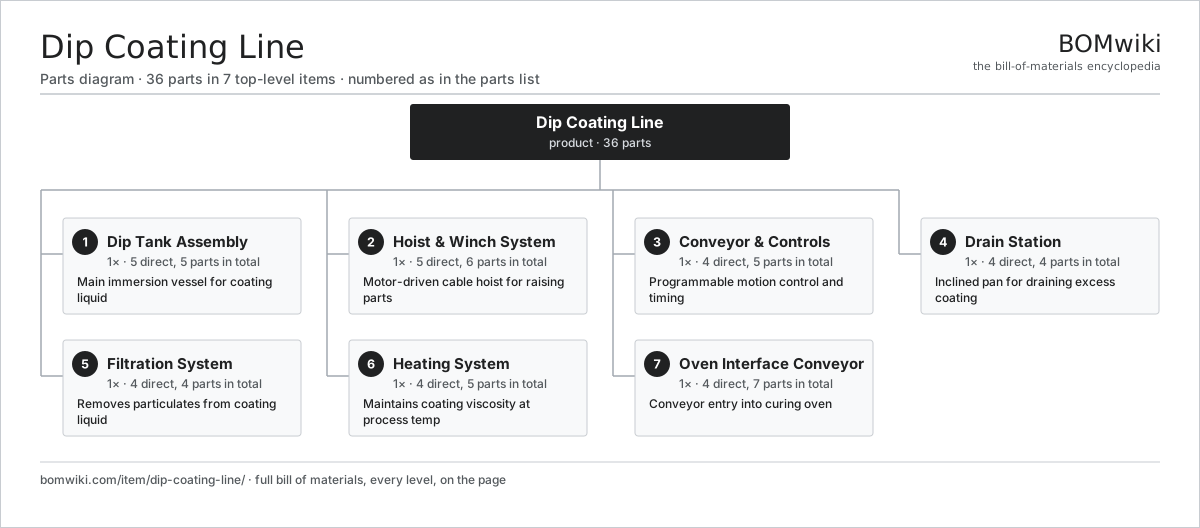
| # | Part | Qty | What it does |
|---|---|---|---|
| 1 | Dip Tank Assembly 5 parts | 1× | Main immersion vessel for coating liquid |
| 2 | Hoist & Winch System 5 parts | 1× | Motor-driven cable hoist for raising parts |
| 3 | Conveyor & Controls 4 parts | 1× | Programmable motion control and timing |
| 4 | Drain Station 4 parts | 1× | Inclined pan for draining excess coating |
| 5 | Filtration System 4 parts | 1× | Removes particulates from coating liquid |
| 6 | Heating System 4 parts | 1× | Maintains coating viscosity at process temp |
| 7 | Oven Interface Conveyor 4 parts | 1× | Conveyor entry into curing oven |
3D model
No 3D model yet. Have a CAD file of this? Add a 3D model. STL renders right on this page; STEP, FreeCAD, and OpenSCAD sources are welcome too (openly licensed, like all 3D models on BOMwiki).
Build & assembly graph
expand / collapse · shared sub-assemblies converge · links to related products · est. labourTap an assembly to expand/collapse · tap a part to open it · use “Open page” for any node · drag to pan, scroll to zoom.
Bill of materials for Dip Coating Line
7 top-level lines · 37 rows shown · 36 parts total · indented to 3 levels| # | Item / sub-assembly | Part no. | Qty/assy | Ext. qty | Parts | Type |
|---|---|---|---|---|---|---|
| 1 | Dip Tank Assembly 5 parts | dip-coating-line-dip-tank | 1× | 1 | 5 | assembly |
| 1.1 | Tank Body | dip-coating-line-tank-body | 1× | 1 | · | part |
| 1.2 | Tank Heater | dip-coating-line-tank-heater | 1× | 1 | · | part |
| 1.3 | Tank Baffles | dip-coating-line-tank-baffles | 1× | 1 | · | part |
| 1.4 | Level Control Valve | dip-coating-line-level-control | 1× | 1 | · | part |
| 1.5 | Drain Valve | dip-coating-line-drain-valve | 1× | 1 | · | part |
| 2 | Hoist & Winch System 5 parts | dip-coating-line-hoist-winch | 1× | 1 | 6 | assembly |
| 2.1 | Electric Hoist Motor | dip-coating-line-electric-hoist | 1× | 1 | · | part |
| 2.2 | Cable Drum | dip-coating-line-cable-drum | 1× | 1 | · | part |
| 2.3 | Steel Hoist Cable | dip-coating-line-cable-steel | 1× | 1 | · | part |
| 2.4 | Hook Block Assembly | dip-coating-line-hook-block | 1× | 1 | · | part |
| 2.5 | Limit Switch | dip-coating-line-limit-switches | 2× | 2 | · | part |
| 3 | Conveyor & Controls 4 parts | dip-coating-line-conveyor-chain | 1× | 1 | 5 | assembly |
| 3.1 | PLC Controller | dip-coating-line-plc-controller | 1× | 1 | · | part |
| 3.2 | Frequency Drive | dip-coating-line-frequency-drive | 1× | 1 | · | part |
| 3.3 | Proximity Sensor | dip-coating-line-proximity-sensors | 2× | 2 | · | part |
| 3.4 | Control Pendant | dip-coating-line-pushbutton-pendant | 1× | 1 | · | part |
| 4 | Drain Station 4 parts | dip-coating-line-drain-station | 1× | 1 | 4 | assembly |
| 4.1 | Drain Pan | dip-coating-line-drain-pan | 1× | 1 | · | part |
| 4.2 | Drain Motor | dip-coating-line-drain-motor | 1× | 1 | · | part |
| 4.3 | Pan Liner Insert | dip-coating-line-pan-liners | 1× | 1 | · | part |
| 4.4 | Drain Return Tube | dip-coating-line-drain-return | 1× | 1 | · | part |
| 5 | Filtration System 4 parts | dip-coating-line-filtration-system | 1× | 1 | 4 | assembly |
| 5.1 | Filter Housing | dip-coating-line-filter-housing | 1× | 1 | · | part |
| 5.2 | Filter Cartridge | dip-coating-line-filter-cartridge | 1× | 1 | · | part |
| 5.3 | Bypass Valve | dip-coating-line-bypass-valve | 1× | 1 | · | part |
| 5.4 | Circulation Pump | dip-coating-line-circulation-pump | 1× | 1 | · | part |
| 6 | Heating System 4 parts | dip-coating-line-heating-system | 1× | 1 | 5 | assembly |
| 6.1 | Immersion Heater | dip-coating-line-immersion-heater | 2× | 2 | · | part |
| 6.2 | Temperature Controller | dip-coating-line-thermostat-controller | 1× | 1 | · | part |
| 6.3 | Temperature Probe | dip-coating-line-temperature-probe | 1× | 1 | · | part |
| 6.4 | Heater Contactor | dip-coating-line-contactor | 1× | 1 | · | part |
| 7 | Oven Interface Conveyor 4 parts | dip-coating-line-oven-interface | 1× | 1 | 7 | assembly |
| 7.1 | Conveyor Motor | dip-coating-line-conveyor-motor | 1× | 1 | · | part |
| 7.2 | Conveyor Speed Control | dip-coating-line-conveyor-drive | 1× | 1 | · | part |
| 7.3 | Conveyor Roller | dip-coating-line-rollers | 4× | 4 | · | part |
| 7.4 | Drive Belt & Pulleys | dip-coating-line-drive-belt | 1× | 1 | · | part |
Something wrong in this list? Report a problem with this BOM.
Sourcing: possible vendors
Browse the supplier directory → Prices, MOQ, and lead times are algorithmic estimates, not quotes, and not claims about these companies. Company mappings are curated by keyword; est. price band $5k–$2M. How estimates work| Vendor | HQ | Specialty | MOQ | Lead time |
|---|---|---|---|---|
| atlascopco.com ↗ | Stockholm, SE | Compressors & industrial | 10 units | 12–20 wks |
|
🇦🇹Andritz
andritz.com ↗
|
Graz, AT | Process plants & machinery | 10 units | 12–20 wks |
| buhlergroup.com ↗ | Uzwil, CH | Food & materials processing | 10 units | 12–20 wks |
| gea.com ↗ | Düsseldorf, DE | Process technology | 10 units | 12–20 wks |
| mhi.com ↗ | Tokyo, JP | Heavy machinery | 10 units | 12–20 wks |
1,516-word article