Disc Refiner
ProductOverview
The disc refiner is a mechanical pulp treatment machine that fibrillates or grinds fibers through controlled interaction between a rotating rotor disc and a stationary stator disc, both covered with bar patterns. Used extensively in tissue, newsprint, and packaging grades, the disc refiner develops fiber bonding without chemical modification, adding 500–1500 J/m² to paper tensile strength per 100 kWh/t of energy input. A typical tissue mill operates refiners at 200–400 kWh/t; a kraft pulp may require 50–200 kWh/t for adequate drainage without over-refining.
Disc refiners operate at 100–3000 kW depending on capacity. A single-rotor unit producing 50 t/day of tissue at 500 kWh/t consumes approximately 1000 kW of electrical power, making energy efficiency a primary economic driver. The specific energy (kWh per tonne of dry fiber) is the key control variable; exceeding the setpoint causes fiber over-fibrillation, which weakens paper and reduces drainage rate on the paper machine.
How It Works
Refining Process
Dilute pulp suspension (2–5% consistency) enters the disc refiner via the Inlet Pipe and travels along the Distributor Tube toward the Refining Chamber. The rotating Rotor Disc (800–3000 rpm) faces a fixed Stator Disc; between them lies a thin gap (0.5–2.0 mm) controlled by the Gap Adjustment System system.
The Bar Pattern on both discs, typically 2–3 mm bar width with 30–60° angle, creates shear and compression forces on fibers passing radially outward from the disc center. Unlike grinding refiners (which crush fibers), disc refiners fibrillate the fiber wall through controlled fiber-to-fiber collisions and shear. Bar spacing determines intensity: coarse spacing (4–5 mm) produces low-intensity refining for hardwood; fine spacing (1–2 mm) intensifies shear for softwood or recycled fiber.
Gap Control and Energy Management
The Gap Adjustment System maintains disc spacing via a Gap Adjustment Cylinder (pneumatic or hydraulic actuator) responding to a Gap Sensor (inductive or laser proximity sensor). As fibers fibrillate, they swell and partially fill the gap; the gap must close slightly to maintain refining intensity as fiber properties evolve during the refining process. A Gap Control Valve proportional solenoid adjusts pilot pressure to hold the gap within ±0.2 mm of setpoint.
The Motor and Drive System draws power proportional to gap closure, rotor speed, and slurry consistency. A Torque Cell measures real-time torque; the Refiner PLC calculates specific energy (kWh/t) by dividing motor power (kW) by Feed Pump flow rate (t/h). If specific energy exceeds setpoint (e.g., 500 kWh/t for tissue), the PLC commands gap opening to reduce intensity. This feedback loop prevents over-refining, which would impair drainage and weaken paper.
Heat Management
Refining generates substantial frictional heat: a 500 kW refiner at 80% gap efficiency converts 400 kW into thermal energy, raising slurry temperature 5–10°C per pass. The Cooling System circulates chilled water through the refiner casing at 50–200 L/min via a Cooling Pump. A Heat Exchanger (plate frame or shell-tube, 500–2000 kW capacity) removes heat, keeping outlet fiber temperature at 40–50°C. A Temperature Sensor (RTD Pt100) feeds back to the Cooling Flow Valve, which adjusts cooling water bypass to maintain stable outlet temperature.
Slurry Flow Path
Refined slurry accelerates radially outward by centrifugal force and exits through the Discharge Pipe into the Collection Tank. An optional Screen Basket (200–500 micron) removes shive (incompletely separated fiber bundles) before storage. The Outlet Valve controls discharge flow rate and allows isolation for maintenance.
Fiber Development and Refining Metrics
Refining develops fibers in three stages:
Primary fibrillation: The fiber external fibrils delaminate from the fiber wall; fiber length decreases by 1–5%. Tear strength and tensile increase rapidly.
Secondary fibrillation: The internal fiber wall fibrillates; swelling increases 10–20%. Drainage on the paper machine slows significantly (freeness drops from 500 to 100 mL CSF); tensile strength plateaus or declines if over-refined.
Over-refining: Fibrillation continues into the fiber interior; fibers fragment. Paper becomes weak and brittle; drainage may remain slow (poor paper machine productivity).
The optimal refining energy depends on pulp origin, target paper grade, and source fiber length. Softwood kraft (long fiber, 2–3 mm) typically requires 100–300 kWh/t; hardwood kraft (short fiber, 1 mm) requires 200–400 kWh/t; recycled fiber may need 300–600 kWh/t for adequate bonding.
Operational Considerations
Specific Energy Control: Modern refiners employ a Power Meter and Refiner PLC to maintain specific energy within ±5% of target. Feed rate is modulated or rotor speed adjusted to achieve constant kWh/t despite variation in fiber properties.
Disc Wear: The Stator Disc and Rotor Disc wear progressively due to fiber abrasion and impact. Wear plates can extend disc life from 6 months to 2 years. Replacement typically occurs at 300–500 operating days, making refiner maintenance a significant mill cost (USD 50,000–150,000 per replacement).
Vibration Management: Disc refiners generate 5–10 Hz vibration from bar impact. The Vibration Isolator isolates the refiner from building floors, protecting structural integrity and nearby equipment.
Integration: The disc refiner typically sits between pulp storage and a paper machine headbox, or between pulp digestion and screening/cleaning. Modern tissue mills often use two parallel refiners in series (primary + secondary) to balance energy input and fiber properties.
Economics
Refining is the third-largest energy cost in a tissue mill after steam (drying) and fiber (raw material). Optimizing specific energy saves 50–100 kW continuously. For a 50 t/day mill at 500 kWh/t and USD 0.10/kWh, reducing energy by 10% saves USD 20,000/year. Predictive maintenance using torque trends and temperature monitoring reduces unplanned downtime from 2% to <0.5% annually.
Disc Refiner parts and their functions
8 top-level parts · 38 parts in total · full bill of materials below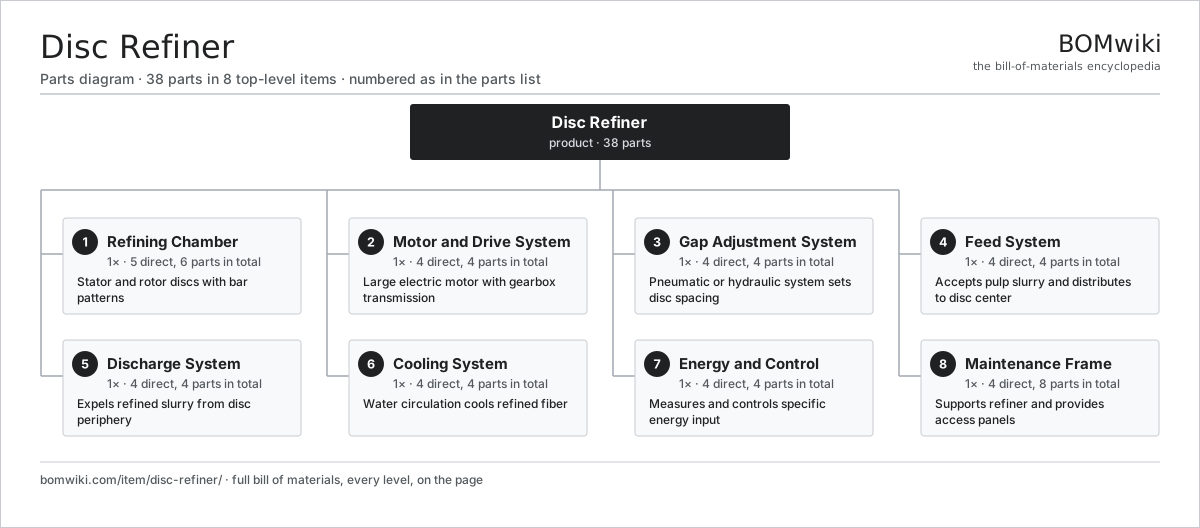
| # | Part | Qty | What it does |
|---|---|---|---|
| 1 | Refining Chamber 5 parts | 1× | Stator and rotor discs with bar patterns |
| 2 | Motor and Drive System 4 parts | 1× | Large electric motor with gearbox transmission |
| 3 | Gap Adjustment System 4 parts | 1× | Pneumatic or hydraulic system sets disc spacing |
| 4 | Feed System 4 parts | 1× | Accepts pulp slurry and distributes to disc center |
| 5 | Discharge System 4 parts | 1× | Expels refined slurry from disc periphery |
| 6 | Cooling System 4 parts | 1× | Water circulation cools refined fiber |
| 7 | Energy and Control 4 parts | 1× | Measures and controls specific energy input |
| 8 | Maintenance Frame 4 parts | 1× | Supports refiner and provides access panels |
3D model
No 3D model yet. Have a CAD file of this? Add a 3D model. STL renders right on this page; STEP, FreeCAD, and OpenSCAD sources are welcome too (openly licensed, like all 3D models on BOMwiki).
Build & assembly graph
expand / collapse · shared sub-assemblies converge · links to related products · est. labourTap an assembly to expand/collapse · tap a part to open it · use “Open page” for any node · drag to pan, scroll to zoom.
Bill of materials for Disc Refiner
8 top-level lines · 41 rows shown · 38 parts total · indented to 3 levels| # | Item / sub-assembly | Part no. | Qty/assy | Ext. qty | Parts | Type |
|---|---|---|---|---|---|---|
| 1 | Refining Chamber 5 parts | disc-refiner-refining-chamber | 1× | 1 | 6 | assembly |
| 1.1 | Stator Disc | disc-refiner-stator-disc | 1× | 1 | · | part |
| 1.2 | Rotor Disc | disc-refiner-rotor-disc | 1× | 1 | · | part |
| 1.3 | Bar Pattern | disc-refiner-bar-geometry | 1× | 1 | · | part |
| 1.4 | Wear Plate | disc-refiner-wear-plate | 2× | 2 | · | part |
| 1.5 | Mechanical Seal | disc-refiner-seal-assembly | 1× | 1 | · | part |
| 2 | Motor and Drive System 4 parts | disc-refiner-motor-drive | 1× | 1 | 4 | assembly |
| 2.1 | Electric Motor | disc-refiner-electric-motor | 1× | 1 | · | part |
| 2.2 | Reduction Gearbox | disc-refiner-gearbox | 1× | 1 | · | part |
| 2.3 | Flexible Coupling | disc-refiner-motor-coupling | 1× | 1 | · | part |
| 2.4 | Torque Cell | disc-refiner-torque-transducer | 1× | 1 | · | part |
| 3 | Gap Adjustment System 4 parts | disc-refiner-gap-adjustment | 1× | 1 | 4 | assembly |
| 3.1 | Gap Sensor | disc-refiner-gap-sensor | 1× | 1 | · | part |
| 3.2 | Gap Adjustment Cylinder | disc-refiner-gap-cylinder | 1× | 1 | · | part |
| 3.3 | Pressure Gauge | disc-refiner-pressure-gauge | 1× | 1 | · | part |
| 3.4 | Gap Control Valve | disc-refiner-control-valve | 1× | 1 | · | part |
| 4 | Feed System 4 parts | disc-refiner-feed-system | 1× | 1 | 4 | assembly |
| 4.1 | Inlet Pipe | disc-refiner-inlet-pipe | 1× | 1 | · | part |
| 4.2 | Distributor Tube | disc-refiner-distributer-tube | 1× | 1 | · | part |
| 4.3 | Feed Pump | disc-refiner-feed-pump | 1× | 1 | · | part |
| 4.4 | Flow Meter | disc-refiner-flow-meter | 1× | 1 | · | part |
| 5 | Discharge System 4 parts | disc-refiner-discharge-system | 1× | 1 | 4 | assembly |
| 5.1 | Discharge Pipe | disc-refiner-discharge-pipe | 1× | 1 | · | part |
| 5.2 | Screen Basket | disc-refiner-screen-basket | 1× | 1 | · | part |
| 5.3 | Outlet Valve | disc-refiner-outlet-valve | 1× | 1 | · | part |
| 5.4 | Collection Tank | disc-refiner-pulp-recovery-tank | 1× | 1 | · | part |
| 6 | Cooling System 4 parts | disc-refiner-cooling-system | 1× | 1 | 4 | assembly |
| 6.1 | Cooling Pump | disc-refiner-cooling-pump | 1× | 1 | · | part |
| 6.2 | Heat Exchanger | disc-refiner-heat-exchanger | 1× | 1 | · | part |
| 6.3 | Temperature Sensor | disc-refiner-temperature-sensor | 1× | 1 | · | part |
| 6.4 | Cooling Flow Valve | disc-refiner-flow-control-valve | 1× | 1 | · | part |
| 7 | Energy and Control 4 parts | disc-refiner-energy-monitoring | 1× | 1 | 4 | assembly |
| 7.1 | Power Meter | disc-refiner-power-meter | 1× | 1 | · | part |
| 7.2 | Gap Display | disc-refiner-gap-feedback | 1× | 1 | · | part |
| 7.3 | Refiner PLC | disc-refiner-plc | 1× | 1 | · | part |
| 7.4 | HMI Panel | disc-refiner-hmi-panel | 1× | 1 | · | part |
| 8 | Maintenance Frame 4 parts | disc-refiner-maintenance-frame | 1× | 1 | 8 | assembly |
| 8.1 | Base Frame | disc-refiner-base-frame | 1× | 1 | · | part |
| 8.2 | Access Door | disc-refiner-access-door | 1× | 1 | · | part |
| 8.3 | Lifting Lug | disc-refiner-lifting-eye | 2× | 2 | · | part |
| 8.4 | Vibration Isolator | disc-refiner-vibration-dampener | 4× | 4 | · | part |
Something wrong in this list? Report a problem with this BOM.
Sourcing: possible vendors
Browse the supplier directory → Prices, MOQ, and lead times are algorithmic estimates, not quotes, and not claims about these companies. Company mappings are curated by keyword; est. price band $5k–$2M. How estimates work| Vendor | HQ | Specialty | MOQ | Lead time |
|---|---|---|---|---|
| atlascopco.com ↗ | Stockholm, SE | Compressors & industrial | 10 units | 12–20 wks |
|
🇦🇹Andritz
andritz.com ↗
|
Graz, AT | Process plants & machinery | 10 units | 12–20 wks |
| buhlergroup.com ↗ | Uzwil, CH | Food & materials processing | 10 units | 12–20 wks |
| gea.com ↗ | Düsseldorf, DE | Process technology | 10 units | 12–20 wks |
| mhi.com ↗ | Tokyo, JP | Heavy machinery | 10 units | 12–20 wks |
1,008-word article