HV Disconnect Switch
ProductOverview
A HV Disconnect Switch is a non-load-breaking isolating switch designed to manually open or close high-voltage circuits once they are de-energized or under no-load conditions. Unlike circuit breakers or load-break switches, a HV Disconnect Switch cannot interrupt fault currents; its sole function is to provide a visible, mechanical separation of live conductors for safe maintenance and equipment testing on high-voltage transmission and distribution networks.
The HV Disconnect Switch consists of a rotating Blade and Carriage Assembly that moves from one fixed contact to another (or both simultaneously in three-phase designs). The Insulator Support Columns support the blade and contacts while maintaining electrical insulation from ground. An Operating Mechanism driven by hand lever or solenoid rotates the blade through 90 degrees, and an optional Grounding Blade Assembly automatically shorts the circuit to ground when the main blade opens, providing a visible proof of zero voltage.
How it works
The Blade and Carriage Assembly pivots on two Pivot Pin and Bearing hinges mounted to the Base Frame and Pedestal. When the operator pulls the Hand Operating Lever, mechanical linkage or gears drive the pivot, rotating the blade from the closed position (blade parallel to and touching fixed Silver Contact Finger Set) to the fully open position (blade perpendicular to contacts, 6–12 mm of air clearance). Throughout the travel, Compression Spring elements maintain firm contact force on the Silver Contact Finger Set, ensuring low-resistance connections and minimal arcing.
The Porcelain Insulator columns withstand the full operating voltage (e.g., 345 kV phase-to-ground) and support all moving and fixed conductors. The Insulator Cap Ferrule ferrules bond contact arms to the insulators, ensuring mechanical and electrical integrity. Three Insulator Support Columns are typically arranged in a delta or vertical configuration, one for each phase.
When the main Moving Conductor Blade opens, a Ground-Blade Cam linkage simultaneously closes the Grounding Blade, which shorts all three phases to a dedicated ground lug. This grounding blade provides visible proof that no voltage is present on the circuit; maintenance personnel can then trust the Position Limit Switch reading and apply portable grounds if needed.
Contact Materials and Wear
The Silver Contact Finger Set is typically molded or riveted from a silver-cadmium or silver-alloy composition. These materials resist oxidation and maintain low contact resistance (10–50 mΩ per contact pair) across millions of switching cycles. However, arcing during separation (especially under light inductive loads where restriking can occur) gradually erodes the silver surface, forming a gray oxide layer. The contact resistance rises slowly over decades; a disconnect switch rated for 600 operations/year will require silver-alloy refurbishment or replacement after 30–50 years of service. The Compression Spring provides the wiping force that displaces oxides and maintains conductivity; as springs age and relax, contact resistance degrades faster.
Insulator Types
Traditional Porcelain Insulator columns are glazed ceramic, brittle but reliable in high-voltage service. Modern replacements use Porcelain Insulator of silicone-composite material: lighter, shatter-resistant, and superior in wet/foggy coastal environments where salt spray attacks porcelain. Both materials are dimensioned using IEC 60383 creepage and clearance rules: creepage distance (along the surface) must be at least 80 mm per kV, and gap distance (air clearance) must be at least 8–10 mm per kV. A 345 kV switch thus requires insulators 27+ m of creepage distance, achieved by stacking multiple disc-type units or using long-rod composite designs.
Mechanical Interlocks and Safety
The Mechanical Interlocks and Indicators section includes two Position Limit Switch limit switches (one at open, one at closed) that confirm blade position and signal to SCADA systems. Many utilities also fit a Operation Counter that records the number of operations, informing maintenance decisions. A padlock hasp on the Hand Operating Lever prevents accidental re-engagement while maintenance is in progress; the padlock can be affixed only when the lever is in the full-open position, providing a mechanical lock-out/tag-out (LOTO) function.
Operating Mechanisms: Manual vs. Solenoid
Manual operation uses a long Hand Operating Lever (1–2 m length) that provides a 100:1 mechanical advantage, allowing a single operator to rotate a 1200 A, 500 kV contact pair with modest hand force (~50 N). The lever is connected via a pin-jointed linkage or Gear or Linkage Assembly (spur gears) to the blade carriage. The motion is typically 2–4 seconds for a complete 90-degree open/close cycle.
Motorized Operating Mechanism employs a low-voltage Solenoid Actuator Coil (110V or 220V DC) that energizes a mechanical latch, allowing a spring-loaded gear train or stored-energy mechanism to rapidly rotate the blade. This is used on remote or frequently-operated switches; a control signal from a SCADA or protection relay coil triggers the solenoid. Motorized versions retain a manual handle override for emergency operation if power is lost.
Environmental and Electrical Stresses
In outdoor service, Porcelain Insulator surfaces accumulate dust, salt, and moisture, forming conductive paths that can initiate surface arcing (flashover). Weekly or monthly washing with deionized water and inspection are standard maintenance. In dry, clean environments (indoor substations), insulators rarely require intervention beyond annual visual checks.
Electrical transients (lightning, switching surges) can induce overvoltages up to 2–3 times nominal kV across the switch's air gap. The gap distance is designed so that the breakdown voltage (flashover voltage) exceeds these peaks by a safety margin (typically 1.5–2×). For a 345 kV switch, a 4 m air gap (across three phases) provides ~1800 kV flashover voltage, safely above the 900–1200 kV transient peaks.
Maintenance Schedule
Annual: Visual inspection of Porcelain Insulator, contact condition, and fastener security. 5–10 years: Contact resistance measurement (megger or DC voltage drop test); silver-alloy refurbishment if resistance exceeds 100 mΩ per phase. 15–30 years: Spring tension check on Compression Spring; replacement if deflection has dropped >20%. 50 years: Full contact replacement or switch overhaul; consider upgrade to modern composite Porcelain Insulator for improved reliability.
Integration with Protection and Automation
The Position Limit Switch signals integrate with substation SCADA, where they appear in the operator interface as open/closed indicators. Automated schemes can inhibit line reclosure relays if the disconnect switch is not fully closed, preventing nuisance tripping. The Grounding Blade Assembly provides a safeguard: if a maintenance crew forgets to close the disconnect before testing, the grounding blade will short the test source, drawing sufficient current to trip upstream protection.
Three-Phase Configuration
A typical three-phase HV Disconnect Switch uses three independent Blade and Carriage Assembly assemblies (one per phase), all driven by a single Operating Mechanism. The mechanical linkage ensures all blades move together in a coordinated manner: they reach open position simultaneously, preventing voltage imbalance issues on three-phase circuits. The blades are often offset vertically or in a triangle pattern to reduce the overall footprint while maintaining adequate spacing between live parts and ground.
HV Disconnect Switch parts and their functions
7 top-level parts · 36 parts in total · full bill of materials below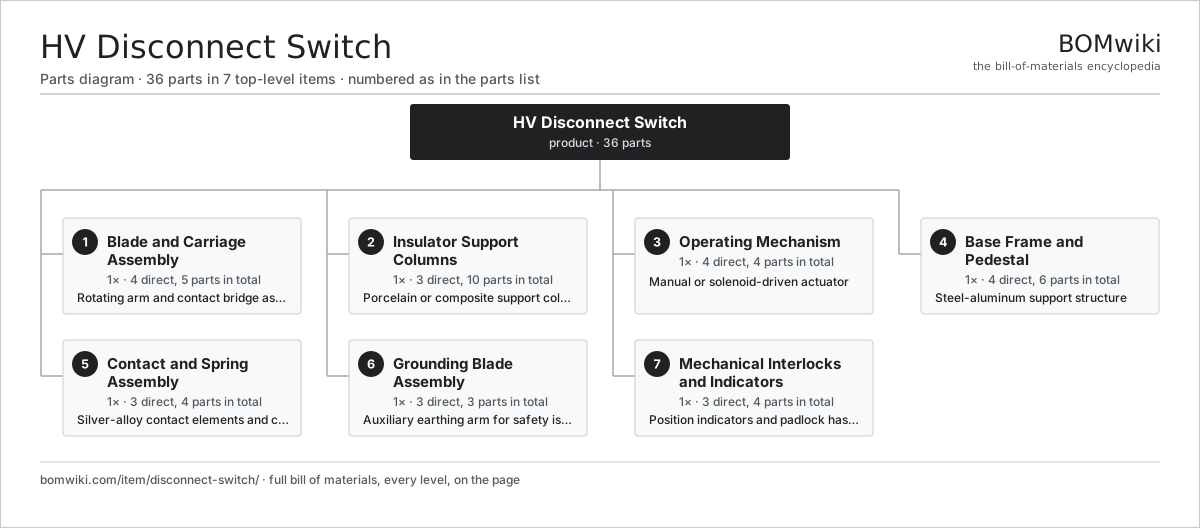
| # | Part | Qty | What it does |
|---|---|---|---|
| 1 | Blade and Carriage Assembly 4 parts | 1× | Rotating arm and contact bridge assembly |
| 2 | Insulator Support Columns 3 parts | 1× | Porcelain or composite support columns |
| 3 | Operating Mechanism 4 parts | 1× | Manual or solenoid-driven actuator |
| 4 | Base Frame and Pedestal 4 parts | 1× | Steel-aluminum support structure |
| 5 | Contact and Spring Assembly 3 parts | 1× | Silver-alloy contact elements and compression springs |
| 6 | Grounding Blade Assembly 3 parts | 1× | Auxiliary earthing arm for safety isolation |
| 7 | Mechanical Interlocks and Indicators 3 parts | 1× | Position indicators and padlock hasps |
3D model
No 3D model yet. Have a CAD file of this? Add a 3D model. STL renders right on this page; STEP, FreeCAD, and OpenSCAD sources are welcome too (openly licensed, like all 3D models on BOMwiki).
Build & assembly graph
expand / collapse · shared sub-assemblies converge · links to related products · est. labourTap an assembly to expand/collapse · tap a part to open it · use “Open page” for any node · drag to pan, scroll to zoom.
Bill of materials for HV Disconnect Switch
7 top-level lines · 31 rows shown · 36 parts total · indented to 3 levels| # | Item / sub-assembly | Part no. | Qty/assy | Ext. qty | Parts | Type |
|---|---|---|---|---|---|---|
| 1 | Blade and Carriage Assembly 4 parts | disconnect-switch-blade-carriage | 1× | 1 | 5 | assembly |
| 1.1 | Moving Conductor Blade | disconnect-switch-moving-blade | 1× | 1 | · | part |
| 1.2 | Carriage Frame | disconnect-switch-carriage-frame | 1× | 1 | · | part |
| 1.3 | Pivot Pin and Bearing | disconnect-switch-bearing-pin | 2× | 2 | · | part |
| 1.4 | Fastener Set | fastener-set | 1× | 1 | · | part |
| 2 | Insulator Support Columns 3 parts | disconnect-switch-insulator-stacks | 1× | 1 | 10 | assembly |
| 2.1 | Porcelain Insulator | disconnect-switch-porcelain-insulator | 3× | 3 | · | part |
| 2.2 | Insulator Cap Ferrule | disconnect-switch-insulator-caps | 6× | 6 | · | part |
| 2.3 | Fastener Set | fastener-set | 1× | 1 | · | part |
| 3 | Operating Mechanism 4 parts | disconnect-switch-operating-mechanism | 1× | 1 | 4 | assembly |
| 3.1 | Hand Operating Lever | disconnect-switch-handle-lever | 1× | 1 | · | part |
| 3.2 | Solenoid Actuator Coil | disconnect-switch-solenoid-coil | 1× | 1 | · | part |
| 3.3 | Gear or Linkage Assembly | disconnect-switch-gear-linkage | 1× | 1 | · | part |
| 3.4 | Connector | connector | 1× | 1 | · | part |
| 4 | Base Frame and Pedestal 4 parts | disconnect-switch-base-frame | 1× | 1 | 6 | assembly |
| 4.1 | Base Plate | disconnect-switch-base-plate | 1× | 1 | · | part |
| 4.2 | Vertical Support Post | disconnect-switch-vertical-posts | 2× | 2 | · | part |
| 4.3 | Cross-Brace Beam | disconnect-switch-cross-beams | 2× | 2 | · | part |
| 4.4 | Fastener Set | fastener-set | 1× | 1 | · | part |
| 5 | Contact and Spring Assembly 3 parts | disconnect-switch-contacts-springs | 1× | 1 | 4 | assembly |
| 5.1 | Silver Contact Finger Set | disconnect-switch-silver-contact-set | 1× | 1 | · | part |
| 5.2 | Compression Spring | disconnect-switch-compression-spring | 2× | 2 | · | part |
| 5.3 | Contact Arm Support | disconnect-switch-contact-arm | 1× | 1 | · | part |
| 6 | Grounding Blade Assembly 3 parts | disconnect-switch-grounding-blade | 1× | 1 | 3 | assembly |
| 6.1 | Grounding Blade | disconnect-switch-ground-blade | 1× | 1 | · | part |
| 6.2 | Ground-Blade Cam | disconnect-switch-ground-cam | 1× | 1 | · | part |
| 6.3 | Fastener Set | fastener-set | 1× | 1 | · | part |
| 7 | Mechanical Interlocks and Indicators 3 parts | disconnect-switch-mechanical-interlocks | 1× | 1 | 4 | assembly |
| 7.1 | Position Limit Switch | disconnect-switch-position-sensor | 2× | 2 | · | part |
| 7.2 | Operation Counter | disconnect-switch-mechanical-counter | 1× | 1 | · | part |
| 7.3 | Connector | connector | 1× | 1 | · | part |
Something wrong in this list? Report a problem with this BOM.
Sourcing: possible vendors
Browse the supplier directory → Prices, MOQ, and lead times are algorithmic estimates, not quotes, and not claims about these companies. Company mappings are curated by keyword; est. price band $5k–$50M. How estimates work| Vendor | HQ | Specialty | MOQ | Lead time |
|---|---|---|---|---|
| gevernova.com ↗ | Cambridge, US | Power generation | made to order | 20–40 wks |
| siemens-energy.com ↗ | Munich, DE | Power & grid | made to order | 20–40 wks |
| hitachienergy.com ↗ | Zurich, CH | Grid & transformers | made to order | 20–40 wks |
|
🇨🇭ABB
abb.com ↗
|
Zurich, CH | Electrification & automation | made to order | 20–40 wks |
| se.com ↗ | Rueil-Malmaison, FR | Electrical & automation | made to order | 20–40 wks |
1,197-word article