Distillation Column Product
Overview
The distillation column is the central separation unit of a refinery crude unit. It splits desalted, preheated crude oil into product cuts by boiling point: overhead naphtha and light gas, kerosene and diesel side draws, and a heavy atmospheric residue from the bottoms. Crude enters partially vaporized in the flash zone and the lighter fractions rise as vapor while the heavier liquid falls, with each tray or packing layer acting as an equilibrium contact stage.
A full column is more than the tower: it includes the heat-input and heat-removal equipment, the accumulator that sets reflux, and the pumps and instrumentation that hold the cut points steady against changing crude quality.
How it works
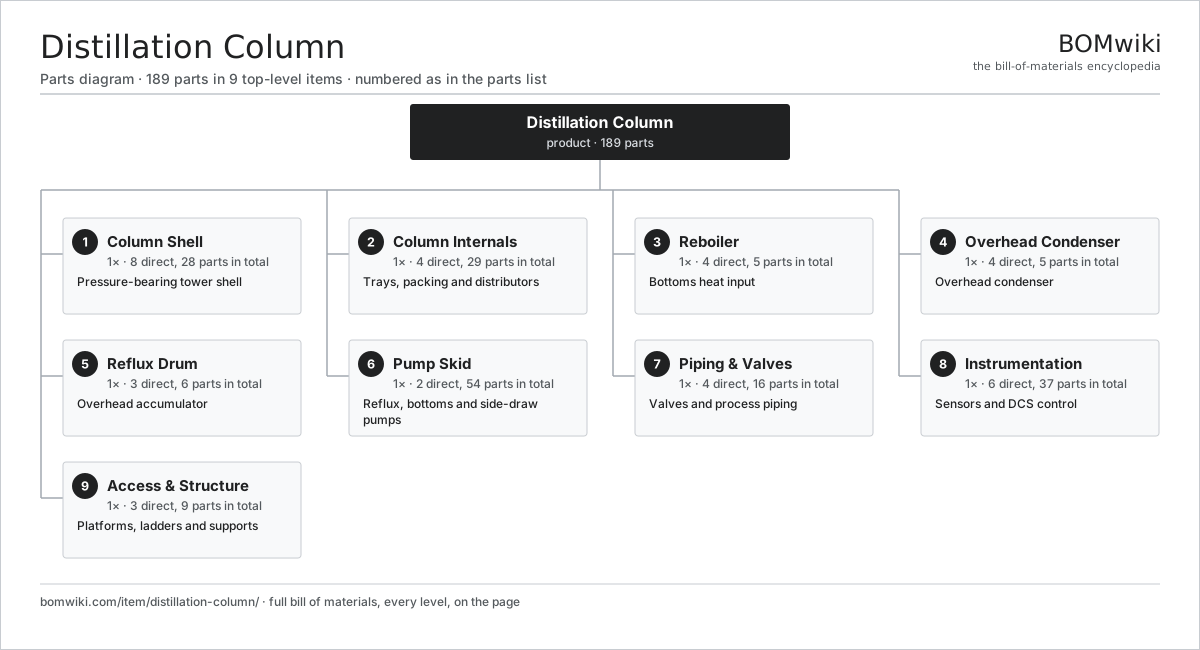
Hot feed flashes in the lower section; vapor rises through the Column Internals, where valve trays in the upper rectifying zone and structured packing beds lower down repeatedly condense and re-vaporize the stream so each component concentrates at the tray matching its boiling point. The pressure-bearing Column Shell carries these internals across stacked cylindrical courses, with nozzles for the feed, side draws and instruments.
Bottoms liquid is partially vaporized in the Reboiler, a kettle exchanger that returns stripping vapor to the base. Overhead vapor passes to the Overhead Condenser, where cooling water liquefies it; the condensate collects in the Reflux Drum, which separates net product, reflux and any water boot draw. The Pump Skid return reflux to the top tray and move bottoms and side-draw product downstream.
Cut points are held by the Instrumentation package: differential-pressure level transmitters, a tray temperature profile, and orifice flow loops feed DCS controllers that modulate reflux, reboiler duty and draw rates through the Piping & Valves control valves. Spring-loaded relief valves guard against overpressure. The Access & Structure platforms and caged ladders give maintenance crews reach to every manway elevation along the 52 m tower.', },
'drilling-top-drive': { specs: [ ['Type', 'AC top drive, derrick-mounted'], ['Hoisting capacity', '650 t (1,000 hp class)'], ['Continuous drilling torque', '60,000 ft·lbf (81 kN·m)'], ['Make-up torque', '95,000 ft·lbf'], ['Drilling speed', '0–230 rpm'], ['Drive motor power', '1,150 hp (858 kW)'], ['Quill bore', '3 in. (76 mm)'], ['Mud working pressure', '7,500 psi (517 bar)'], ['IBOP bore', '3 in. full-open'], ['Pipe handler rotation', '±185° (360° optional)'], ['Cooling', 'Forced-air blower, 4,500 m³/h'], ['Power supply', '600 VAC via VFD'], ['Dry weight', '14.5 t'], ], body: '## Overview
A drilling top drive replaces the rotary table and kelly on a modern rig. Suspended from the traveling block and guided down a derrick rail, it rotates the drill string directly from a powered swivel at the top of the stand. This lets the crew drill in 90-foot triple stands rather than single joints, ream up and down, and break circulation at any point in the hole, which shortens connection time and reduces stuck-pipe risk.
The unit combines a powered rotary drive, an integral mud passage, and a pipe-handling system that makes and breaks connections without a separate floor crew operating tongs.
How it works
Rig power is converted in the VFD Drive Cabinet to controlled voltage and frequency, driving the AC Drive Motor across a wide torque-speed range. The motor feeds the two-stage Reduction Gearbox, which steps speed down to drilling torque at the Main Shaft / Quill — a hollow drive stem that carries both the hoisting load and the mud flow, sealing the rotating-to-static transition through replaceable wash-pipe packing.
High-pressure mud reaches the quill bore through the Swivel & Mud Connection and its cast gooseneck from the standpipe hose. Reactive torque is taken by the Guide Dolly, a roller carriage running on the derrick guide beam that also constrains vertical travel.
Connections are handled by the Pipe Handler: a rotating head carrying a hydraulic torque wrench, link-tilt cylinders, the IBOP safety valve and a sacrificial saver sub. Below it the Bails & Elevator suspend the elevator that latches and hoists tubulars. A spring-applied Disc Brake parks the quill, and the driller coordinates rotation, torque and handler functions from the Driller Control System console.', },
'gas-compressor-station': { specs: [ ['Service', 'Pipeline gas boosting'], ['Driver', 'Two-shaft industrial gas turbine'], ['Driver power (ISO)', '23 MW'], ['Compressor type', 'Multi-stage barrel centrifugal'], ['Compression stages', '6'], ['Suction pressure', '45 bar (650 psi)'], ['Discharge pressure', '92 bar (1,335 psi)'], ['Pressure ratio', '2.05'], ['Throughput', '14 MMSm³/day'], ['Compressor speed', '9,200 rpm'], ['Polytropic efficiency', '84 %'], ['Shaft sealing', 'Tandem dry gas seals'], ['Enclosure rating', 'Acoustic, ATEX Zone 2'], ['Package weight', '210 t'], ], body: '## Overview
A gas compressor station boosts pipeline pressure to keep gas moving over long transmission distances and to deliver it into higher-pressure systems. This package is a skid-mounted gas-turbine-driven centrifugal compressor train: a self-contained unit carrying the prime mover, compressor, all auxiliary oil and control systems, and a ventilated acoustic enclosure, designed to run unattended for long intervals between maintenance.
The centrifugal machine is chosen for high, steady throughput at moderate pressure ratio, which suits trunk-line duty better than reciprocating compression.
Construction
The whole train sits on the Skid & Acoustic Enclosure, a welded baseplate with machined mounting pads inside a sound-attenuating housing with forced ventilation. Power comes from the Gas Turbine Driver, a two-shaft turbine whose free power turbine drives the load independent of gas-generator speed, giving good part-load efficiency. Its output passes through the Speed-Increasing Gearbox, which matches power-turbine speed to the compressor through flexible disc couplings.
The Centrifugal Compressor is a barrel-cased rotor carrying six stacked impellers, with tilting-pad journal and thrust bearings and tandem dry gas seals that contain process gas without an oil barrier. Gas conditioning is handled by the Process Gas System: suction and discharge scrubbers remove liquids, a fast-acting anti-surge valve recycles flow to protect the machine at low rates, and check and relief valves guard the discharge.
Lubrication and seal supply come from the Lube & Seal Oil Console console with duplex filters and dual pumps. The Unit Control Panel runs turbine and compressor control, anti-surge logic and emergency shutdown, taking vibration and pressure inputs, while the Fire & Gas System system provides flame, gas and heat detection with clean-agent release.', },
'mud-pump': { specs: [ ['Type', 'Triplex single-acting reciprocating'], ['Rated input power', '1,600 hp (1,193 kW)'], ['Maximum discharge pressure', '7,500 psi (517 bar)'], ['Liner sizes', '5 in.–7.25 in.'], ['Maximum flow rate', '1,180 L/min (312 gpm) at 6.5 in. liner'], ['Rated speed', '120 strokes/min'], ['Stroke length', '12 in. (305 mm)'], ['Gear reduction ratio', '4.2 : 1'], ['Valve type', 'API No. 7 full-open'], ['Pulsation dampener pre-charge', '500 psi N₂'], ['Suction charge pressure', '30–50 psi'], ['Drive', 'AC motor, multi V-belt'], ['Dry weight', '26.5 t'], ], body: '## Overview
A drilling mud pump is the heart of a rig's circulating system. It forces drilling fluid down the drill string, out the bit nozzles to clear cuttings and cool the bit, and back up the annulus to the surface. This is a triplex single-acting design: three pistons fire in sequence so each delivers fluid only on its forward stroke, which smooths the discharge compared with a duplex pump and packs high horsepower into a compact frame.
The pump splits cleanly into a mechanical power end and a hydraulic fluid end, the two ends joined through crossheads and rods so that wearing fluid-end parts can be changed without disturbing the gear train.
Construction
The Power End holds a forged three-throw crankshaft driven through a bull-gear-and-pinion reduction in an oil-bath crankcase. Connecting rods drive three crossheads that slide in the frame guides, converting rotation into reciprocating motion and carrying the side thrust off the rods. Each crosshead pushes a pony rod through to the fluid side.
Three identical Fluid End Module cylinders do the pumping: a piston runs in a renewable bi-metal liner, and spring-loaded suction and discharge valves check the flow each stroke while a stuffing box seals the reciprocating rod. Charge fluid enters through the common Suction Manifold and high-pressure output collects in the Discharge Manifold.
A nitrogen-charged Pulsation Dampener absorbs the discharge pressure pulses, and the Pressure Relief Valve protects the line from overpressure. Power comes from the belt-driven Pump Drive, while the Liner Wash Pump circulates coolant over the piston backsides. The Control Panel houses the controller, pressure gauge and stroke counter reporting strokes-per-minute.', },
'oil-pumpjack': { specs: [ ['Type', 'Beam pumping unit (sucker-rod)'], ['API designation', 'C-456D-256-120'], ['Peak polished-rod load', '25,600 lbf (114 kN)'], ['Maximum stroke length', '120 in. (3.05 m)'], ['Pumping speed', '4–15 strokes/min'], ['Gearbox torque rating', '456,000 in·lbf'], ['Gear reduction ratio', '30 : 1 (double-reduction)'], ['Prime mover', '40 hp (30 kW) NEMA D motor'], ['Pumping depth', '1,800 m (5,900 ft)'], ['Production rate', '120 bbl/day'], ['Counterbalance', 'Rotary crank weights'], ['Control', 'Pump-off controller + VFD'], ['Unit weight', '12 t'], ], body: '## Overview
An oil pumpjack — a beam pumping unit — is the familiar nodding lift on land wells that lack the natural pressure to flow to surface. A surface engine drives a pivoting beam up and down, and the beam reciprocates a string of rods running thousands of feet to a subsurface plunger pump that lifts crude with each upstroke. It is the most common form of artificial lift because it is rugged, mechanically simple, and easy to service.
The unit converts continuous motor rotation into a slow reciprocating stroke, with counterweights storing energy on the down-stroke to even out the load the motor sees.
How it works
The Prime Mover (Electric Motor) drives through the V-Belt Drive into the Gear Reducer (Double-Reduction), a double-reduction gearbox that drops motor speed to a few strokes per minute while multiplying torque. The slow output shaft turns the Pitman, Crank & Counterweights assembly, whose cranks and counterweights drive the pitman arms.
Those arms rock the Walking Beam & Horsehead about its center bearing on the Samson Post (A-Frame) A-frame. The beam's horsehead and bridle keep the polished rod pulling vertically through the stroke. At the surface the Wellhead Interface carries the polished rod through a stuffing box and routes produced fluid out the pumping tee.
Below ground the Downhole Equipment string of sucker rods reciprocates an insert pump: on the upstroke the traveling valve closes and the standing valve opens to draw fluid into the barrel; on the downstroke the valves reverse and lift the column. A Crankshaft Brake parks the crank for service, and the Control Panel pump-off controller and VFD slow or idle the unit when the well draws down to prevent pumping the reservoir dry.', },
'subsea-wellhead': { specs: [ ['Type', 'Vertical subsea christmas tree'], ['Bore size', '5 in. × 2 in. (production × annulus)'], ['Wellhead housing bore', '18-3/4 in.'], ['Pressure rating', '15,000 psi (1,034 bar)'], ['Temperature rating', 'API PR2, –18 to 121 °C'], ['Water depth rating', '3,000 m (9,840 ft)'], ['Material class', 'API 6A HH (sour service)'], ['Valve actuation', 'Hydraulic, fail-safe-close'], ['Production valves', 'Master, wing, swab, crossover'], ['Choke', 'Multi-orifice, electric actuator'], ['Control', 'Electro-hydraulic multiplexed SCM'], ['Connector', 'Hydraulic collet, metal hub seal'], ['Tree weight (in air)', '85 t'], ], body: '## Overview
A subsea wellhead tree controls and routes hydrocarbon flow from a deepwater well into the production flowline, sitting on the seabed in place of the surface wellhead used on land. It contains the well pressure, provides the valves to open, throttle and shut in production, and gives a remotely operated vehicle the interfaces to operate and intervene without a rig on station. This is a vertical tree rated to 15,000 psi for a 3,000 m water depth, in sour-service materials.
The system stacks a structural high-pressure wellhead, the valve-bearing tree body, and the control and intervention hardware that lets it run unattended on the seabed for the field life.
Construction
The High-Pressure Wellhead Housing forms the structural foundation: a forged high-pressure housing landing the Casing Hanger strings with metal-to-metal annulus seals over a low-pressure conductor housing. Production tubing lands in the Production Tubing Hanger, whose stab plate aligns hydraulic and electric penetrations.
The Subsea Christmas Tree carries the production valve block — master, wing, swab and crossover gate valves, each a fail-safe-close slab gate driven by a spring-return hydraulic actuator — plus the production choke and an internal tree cap. The Connector System uses hydraulic collet connectors with API metal hub gaskets to lock the tree onto the wellhead and mate the flowlines.
Control runs through the Subsea Control Module, a retrievable module whose electronics, pilot solenoids and pressure/temperature sensors actuate the tree on multiplexed electro-hydraulic command. The Hydraulic Accumulator Bank stores hydraulic energy for fast valve response, and the ROV Interface Panel provides standardized torque buckets and hot-stab receptacles for ROV intervention and valve override.
Build & assembly graph
expand / collapse · shared sub-assemblies converge · links to related products · est. labourTap an assembly to expand/collapse · tap a part to open it · use “Open page” for any node · drag to pan, scroll to zoom.
Bill of materials
9 top-level lines · 58 rows shown · 189 parts total · indented to 3 levels| # | Item / sub-assembly | Part no. | Qty/assy | Ext. qty | Parts | Type |
|---|---|---|---|---|---|---|
| 1 | Column Shell 8 parts | distillation-column-shell | 1× | 1 | 28 | assembly |
| 1.1 | Shell Section | distillation-column-shell-section | 6× | 6 | — | part |
| 1.2 | Vessel Head | distillation-column-head | 2× | 2 | — | part |
| 1.3 | Support Skirt | distillation-column-skirt | 1× | 1 | — | part |
| 1.4 | Manway | distillation-column-manway | 4× | 4 | — | part |
| 1.5 | Process Nozzle | distillation-column-nozzle | 12× | 12 | — | part |
| 1.6 | Insulation & Cladding | distillation-column-insulation | 1× | 1 | — | part |
| 1.7 | O-Ring Set | oring-set | 1× | 1 | — | part |
| 1.8 | Fastener Set | fastener-set | 1× | 1 | — | part |
| 2 | Column Internals 4 parts | distillation-column-internals | 1× | 1 | 29 | assembly |
| 2.1 | Valve Tray | distillation-column-tray | 24× | 24 | — | part |
| 2.2 | Structured Packing Bed | distillation-column-packing | 2× | 2 | — | part |
| 2.3 | Liquid Distributor | distillation-column-distributor | 2× | 2 | — | part |
| 2.4 | Demister Pad | distillation-column-demister | 1× | 1 | — | part |
| 3 | Reboiler 4 parts | distillation-column-reboiler | 1× | 1 | 5 | assembly |
| 3.1 | Heating Tube Bundle | distillation-column-tube-bundle | 1× | 1 | — | part |
| 3.2 | Tubesheet | distillation-column-tubesheet | 2× | 2 | — | part |
| 3.3 | O-Ring Set | oring-set | 1× | 1 | — | part |
| 3.4 | Fastener Set | fastener-set | 1× | 1 | — | part |
| 4 | Overhead Condenser 4 parts | distillation-column-condenser | 1× | 1 | 5 | assembly |
| 4.1 | Condenser Tube Bundle | distillation-column-condenser-tubes | 1× | 1 | — | part |
| 4.2 | Tubesheet | distillation-column-tubesheet | 2× | 2 | — | part |
| 4.3 | O-Ring Set | oring-set | 1× | 1 | — | part |
| 4.4 | Fastener Set | fastener-set | 1× | 1 | — | part |
| 5 | Reflux Drum 3 parts | distillation-column-reflux-drum | 1× | 1 | 6 | assembly |
| 5.1 | Drum Vessel | distillation-column-drum-vessel | 1× | 1 | — | part |
| 5.2 | Process Nozzle | distillation-column-nozzle | 4× | 4 | — | part |
| 5.3 | Pressure Sensor | pressure-sensor | 1× | 1 | — | part |
| 6 | Pump Skid 2 parts | distillation-column-pumps | 1× | 1 | 54 | assembly |
| 6.1 | Process Pump 5 parts | distillation-column-process-pump | 2× | 2 | 26 | assembly |
| 6.1.1 | Stator Assembly 3 parts + deeper › | stator-assembly | 1× | 2 | 3 | assembly |
| 6.1.2 | Rotor Assembly 4 parts + deeper › | rotor-assembly | 1× | 2 | 19 | assembly |
| 6.1.3 | Pump Wet End | distillation-column-pump-casing | 1× | 2 | — | part |
| 6.1.4 | Ball Bearing | ball-bearing | 2× | 4 | — | part |
| 6.1.5 | O-Ring Set | oring-set | 1× | 2 | — | part |
| 6.2 | Coolant Pump | coolant-pump | 2× | 2 | — | part |
| 7 | Piping & Valves 4 parts | distillation-column-piping | 1× | 1 | 16 | assembly |
| 7.1 | Control Valve | distillation-column-control-valve | 4× | 4 | — | part |
| 7.2 | Pressure Relief Valve | distillation-column-relief-valve | 2× | 2 | — | part |
| 7.3 | Isolation Valve | distillation-column-isolation-valve | 8× | 8 | — | part |
| 7.4 | O-Ring Set | oring-set | 2× | 2 | — | part |
| 8 | Instrumentation 6 parts | distillation-column-instrumentation | 1× | 1 | 37 | assembly |
| 8.1 | Level Transmitter | distillation-column-level-transmitter | 2× | 2 | — | part |
| 8.2 | Pressure Sensor | pressure-sensor | 3× | 3 | — | part |
| 8.3 | Temperature Element | distillation-column-temperature-element | 4× | 4 | — | part |
| 8.4 | Flow Transmitter | distillation-column-flow-transmitter | 3× | 3 | — | part |
| 8.5 | DCS Control Module 4 parts | distillation-column-control-loop | 2× | 2 | 8 | assembly |
| 8.5.1 | Bare PCB | pcb-bare | 1× | 2 | — | part |
| 8.5.2 | Microcontroller | mcu | 1× | 2 | — | part |
| 8.5.3 | Relay | relay | 2× | 4 | — | part |
| 8.5.4 | Connector | connector | 4× | 8 | — | part |
| 8.6 | Local Control Panel 2 parts | distillation-column-control-panel | 1× | 1 | 9 | assembly |
| 8.6.1 | Wire Bundle | wire-bundle | 1× | 1 | — | part |
| 8.6.2 | Connector | connector | 8× | 8 | — | part |
| 9 | Access & Structure 3 parts | distillation-column-access | 1× | 1 | 9 | assembly |
| 9.1 | Access Platform | distillation-column-platform | 4× | 4 | — | part |
| 9.2 | Caged Ladder | distillation-column-ladder | 4× | 4 | — | part |
| 9.3 | Fastener Set | fastener-set | 1× | 1 | — | part |
Sourcing — likely vendors
Companies that make this · indicative price $10k–$50M · MOQ & lead are typical| Vendor | HQ | Specialty | MOQ | Lead time |
|---|---|---|---|---|
| 🇺🇸SLB slb.com ↗ | Houston, US | Oilfield services & equipment | made to order | 24–48 wks |
| halliburton.com ↗ | Houston, US | Oilfield services | made to order | 24–48 wks |
| bakerhughes.com ↗ | Houston, US | Energy technology | made to order | 24–48 wks |
| 🇺🇸NOV nov.com ↗ | Houston, US | Drilling equipment | made to order | 24–48 wks |
| technipfmc.com ↗ | London, GB | Subsea & surface systems | made to order | 24–48 wks |
2,242-word article