Spacecraft Docking Adapter
ProductOverview
The spacecraft docking adapter is a mechanical and electrical interface system that enables controlled autonomous capture, alignment, and structural mating between two spacecraft or between a spacecraft and a space station. Operating in the vacuum of space, the adapter must manage approach dynamics, provide redundant capture mechanisms, maintain environmental seals, and transfer power and data after successful docking. The adapter combines a soft-capture ring for initial contact absorption with hard-capture hooks for load-bearing lock, guided by proximity sensors and relative navigation cues.
Most docking systems employ an androgynous design, identical hardware on both vehicles, simplifying mission planning and enabling any spacecraft to dock with any port of compatible size. The system architecture separates concerns: the Soft Capture Ring absorbs impact energy and alignment errors, the Hard Capture Hooks provides fail-safe mechanical locking, and the Thermal and Pressure Seals maintain pressure boundary integrity. Approach is monitored by Proximity and Engagement Sensors providing continuous feedback to vehicle guidance; once aligned, the Docking Tunnel Structure forms a pressurized passage for crew and cargo transfer.
How it works
The docking sequence proceeds in discrete phases: approach, soft capture, alignment verification, and hard capture lock.
Approach phase. Each vehicle's guidance and relative navigation system computes a nominal approach vector, targeting the opposing docking port center at a closing rate of 0.1–0.3 m/s. The Laser Ranging Module module continuously measures separation distance, while gyroscopes and star trackers on each vehicle monitor angular alignment. Approaching vehicle maintains attitude hold until contact.
Soft capture. As the approaching vehicle makes initial contact with the Contact Fingers, the Compliance Pads compress elastically, absorbing relative kinetic energy. The compliant response (stiffness ~10–50 kN/m) allows angular and lateral misalignment, up to ±15° and ±100 mm, without damage. During this phase, the Approach Guide Assembly tapered funnel and Alignment Vanes passively correct off-axis approach, centering the vehicles. The Shock Damper Assembly hydraulic cylinders dissipate remaining energy, bringing relative velocity to near-zero within 2–5 seconds.
Alignment and capture confirmation. Once the vehicles are stationary relative each other, Proximity and Engagement Sensors, including Pressure Sensor elements and magnetic Hall Sensor switches on each hook, verify engagement and correct positioning. Position encoder data confirms that all four or six Hook Mechanism elements are in the engagement zone. This redundant confirmation prevents premature hard-capture.
Hard capture lock. Once alignment is confirmed, pyrotechnic or motor-driven Hook Actuator Motor elements actuate the Hard Capture Hooks hooks, swinging them into locked position over corresponding capture points on the opposing ring. Each hook is load-rated for the full axial and lateral load of the docked configuration (typically 50–200 kN depending on vehicle class). Springs maintain latch tension, and redundant locking pins prevent unintended release. Capture typically completes within 30–60 seconds.
Sealing and pressurization. Once hard capture is confirmed, the Thermal and Pressure Seals are energized, either by mechanical force from the docking mechanism or by pneumatic pressure. The primary O-Ring Set elements compress into their grooves, creating a near-zero-leakage boundary. The Metal Seal Ring provides redundant hard contact, and the Thermal Insulation Layer MLI blanket isolates the seal area from extreme space temperatures. The Tunnel Bulkhead is opened (either by spring ejection or by mechanical release), exposing the pressurized Docking Tunnel Structure to the receiving vehicle.
Electrical connection. As mechanical capture and sealing confirm, motorized Connector pins deploy or align, engaging with corresponding receptacles on the opposing port. The Relay elements on the interface Bare PCB energize main power and backup systems to the receiving vehicle's distributed power nodes. A Wire Bundle internal to the adapter ring routes power and signal, while protocol negotiation (1553B or CAN-bus) over the data connector establishes command and telemetry flow.
Undocking and failure modes
Undocking reverses the sequence: the receiving vehicle ceases power draw, the Hook Actuator Motor retracts hooks, and spring-loaded latch pins release. The vehicles are then separated by small thrusters or by spring eject mechanisms. All systems are designed for redundancy: dual seals, redundant hook mechanisms, dual electrical connectors, and mechanical hard-stops prevent single-fault loss of vehicles.
In the event of soft-capture failure (impact energy exceeding damper capacity), the Shock Damper Assembly may reach their mechanical end-stroke, preventing the hard-capture phase and triggering an autonomous abort. Most systems use pyrotechnic load-limiting devices that fire if capture forces exceed safe limits, severing the mating to prevent structural damage. The Proximity and Engagement Sensors relay all pressure and position data to the vehicle flight computer, which can command abort even after soft capture if conditions are out of nominal bounds.
Materials and construction
The Ring Frame is machined from 7075-T73 aluminum alloy or Ti-6Al-4V titanium, chosen for high strength-to-weight ratio and stability across the −120 °C to +85 °C thermal range typical of low-Earth orbit. All elastomeric seals (O-Ring Set, Compliance Pads) are Viton or EPDM, rated for vacuum and UV exposure. The Tunnel Cylinder and Tunnel Bulkhead are pressure vessels meeting ASME Boiler and Pressure Vessel Code Section VIII, with factor-of-safety ≥ 4.0 on ultimate load. The Docking Tunnel Structure structure also incorporates a Sheet Metal Panel of aluminum or Kevlar fabric, providing micrometeorite shielding.
Electrical connectors are typically circular mil-spec connectors (MS3100 or equivalent) rated for 100+ mate/demate cycles, with gold-plated pins and filtered feedthroughs for 28 VDC ripple and noise immunity. All internal electronics (Bare PCB, Relay, Encoder) are conformal-coated and potted to withstand launch vibration and thermal vacuum.
Spacecraft Docking Adapter parts and their functions
8 top-level parts · 41 parts in total · full bill of materials below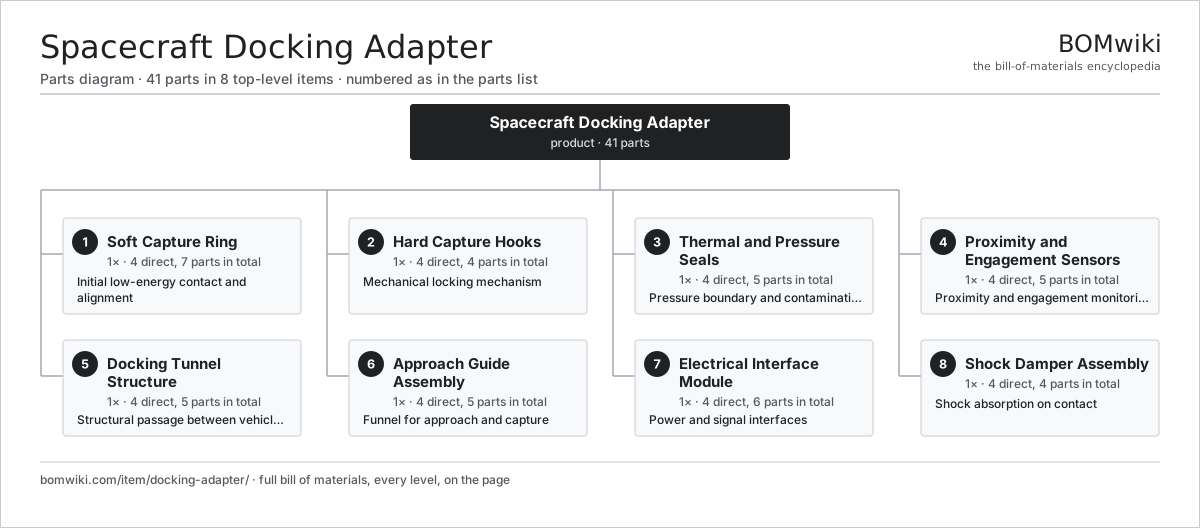
| # | Part | Qty | What it does |
|---|---|---|---|
| 1 | Soft Capture Ring 4 parts | 1× | Initial low-energy contact and alignment |
| 2 | Hard Capture Hooks 4 parts | 1× | Mechanical locking mechanism |
| 3 | Thermal and Pressure Seals 4 parts | 1× | Pressure boundary and contamination barriers |
| 4 | Proximity and Engagement Sensors 4 parts | 1× | Proximity and engagement monitoring |
| 5 | Docking Tunnel Structure 4 parts | 1× | Structural passage between vehicles |
| 6 | Approach Guide Assembly 4 parts | 1× | Funnel for approach and capture |
| 7 | Electrical Interface Module 4 parts | 1× | Power and signal interfaces |
| 8 | Shock Damper Assembly 4 parts | 1× | Shock absorption on contact |
3D model
No 3D model yet. Have a CAD file of this? Add a 3D model. STL renders right on this page; STEP, FreeCAD, and OpenSCAD sources are welcome too (openly licensed, like all 3D models on BOMwiki).
Build & assembly graph
expand / collapse · shared sub-assemblies converge · links to related products · est. labourTap an assembly to expand/collapse · tap a part to open it · use “Open page” for any node · drag to pan, scroll to zoom.
Bill of materials for Spacecraft Docking Adapter
8 top-level lines · 40 rows shown · 41 parts total · indented to 3 levels| # | Item / sub-assembly | Part no. | Qty/assy | Ext. qty | Parts | Type |
|---|---|---|---|---|---|---|
| 1 | Soft Capture Ring 4 parts | docking-adapter-soft-capture | 1× | 1 | 7 | assembly |
| 1.1 | Ring Frame | docking-adapter-ring-frame | 1× | 1 | · | part |
| 1.2 | Compliance Pads | docking-adapter-compliance-pads | 1× | 1 | · | part |
| 1.3 | Contact Fingers | docking-adapter-contact-fingers | 1× | 1 | · | part |
| 1.4 | Ball Bearing | ball-bearing | 4× | 4 | · | part |
| 2 | Hard Capture Hooks 4 parts | docking-adapter-hard-capture | 1× | 1 | 4 | assembly |
| 2.1 | Hook Mechanism | docking-adapter-hook-mechanism | 1× | 1 | · | part |
| 2.2 | Fastener Set | fastener-set | 1× | 1 | · | part |
| 2.3 | Hook Actuator Motor | docking-adapter-hook-motor | 1× | 1 | · | part |
| 2.4 | Encoder | encoder | 1× | 1 | · | part |
| 3 | Thermal and Pressure Seals 4 parts | docking-adapter-seals | 1× | 1 | 5 | assembly |
| 3.1 | O-Ring Set | oring-set | 2× | 2 | · | part |
| 3.2 | Metal Seal Ring | docking-adapter-metal-seal-ring | 1× | 1 | · | part |
| 3.3 | Thermal Insulation Layer | docking-adapter-thermal-insulation | 1× | 1 | · | part |
| 3.4 | Sheet Metal Panel | sheet-panel | 1× | 1 | · | part |
| 4 | Proximity and Engagement Sensors 4 parts | docking-adapter-sensors | 1× | 1 | 5 | assembly |
| 4.1 | Pressure Sensor | pressure-sensor | 1× | 1 | · | part |
| 4.2 | Hall Sensor | hall-sensor | 2× | 2 | · | part |
| 4.3 | Laser Ranging Module | docking-adapter-laser-ranging | 1× | 1 | · | part |
| 4.4 | Bare PCB | pcb-bare | 1× | 1 | · | part |
| 5 | Docking Tunnel Structure 4 parts | docking-adapter-tunnel | 1× | 1 | 5 | assembly |
| 5.1 | Tunnel Cylinder | docking-adapter-tunnel-cylinder | 1× | 1 | · | part |
| 5.2 | Tunnel Bulkhead | docking-adapter-tunnel-bulkhead | 2× | 2 | · | part |
| 5.3 | Fastener Set | fastener-set | 1× | 1 | · | part |
| 5.4 | Sheet Metal Panel | sheet-panel | 1× | 1 | · | part |
| 6 | Approach Guide Assembly 4 parts | docking-adapter-guide-system | 1× | 1 | 5 | assembly |
| 6.1 | Guide Cone | docking-adapter-guide-cone | 1× | 1 | · | part |
| 6.2 | Alignment Vanes | docking-adapter-alignment-vanes | 1× | 1 | · | part |
| 6.3 | Ball Bearing | ball-bearing | 2× | 2 | · | part |
| 6.4 | Fastener Set | fastener-set | 1× | 1 | · | part |
| 7 | Electrical Interface Module 4 parts | docking-adapter-electrical | 1× | 1 | 6 | assembly |
| 7.1 | Connector | connector | 2× | 2 | · | part |
| 7.2 | Relay | relay | 2× | 2 | · | part |
| 7.3 | Bare PCB | pcb-bare | 1× | 1 | · | part |
| 7.4 | Wire Bundle | wire-bundle | 1× | 1 | · | part |
| 8 | Shock Damper Assembly 4 parts | docking-adapter-dampers | 1× | 1 | 4 | assembly |
| 8.1 | Damper Cylinder | docking-adapter-damper-cylinder | 1× | 1 | · | part |
| 8.2 | Coil Spring | coil-spring | 1× | 1 | · | part |
| 8.3 | Fastener Set | fastener-set | 1× | 1 | · | part |
| 8.4 | O-Ring Set | oring-set | 1× | 1 | · | part |
Something wrong in this list? Report a problem with this BOM.
Related products
same domain, ranked by shared parts Reaction Wheel Assembly
39 parts · shares 4 with this page
Reaction Wheel Assembly
39 parts · shares 4 with this page
 GPS Navigation Satellite
2,640 parts · shares 5 with this page
GPS Navigation Satellite
2,640 parts · shares 5 with this page
 Weather Satellite
1,765 parts · shares 5 with this page
Weather Satellite
1,765 parts · shares 5 with this page
 Lunar Lander
1,803 parts · shares 5 with this page
Lunar Lander
1,803 parts · shares 5 with this page
 Space Station Treadmill
151 parts · shares 4 with this page
Space Station Treadmill
151 parts · shares 4 with this page
 Deployable Solar Array Wing
37 parts · shares 3 with this page
Deployable Solar Array Wing
37 parts · shares 3 with this page
Sourcing: possible vendors
Browse the supplier directory → Prices, MOQ, and lead times are algorithmic estimates, not quotes, and not claims about these companies. Company mappings are curated by keyword; est. price band $50k–$500M. How estimates work| Vendor | HQ | Specialty | MOQ | Lead time |
|---|---|---|---|---|
|
🇺🇸SpaceX
spacex.com ↗
|
Hawthorne, US | Launch & spacecraft | made to order | 52–104 wks |
| northropgrumman.com ↗ | Falls Church, US | Space & defense | made to order | 52–104 wks |
|
🇫🇷Airbus
airbus.com ↗
|
Toulouse, FR | Aerospace OEM | made to order | 52–104 wks |
| rocketlabusa.com ↗ | Long Beach, US | Launch & spacecraft | made to order | 52–104 wks |
| thalesaleniaspace.com ↗ | Cannes, FR | Satellites | made to order | 52–104 wks |
953-word article