Fireproof Document Safe
ProductOverview
A fireproof document safe is a compact vault designed to protect irreplaceable documents, photographs, and valuables from fire and theft. Unlike full-room safes embedded in walls, portable document safes sit freestanding on a floor or desk, locking with an electronic keypad and containing multiple insulated compartments.
The safe's core function is thermal protection: maintaining internal temperatures below 350°F while external surfaces experience 1,550°F in a building fire. This threshold protects paper documents, which ignite around 451°F (Fahrenheit 451), and digital media (CDs, external hard drives) sensitive to heat-induced corruption.
Thermal Insulation Design
The Safe Body uses a double-wall steel construction: an Outer Wall (3/16 to 1/4 inch steel) and an Inner Wall separated by 1.5–2 inches of Insulation Layer. Insulation materials typically include calcium silicate boards, perlite-filled gypsum, or mineral-fiber composites.
These ablative materials work by absorbing heat through endothermic chemical reactions, the material breaks down under extreme heat, consuming energy that would otherwise raise internal temperature. Unlike passive insulation, ablative materials actually cool as they decompose.
A typical 1-hour fire-rated safe experiences these conditions: exterior steel reaches 1,550°F, interior cavity remains ≤350°F. This 1,200°F gradient is maintained by the insulation's poor thermal conductivity (approximately 0.1–0.2 W/m·K, compared to 50 W/m·K for aluminum).
The Safe Door, equally insulated, is the thermal weak point. A slight temperature rise occurs at the door seal, which is why Door Gasket, intumescent rubber, is critical. Intumescent gaskets are embedded with salts that release water vapor when heated, creating pressure that forces the gasket to expand and fill gaps, blocking heat flow.
Structural & Locking
The Locking Mechanism uses a Keypad accepting a 4–8 digit PIN. When the correct code is entered, a Bare PCB control board energizes Solenoid Bolt, which retracts steel bolts from the Door Frame. The solenoids are powered by 4–8 AA batteries or a plug-in 12V adapter.
A Mechanical Lock serves as a backup, a physical key lock independent of electronics. This is mandatory: if batteries fail or the circuit malfunctions, the user can still access their documents using a mechanical key.
The door is hinged on the safe body via Door Hinges, heavy-duty stainless steel or chrome-plated units supporting 100–200 lbs of door weight. The hinge is often a point of compromise in cheap safes; quality models use bolted hinges rated for 500+ lbf load.
A relocking device, a mechanical or electronic system that re-locks the safe door if the lock mechanism is tampered with, is standard on higher-end models, making forced entry more difficult.
Interior Organization
Interior Shelving divides the internal volume, typically 8–12 cubic feet, into compartments. Two Shelf Panel shelves, mounted on Shelf Bracket, allow storage of documents in drawers, hanging folders, or organized piles. Shelves are rated for 50–100 lbs per level.
Common storage items: wills, deed of trust, insurance policies, birth certificates, passport copies, irreplaceable photographs, external hard drives, and valuables like jewelry or coins. The safe is not rated for magnetic media (magnetic tape degrades above 120°F), so backup digital files are stored elsewhere; external drives are vulnerable to heat. Physical documents and certified copies are the primary purpose.
Performance & Limitations
Fire ratings are standardized: UL Class 350 means documents remain ≤350°F for 1 hour during a 1,550°F fire. UL Class 250 is lower temperature (safer for media), while Class 350 is the standard for documents. The rating applies to the test conditions, a lab fire in an insulated chamber, not necessarily a real building fire, which can exceed 1,550°F or last longer than 1 hour.
After exposure to fire, even if internal temperature was controlled, documents may be damp and warped from cooling-induced condensation. A heat-treated safe will need drying and climate control post-event.
Safes are not typically rated for water damage. A residential sprinkler system during fire suppression may flood the safe interior. Some designs include drain plugs for this purpose.
Theft protection is secondary; document safes are lightweight compared to security safes (400–800 lbs vs. 1,000+ lbs), and determined thieves can defeat them with time and tools. The primary value is fire protection, not burglary.
Maintenance & Usage
Electronic locks require battery changes every 2–5 years depending on usage frequency. Battery drain is minimal, solenoids draw current only during unlock, not during standby.
The Door Gasket ages with time and heat exposure; inspection every 5 years is recommended. Degraded gaskets should be replaced to maintain fire rating.
The insulation is irreplaceable without disassembling the safe, so the unit has a lifespan of 15–25 years before thermal performance degrades significantly.
Placement matters: avoid placing a safe directly against exterior walls in high-fire-risk areas, as external ignition sources can exceed design temperatures.
Annual inspection of the mechanical lock and hinge function ensures reliable access. Shelves and brackets should be checked for corrosion or structural fatigue, particularly in humid basements.
Fireproof Document Safe parts and their functions
5 top-level parts · 38 parts in total · full bill of materials below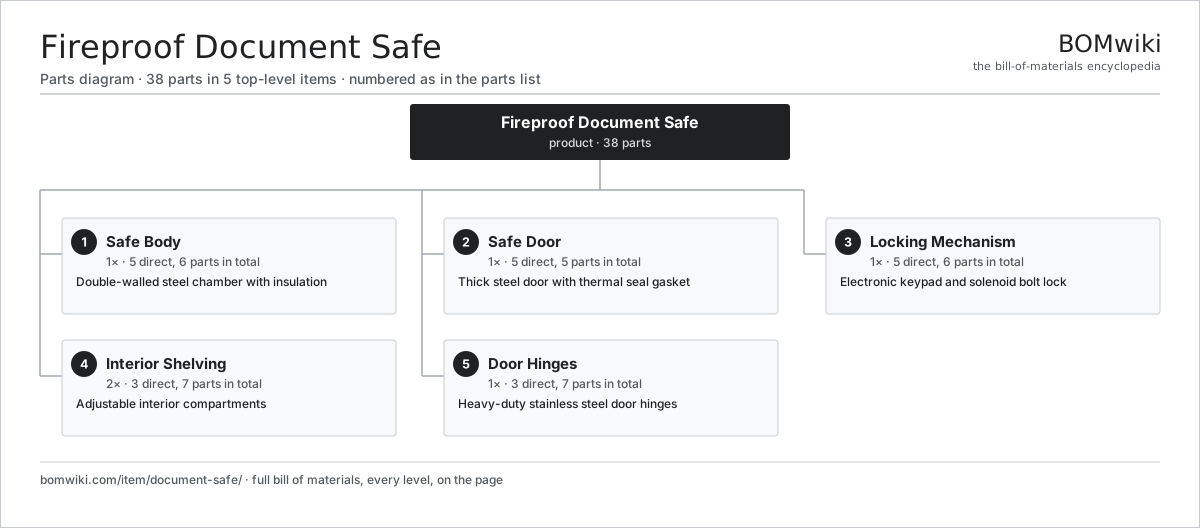
| # | Part | Qty | What it does |
|---|---|---|---|
| 1 | Safe Body 5 parts | 1× | Double-walled steel chamber with insulation |
| 2 | Safe Door 5 parts | 1× | Thick steel door with thermal seal gasket |
| 3 | Locking Mechanism 5 parts | 1× | Electronic keypad and solenoid bolt lock |
| 4 | Interior Shelving 3 parts | 2× | Adjustable interior compartments |
| 5 | Door Hinges 3 parts | 1× | Heavy-duty stainless steel door hinges |
3D model
No 3D model yet. Have a CAD file of this? Add a 3D model. STL renders right on this page; STEP, FreeCAD, and OpenSCAD sources are welcome too (openly licensed, like all 3D models on BOMwiki).
Build & assembly graph
expand / collapse · shared sub-assemblies converge · links to related products · est. labourTap an assembly to expand/collapse · tap a part to open it · use “Open page” for any node · drag to pan, scroll to zoom.
Bill of materials for Fireproof Document Safe
5 top-level lines · 26 rows shown · 38 parts total · indented to 3 levels| # | Item / sub-assembly | Part no. | Qty/assy | Ext. qty | Parts | Type |
|---|---|---|---|---|---|---|
| 1 | Safe Body 5 parts | document-safe-body | 1× | 1 | 6 | assembly |
| 1.1 | Outer Wall | document-safe-outer-wall | 1× | 1 | · | part |
| 1.2 | Inner Wall | document-safe-inner-wall | 1× | 1 | · | part |
| 1.3 | Insulation Layer | document-safe-insulation-layer | 1× | 1 | · | part |
| 1.4 | Base Pan | document-safe-base-pan | 1× | 1 | · | part |
| 1.5 | Fastener Set | fastener-set | 2× | 2 | · | part |
| 2 | Safe Door 5 parts | document-safe-door | 1× | 1 | 5 | assembly |
| 2.1 | Door Panel | document-safe-door-panel | 1× | 1 | · | part |
| 2.2 | Door Insulation | document-safe-door-insulation | 1× | 1 | · | part |
| 2.3 | Door Gasket | document-safe-gasket | 1× | 1 | · | part |
| 2.4 | Door Frame | document-safe-door-frame | 1× | 1 | · | part |
| 2.5 | Fastener Set | fastener-set | 1× | 1 | · | part |
| 3 | Locking Mechanism 5 parts | document-safe-locking-mechanism | 1× | 1 | 6 | assembly |
| 3.1 | Keypad | document-safe-keypad | 1× | 1 | · | part |
| 3.2 | Bare PCB | pcb-bare | 1× | 1 | · | part |
| 3.3 | Solenoid Bolt | document-safe-solenoid-bolt | 2× | 2 | · | part |
| 3.4 | Mechanical Lock | document-safe-mechanical-lock | 1× | 1 | · | part |
| 3.5 | Battery Pack | battery | 1× | 1 | · | part |
| 4 | Interior Shelving 3 parts | document-safe-shelving | 2× | 2 | 7 | assembly |
| 4.1 | Shelf Bracket | document-safe-shelf-bracket | 4× | 8 | · | part |
| 4.2 | Shelf Panel | document-safe-shelf-panel | 2× | 4 | · | part |
| 4.3 | Fastener Set | fastener-set | 1× | 2 | · | part |
| 5 | Door Hinges 3 parts | document-safe-hinges | 1× | 1 | 7 | assembly |
| 5.1 | Hinge Leaf | document-safe-hinge-leaf | 4× | 4 | · | part |
| 5.2 | Hinge Pin | document-safe-hinge-pin | 2× | 2 | · | part |
| 5.3 | Fastener Set | fastener-set | 1× | 1 | · | part |
Something wrong in this list? Report a problem with this BOM.
Sourcing: possible vendors
Browse the supplier directory → Prices, MOQ, and lead times are algorithmic estimates, not quotes, and not claims about these companies. Company mappings are curated by keyword; est. price band $50–$15k. How estimates work| Vendor | HQ | Specialty | MOQ | Lead time |
|---|---|---|---|---|
|
🇯🇵Canon
canon.com ↗
|
Tokyo, JP | Imaging & optics | 500 units | 8–12 wks |
|
🇯🇵Ricoh
ricoh.com ↗
|
Tokyo, JP | Office imaging | 500 units | 8–12 wks |
|
🇺🇸Xerox
xerox.com ↗
|
Norwalk, US | Printers & copiers | 500 units | 8–12 wks |
|
🇯🇵Epson
epson.com ↗
|
Suwa, JP | Printers & projectors | 500 units | 8–12 wks |
|
🇯🇵Brother
brother.com ↗
|
Nagoya, JP | Printers & sewing | 500 units | 8–12 wks |
875-word article