Dough Sheeter
ProductOverview
A dough sheeter is a powered machine that progressively reduces dough thickness between two rotating rollers. The Roller Assembly consists of two pairs of hardened steel rollers: the Input Roller Pair make a rough initial compression, and the Output Roller Pair fine-tune the final thickness. A Flour Duster Assembly dusts the moving dough to prevent sticking. The Input & Output Conveyor feeds dough into the rollers and removes the finished sheet.
Industrial dough sheeters are found in bakeries, pasta factories, and production facilities making tortillas, flatbreads, or pastry sheets. They replace hand-rolling, which is labor-intensive and produces uneven thickness. A well-tuned sheeter produces uniform thickness (±0.2 mm) across the width, essential for consistent cooking and appearance.
Roller mechanics
The Input Roller Pair and Output Roller Pair are both motor-driven. The Roller Gap Adjuster allows the operator to position the output rollers to the desired gap; the input rollers typically run at fixed spacing. Both roller pairs are fed by the Input Conveyor Belt belt and connected to the same variable-frequency drive so both pairs move at the same speed, preventing shearing.
The rollers themselves are hardened steel, typically 40–50 HRC surface hardness, mirror-polished to minimize dough sticking and surface drag. The Input Roller Barrels are wider (to compress at lower pressure) than the Output Roller Barrels (which are narrower and produce finer thickness control). Both rotate on Ball Bearings held in dough-sheeter-bearing-pillow-blocks; the bearings are sealed and grease-lubricated.
Drive train and variable speed
The Drive & Transmission uses a motor and Direction Reverser to run both the rollers and conveyor belts. The Main Drive Motor is connected via belt or chain to a reversing mechanism, usually an electromagnetic clutch or a small planetary gearbox, that can instantly flip the belt direction, allowing dough to exit in reverse if the operator needs to rescue a jam.
The entire line is controlled by a Speed Potentiometer, typically a VFD or mechanical dial, that adjusts motor speed from 10% to 100%. Lower speeds produce finer dough (longer contact time with the rollers, thinner final sheet); higher speeds are used for dough that needs gentle handling or for maximum throughput.
Conveyor belts and flour dusting
The Input Conveyor Belt carries raw dough from the hopper or scrap collector into the input rollers. The Output Conveyor Belt receives the shaped sheet and moves it away. Both are rubber-faced fabric belts, typical 800–1000 mm wide, capable of supporting dough weight and providing friction. The belts can run forward or backward via the reverser.
The Flour Duster Assembly is a critical subassembly that prevents dough from sticking to the rollers and belts. It consists of a rotating dough-sheeter-stirrer-arm or brush drum that dusts flour across the top of the dough as it enters the rollers. The flour prevents adhesion but also dries the dough surface; heavy dusting can create a dry crust that cracks as the dough bends, so the duster rate is tuned to the specific dough type.
Thickness adjustment
The Roller Gap Adjuster is a precision screw mechanism with a graduated handwheel. One full turn of the wheel typically moves the rollers 2–4 mm. The adjustment nut rides on the acme screw thread and pushes the movable roller beam up or down. Both rollers must move together to avoid binding; some models use a parallel screw pair to ensure synchronized adjustment.
Thickness control is critical in croissant lamination, where multiple passes must produce sheets of increasing thinness; in tortilla production, where 1–2 mm variation is unacceptable; and in phyllo dough work, where final sheets must be thin enough to be transparent. Many modern sheeters include digital thickness indication: a laser or capacitive sensor measures the exiting sheet and feeds back to the PLC, which nudges the adjuster to maintain setpoint.
Dough type and temperature sensitivity
Dough behavior is strongly temperature-dependent. Cold dough (below 15 °C) is stiff and tears; warm dough (above 25 °C) is sticky and compresses unevenly. Most facilities maintain dough at 18–22 °C by adjusting formulation water temperature or routing dough through a tempering step before the sheeter.
Hard doughs (bread, doughnuts) tolerate high compression; soft doughs (laminated pastry, phyllo) require gentle handling and often multiple passes at lower pressure to avoid tearing. Some recipes demand a slow final pass (the "final skin" or "polish" pass) to smooth the surface without compressing the interior.
Control panel and safety
The Control Panel typically includes a forward/reverse selector, a speed potentiometer, and an emergency stop. The forward direction feeds dough; reverse backs the dough out in case of jam. Some industrial units have a Variable Frequency Drive that accepts speed commands from a PLC, allowing integration into a full production line.
Safety guards surround the rollers to prevent operator contact. The stop button is large and red, often placed where the operator feeds dough in. Some models include a pressure-sensitive edge that stops the rollers if dough bunches up.
Maintenance
Daily cleaning involves running warm water through the Input & Output Conveyor and wiping the rollers with damp cloths. Flour and dough residue are removed from the duster. The Tension Slot bolts are checked for looseness; belt tension is adjusted so the belt does not slip at full load.
Weekly, the dough-sheeter-bearing-pillow-blocks are checked for smooth rotation and any squeaks indicating dry bearings. Monthly, the dough-sheeter-motor-gearbox oil level is checked; if it drops, seals may be worn. The dough-sheeter-rol-gap-adjuster mechanism is wiped clean of flour dust so it operates smoothly.
After extended runs, the rollers may develop a slight gloss from oil or residue transfer; they are cleaned with a stainless brush or very fine abrasive pad to restore grip. If a roller becomes scored or develops flat spots, it must be re-ground or replaced.
Dough Sheeter parts and their functions
7 top-level parts · 103 parts in total · full bill of materials below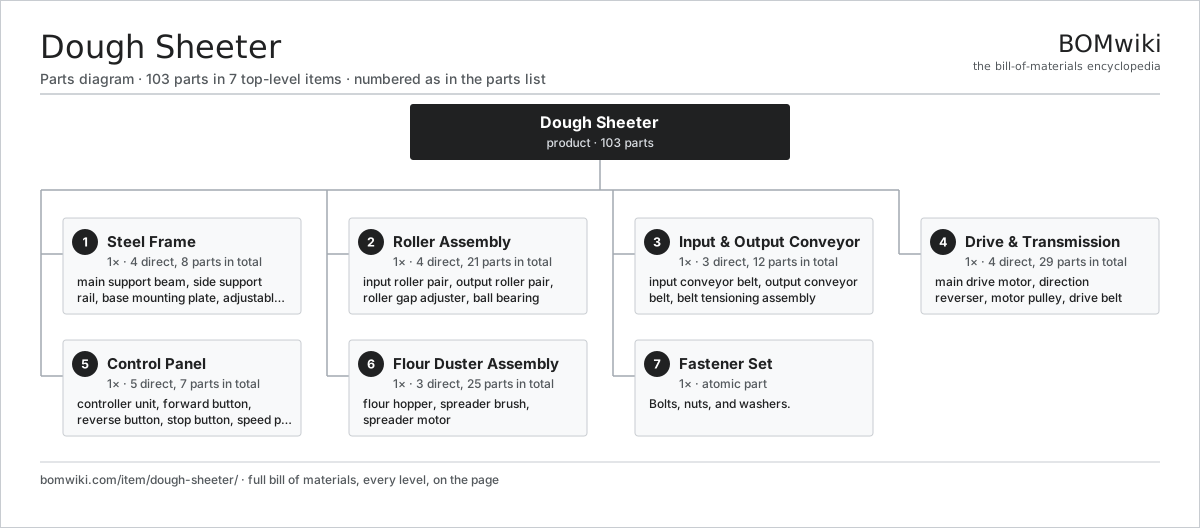
| # | Part | Qty | What it does |
|---|---|---|---|
| 1 | Steel Frame 4 parts | 1× | Welded structural frame supporting rollers and conveyor. |
| 2 | Roller Assembly 4 parts | 1× | Two pairs of hardened steel rollers with adjustable gap for thickness control. |
| 3 | Input & Output Conveyor 3 parts | 1× | Dual reversible belt conveyors feeding and receiving dough. |
| 4 | Drive & Transmission 4 parts | 1× | Motor and reversing belt drive system powering rollers and conveyors. |
| 5 | Control Panel 5 parts | 1× | Operator interface for speed and direction control. |
| 6 | Flour Duster Assembly 3 parts | 1× | Hopper and spreader preventing dough sticking to rollers. |
| 7 | Fastener Set | 1× | Bolts, nuts, and washers. |
3D model
No 3D model yet. Have a CAD file of this? Add a 3D model. STL renders right on this page; STEP, FreeCAD, and OpenSCAD sources are welcome too (openly licensed, like all 3D models on BOMwiki).
Build & assembly graph
expand / collapse · shared sub-assemblies converge · links to related products · est. labourTap an assembly to expand/collapse · tap a part to open it · use “Open page” for any node · drag to pan, scroll to zoom.
Bill of materials for Dough Sheeter
7 top-level lines · 61 rows shown · 103 parts total · indented to 3 levels| # | Item / sub-assembly | Part no. | Qty/assy | Ext. qty | Parts | Type |
|---|---|---|---|---|---|---|
| 1 | Steel Frame 4 parts | dough-sheeter-frame | 1× | 1 | 8 | assembly |
| 1.1 | Main Support Beam | dough-sheeter-main-beam | 1× | 1 | · | part |
| 1.2 | Side Support Rail | dough-sheeter-side-rail | 2× | 2 | · | part |
| 1.3 | Base Mounting Plate | dough-sheeter-base-plate | 1× | 1 | · | part |
| 1.4 | Adjustable Foot | dough-sheeter-leveling-feet | 4× | 4 | · | part |
| 2 | Roller Assembly 4 parts | dough-sheeter-roller-unit | 1× | 1 | 21 | assembly |
| 2.1 | Input Roller Pair 3 parts | dough-sheeter-input-rollers | 1× | 1 | 7 | assembly |
| 2.1.1 | Input Roller Shaft | dough-sheeter-input-shaft | 1× | 1 | · | part |
| 2.1.2 | Input Roller Barrel | dough-sheeter-input-roller-barrel | 2× | 2 | · | part |
| 2.1.3 | Input Bearing Block 2 parts + deeper › | dough-sheeter-input-bearing-block | 2× | 2 | 2 | assembly |
| 2.2 | Output Roller Pair 3 parts | dough-sheeter-output-rollers | 1× | 1 | 7 | assembly |
| 2.2.1 | Output Roller Shaft | dough-sheeter-output-shaft | 1× | 1 | · | part |
| 2.2.2 | Output Roller Barrel | dough-sheeter-output-roller-barrel | 2× | 2 | · | part |
| 2.2.3 | Output Bearing Block 2 parts + deeper › | dough-sheeter-output-bearing-block | 2× | 2 | 2 | assembly |
| 2.3 | Roller Gap Adjuster 3 parts | dough-sheeter-roller-gap-adjuster | 1× | 1 | 3 | assembly |
| 2.3.1 | Adjustment Screw | dough-sheeter-adj-screw | 1× | 1 | · | part |
| 2.3.2 | Adjustment Handwheel | dough-sheeter-adj-handwheel | 1× | 1 | · | part |
| 2.3.3 | Adjustment Nut Block | dough-sheeter-adj-nut-block | 1× | 1 | · | part |
| 2.4 | Ball Bearing | ball-bearing | 4× | 4 | · | part |
| 3 | Input & Output Conveyor 3 parts | dough-sheeter-conveyor-system | 1× | 1 | 12 | assembly |
| 3.1 | Input Conveyor Belt 4 parts | dough-sheeter-input-conveyor | 1× | 1 | 4 | assembly |
| 3.1.1 | Input Belt Loop | dough-sheeter-input-belt | 1× | 1 | · | part |
| 3.1.2 | Input Drive Pulley | dough-sheeter-input-pulley-head | 1× | 1 | · | part |
| 3.1.3 | Input Idler Pulley | dough-sheeter-input-pulley-tail | 1× | 1 | · | part |
| 3.1.4 | Input Conveyor Frame | dough-sheeter-input-belt-frame | 1× | 1 | · | part |
| 3.2 | Output Conveyor Belt 4 parts | dough-sheeter-output-conveyor | 1× | 1 | 4 | assembly |
| 3.2.1 | Output Belt Loop | dough-sheeter-output-belt | 1× | 1 | · | part |
| 3.2.2 | Output Drive Pulley | dough-sheeter-output-pulley-head | 1× | 1 | · | part |
| 3.2.3 | Output Idler Pulley | dough-sheeter-output-pulley-tail | 1× | 1 | · | part |
| 3.2.4 | Output Conveyor Frame | dough-sheeter-output-belt-frame | 1× | 1 | · | part |
| 3.3 | Belt Tensioning Assembly 2 parts | dough-sheeter-belt-tension | 2× | 2 | 2 | assembly |
| 3.3.1 | Tension Bolt | dough-sheeter-tension-bolt | 1× | 2 | · | part |
| 3.3.2 | Tension Slot | dough-sheeter-tension-slot | 1× | 2 | · | part |
| 4 | Drive & Transmission 4 parts | dough-sheeter-drive-train | 1× | 1 | 29 | assembly |
| 4.1 | Main Drive Motor 4 parts | dough-sheeter-motor | 1× | 1 | 25 | assembly |
| 4.1.1 | Stator Assembly 3 parts + deeper › | stator-assembly | 1× | 1 | 3 | assembly |
| 4.1.2 | Rotor Assembly 4 parts + deeper › | rotor-assembly | 1× | 1 | 19 | assembly |
| 4.1.3 | Motor Housing | motor-housing | 1× | 1 | · | part |
| 4.1.4 | Ball Bearing | ball-bearing | 2× | 2 | · | part |
| 4.2 | Direction Reverser 2 parts | dough-sheeter-reverser | 1× | 1 | 2 | assembly |
| 4.2.1 | Reverser Solenoid | dough-sheeter-reverser-solenoid | 1× | 1 | · | part |
| 4.2.2 | Reverser Mechanism | dough-sheeter-reverser-mechanism | 1× | 1 | · | part |
| 4.3 | Motor Pulley | dough-sheeter-drive-pulley | 1× | 1 | · | part |
| 4.4 | Drive Belt | dough-sheeter-drive-belt | 1× | 1 | · | part |
| 5 | Control Panel 5 parts | dough-sheeter-control-panel | 1× | 1 | 7 | assembly |
| 5.1 | Controller Unit 3 parts | dough-sheeter-controller | 1× | 1 | 3 | assembly |
| 5.1.1 | Relay | relay | 1× | 1 | · | part |
| 5.1.2 | Variable Frequency Drive | dough-sheeter-vfd | 1× | 1 | · | part |
| 5.1.3 | Bare PCB | pcb-bare | 1× | 1 | · | part |
| 5.2 | Forward Button | dough-sheeter-forward-button | 1× | 1 | · | part |
| 5.3 | Reverse Button | dough-sheeter-reverse-button | 1× | 1 | · | part |
| 5.4 | Stop Button | dough-sheeter-stop-button | 1× | 1 | · | part |
| 5.5 | Speed Potentiometer | dough-sheeter-speed-controller | 1× | 1 | · | part |
| 6 | Flour Duster Assembly 3 parts | dough-sheeter-flour-duster | 1× | 1 | 25 | assembly |
| 6.1 | Flour Hopper | dough-sheeter-dust-hopper | 1× | 1 | · | part |
| 6.2 | Spreader Brush | dough-sheeter-dust-spreader | 1× | 1 | · | part |
| 6.3 | Spreader Motor 3 parts | dough-sheeter-dust-motor | 1× | 1 | 23 | assembly |
| 6.3.1 | Stator Assembly 3 parts + deeper › | stator-assembly | 1× | 1 | 3 | assembly |
| 6.3.2 | Rotor Assembly 4 parts + deeper › | rotor-assembly | 1× | 1 | 19 | assembly |
| 6.3.3 | Motor Housing | motor-housing | 1× | 1 | · | part |
| 7 | Fastener Set | fastener-set | 1× | 1 | · | part |
Something wrong in this list? Report a problem with this BOM.
Related products
same domain, ranked by shared parts Bottle Washing Machine
2,388 parts · shares 10 with this page
Brine Chilling System
239 parts · shares 10 with this page
Bottle Washing Machine
2,388 parts · shares 10 with this page
Brine Chilling System
239 parts · shares 10 with this page
 Chamber Vacuum Sealer
76 parts · shares 10 with this page
Cheese Vat
276 parts · shares 10 with this page
Chamber Vacuum Sealer
76 parts · shares 10 with this page
Cheese Vat
276 parts · shares 10 with this page
Sourcing: possible vendors
Browse the supplier directory → Prices, MOQ, and lead times are algorithmic estimates, not quotes, and not claims about these companies. Company mappings are curated by keyword; est. price band $1k–$500k. How estimates work| Vendor | HQ | Specialty | MOQ | Lead time |
|---|---|---|---|---|
| gea.com ↗ | Düsseldorf, DE | Process technology | 20 units | 12–20 wks |
| buhlergroup.com ↗ | Uzwil, CH | Food & materials processing | 20 units | 12–20 wks |
| tetrapak.com ↗ | Pully, CH | Food packaging & processing | 20 units | 12–20 wks |
| jbtc.com ↗ | Chicago, US | Food processing equipment | 20 units | 12–20 wks |
| alfalaval.com ↗ | Lund, SE | Heat transfer & separation | 20 units | 12–20 wks |
1,021-word article