Drip Bag Packing Machine
ProductOverview
A drip bag packing machine automates the production of single-serve drip bags, small hand-brew coffee units where ground coffee is enclosed in a micro-filter bag with two hanging tabs (ears) that rest on the rim of a coffee cup. Hot water is poured over the bag, extracting the coffee into the cup below in 3–4 minutes. Drip bags are popular in Japan, Southeast Asia, and specialty markets worldwide due to their convenience and portability.
The machine is a multi-station inline system: an inner bag forming station creates the filter bag from non-woven material, a dosing unit fills it with precisely portioned ground coffee, an outer envelope station wraps and seals the package, and a final stacking unit collects finished bags into packs.
The Inner Bag Forming Station shapes flat micro-filter material into a cup with two hanging ears using a precision die. The Coffee Dosing System dispenses 8–12 grams of ground coffee into the formed cup. The Outer Envelope Sealing Station wraps and seals a kraft or foil outer envelope around the filled bag, protecting the coffee from light and oxygen. Finally, the Stacking and Collection Unit collects finished bags and arranges them into packs of 10, 20, or 50 for carton packing.
All operations are synchronized by a Control and Timing System PLC and a Conveyor Feed System advancing bags through each station at consistent speed.
How it works
An operator fills the Dosing Hopper with freshly ground coffee (medium grind, similar to pour-over texture). The Vibrating Feeder Chute vibrates continuously, preventing compacting.
At the first station (inner bag forming): A roll of non-woven filter material (the Inner Filter Material Roll) is loaded into the machine. As the Conveyor Feed System advances, the material passes through the Forming Die Set, a precision die set. The die compresses and shapes the flat material into a cup-like form with two hanging tabs (ears) at the top. The formed shape is sealed via the Inner Seal Bar, which heats or impulse-seals the cup edges at 150–180 °C. The Guillotine Cutter guillotine blade then separates the completed inner bag from the roll web.
At the second station (coffee dosing): The formed, empty inner bag advances on the conveyor. The Dosing Auger, driven by the Dosing Motor, rotates to dispense ground coffee into the cup. The auger is calibrated to release exactly 8–12 grams per rotation. The Control and Timing System PLC monitors the dosing time and stops the motor when the target weight is reached. An optional drip-bag-packing-machine-pressure-sensor can verify fill level.
At the third station (outer envelope sealing): The filled inner bag now moves into the wrapping station. A roll of kraft paper or foil (the Outer Envelope Material Roll) is guided by the Wrapping Guide Die, wrapping around the filled bag. The Outer Envelope Sealer heat-seals or impulse-seals the envelope overlap (the join line) at 160–200 °C. The Overlap Trimmer trims excess material, leaving a clean sealed package.
At the fourth station (stacking): The completed drip bag exits the sealing station. The Stacking and Collection Unit collects bags on a Collection Tray. A Stacker Pneumatic Arm (pneumatic or servo-driven) pushes each bag into alignment. The Pack Count Sensor counts bags as they arrive; when the count reaches 10, 20, or 50 (operator-selectable), the Control and Timing System signals completion of one pack. The full tray is removed, and an empty Collection Tray swaps in to continue stacking the next pack.
Cycle time is typically 0.6–1.5 seconds per bag, yielding 40–100 bags per minute depending on machine model and material type.
Key engineering features
Inner bag forming: The Forming Die Set is precision-machined to create consistent cup shape and ear geometry. The ears must be dimensioned (typically 20–30 mm each) to balance securely on an 8–12 oz cup rim without tipping. A weak seal or misaligned ear results in bags falling into the cup during brewing.
Micro-filter material: The Inner Filter Material Roll is non-woven polyester or micro-mesh paper, 200–400 microns. This porosity is critical: too small (<150 microns) and the material is slow to extract; too large (>500 microns) and fine grounds pass through into the cup. The material must also be heat-sealable, some papers have a thermoplastic coating for the Inner Seal Bar.
Dosing consistency: The Dosing Auger must deliver exactly 8–12 grams within ±0.5 gram tolerance. This is achieved via stepper motor control and timed auger rotation. Consistency is critical because each bag produces 8–12 oz of finished coffee; under-dosing yields weak coffee, over-dosing yields bitter, over-extracted coffee. Some machines employ a backup verification, a load cell under the cup detecting mass before the envelope is applied.
Heat sealing vs. impulse sealing: Inner Seal Bar (inner bag) and Outer Envelope Sealer (outer envelope) can use either continuous heat or impulse (brief high-temperature pulse). Impulse sealing is faster and uses less energy; continuous heat gives stronger seals on heavy materials. Material type (paper vs. foil) determines choice.
Synchronized conveyor timing: The Conveyor Feed System speed must be synchronized to forming, dosing, and sealing dwell times. The Control and Timing System PLC coordinates the conveyor motor speed with all station motors to avoid collisions or missed operations. An encoder on the Conveyor Drive Motor provides position feedback.
Stacking and counting: The Stacking and Collection Unit must reliably count and stack bags without jamming or misalignment. The Pack Count Sensor is typically a simple photoelectric or mechanical switch. When the count reaches the desired number (10, 20, 50), a solenoid-driven gate diverts bags to a new tray.
Quality control
Many machines offer inline verification: cameras can inspect bag sealing quality (gaps, weak seals), and weight sensors can verify coffee dose before the outer envelope is applied. If a bag fails inspection, an air jet can blow it off the conveyor into a reject bin.
Maintenance
The Inner Seal Bar (inner) and Outer Envelope Sealer (outer) accumulate adhesive residue from thermoplastic coatings. Weekly cleaning with a soft cloth and rubbing alcohol restores seal quality. The dies require no maintenance beyond visual inspection for wear.
The Dosing Auger should be vacuumed weekly to prevent rancid coffee oil buildup. All pneumatic components should be inspected annually (seals, pressure lines) and replaced if degraded.
The drip-bag-packing-machine-conveyor-belt is food-safe silicone or stainless steel and can last 2–3 years. The Conveyor Roller have sealed bearings and are maintenance-free.
Market variations
Small roasters use benchtop 30–40 cycles/min machines producing 1800–2400 bags per 8-hour shift. Larger roasters scale to 60–100 cycles/min achieving 3600–6000 bags per shift. Contract manufacturers run multiple units in parallel.
Some machines offer changeover kits for different bag sizes (8 oz, 10 oz, 12 oz) to serve varying cup sizes and market segments.
Drip Bag Packing Machine parts and their functions
6 top-level parts · 52 parts in total · full bill of materials below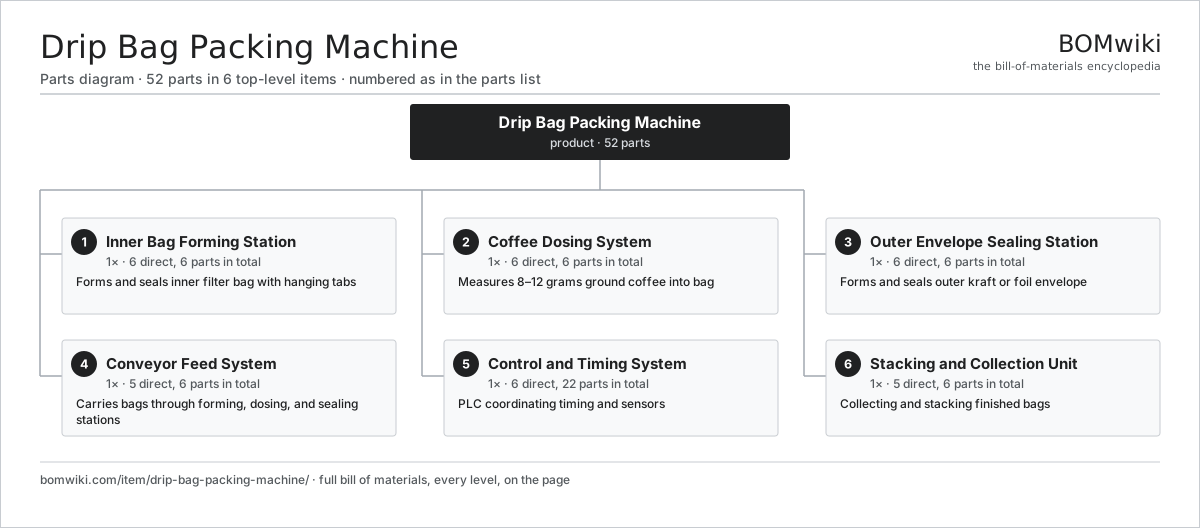
| # | Part | Qty | What it does |
|---|---|---|---|
| 1 | Inner Bag Forming Station 6 parts | 1× | Forms and seals inner filter bag with hanging tabs |
| 2 | Coffee Dosing System 6 parts | 1× | Measures 8–12 grams ground coffee into bag |
| 3 | Outer Envelope Sealing Station 6 parts | 1× | Forms and seals outer kraft or foil envelope |
| 4 | Conveyor Feed System 5 parts | 1× | Carries bags through forming, dosing, and sealing stations |
| 5 | Control and Timing System 6 parts | 1× | PLC coordinating timing and sensors |
| 6 | Stacking and Collection Unit 5 parts | 1× | Collecting and stacking finished bags |
3D model
No 3D model yet. Have a CAD file of this? Add a 3D model. STL renders right on this page; STEP, FreeCAD, and OpenSCAD sources are welcome too (openly licensed, like all 3D models on BOMwiki).
Build & assembly graph
expand / collapse · shared sub-assemblies converge · links to related products · est. labourTap an assembly to expand/collapse · tap a part to open it · use “Open page” for any node · drag to pan, scroll to zoom.
Bill of materials for Drip Bag Packing Machine
6 top-level lines · 40 rows shown · 52 parts total · indented to 3 levels| # | Item / sub-assembly | Part no. | Qty/assy | Ext. qty | Parts | Type |
|---|---|---|---|---|---|---|
| 1 | Inner Bag Forming Station 6 parts | drip-bag-packing-machine-inner-former | 1× | 1 | 6 | assembly |
| 1.1 | Inner Filter Material Roll | drip-bag-packing-machine-film-roll | 1× | 1 | · | part |
| 1.2 | Forming Die Set | drip-bag-packing-machine-forming-die | 1× | 1 | · | part |
| 1.3 | Inner Seal Bar | drip-bag-packing-machine-seal-bar | 1× | 1 | · | part |
| 1.4 | Guillotine Cutter | drip-bag-packing-machine-cutter | 1× | 1 | · | part |
| 1.5 | Heating Element | heating-element | 1× | 1 | · | part |
| 1.6 | Relay | relay | 1× | 1 | · | part |
| 2 | Coffee Dosing System 6 parts | drip-bag-packing-machine-dosing-unit | 1× | 1 | 6 | assembly |
| 2.1 | Dosing Hopper | drip-bag-packing-machine-hopper | 1× | 1 | · | part |
| 2.2 | Vibrating Feeder Chute | drip-bag-packing-machine-vibrating-feeder | 1× | 1 | · | part |
| 2.3 | Dosing Auger | drip-bag-packing-machine-dose-auger | 1× | 1 | · | part |
| 2.4 | Dosing Motor | drip-bag-packing-machine-dose-motor | 1× | 1 | · | part |
| 2.5 | Pressure Sensor | pressure-sensor | 1× | 1 | · | part |
| 2.6 | SMD Passive (R/C/L) | smd-passives | 1× | 1 | · | part |
| 3 | Outer Envelope Sealing Station 6 parts | drip-bag-packing-machine-outer-envelope-unit | 1× | 1 | 6 | assembly |
| 3.1 | Outer Envelope Material Roll | drip-bag-packing-machine-envelope-roll | 1× | 1 | · | part |
| 3.2 | Wrapping Guide Die | drip-bag-packing-machine-wrapping-die | 1× | 1 | · | part |
| 3.3 | Outer Envelope Sealer | drip-bag-packing-machine-envelope-sealer | 1× | 1 | · | part |
| 3.4 | Overlap Trimmer | drip-bag-packing-machine-overlap-cutter | 1× | 1 | · | part |
| 3.5 | Heating Element | heating-element | 1× | 1 | · | part |
| 3.6 | Relay | relay | 1× | 1 | · | part |
| 4 | Conveyor Feed System 5 parts | drip-bag-packing-machine-conveyor-feed | 1× | 1 | 6 | assembly |
| 4.1 | Conveyor Drive Motor | drip-bag-packing-machine-conveyor-motor | 1× | 1 | · | part |
| 4.2 | Conveyor Belt | drip-bag-packing-machine-belt | 1× | 1 | · | part |
| 4.3 | Conveyor Roller | drip-bag-packing-machine-rollers | 2× | 2 | · | part |
| 4.4 | Conveyor Position Encoder | drip-bag-packing-machine-position-sensor | 1× | 1 | · | part |
| 4.5 | Fastener Set | fastener-set | 1× | 1 | · | part |
| 5 | Control and Timing System 6 parts | drip-bag-packing-machine-control-system | 1× | 1 | 22 | assembly |
| 5.1 | Microcontroller | mcu | 1× | 1 | · | part |
| 5.2 | Bare PCB | pcb-bare | 1× | 1 | · | part |
| 5.3 | Relay | relay | 6× | 6 | · | part |
| 5.4 | LCD Panel | lcd-panel | 1× | 1 | · | part |
| 5.5 | Connector | connector | 12× | 12 | · | part |
| 5.6 | Power Supply | power-supply | 1× | 1 | · | part |
| 6 | Stacking and Collection Unit 5 parts | drip-bag-packing-machine-stackers | 1× | 1 | 6 | assembly |
| 6.1 | Stacker Pneumatic Arm | drip-bag-packing-machine-stacker-arm | 1× | 1 | · | part |
| 6.2 | Pusher Plate | drip-bag-packing-machine-pusher-plate | 1× | 1 | · | part |
| 6.3 | Pack Count Sensor | drip-bag-packing-machine-count-sensor | 1× | 1 | · | part |
| 6.4 | Collection Tray | drip-bag-packing-machine-collection-tray | 2× | 2 | · | part |
| 6.5 | Relay | relay | 1× | 1 | · | part |
Something wrong in this list? Report a problem with this BOM.
Related products
same domain, ranked by shared parts Bottle Washing Machine
2,388 parts · shares 8 with this page
Dough Rounding Machine
212 parts · shares 8 with this page
Bottle Washing Machine
2,388 parts · shares 8 with this page
Dough Rounding Machine
212 parts · shares 8 with this page
 Edible Oil Refining Line
3,224 parts · shares 8 with this page
Egg Breaking and Separating Line
1,126 parts · shares 8 with this page
Egg Grading and Packing Line
705 parts · shares 8 with this page
Edible Oil Refining Line
3,224 parts · shares 8 with this page
Egg Breaking and Separating Line
1,126 parts · shares 8 with this page
Egg Grading and Packing Line
705 parts · shares 8 with this page
 Fluid Bed Dryer
550 parts · shares 8 with this page
Fluid Bed Dryer
550 parts · shares 8 with this page
Sourcing: possible vendors
Browse the supplier directory → Prices, MOQ, and lead times are algorithmic estimates, not quotes, and not claims about these companies. Company mappings are curated by keyword; est. price band $1k–$500k. How estimates work| Vendor | HQ | Specialty | MOQ | Lead time |
|---|---|---|---|---|
| gea.com ↗ | Düsseldorf, DE | Process technology | 20 units | 12–20 wks |
| buhlergroup.com ↗ | Uzwil, CH | Food & materials processing | 20 units | 12–20 wks |
| tetrapak.com ↗ | Pully, CH | Food packaging & processing | 20 units | 12–20 wks |
| jbtc.com ↗ | Chicago, US | Food processing equipment | 20 units | 12–20 wks |
| alfalaval.com ↗ | Lund, SE | Heat transfer & separation | 20 units | 12–20 wks |
1,282-word article