Driving School Car
ProductOverview
A driving school car is a standard compact sedan modified with dual brake and clutch pedals, mirror upgrades, and safety enhancements to enable professional instructor training of student drivers. The vehicle operates in an intensive educational environment, accumulating 50,000–200,000 miles within 8–10 years (vs. 12,000–15,000 miles/year for a typical private vehicle), resulting in accelerated wear on brakes, tires, clutch (if manual), and engine components.
The driving school fleet typically comprises 5–30 vehicles (small independent school to large commercial chain), with staggered purchasing cycles. New training cars cost $18,000–25,000 (base sedan + dual controls + signage), while used models (2–3 years old) cost $10,000–15,000 and are common entry points for new schools or expansion.
Dual Brake Pedal System
The critical modification is the Dual Pedal Control System system, which provides the instructor with redundant brake authority. The Brake Priority Valve is a hydraulic component mounted inline with the brake master cylinder. When both instructor and student press their brake pedals simultaneously, the valve prioritizes the instructor input, allowing immediate deceleration without waiting for the student to release their (wrong) foot.
Hydraulic principle: The brake system is DOT-approved dual-circuit (front wheels on circuit 1, rear wheels on circuit 2). When the instructor applies full force on their pedal, the priority valve closes the student circuit, allowing the instructor hydraulic pressure to dominate. If the student brakes alone, the valve opens the circuit normally, providing standard braking. This design prevents student error from overriding instructor safety action.
Common failures:
- Valve stiction: Residual pressure or contamination causes the valve to stick open, reducing instructor override effectiveness. Symptom: instructor brake feels "soft" or unresponsive. Solution: replace valve ($300–500 labor + parts).
- Seal leakage: Master cylinder or valve seals degrade after 50,000–80,000 miles of frequent hard braking, causing brake fluid loss and reduced pressure. Symptom: "mushy" pedal feel. Solution: rebuild or replace master cylinder.
- Brake fluid contamination: Moisture absorption in frequent-use vehicles accelerates fluid degradation. Professional schools flush brake fluid every 12 months (vs. every 2 years for civilian cars).
Dual clutch pedal (manual transmission vehicles): A mechanical cable-actuated Clutch Priority Valve allows the instructor to disengage the clutch independently. The valve is simpler (no hydraulics) but requires higher actuation force. Instructors must be trained to coordinate throttle and clutch to avoid shocking the drivetrain.
Mirrors and Vision Enhancement
Student drivers have higher accident rates in low-visibility scenarios (parking, reversing, night driving). The Mirror and Vision System expands instructor visibility:
- Instructor convex mirror: A 10-inch curved mirror mounted on the driver's side (left, outer edge) provides a 180-degree fish-eye view of the student's side, allowing the instructor to monitor street, curb distance, and approaching traffic without turning.
- Wide-angle side mirrors: Passenger-side mirrors are replaced with convex or wide-angle versions (vs. standard flat mirrors), reducing the dangerous blind spot on the right side where bicyclists and pedestrians often ride.
- Interior rearview extension: Some schools add a second interior rearview mirror or a wide-view mirror, enabling the instructor to see the rear view clearly.
Backup camera system: The Backup Camera (120-degree wide-angle) and Camera Display (5–7 inch LCD mounted on the instructor's side or center console) allow step-by-step parking guidance. The instructor can direct "left, left, stop" based on the camera feed, teaching proper reversing technique without relying on the student's (often poor) judgment of distance.
Signage and Road Visibility
The Signage and Identification serves two purposes: legal/regulatory and risk management.
- Roof sign: A magnetic box with "Student Driver" lettering in 4-6 inch letters is visible to following traffic at 500+ feet. In most states, this signage is optional but highly recommended; some states legally require it for vehicles operated by drivers under 21.
- Bumper and side decals: School name, phone number, and "Student Driver" labels. Insurance companies often require visible identification for risk management (liability claims are clearer when the vehicle is identifiable).
- Amber light bar (optional): Some instructors add a low-intensity amber strobe or LED bar (roof or rear window). This is legal in most states for non-emergency vehicles and signals to traffic that the vehicle is operating under training protocols.
Seat Protection and Durability
Intensive use (4–8 lessons per day, 5 days/week = 20–40 hours/week) accelerates interior wear:
- Seat covers: Heavy-duty neoprene or canvas covers protect original upholstery from sweat, spill, and abrasion. Covers are replaced annually ($200–300 per set) or as needed.
- Door panel guards: Protective plastic panels prevent accidental or repeated lock/unlock button activation by passengers and protect door cards from scuffing.
- Floor mats: All-weather rubber mats are replaced seasonally to manage mud, snow, and dirt ingress.
Professional schools budget $1,500–2,500 per vehicle per year for interior wear items (covers, mats, upholstery repair).
Safety Equipment and Emergency Response
The vehicle carries emergency-response equipment:
- Grab handles: Mounted on the instructor side (door pillar) and rear passenger side (above window), allowing occupants to brace during hard maneuvers or sudden stops. The instructor handle is essential for stability when reaching for the dual brake pedal.
- Seat belt anchors: Reinforced weld points (exceeding OEM strength) support instructor application of emergency braking force and ensure passengers remain restrained during emergency maneuvers.
- Fire extinguisher: A 5 lb ABC dry-powder extinguisher mounted in a quick-release bracket (typically under the front passenger seat or on the dashboard). Required by many insurance policies and vocational licensing boards.
- First aid kit: Adhesive bandages, antibiotic ointment, pain relievers, and emergency contact cards. Mounted in a labeled plastic box for rapid access.
- Emergency light beacon: Some schools add a roof-mounted strobe or LED beacon (amber or white) for breakdown situations, increasing visibility when pulled over on a busy street.
Communication Systems
The Communication and Alert System system enables real-time feedback without the instructor needing to shout over engine noise or traffic:
- Intercom headsets: Wireless (2.4 GHz) or hard-wired headsets with noise-canceling microphones. The instructor can speak calmly while the student focuses on the road. Typical cost: $150–400 per vehicle.
- Warning buzzer: A loud 95+ dB buzzer provides immediate audio feedback for critical errors (speeding, drifting out of lane, ignoring traffic signals). The buzzer is triggered by the instructor via a dashboard button.
- Backup camera display: Mounted on the instructor console, the 5–7 inch LCD screen shows the rear and side views, enabling the instructor to teach proper backing techniques and park angles.
Intercom reliability: Wireless systems occasionally drop signal in urban environments (high RF interference). Most professional schools use wired systems or dual wireless/wired hybrid systems for reliability.
Bumper Reinforcement and Accident Tolerance
Student drivers will have minor accidents: parking lot scrapes, low-speed curb collisions, and gentle fender-benders. The vehicle is designed to tolerate these with minimal cosmetic or structural damage:
- Reinforced bumper beams: Front and rear steel beams are thicker and more robust than OEM versions, absorbing low-speed impacts (< 5 mph) without frame bending.
- Energy-absorbing foam: Polyurethane foam layers (2–3 inches) between the bumper cover and beam deform under impact, dissipating energy and reducing intrusion into the passenger compartment.
- Plastic bumper guards: Removable plastic impact strips protect the bumper cover from scratches and shallow dents, can be replaced inexpensively.
- Frame reinforcement: Additional cross-bracing (X-pattern gussets) welded to the frame adds torsional stiffness, reducing frame flex during hard cornering or side impact.
Insurance implications: Reinforced bumpers reduce repair costs after minor accidents. A standard bumper replacement costs $300–600; a reinforced bumper guard replacement costs $50–100. Schools with active fleets expect 2–4 minor accidents per vehicle per year, so bumper durability directly impacts insurance premiums and total cost of ownership.
Operational and Maintenance Considerations
Brake System Stress
Dual-pedal vehicles experience approximately 3–5x higher brake duty cycles than civilian cars. A typical student lesson includes 10–20 hard braking events (panic stops, emergency stops, hill starts, parking). Over 200,000 miles:
- Brake pads wear out every 30,000–50,000 miles (vs. 50,000–70,000 civilian).
- Rotors (discs) warp or score every 40,000–80,000 miles (vs. 60,000–100,000 civilian).
- Brake fluid becomes contaminated faster due to repeated high-temperature cycling.
Professional schools budget $1,500–3,000 annually per vehicle for brake maintenance (pads, rotors, fluid flushes).
Clutch and Transmission Wear (Manual)
If the school operates manual-transmission training vehicles:
- Clutch plates wear out every 40,000–80,000 miles (vs. 100,000–150,000 civilian) due to repeated hill starts, stalls, and grinding.
- Flywheel resurfacing or replacement often accompanies clutch replacement ($800–1,500 per service).
- Synchromesh wear accelerates from improper gear selection (student error), requiring transmission rebuild or replacement ($2,500–4,500).
Automatic transmissions have lower student-driver failure rates because downshifts and park-to-drive engagement are power-assisted.
Tire and Suspension Wear
Frequent hard cornering, rapid acceleration, and braking accelerate:
- Tire wear: 20,000–30,000 miles per set (vs. 40,000–60,000 civilian) due to hard steering inputs.
- Suspension component wear: Control arm bushings, strut mounts, and ball joints wear faster, requiring replacement every 50,000–80,000 miles.
- Wheel alignment: Schools perform alignment every 15,000–20,000 miles (vs. 30,000–40,000 civilian) to counter tire wear.
Engine and Transmission Longevity
Despite intensive use, modern engines and automatics are durable to 150,000–200,000 miles if properly maintained. Schools that follow OEM maintenance intervals (oil changes every 3,000–5,000 miles vs. 7,500–10,000) see reliable performance. However, transmission longevity is sensitive to overheating; schools in hot climates (>90 °F summer temps) need coolers or frequent fluid changes.
Regulatory and Insurance Considerations
- Licensing: Each state has different requirements for dual-control vehicle certification. Some states require inspection by the DMV; others defer to the school's certification.
- Insurance: Driver training vehicles carry commercial liability policies (covering passenger/third-party injury claims). Costs: $2,000–4,000 per vehicle per year for a 5-vehicle fleet, $1,200–2,000 per vehicle for a 20+ vehicle fleet (economies of scale).
- Instructor certification: Most states require driving instructors to pass written exams and background checks. Some states mandate annual continuing education.
Cost of Ownership
Capital: $20,000 (new with dual controls + signage). Annual operating cost:
- Fuel: $2,000–2,500 (intensive use, 30,000–40,000 mi/year).
- Maintenance (oil, filters, tires): $2,500–3,500.
- Brake service: $1,500–2,000.
- Insurance: $1,500–2,500.
- Depreciation: $2,000 per year (10-year lifespan).
- Total: $9,500–13,000 per vehicle per year, or $0.24–0.33 per mile.
Revenue per vehicle: A single-instructor, single-vehicle school performs 20–25 hours of instruction per week at $25–40 per hour = $500–1,000/week or $26,000–52,000 annually. After operating costs of ~$10,000/year, net revenue is $16,000–42,000 per vehicle per year, making small driving schools modestly profitable (15–30% margin) when run efficiently.
Driving School Car parts and their functions
8 top-level parts · 56 parts in total · full bill of materials below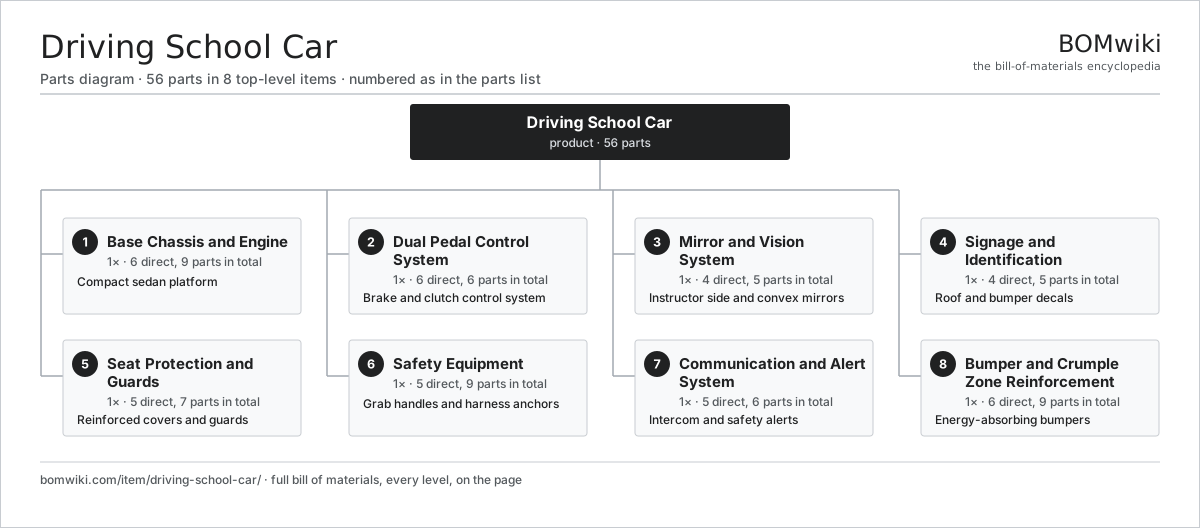
| # | Part | Qty | What it does |
|---|---|---|---|
| 1 | Base Chassis and Engine 6 parts | 1× | Compact sedan platform |
| 2 | Dual Pedal Control System 6 parts | 1× | Brake and clutch control system |
| 3 | Mirror and Vision System 4 parts | 1× | Instructor side and convex mirrors |
| 4 | Signage and Identification 4 parts | 1× | Roof and bumper decals |
| 5 | Seat Protection and Guards 5 parts | 1× | Reinforced covers and guards |
| 6 | Safety Equipment 5 parts | 1× | Grab handles and harness anchors |
| 7 | Communication and Alert System 5 parts | 1× | Intercom and safety alerts |
| 8 | Bumper and Crumple Zone Reinforcement 6 parts | 1× | Energy-absorbing bumpers |
3D model
No 3D model yet. Have a CAD file of this? Add a 3D model. STL renders right on this page; STEP, FreeCAD, and OpenSCAD sources are welcome too (openly licensed, like all 3D models on BOMwiki).
Build & assembly graph
expand / collapse · shared sub-assemblies converge · links to related products · est. labourTap an assembly to expand/collapse · tap a part to open it · use “Open page” for any node · drag to pan, scroll to zoom.
Bill of materials for Driving School Car
8 top-level lines · 49 rows shown · 56 parts total · indented to 3 levels| # | Item / sub-assembly | Part no. | Qty/assy | Ext. qty | Parts | Type |
|---|---|---|---|---|---|---|
| 1 | Base Chassis and Engine 6 parts | driving-school-car-base-chassis | 1× | 1 | 9 | assembly |
| 1.1 | Frame | driving-school-car-frame | 1× | 1 | · | part |
| 1.2 | Engine | driving-school-car-engine | 1× | 1 | · | part |
| 1.3 | Transmission | driving-school-car-transmission | 1× | 1 | · | part |
| 1.4 | Suspension | driving-school-car-suspension | 1× | 1 | · | part |
| 1.5 | Wheels and Tires | driving-school-car-wheels-tires | 4× | 4 | · | part |
| 1.6 | ABS System | driving-school-car-abs-system | 1× | 1 | · | part |
| 2 | Dual Pedal Control System 6 parts | driving-school-car-dual-pedals | 1× | 1 | 6 | assembly |
| 2.1 | Instructor Brake Pedal | driving-school-car-instructor-brake-pedal | 1× | 1 | · | part |
| 2.2 | Instructor Clutch Pedal | driving-school-car-instructor-clutch-pedal | 1× | 1 | · | part |
| 2.3 | Brake Priority Valve | driving-school-car-brake-priority-valve | 1× | 1 | · | part |
| 2.4 | Clutch Priority Valve | driving-school-car-clutch-priority-valve | 1× | 1 | · | part |
| 2.5 | Brake Line Routing | driving-school-car-brake-line-routing | 1× | 1 | · | part |
| 2.6 | Clutch Cable Routing | driving-school-car-clutch-cable-routing | 1× | 1 | · | part |
| 3 | Mirror and Vision System 4 parts | driving-school-car-mirror-set | 1× | 1 | 5 | assembly |
| 3.1 | Instructor Convex Mirror | driving-school-car-instructor-convex-mirror | 1× | 1 | · | part |
| 3.2 | Wide-Angle Side Mirror | driving-school-car-wide-angle-side-mirror | 2× | 2 | · | part |
| 3.3 | Interior Mirror Extension | driving-school-car-interior-mirror-extension | 1× | 1 | · | part |
| 3.4 | Mirror Mounting | driving-school-car-mirror-mounting | 1× | 1 | · | part |
| 4 | Signage and Identification 4 parts | driving-school-car-signage | 1× | 1 | 5 | assembly |
| 4.1 | Roof Sign | driving-school-car-roof-sign | 1× | 1 | · | part |
| 4.2 | Bumper Sticker | driving-school-car-bumper-sticker | 2× | 2 | · | part |
| 4.3 | Side Lettering | driving-school-car-side-lettering | 1× | 1 | · | part |
| 4.4 | Light Bar | driving-school-car-light-bar | 1× | 1 | · | part |
| 5 | Seat Protection and Guards 5 parts | driving-school-car-seat-protection | 1× | 1 | 7 | assembly |
| 5.1 | Front Seat Cover | driving-school-car-seat-cover-front | 1× | 1 | · | part |
| 5.2 | Rear Seat Cover | driving-school-car-seat-cover-rear | 1× | 1 | · | part |
| 5.3 | Armrest Protector | driving-school-car-armrest-protector | 2× | 2 | · | part |
| 5.4 | Door Panel Guard | driving-school-car-door-panel-guard | 2× | 2 | · | part |
| 5.5 | Floor Mat Set | driving-school-car-floor-mat-set | 1× | 1 | · | part |
| 6 | Safety Equipment 5 parts | driving-school-car-safety-equipment | 1× | 1 | 9 | assembly |
| 6.1 | Grab Handle | driving-school-car-grab-handle | 2× | 2 | · | part |
| 6.2 | Seat Belt Anchor | driving-school-car-seat-belt-anchor | 4× | 4 | · | part |
| 6.3 | Fire Extinguisher Mount | driving-school-car-fire-extinguisher-mount | 1× | 1 | · | part |
| 6.4 | First Aid Kit | driving-school-car-first-aid-kit | 1× | 1 | · | part |
| 6.5 | Emergency Light | driving-school-car-emergency-light | 1× | 1 | · | part |
| 7 | Communication and Alert System 5 parts | driving-school-car-communication | 1× | 1 | 6 | assembly |
| 7.1 | Intercom Headset | driving-school-car-intercom-headset | 2× | 2 | · | part |
| 7.2 | Intercom Base Unit | driving-school-car-intercom-base-unit | 1× | 1 | · | part |
| 7.3 | Warning Buzzer | driving-school-car-warning-buzzer | 1× | 1 | · | part |
| 7.4 | Backup Camera | driving-school-car-backup-camera | 1× | 1 | · | part |
| 7.5 | Camera Display | driving-school-car-camera-display | 1× | 1 | · | part |
| 8 | Bumper and Crumple Zone Reinforcement 6 parts | driving-school-car-bumper-reinforcement | 1× | 1 | 9 | assembly |
| 8.1 | Front Bumper Beam | driving-school-car-bumper-beam-front | 1× | 1 | · | part |
| 8.2 | Rear Bumper Beam | driving-school-car-bumper-beam-rear | 1× | 1 | · | part |
| 8.3 | Bumper Foam | driving-school-car-bumper-foam | 2× | 2 | · | part |
| 8.4 | Bumper Guard Front | driving-school-car-bumper-guard-front | 2× | 2 | · | part |
| 8.5 | Bumper Guard Rear | driving-school-car-bumper-guard-rear | 2× | 2 | · | part |
| 8.6 | Frame Reinforcement | driving-school-car-frame-reinforcement | 1× | 1 | · | part |
Something wrong in this list? Report a problem with this BOM.
Sourcing: possible vendors
Browse the supplier directory → Prices, MOQ, and lead times are algorithmic estimates, not quotes, and not claims about these companies. Company mappings are curated by keyword; est. price band $8k–$90k. How estimates work| Vendor | HQ | Specialty | MOQ | Lead time |
|---|---|---|---|---|
|
🇯🇵Toyota
global.toyota ↗
|
Toyota City, JP | Automaker | made to order | 16–28 wks |
| volkswagen-group.com ↗ | Wolfsburg, DE | Automaker | made to order | 16–28 wks |
| gm.com ↗ | Detroit, US | Automaker | made to order | 16–28 wks |
| hyundai.com ↗ | Seoul, KR | Automaker | made to order | 16–28 wks |
|
🇨🇳BYD
byd.com ↗
|
Shenzhen, CN | EV & battery manufacturer | made to order | 16–28 wks |
1,874-word article