Drop Hammer
ProductAlso known as: Drop Forge Hammer
Overview
A drop hammer (or trip hammer) is one of the oldest and most versatile forging machines, relying on gravity to deliver impact energy. In its simplest form, a tup (upper hammer mass) is raised by a rotating cam or mechanical linkage, then released to free-fall onto a heated workpiece resting on a lower anvil block. The impact deforms the metal plastically; for complex shapes, the workpiece is repositioned between successive blows.
Drop hammers are labor-intensive and slower than modern hydraulic presses (typically 20–60 blows/minute vs. 10–30 cycles/minute for large closed-die presses), but they excel at small-batch and custom forging work. A single drop hammer can accept different die sets, allowing a shop to produce dozens of part families without major equipment investment. The simplicity and ruggedness of the mechanical design make drop hammers nearly indestructible and easy to maintain, with a service life often exceeding 50 years.
Modern drop hammers range from 50 lbs (for jewelry or watchmaking) to 10,000+ lbs (for large structural forgings), with strike heights from 0.5 m to 3 m determining the impact energy available per blow.
How it works
The operator or automatic handling system positions a heated workpiece (typically 900–1200 °C) on the lower anvil. The upper tup, held at a fixed height by a rotating cam or mechanical lift, is released. It falls freely under gravity, accelerating to a velocity determined by the height. Upon impact, all kinetic energy is transferred to the workpiece in a few milliseconds, causing plastic deformation concentrated at the contact area between tup and anvil dies.
The impact impulse is severe but brief (10–50 ms). The anvil block, resting on resilient mounts (coil springs or elastomer pads), absorbs the rebound energy, preventing shock transmission to the floor and building structure. A well-designed anvil mounting allows the sow block to rise 10–50 mm after impact before returning to rest, dissipating energy harmlessly.
After the tup rebounds and comes to rest, the lift mechanism engages. For a board-drop hammer, a rotating cam (one lobe per cycle) contacts a roller on the board, raising the tup and its connected mass to the preset drop height. Once the cam lobe passes, the board is released, the tup falls, and the cycle repeats.
For complex forgings, the operator (wearing heat-resistant gloves) manually repositions the workpiece after each blow, rotating it or moving it along the die cavity to work the metal progressively. This manual control and flexibility is the key advantage of drop hammers for low-volume, high-customization work.
Tup Mass and Impact Energy
The energy delivered per blow is determined by E = mgh, where m is the tup mass, g is gravitational acceleration, and h is the drop height. A 500 lbs tup dropped from 2 m delivers approximately 4500 J, sufficient to upset a 50 mm diameter steel workpiece. A 10,000 lbs tup dropped from 2 m delivers 90,000 J, capable of forging large parts or multiple smaller workpieces simultaneously.
The impact force is not simply E/d (where d is contact deformation distance) because metal deformation is inelastic. Instead, the actual stress depends on the strain rate, material temperature, and die geometry. Hotter, softer metals require less impact energy; cold metals require more. A skilled operator learns to position the workpiece and space blows to maximize material flow while minimizing die wear.
Die Mounting and Changeability
Dies are typically mounted on quick-change pockets (T-slots or wedge locks) on both tup and anvil faces. Changing dies requires 20–60 minutes of labor to remove, align, and secure the new tooling. This manual process is a major advantage for job shops: a single hammer can support multiple product lines, and new parts can be added without major capital investment.
Dies are made of H11 or H13 tool steel, hardened to 36–42 HRC. At these hardness levels, die life varies from 1000 to 50,000 blows depending on material being forged and die cavity complexity. Carbon steel forgings produce less die wear than stainless steel or nickel alloys.
Lifting Mechanisms
Board drop: The simplest and most common. A rotating camshaft (driven by a 3–15 kW motor through a gearbox) lifts a wooden or steel board connected to the tup via a vertical rod. When the cam lobe releases the board, it falls freely.
Power lift: More modern machines use hydraulic or electric lift motors to raise the tup, offering programmable drop heights and speeds. This allows precise control of blow intensity and can reduce shock.
Spring assist: Large heavy tups (over 5000 lbs) often employ counterweights or springs to reduce the motor torque required for lifting, improving energy efficiency.
Vibration and Foundation
Drop hammers are among the most vibration-intensive machines in a shop. Each blow generates an impulse force of 500 kN to 5 MN lasting 10–50 ms. The anvil suspension must be tuned to avoid resonance with floor frequencies (typically 3–10 Hz). A poorly designed foundation can transmit vibration throughout a building, disturbing other machines and operations.
Professional installations embed the anvil in reinforced concrete (often 1–2 m deep) with elastomer isolators or spring mounts. The floor itself may require additional mass (a concrete apron surrounding the hammer) to improve dynamic stiffness. Proper installation costs $50,000–$200,000 for a large hammer, often exceeding the cost of the machine itself.
Operator Safety
Drop hammers pose significant hazards: the free-falling tup, the heated workpiece, and the manual repositioning create burn and crush risks. Modern machines include:
- Fixed guards preventing access to the die area during operation
- E-stop buttons within arm's reach
- Automatic cycle stops if guards are opened
- Operator cages or protective barriers
Many jurisdictions classify drop hammers as high-hazard machines and require annual safety inspections and operator certification.
Automation Potential
While drop hammers are traditionally manual, modern installations integrate robotic part handling and positioning. A robot arm loads and unloads parts, and can reposition the workpiece between blows, eliminating manual labor and increasing cycle rates. Fully automated drop hammer lines achieve 40–60 blows/minute, competitive with some hydraulic press installations.
Production Economics
Drop hammers excel at:
- Custom or low-volume work: Different die sets require no major retooling.
- Large workpieces: A 10,000 lbs hammer can forge parts weighing 50–500 lbs, difficult to accommodate in smaller hydraulic presses.
- Flexible part geometry: The operator can use the same hammer for round forgings, flat bars, or complex shapes.
Break-even point is typically 1000–5000 parts per SKU. Beyond that, a dedicated hydraulic press or forging cell may be more economical due to faster cycle time and reduced labor.
Maintenance and Longevity
Drop hammers are remarkably durable. A well-maintained machine has a 50+ year service life. Routine maintenance includes:
- Periodic oil changes in lift gearbox and bearing circuits
- Annual inspection of frame for cracks (rare but possible)
- Replacement of column bushings and guides every 5–10 years
- Die maintenance (inspection, rework, replacement as needed)
The mechanical simplicity means repair is often local, replacement of a worn bushing or coupling does not require specialized technicians. Many drop hammers installed in the 1960s–1980s are still in active service.
Drop Hammer parts and their functions
8 top-level parts · 47 parts in total · full bill of materials below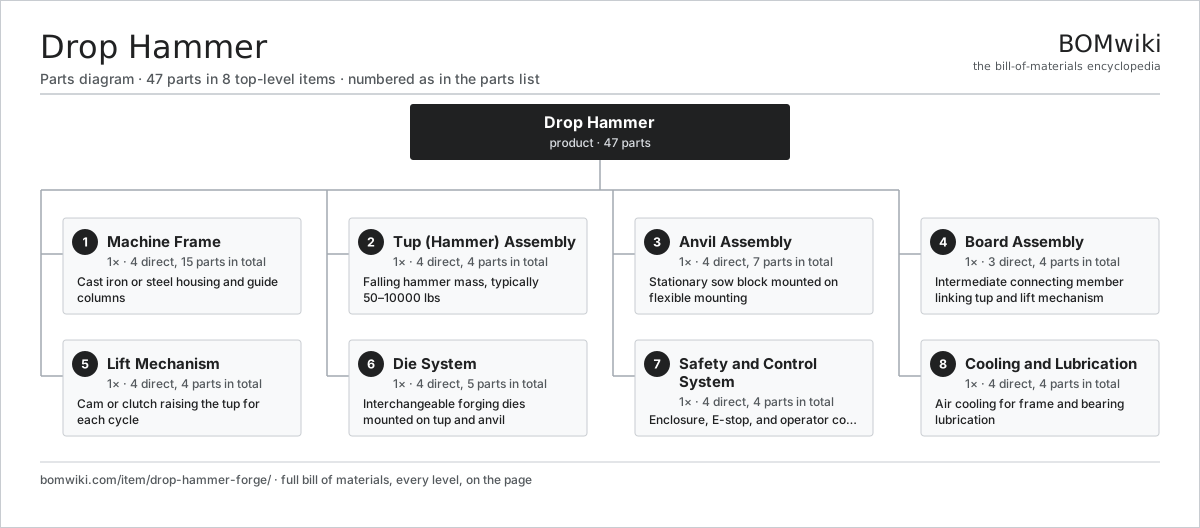
| # | Part | Qty | What it does |
|---|---|---|---|
| 1 | Machine Frame 4 parts | 1× | Cast iron or steel housing and guide columns |
| 2 | Tup (Hammer) Assembly 4 parts | 1× | Falling hammer mass, typically 50–10000 lbs |
| 3 | Anvil Assembly 4 parts | 1× | Stationary sow block mounted on flexible mounting |
| 4 | Board Assembly 3 parts | 1× | Intermediate connecting member linking tup and lift mechanism |
| 5 | Lift Mechanism 4 parts | 1× | Cam or clutch raising the tup for each cycle |
| 6 | Die System 4 parts | 1× | Interchangeable forging dies mounted on tup and anvil |
| 7 | Safety and Control System 4 parts | 1× | Enclosure, E-stop, and operator controls |
| 8 | Cooling and Lubrication 4 parts | 1× | Air cooling for frame and bearing lubrication |
3D model
No 3D model yet. Have a CAD file of this? Add a 3D model. STL renders right on this page; STEP, FreeCAD, and OpenSCAD sources are welcome too (openly licensed, like all 3D models on BOMwiki).
Build & assembly graph
expand / collapse · shared sub-assemblies converge · links to related products · est. labourTap an assembly to expand/collapse · tap a part to open it · use “Open page” for any node · drag to pan, scroll to zoom.
Bill of materials for Drop Hammer
8 top-level lines · 39 rows shown · 47 parts total · indented to 3 levels| # | Item / sub-assembly | Part no. | Qty/assy | Ext. qty | Parts | Type |
|---|---|---|---|---|---|---|
| 1 | Machine Frame 4 parts | drop-hammer-forge-frame | 1× | 1 | 15 | assembly |
| 1.1 | Main Frame Casting | drop-hammer-forge-frame-casting | 1× | 1 | · | part |
| 1.2 | Guide Columns | drop-hammer-forge-guide-columns | 2× | 2 | · | part |
| 1.3 | Column Bushings | drop-hammer-forge-column-bushings | 4× | 4 | · | part |
| 1.4 | Fastener Set | fastener-set | 8× | 8 | · | part |
| 2 | Tup (Hammer) Assembly 4 parts | drop-hammer-forge-tup | 1× | 1 | 4 | assembly |
| 2.1 | Hammer Mass | drop-hammer-forge-tup-mass | 1× | 1 | · | part |
| 2.2 | Die Holder | drop-hammer-forge-tup-die-holder | 1× | 1 | · | part |
| 2.3 | Tup Connecting Rod | drop-hammer-forge-tup-rod | 1× | 1 | · | part |
| 2.4 | Tup Seat Bearing | drop-hammer-forge-tup-seat | 1× | 1 | · | part |
| 3 | Anvil Assembly 4 parts | drop-hammer-forge-anvil | 1× | 1 | 7 | assembly |
| 3.1 | Sow Block (Anvil) | drop-hammer-forge-sow-block | 1× | 1 | · | part |
| 3.2 | Anvil Die Holder | drop-hammer-forge-anvil-die-holder | 1× | 1 | · | part |
| 3.3 | Anvil Suspension | drop-hammer-forge-anvil-suspension | 1× | 1 | · | part |
| 3.4 | Suspension Anchor Bolts | drop-hammer-forge-anvil-anchor | 4× | 4 | · | part |
| 4 | Board Assembly 3 parts | drop-hammer-forge-board | 1× | 1 | 4 | assembly |
| 4.1 | Board Beam | drop-hammer-forge-board-beam | 1× | 1 | · | part |
| 4.2 | Board Guide Sleeves | drop-hammer-forge-board-guides | 2× | 2 | · | part |
| 4.3 | Board Pivot Bearing | drop-hammer-forge-board-bearing | 1× | 1 | · | part |
| 5 | Lift Mechanism 4 parts | drop-hammer-forge-lift-mechanism | 1× | 1 | 4 | assembly |
| 5.1 | Lift Motor | drop-hammer-forge-lift-motor | 1× | 1 | · | part |
| 5.2 | Lift Gearbox | drop-hammer-forge-lift-gearbox | 1× | 1 | · | part |
| 5.3 | Lift Cam or Clutch | drop-hammer-forge-cam-or-clutch | 1× | 1 | · | part |
| 5.4 | Counterweight | drop-hammer-forge-counterweight | 1× | 1 | · | part |
| 6 | Die System 4 parts | drop-hammer-forge-dies | 1× | 1 | 5 | assembly |
| 6.1 | Upper Die | drop-hammer-forge-upper-die | 1× | 1 | · | part |
| 6.2 | Lower Die | drop-hammer-forge-lower-die | 1× | 1 | · | part |
| 6.3 | Die Handles | drop-hammer-forge-die-handles | 2× | 2 | · | part |
| 6.4 | Flash Carrier Basin | drop-hammer-forge-flash-carrier | 1× | 1 | · | part |
| 7 | Safety and Control System 4 parts | drop-hammer-forge-safety-guards | 1× | 1 | 4 | assembly |
| 7.1 | Guard Cage | drop-hammer-forge-guard-cage | 1× | 1 | · | part |
| 7.2 | Safety Railings | drop-hammer-forge-safety-railings | 1× | 1 | · | part |
| 7.3 | E-Stop Button | drop-hammer-forge-estop-button | 1× | 1 | · | part |
| 7.4 | Safety Relay Module | drop-hammer-forge-safety-relays | 1× | 1 | · | part |
| 8 | Cooling and Lubrication 4 parts | drop-hammer-forge-cooling | 1× | 1 | 4 | assembly |
| 8.1 | Cooling Fan | drop-hammer-forge-fan | 1× | 1 | · | part |
| 8.2 | Lubrication Pump | drop-hammer-forge-lubrication-pump | 1× | 1 | · | part |
| 8.3 | Oil Reservoir | drop-hammer-forge-oil-reservoir | 1× | 1 | · | part |
| 8.4 | Oil Filter | drop-hammer-forge-oil-filter | 1× | 1 | · | part |
Something wrong in this list? Report a problem with this BOM.
Sourcing: possible vendors
Browse the supplier directory → Prices, MOQ, and lead times are algorithmic estimates, not quotes, and not claims about these companies. Company mappings are curated by keyword; est. price band $10k–$1M. How estimates work| Vendor | HQ | Specialty | MOQ | Lead time |
|---|---|---|---|---|
|
🇩🇪DMG MORI
dmgmori.com ↗
|
Bielefeld, DE | Machine tools | 5 units | 12–20 wks |
|
🇯🇵Mazak
mazak.com ↗
|
Oguchi, JP | Machine tools | 5 units | 12–20 wks |
| haascnc.com ↗ | Oxnard, US | CNC machine tools | 5 units | 12–20 wks |
|
🇯🇵Okuma
okuma.com ↗
|
Niwa, JP | Machine tools | 5 units | 12–20 wks |
|
🇩🇪Trumpf
trumpf.com ↗
|
Ditzingen, DE | Laser & sheet-metal machines | 5 units | 12–20 wks |
1,209-word article