Drop Tower Ride
ProductOverview
A drop tower is a thrill ride combining a tall lift structure with a freefall element and controlled deceleration. Passengers are seated in a rotating or stationary gondola that is lifted to peak height, held briefly at the top for psychological effect, then released into free-fall. Magnetic or friction brakes arrest the descent 1–2 meters above ground, producing 0.5–1.5 g deceleration and a sensation of weightlessness during the freefall phase.
Unlike a traditional elevator, drop towers are specifically engineered for repeated shock loading and dynamic braking. The gondola structure, suspension system, and brake engagement timing are all tuned to deliver consistent sensations across hundreds of cycles per season.
How It Works
Lift Phase
The gondola is pulled upward via a hydraulic elevator or electric winch. A load cell under the lift carriage confirms that passengers are seated and restrained before ascent begins. Hall-effect sensors monitor restraint closure; if any restraint is open, a solenoid valve vents hydraulic pressure and prevents further lifting.
The control system uses position feedback (either a pressure transducer on the hydraulic line or a rotary encoder on the winch) to reach peak height precisely. When the gondola reaches the target height (typically 85–95% of tower height), the lift motor shuts off and a mechanical lock or solenoid-controlled latch holds it in place.
Freefall and Deceleration
After a 1–2 second pause at the top, the latch is released. The gondola drops under gravity, accelerating at 9.81 m/s². During freefall, passengers experience true weightlessness and can lift slightly out of their seats if not restrained.
Approximately 1–2 meters above ground, the magnetic brake system engages. If the gondola uses eddy-current brakes, rotating aluminum fins on the lift carriage pass through permanent magnets fixed to the tower frame. The relative motion induces eddy currents in the aluminum, creating a braking force proportional to velocity. The brake is self-regulating: as the gondola slows, the braking force decreases, preventing abrupt stopping.
Deceleration is tuned to 0.5–1.5 g, which feels firm but not injurious. A velocity encoder provides real-time feedback to the control system; if velocity is too high at the critical brake engagement point, a solenoid-valve pilot system applies supplemental friction brakes to prevent overshoot.
Final Stop and Restraint Release
The gondola comes to rest at ground level (or slightly raised on final shock-absorber springs). The control system verifies zero velocity before unlocking solenoids in the restraint modules. Passengers unbuckle and exit via a ramp or platform.
Optional Carousel Rotation
Some models rotate the gondola during the lift or freefall, adding rotational g-forces. A variable-frequency-drive motor and gear reducer on the top ring bearing implement slow rotation (0–2 rpm) controlled by a second PLC channel.
Structural Design
The tower is a triangular or square lattice of welded steel tube, typically 40–70 meters tall. Corner legs transfer load into concrete footings (4–6 meter deep pile caps, each anchored with 36–64 threaded rods).
The lift mechanism is mounted on a carriage that rides on rails or inside tubes. For hydraulic systems, the carriage contains an accumulator (nitrogen gas spring) that absorbs shock when the latch engages at the top. For electric winch systems, a spring-damper system on the cable provides similar cushioning.
The top of the tower has a large slew bearing (10–15 meter diameter) if carousel rotation is enabled. This bearing is supported by four large ball bearings and must handle radial and thrust loads from the rotating gondola.
Brake System Specifics
Eddy-Current Brakes (Preferred)
Rare-earth permanent magnets (neodymium, 1–2 Tesla field strength) are mounted in a bracket on the tower frame. Aluminum fins bolted to the lift carriage swing past the magnets 1–2 times per cycle.
Induced currents in the aluminum generate heat (dissipated as warmth in the fin material). The braking force is:
- Non-contact (no mechanical wear).
- Proportional to velocity (self-regulating).
- Repeatable cycle-to-cycle within ±5 %.
Disadvantage: Magnet strength degrades slightly over 10–15 years; periodic magnet replacement is required.
Friction Brakes (Legacy)
Mechanical calipers with friction pads grip a brake rotor mounted on the carriage. A solenoid pilot valve modulates hydraulic or pneumatic pressure to the caliper, adjusting braking force during descent. This system requires more maintenance (pad replacement every 1–2 years) but is simpler and less sensitive to environmental factors.
Control and Safety
A hardwired PLC executes the cycle sequence:
- Restraint check: All 16–32 restraint sensors must report "closed" within 10 seconds, else abort lift.
- Lift phase: Motor runs until position encoder reads peak height.
- Hold phase: Latch solenoid is energized, motor stops.
- Timed wait: Operators can adjust hold time (1–5 seconds) for dramatic effect.
- Release: Latch solenoid de-energizes.
- Freefall: Velocity encoder monitors descent rate.
- Brake engagement: Magnetic brakes engage passively; pilot solenoid applies friction if needed.
- Stop detection: Velocity sensor confirms < 0.5 m/s before restraint unlock.
Dual-channel safety relays enforce that a single sensor or solenoid fault does not allow unsafe operation. Loss of hydraulic pressure, for example, automatically triggers a spring-applied parking brake on the lift carriage.
Maintenance and Reliability
Key maintenance items:
- Magnet inspection: Visual check annually for cracks; strength testing every 5 years.
- Restraint sensors: Replaced every 2–3 years as contacts wear.
- Lift carriage seals: Hydraulic rod seals replaced every 1–2 years.
- Cable inspection: Visual and ultrasonic checks annually (electric winch systems).
- Foundation monitoring: Concrete anchor rods inspected every 3–5 years for corrosion.
Drop towers typically achieve 98 %+ uptime. Seasonal downtime includes full structural inspection, load cell recalibration, and magnet demagnetization testing.
Standards and Safety
Design follows ASTM F24 (F2291 for drop/falling ride systems) and international EN 13814. Key design factors:
- Restraint hold forces: 1.5–3.0 kN per anchor point (varies by rider mass and expected g-forces).
- Emergency brakes: At least two independent braking systems (magnetic + friction, or two friction systems in series).
- Lift redundancy: Hydraulic accumulators and mechanical locks ensure gondola cannot free-fall uncontrolled if lift fails.
- Stress analysis: Structures designed for 50-year life, 50 million+ cycles, with 3:1 safety factor on critical components.
Economics and Market
A typical 50-meter drop tower with 24-seat gondola costs $8–20 million to design, construct, and install. Annual operational costs are $250,000–$800,000 (primarily labor, electric, and maintenance). Revenue potential is $1.5–4 million per season at busy parks.
Drop towers are popular in mid-size regional parks (1–3 million annual visitors) and destination parks. Newer models with rotating gondolas or tilting seats command higher ticket prices and attract repeat riders.
Drop Tower Ride parts and their functions
7 top-level parts · 308 parts in total · full bill of materials below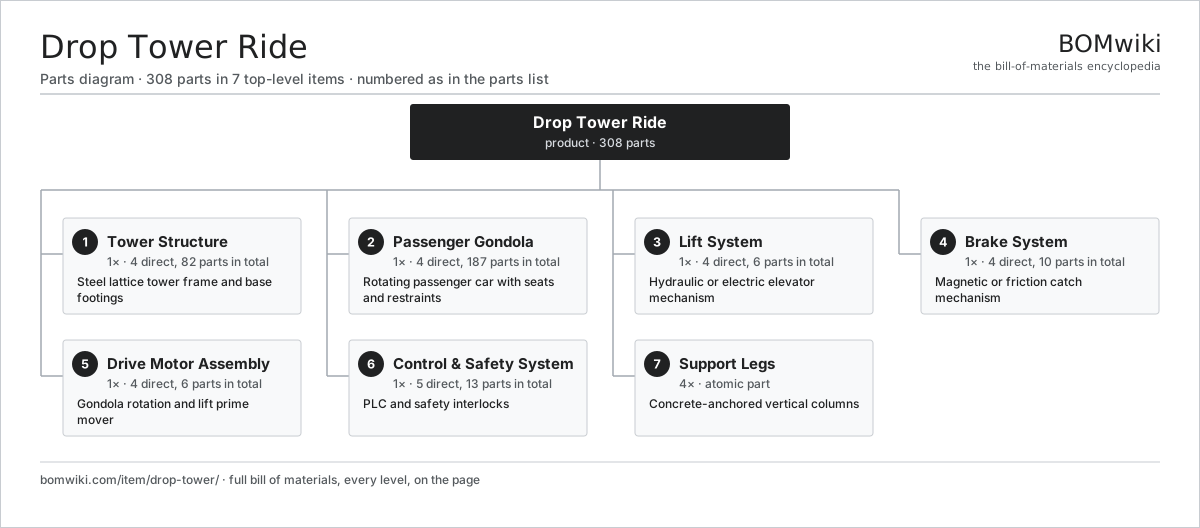
| # | Part | Qty | What it does |
|---|---|---|---|
| 1 | Tower Structure 4 parts | 1× | Steel lattice tower frame and base footings |
| 2 | Passenger Gondola 4 parts | 1× | Rotating passenger car with seats and restraints |
| 3 | Lift System 4 parts | 1× | Hydraulic or electric elevator mechanism |
| 4 | Brake System 4 parts | 1× | Magnetic or friction catch mechanism |
| 5 | Drive Motor Assembly 4 parts | 1× | Gondola rotation and lift prime mover |
| 6 | Control & Safety System 5 parts | 1× | PLC and safety interlocks |
| 7 | Support Legs | 4× | Concrete-anchored vertical columns |
3D model
No 3D model yet. Have a CAD file of this? Add a 3D model. STL renders right on this page; STEP, FreeCAD, and OpenSCAD sources are welcome too (openly licensed, like all 3D models on BOMwiki).
Build & assembly graph
expand / collapse · shared sub-assemblies converge · links to related products · est. labourTap an assembly to expand/collapse · tap a part to open it · use “Open page” for any node · drag to pan, scroll to zoom.
Bill of materials for Drop Tower Ride
7 top-level lines · 39 rows shown · 308 parts total · indented to 3 levels| # | Item / sub-assembly | Part no. | Qty/assy | Ext. qty | Parts | Type |
|---|---|---|---|---|---|---|
| 1 | Tower Structure 4 parts | drop-tower-structure | 1× | 1 | 82 | assembly |
| 1.1 | Sheet Metal Panel | sheet-panel | 60× | 60 | · | part |
| 1.2 | Fastener Set | fastener-set | 12× | 12 | · | part |
| 1.3 | Ball Bearing | ball-bearing | 8× | 8 | · | part |
| 1.4 | Cable Bundle | cable-bundle | 2× | 2 | · | part |
| 2 | Passenger Gondola 4 parts | drop-tower-gondola-assembly | 1× | 1 | 187 | assembly |
| 2.1 | Gondola Frame | drop-tower-gondola-frame | 1× | 1 | · | part |
| 2.2 | Seat Assembly 5 parts | seat-assembly | 24× | 24 | 7 | assembly |
| 2.2.1 | Seat Frame | seat-frame | 1× | 24 | · | part |
| 2.2.2 | Seat Foam | seat-foam | 2× | 48 | · | part |
| 2.2.3 | Seat Cover | seat-cover | 1× | 24 | · | part |
| 2.2.4 | Seat Motor | seat-motor | 2× | 48 | · | part |
| 2.2.5 | Seat Heater Mat | seat-heater | 1× | 24 | · | part |
| 2.3 | Restraint Module 2 parts | drop-tower-restraint-module | 8× | 8 | 2 | assembly |
| 2.3.1 | Hall Sensor | hall-sensor | 1× | 8 | · | part |
| 2.3.2 | Fastener Set | fastener-set | 1× | 8 | · | part |
| 2.4 | Connector | connector | 2× | 2 | · | part |
| 3 | Lift System 4 parts | drop-tower-lift-system | 1× | 1 | 6 | assembly |
| 3.1 | Blower Motor | blower-motor | 1× | 1 | · | part |
| 3.2 | Pressure Sensor | pressure-sensor | 2× | 2 | · | part |
| 3.3 | Cable Bundle | cable-bundle | 1× | 1 | · | part |
| 3.4 | Fastener Set | fastener-set | 2× | 2 | · | part |
| 4 | Brake System 4 parts | drop-tower-brake-system | 1× | 1 | 10 | assembly |
| 4.1 | Neodymium Magnet | neodymium-magnet | 6× | 6 | · | part |
| 4.2 | Pressure Sensor | pressure-sensor | 1× | 1 | · | part |
| 4.3 | Fastener Set | fastener-set | 2× | 2 | · | part |
| 4.4 | Encoder | encoder | 1× | 1 | · | part |
| 5 | Drive Motor Assembly 4 parts | drop-tower-drive-motor | 1× | 1 | 6 | assembly |
| 5.1 | Blower Motor | blower-motor | 1× | 1 | · | part |
| 5.2 | Gearbox Housing | gearbox-housing | 1× | 1 | · | part |
| 5.3 | Ball Bearing | ball-bearing | 3× | 3 | · | part |
| 5.4 | Fastener Set | fastener-set | 1× | 1 | · | part |
| 6 | Control & Safety System 5 parts | drop-tower-control-system | 1× | 1 | 13 | assembly |
| 6.1 | Microcontroller | mcu | 1× | 1 | · | part |
| 6.2 | Relay | relay | 6× | 6 | · | part |
| 6.3 | Bare PCB | pcb-bare | 2× | 2 | · | part |
| 6.4 | LCD Panel | lcd-panel | 1× | 1 | · | part |
| 6.5 | Connector | connector | 3× | 3 | · | part |
| 7 | Support Legs | drop-tower-support-legs | 4× | 4 | · | part |
Something wrong in this list? Report a problem with this BOM.
Related products
same domain, ranked by shared parts Pirate Ship Ride
478 parts · shares 15 with this page
Pirate Ship Ride
478 parts · shares 15 with this page
 Teacup Ride
660 parts · shares 15 with this page
Teacup Ride
660 parts · shares 15 with this page
 Roller Coaster
657 parts · shares 15 with this page
Roller Coaster
657 parts · shares 15 with this page
 Dark Ride System
1,005 parts · shares 15 with this page
Dark Ride System
1,005 parts · shares 15 with this page
 Log Flume Ride
486 parts · shares 13 with this page
Log Flume Ride
486 parts · shares 13 with this page
 Ferris Wheel
3,547 parts · shares 12 with this page
Ferris Wheel
3,547 parts · shares 12 with this page
Sourcing: possible vendors
Browse the supplier directory → Prices, MOQ, and lead times are algorithmic estimates, not quotes, and not claims about these companies. Company mappings are curated by keyword; est. price band $20–$3k. How estimates work| Vendor | HQ | Specialty | MOQ | Lead time |
|---|---|---|---|---|
|
🇩🇰LEGO
lego.com ↗
|
Billund, DK | Construction toys | 2,000 units | 6–10 wks |
|
🇺🇸Mattel
mattel.com ↗
|
El Segundo, US | Toys | 2,000 units | 6–10 wks |
|
🇺🇸Hasbro
hasbro.com ↗
|
Pawtucket, US | Toys & games | 2,000 units | 6–10 wks |
| bandainamco.co.jp ↗ | Tokyo, JP | Toys & amusement | 2,000 units | 6–10 wks |
| spinmaster.com ↗ | Toronto, CA | Toys | 2,000 units | 6–10 wks |
1,130-word article