Drum Machine
ProductOverview
A drum machine is a self-contained percussion instrument that generates rhythm patterns without acoustic drums, performers, or sampling from external sources. It combines a padded control surface, a sample-based or synthesis-based sound engine, and a pattern sequencer into a single unit, making it the standard tool for electronic music production, live performance, and beat creation in hip-hop and electronic genres.
The device centers on a Pad Array grid (typically 16 or 64 illuminated velocity-sensitive pads) that the user strikes to trigger drum voices stored in the Sound Engine (Samples + Synthesis). Unlike a MIDI controller, which merely sends MIDI messages to external software or synthesizers, a drum machine generates its own audio output directly. The Sequencer Engine engine allows patterns to be programmed in step or real-time mode, then looped and combined into full songs.
How it works
The Drum Pads form the performance interface. Each drum-machine-pad contains a Pressure Sensor that measures strike velocity from the impact force, sending a signal proportional to velocity to the Pad Matrix PCB. This scanning PCB encodes the pad number and velocity as an internal protocol (not necessarily MIDI) and sends it to the Main Microprocessor microprocessor.
The Main Microprocessor runs the Sequencer Engine firmware. In real-time mode, it immediately forwards pad triggers to the Sound Engine (Samples + Synthesis). In step-edit mode, it captures pattern data: which pad to trigger, at what step in a 16- or 32-step pattern, and at what velocity. Patterns are stored in the Pattern Memory, typically nonvolatile flash, allowing the user to save and recall combinations.
The Sound Engine (Samples + Synthesis) is where audio is actually generated. It consists of a dedicated Audio DSP Processor audio processor and a Sample ROM Library containing professional drum samples (kicks, snares, hi-hats, claps, cowbells, tom-toms, cymbals, percussion). When a pad is triggered, the DSP either plays back the corresponding sample, applies time-stretching if needed to match the song tempo, or synthesizes a drum sound using oscillators and envelope generators (for synthetic kick or snare tones). The DSP also applies effects like reverb, compression, and EQ to individual drum voices.
All voices mix internally to a stereo signal, which is fed to the Audio DAC 24-bit stereo digital-to-analog converter. The output stage drives both Audio Output Stage line-level outputs (for mixing console integration) and a Headphone Amplifier for standalone monitoring.
The Control Interface (Buttons, Display, Knobs) provides pattern editing, sound selection, and parameter tweaking. A Display LCD shows the current pattern, step number, and selected drum voice parameters. Navigation buttons and Navigation Encoders allow the user to browse sounds, change swing timing, adjust drum voice parameters (attack time, decay, pitch modulation), and set the tempo (via tap tempo or numeric input).
Sequencing modes
Most drum machines support multiple ways to create rhythm:
- Real-time mode: Strike pads to perform; the sequencer records every strike and its timing, allowing human feel.
- Step sequencing: Select a drum sound, then mark steps 1–16 (or 1–32) of a pattern grid, stepping through and entering notes in time-sync with the sequencer master clock.
- Pattern chaining: Link multiple patterns to form a complete song structure (intro, verse, chorus, break, outro).
- Sidechain compression (optional): Route one drum (e.g., kick) to sidechain-compress another voice (e.g., bass synth in a DAW), creating the characteristic "pumping" effect in EDM.
Professional drum machines often include MIDI clock synchronization: the Clock Synchronization Module input accepts MIDI beat clock from a host DAW, ensuring the drum machine stays locked to the session tempo without manual beat sync.
Sound design and customization
Advanced machines allow real-time parameter editing: adjusting the pitch or envelope of a kick drum while playing, or swapping samples on-the-fly. Some machines support user sample import via USB, allowing custom drum sounds. The Audio DSP Processor synthesis capabilities vary by model: high-end machines model the physics of acoustic drums (simulating air pressure in a drum shell, stick impact timbre, sympathetic resonance), while others offer straightforward sample playback with pitch and time-stretch only.
Live and studio use
In the studio, a drum machine is often the first element of a track, either as the final rhythm (bounced directly into the mix) or as a timing reference that guides subsequent instrumental overdubs. In live performance, musicians use drum machines for backing tracks, synchronization to click tracks, or as a secondary rhythm source layered with acoustic drums. The Pad LED feedback allows the performer to see which pads are active (triggering samples) or which patterns are loaded, aiding live control and improvisation.
Drum Machine parts and their functions
6 top-level parts · 95 parts in total · full bill of materials below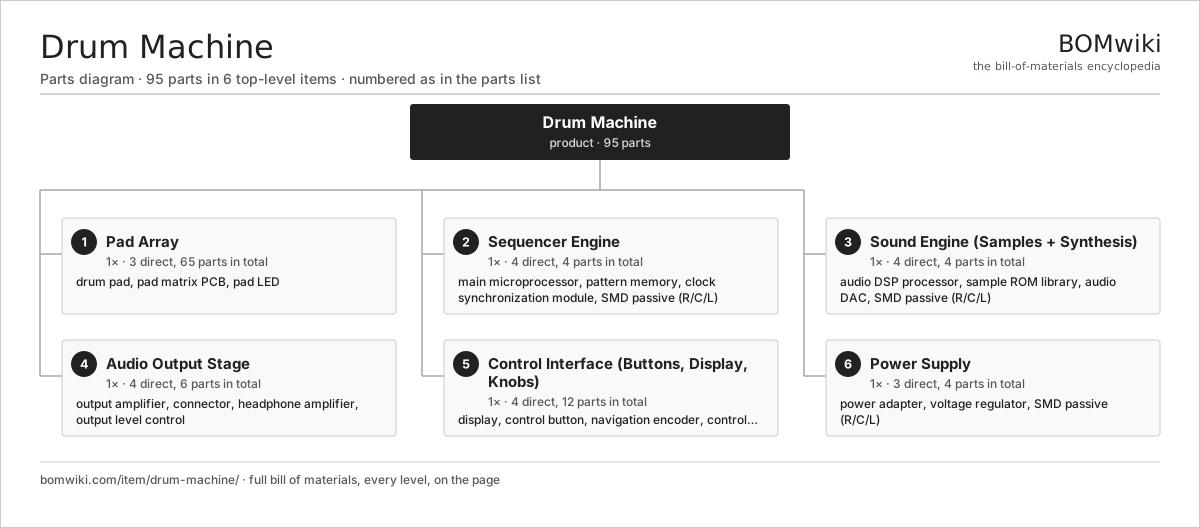
| # | Part | Qty | What it does |
|---|---|---|---|
| 1 | Pad Array 3 parts | 1× | 16-pad or 64-pad velocity-sensitive and illuminated grid for triggering drum voices. |
| 2 | Sequencer Engine 4 parts | 1× | Step sequencer or pattern-based rhythm arranger with programmable note timing and parameter automation. |
| 3 | Sound Engine (Samples + Synthesis) 4 parts | 1× | DSP processor running drum voice algorithms, sample playback, drum synthesis (kick, snare, hi-hat modeling), and effects. |
| 4 | Audio Output Stage 4 parts | 1× | Balanced XLR and unbalanced RCA outputs with level control and headphone amplifier. |
| 5 | Control Interface (Buttons, Display, Knobs) 4 parts | 1× | LCD or OLED display, mode buttons, and navigation knobs for pattern editing and parameter adjustment. |
| 6 | Power Supply 3 parts | 1× | Wall adapter or internal battery with voltage regulation and power management. |
3D model
No 3D model yet. Have a CAD file of this? Add a 3D model. STL renders right on this page; STEP, FreeCAD, and OpenSCAD sources are welcome too (openly licensed, like all 3D models on BOMwiki).
Build & assembly graph
expand / collapse · shared sub-assemblies converge · links to related products · est. labourTap an assembly to expand/collapse · tap a part to open it · use “Open page” for any node · drag to pan, scroll to zoom.
Bill of materials for Drum Machine
6 top-level lines · 31 rows shown · 95 parts total · indented to 3 levels| # | Item / sub-assembly | Part no. | Qty/assy | Ext. qty | Parts | Type |
|---|---|---|---|---|---|---|
| 1 | Pad Array 3 parts | drum-machine-pads | 1× | 1 | 65 | assembly |
| 1.1 | Drum Pad 3 parts | drum-machine-pad-unit | 16× | 16 | 3 | assembly |
| 1.1.1 | Pad Cap | drum-machine-pad-cap | 1× | 16 | · | part |
| 1.1.2 | Pad Return Spring | drum-machine-pad-spring | 1× | 16 | · | part |
| 1.1.3 | Pressure Sensor | drum-machine-pad-sensor | 1× | 16 | · | part |
| 1.2 | Pad Matrix PCB | drum-machine-pad-matrix-pcb | 1× | 1 | · | part |
| 1.3 | Pad LED | drum-machine-pad-led | 16× | 16 | · | part |
| 2 | Sequencer Engine 4 parts | drum-machine-sequencer | 1× | 1 | 4 | assembly |
| 2.1 | Main Microprocessor | drum-machine-main-mcu | 1× | 1 | · | part |
| 2.2 | Pattern Memory | drum-machine-memory | 1× | 1 | · | part |
| 2.3 | Clock Synchronization Module | drum-machine-clock-sync | 1× | 1 | · | part |
| 2.4 | SMD Passive (R/C/L) | smd-passives | 1× | 1 | · | part |
| 3 | Sound Engine (Samples + Synthesis) 4 parts | drum-machine-sound-engine | 1× | 1 | 4 | assembly |
| 3.1 | Audio DSP Processor | drum-machine-dsp | 1× | 1 | · | part |
| 3.2 | Sample ROM Library | drum-machine-sample-rom | 1× | 1 | · | part |
| 3.3 | Audio DAC | drum-machine-audio-dac | 1× | 1 | · | part |
| 3.4 | SMD Passive (R/C/L) | smd-passives | 1× | 1 | · | part |
| 4 | Audio Output Stage 4 parts | drum-machine-audio-output | 1× | 1 | 6 | assembly |
| 4.1 | Output Amplifier | drum-machine-output-amplifier | 1× | 1 | · | part |
| 4.2 | Connector | connector | 3× | 3 | · | part |
| 4.3 | Headphone Amplifier | drum-machine-headphone-amp | 1× | 1 | · | part |
| 4.4 | Output Level Control | drum-machine-output-level-pot | 1× | 1 | · | part |
| 5 | Control Interface (Buttons, Display, Knobs) 4 parts | drum-machine-control-ui | 1× | 1 | 12 | assembly |
| 5.1 | Display | drum-machine-display | 1× | 1 | · | part |
| 5.2 | Control Button | drum-machine-button | 8× | 8 | · | part |
| 5.3 | Navigation Encoder | drum-machine-encoder | 2× | 2 | · | part |
| 5.4 | Control PCB | drum-machine-control-pcb | 1× | 1 | · | part |
| 6 | Power Supply 3 parts | drum-machine-power-supply | 1× | 1 | 4 | assembly |
| 6.1 | Power Adapter | drum-machine-power-adapter | 1× | 1 | · | part |
| 6.2 | Voltage Regulator | drum-machine-regulator | 2× | 2 | · | part |
| 6.3 | SMD Passive (R/C/L) | smd-passives | 1× | 1 | · | part |
Something wrong in this list? Report a problem with this BOM.
Related products
same domain, ranked by shared parts Digital Piano
689 parts · shares 2 with this page
Digital Piano
689 parts · shares 2 with this page
 Electronic Drum Kit
336 parts · shares 2 with this page
Electronic Drum Kit
336 parts · shares 2 with this page
 Guitar Amplifier
439 parts · shares 2 with this page
Guitar Amplifier
439 parts · shares 2 with this page
 Guitar Multi-Effects Processor
70 parts · shares 2 with this page
Guitar Multi-Effects Processor
70 parts · shares 2 with this page
 Synthesizer
425 parts · shares 2 with this page
Synthesizer
425 parts · shares 2 with this page
 Theremin
47 parts · shares 2 with this page
Theremin
47 parts · shares 2 with this page
Sourcing: possible vendors
Browse the supplier directory → Prices, MOQ, and lead times are algorithmic estimates, not quotes, and not claims about these companies. Company mappings are curated by keyword; est. price band $50–$5k. How estimates work| Vendor | HQ | Specialty | MOQ | Lead time |
|---|---|---|---|---|
| yamaha.com ↗ | Hamamatsu, JP | Audio & instruments | 200 units | 8–14 wks |
|
🇺🇸Fender
fender.com ↗
|
Los Angeles, US | Guitars & amps | 200 units | 8–14 wks |
|
🇺🇸Gibson
gibson.com ↗
|
Nashville, US | Guitars | 200 units | 8–14 wks |
|
🇯🇵Roland
roland.com ↗
|
Hamamatsu, JP | Electronic instruments | 200 units | 8–14 wks |
| steinway.com ↗ | New York, US | Pianos | 200 units | 8–14 wks |
802-word article