DSL Modem Router
ProductOverview
A DSL modem-router combines a DSL analog front-end with a multi-port Ethernet switch and WiFi access point in a single consumer gateway. Deployed by ISPs to bridge last-mile telephone copper to broadband internet, it serves as the demarcation point between carrier DSL infrastructure and customer LAN. The device interprets high-frequency tones transmitted from the CO (central office) and modulates customer traffic back toward the DSL network using Discrete Multi-Tone (DMT) modulation across 256 subcarriers spanning 1.1 MHz.
DSL modems embed the entire OSI stack: physical layer AFE (analog front-end) for tone generation, ADSL/VDSL MAC engines in the SoC, Ethernet switch fabric for LAN bridging, and embedded Linux for routing and stateful firewall. A typical unit consumes 18W, driven by an external AC-DC adapter. Thermal design is passive in budget units but may include a small axial fan for reliability in hot climates; the aluminum heatsink beneath the SoC dissipates 8–10W to the plastic enclosure, which then radiates to room air.
How it works
The DSL front-end begins with an isolation transformer coupled to the RJ11 phone jack. The AFE chip (e.g., Lantiq, Broadcom) applies a hybrid network that separates transmit and receive signals on the same twisted pair, critical since DSL is full-duplex. Each of 256 subcarriers is modulated independently; the SoC firmware runs the tone training algorithm to detect which tones are usable (SNR > 6 dB) and allocates bits accordingly. Downstream pilot tones and training sequences are received continuously to adapt modulation.
The switch ASIC performs per-port forwarding based on learned MAC addresses. Packets from WiFi clients pass through the SoC's SoC and Control Plane where Linux bridge driver forwards them to Ethernet ports or DSL. NAT and stateful firewall rules running on the SoC intercept traffic destined for WAN (DSL), rewriting source IPs. The SoC also implements DHCP server for LAN clients, assigning addresses from a small pool (192.168.0.0/24 default).
WiFi is provided by a single-band 2.4 GHz MIMO radio using Atheros/Qualcomm chipset. Two external antennas are fed by low-noise amplifiers and a bandpass filter rejecting interference outside 2.4–2.5 GHz. The radio operates in 802.11n mode with channel bonding disabled (to avoid regulatory issues), achieving ~150 Mbps aggregate throughput in ideal conditions. Actual user throughput over DSL is bottlenecked by the AFE's line rate.
Power distribution on the PCB uses a hierarchical linear regulator chain: the 12V adapter output feeds a buck converter producing 3.3V for digital I/O and flash, a second buck then steps down to 1.8V for memory, and an LDO generates 1.2V for the ARM processor core. This cascading approach minimizes component count and allows each domain to soft-start independently, reducing inrush current during cold boot.
Firmware updates are delivered over-the-air by the ISP via DHCP option 60 (Vendor Class Identifier) or by user upload via web GUI. The bootloader resides in NOR flash and is never overwritten; the OS, kernel, and applications occupy the larger NAND flash. A watchdog timer resets the SoC if it hangs longer than 30 seconds, critical for production deployments where access may not be immediate.
The DSL Line Driver Subsystem includes surge protection (gas discharge tube and clamping diodes) to withstand ring voltage (90V AC) or lightning transients on the DSL line. The transformer is rated for 120V impulse and 600 Ω characteristic impedance, matching the telco wiring standard. Over-temperature or brown-out conditions trigger graceful shutdown of the DSL transceiver to avoid damage to the AFE.
User management is minimal: a factory reset button held for 10 seconds erases all configuration (WiFi SSID, admin password, DHCP settings) and reboots into DHCP client mode awaiting ISP provisioning. Status LEDs indicate DSL link state, WiFi activity, and internet connectivity. Advanced users can enable a serial console on a debug header for UART access at 115200 baud.
Standards and Protocols
DSL Modem-routers conform to ITU-T G.992.x standards (ADSL, ADSL2, ADSL2+). The AFE implements ITU G.994.1 G.hs handshake for line negotiation, identifying loop length and loading coil position, then selects the appropriate modulation profile. Downstream rates up to 24 Mbps require line lengths under 2.5 km; longer loops fall back to lower modulation (ADSL1 @ 8 Mbps). The DMT encoder inverts all 256 subcarrier values using IFFT, transmits over the AFE, and the receiver performs FFT to recover magnitude and phase, then applies QAM demodulation per carrier.
The Ethernet switch conforms to IEEE 802.3u Fast Ethernet. Each RJ45 jack includes isolation magnetics, a 1:1 transformer in series with each data pair, to prevent ground loops when long cables are plugged in. The PHY negotiates auto-negotiation on link-up, defaulting to 100 Base-TX full-duplex.
Wireless frames are formatted per IEEE 802.11n: up to 7 OFDM subcarriers per PPDU, with Guard Interval (GI) selectable as 800 ns (standard) or 400 ns (short). Aggregation of multiple MPDUs in a single frame increases efficiency for bulk file transfers.
Architecture Notes
The design prioritizes cost and integration: a single SoC integrates DSL modem engine, Ethernet MACs, GPIO controller, and UART. Shared components like the Power Supply and SMD Passive (R/C/L) appear across all subsystems. The Enclosure and Thermal may omit the blower motor in cooler regions (e.g., Northern Europe), keeping acoustic noise under 35 dB(A) via passive heat dissipation alone.
Field deployments often involve provisioning the unit with carrier-specific firmware that locks DSL line settings and restricts user access to WiFi password changes only. This firmware is stored in NAND flash and signed with the ISP's RSA key, preventing third-party modification.
DSL Modem Router parts and their functions
7 top-level parts · 56 parts in total · full bill of materials below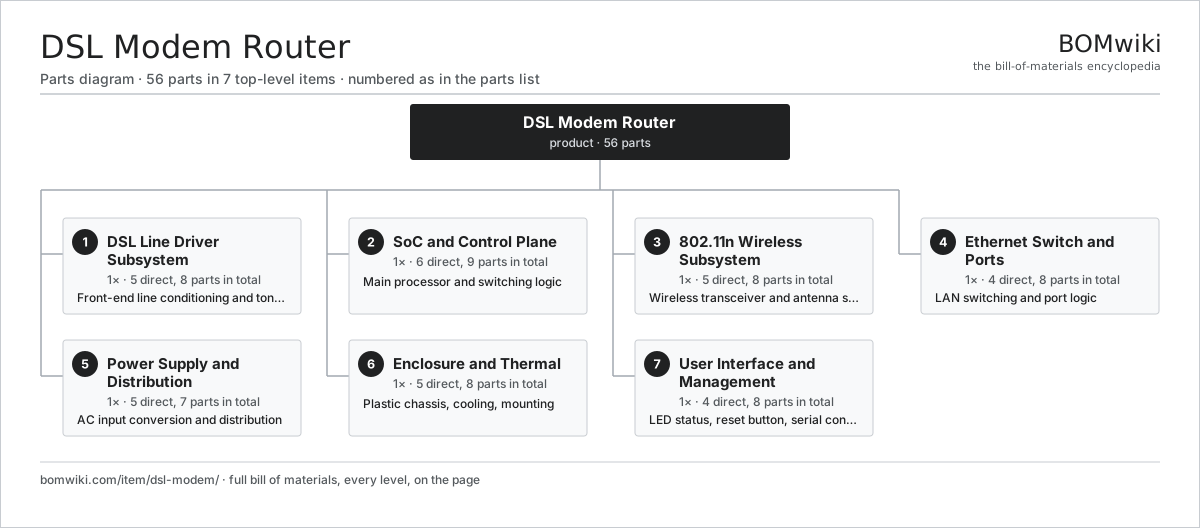
| # | Part | Qty | What it does |
|---|---|---|---|
| 1 | DSL Line Driver Subsystem 5 parts | 1× | Front-end line conditioning and tone generation |
| 2 | SoC and Control Plane 6 parts | 1× | Main processor and switching logic |
| 3 | 802.11n Wireless Subsystem 5 parts | 1× | Wireless transceiver and antenna system |
| 4 | Ethernet Switch and Ports 4 parts | 1× | LAN switching and port logic |
| 5 | Power Supply and Distribution 5 parts | 1× | AC input conversion and distribution |
| 6 | Enclosure and Thermal 5 parts | 1× | Plastic chassis, cooling, mounting |
| 7 | User Interface and Management 4 parts | 1× | LED status, reset button, serial console |
3D model
No 3D model yet. Have a CAD file of this? Add a 3D model. STL renders right on this page; STEP, FreeCAD, and OpenSCAD sources are welcome too (openly licensed, like all 3D models on BOMwiki).
Build & assembly graph
expand / collapse · shared sub-assemblies converge · links to related products · est. labourTap an assembly to expand/collapse · tap a part to open it · use “Open page” for any node · drag to pan, scroll to zoom.
Bill of materials for DSL Modem Router
7 top-level lines · 41 rows shown · 56 parts total · indented to 3 levels| # | Item / sub-assembly | Part no. | Qty/assy | Ext. qty | Parts | Type |
|---|---|---|---|---|---|---|
| 1 | DSL Line Driver Subsystem 5 parts | dsl-modem-dsl-subsystem | 1× | 1 | 8 | assembly |
| 1.1 | DSL AFE IC | dsl-modem-afe-chip | 1× | 1 | · | part |
| 1.2 | Line Coupling Transformer | dsl-modem-transformer | 2× | 2 | · | part |
| 1.3 | Surge and Transient Protection | dsl-modem-surge-protection | 1× | 1 | · | part |
| 1.4 | Connector | connector | 1× | 1 | · | part |
| 1.5 | SMD Passive (R/C/L) | smd-passives | 3× | 3 | · | part |
| 2 | SoC and Control Plane 6 parts | dsl-modem-soc-subsystem | 1× | 1 | 9 | assembly |
| 2.1 | Dual-Core SoC | dsl-modem-soc-chip | 1× | 1 | · | part |
| 2.2 | 128 MB DDR3 Module | dsl-modem-dram | 1× | 1 | · | part |
| 2.3 | 16 MB NOR Flash | dsl-modem-nor-flash | 1× | 1 | · | part |
| 2.4 | 256 MB NAND Flash | dsl-modem-nand-flash | 1× | 1 | · | part |
| 2.5 | Bare PCB | pcb-bare | 1× | 1 | · | part |
| 2.6 | SMD Passive (R/C/L) | smd-passives | 4× | 4 | · | part |
| 3 | 802.11n Wireless Subsystem 5 parts | dsl-modem-wifi-subsystem | 1× | 1 | 8 | assembly |
| 3.1 | MIMO Radio IC | dsl-modem-wifi-transceiver | 1× | 1 | · | part |
| 3.2 | External Dipole Antenna | dsl-modem-antenna-x2 | 2× | 2 | · | part |
| 3.3 | LNA and Bandpass Filter | dsl-modem-lna-filter | 1× | 1 | · | part |
| 3.4 | SMD Passive (R/C/L) | smd-passives | 2× | 2 | · | part |
| 3.5 | Coaxial Pigtail | dsl-modem-wifi-cable | 2× | 2 | · | part |
| 4 | Ethernet Switch and Ports 4 parts | dsl-modem-ethernet-subsystem | 1× | 1 | 8 | assembly |
| 4.1 | Fast Ethernet Switch IC | dsl-modem-switch-chip | 1× | 1 | · | part |
| 4.2 | RJ45 Jack with Magnetics | dsl-modem-rj45-ports | 4× | 4 | · | part |
| 4.3 | SMD Passive (R/C/L) | smd-passives | 2× | 2 | · | part |
| 4.4 | Bare PCB | pcb-bare | 1× | 1 | · | part |
| 5 | Power Supply and Distribution 5 parts | dsl-modem-power-subsystem | 1× | 1 | 7 | assembly |
| 5.1 | Power Supply | power-supply | 1× | 1 | · | part |
| 5.2 | 12V to 3.3V Buck Converter | dsl-modem-dcdc-12v-3v3 | 1× | 1 | · | part |
| 5.3 | 3.3V to 1.8V Converter | dsl-modem-dcdc-3v3-1v8 | 1× | 1 | · | part |
| 5.4 | 1.2V LDO with Soft-Start | dsl-modem-ldo-1v2 | 1× | 1 | · | part |
| 5.5 | SMD Passive (R/C/L) | smd-passives | 3× | 3 | · | part |
| 6 | Enclosure and Thermal 5 parts | dsl-modem-enclosure-subsystem | 1× | 1 | 8 | assembly |
| 6.1 | Injection-Molded Chassis | dsl-modem-chassis-plastic | 1× | 1 | · | part |
| 6.2 | Blower Motor | blower-motor | 1× | 1 | · | part |
| 6.3 | Intake Air Filter | dsl-modem-air-filter | 1× | 1 | · | part |
| 6.4 | Sheet Metal Panel | sheet-panel | 1× | 1 | · | part |
| 6.5 | Silicone Isolation Feet | dsl-modem-rubber-feet | 4× | 4 | · | part |
| 7 | User Interface and Management 4 parts | dsl-modem-management-subsystem | 1× | 1 | 8 | assembly |
| 7.1 | Bicolor Status LED | dsl-modem-led-status-x4 | 4× | 4 | · | part |
| 7.2 | Factory Reset Button | dsl-modem-reset-button | 1× | 1 | · | part |
| 7.3 | Serial Console Header | dsl-modem-uart-header | 1× | 1 | · | part |
| 7.4 | Fastener Set | fastener-set | 2× | 2 | · | part |
Something wrong in this list? Report a problem with this BOM.
Related products
same domain, ranked by shared parts 5G Base Station
436 parts · shares 3 with this page
Data Center Switch (Spine)
3,264 parts · shares 3 with this page
5G Base Station
436 parts · shares 3 with this page
Data Center Switch (Spine)
3,264 parts · shares 3 with this page
 Firewall Appliance
82 parts · shares 3 with this page
Load Balancer Appliance
911 parts · shares 3 with this page
Firewall Appliance
82 parts · shares 3 with this page
Load Balancer Appliance
911 parts · shares 3 with this page
 Network Switch
1,367 parts · shares 3 with this page
Server Rack
304 parts · shares 3 with this page
Network Switch
1,367 parts · shares 3 with this page
Server Rack
304 parts · shares 3 with this page
Sourcing: possible vendors
Browse the supplier directory → Prices, MOQ, and lead times are algorithmic estimates, not quotes, and not claims about these companies. Company mappings are curated by keyword; est. price band $30–$50k. How estimates work| Vendor | HQ | Specialty | MOQ | Lead time |
|---|---|---|---|---|
|
🇺🇸Cisco
cisco.com ↗
|
San Jose, US | Networking | 500 units | 8–14 wks |
|
🇺🇸Juniper
juniper.net ↗
|
Sunnyvale, US | Networking | 500 units | 8–14 wks |
| arista.com ↗ | Santa Clara, US | Networking | 500 units | 8–14 wks |
|
🇫🇮Nokia
nokia.com ↗
|
Espoo, FI | Telecom equipment | 500 units | 8–14 wks |
|
🇨🇳Huawei
huawei.com ↗
|
Shenzhen, CN | Networking & telecom | 500 units | 8–14 wks |
959-word article