Direct-to-Garment Printer
ProductOverview
Direct-to-garment (DTG) printers revolutionized on-demand apparel decoration by eliminating the need for screen setup or transfer media. They print full-color images directly onto cotton, cotton-blend, and polyester fabrics using piezoelectric inkjet technology. A single machine can produce unlimited print designs without retooling, making DTG ideal for custom t-shirts, hoodies, and small-batch fashion.
The workflow is straightforward: lay a garment on the heated platen, optionally spray a chemical pretreatment to enhance color vibrancy, position the print head carriage, and fire piezo nozzles to deposit CMYK inks. White ink is applied first (as an opaque base) on dark fabrics, then colors are overprinted. Heat curing fuses the ink to fiber, yielding a soft, durable print that survives 50+ wash cycles.
DTG printers bridge the gap between screen printing (requires setup but is cheapest per unit at high volume) and hand decoration (unlimited designs but slow). A DTG printer pays for itself in 1-2 years running a custom apparel business.
How it works
An operator loads a garment (t-shirt, sweatshirt, etc.) onto the Platen System. If the fabric is dark, a pretreatment chemical is sprayed via the Pretreat Interface spray head and dried by an infrared element. This pretreatment (usually a polyurethane or acrylic copolymer) improves white ink adhesion and color brightness on dark synthetics.
The Platen System is heated to 40-60 C to warm the fabric, making inks transfer more smoothly. The operator loads an image file (JPG, PNG) into the RIP Controller, a specialized print controller that rasterizes the image at 1200-1440 dpi and separates it into CMYK halftone screens plus a white layer.
The RIP sends firing commands to the Print Head Carriage, which glides across the garment width via a stepper motor. The carriage carries five piezoelectric inkjet heads: four for CMYK and one for white. Each head fires 8-16 nozzles at 10-20 kHz, depositing droplets (picoliters each) in precise patterns.
White ink is printed first as a uniform or variable-opacity underbase. The White Ink Circulation system continuously agitates the white ink tank to prevent pigment settling (white inks are opaque and settle faster than dyes). After white, the carriage makes additional passes laying down cyan, magenta, and yellow at different nozzle intensities to recreate the full color image.
Once printing completes, the garment is transferred to the Curing Station, an infrared heater or heated platen maintained at 80-120 C. Dwell time is 30-90 seconds. This heat chemically fixes the ink to cellulose or synthetic fibers, rendering the print wash-fast and durable.
Ink Chemistry and Pretreatment
DTG inks are pigment-based, not dye-based. Pigments (carbon black, iron oxides, organic colorants) are suspended in a carrier liquid and deposited as a film on fabric. Unlike dyes, which chemically bond to fiber, pigments sit on the surface and must be mechanically fixed by heat and the pretreatment binder.
The pretreatment chemical is a thin film (5-20 mg/cm²) of polyurethane or acrylic copolymer. When wet, it provides tack for ink adhesion. After drying and heat curing, it creates a bond layer holding pigment particles to the fabric. Without pretreatment, prints on dark synthetics appear dull and wash out quickly.
White ink is essential for dark garments. A single pass of full-opacity white creates an 80-100 μm opaque layer. CMYK is then overprinted at full color saturation. On light fabrics, white is usually skipped, CMYK alone yields vibrant colors.
Print Quality and Resolution
DTG printers achieve 1200-1440 dpi, approaching photographic quality. At 1200 dpi, halftone dot size is ~21 micrometers. The piezoelectric nozzles are stable to ±1-2 micrometers, allowing fine detail reproduction.
Color gamut is limited compared to screen printing because ink layers build up, creating slight color shifts and reduced vibrancy. Professional DTG operators use color management software and ICC profiles to match brand colors. Resolution allows fine photo reproduction, but fine linework (< 0.5 pt) may break up.
White Ink Management
White ink is the most problematic aspect of DTG. Pigment particles (10-50 micrometers) settle within hours if the tank is still. The White Ink Circulation system operates continuously during printing, with an agitator impeller running at 50-100 rpm inside the tank and a small peristaltic pump cycling ink through the system at 0.5-2 L/min.
Even with agitation, white ink requires daily mixing and weekly settling-tank cleaning. Nozzles clog more easily with white than CMYK, requiring frequent flushing.
Garment Compatibility
DTG works best on 100% cotton or 50/50 cotton-poly blends. Polyester shrinks under cure heat (80-120 C), so the pretreatment must be applied before printing to prevent the print from shifting. Nylon and spandex blends can be problematic.
Heavier garments (hoodies, sweatshirts) require longer dwell time (60-90 seconds) for the ink to fully cure through the heavier pile. Lightweight tees cure in 30-45 seconds.
Throughput and Economics
A typical production run prints 30-50 garments/hour, including pretreatment spray, printing, and curing. This includes setup time. White ink borders reduce speed slightly because additional passes are required.
At this throughput, a DTG printer handling custom orders can generate $50,000-$100,000 annual revenue on a single unit. The machine cost is $15,000-$30,000 depending on features.
Maintenance
Daily tasks: cleaning white ink filter, verifying ink levels, flushing print heads. Weekly: deep cleaning ink supply lines, checking damper condition. Monthly: replacing or cleaning air filters in the compressed air supply.
Print head lifespan is 3-5 years with proper maintenance. Head replacement costs $2,000-$5,000 depending on brand. Ink consumption for a full-coverage 50×75 cm print is approximately 8-12 mL (all colors combined).
Direct-to-Garment Printer parts and their functions
8 top-level parts · 64 parts in total · full bill of materials below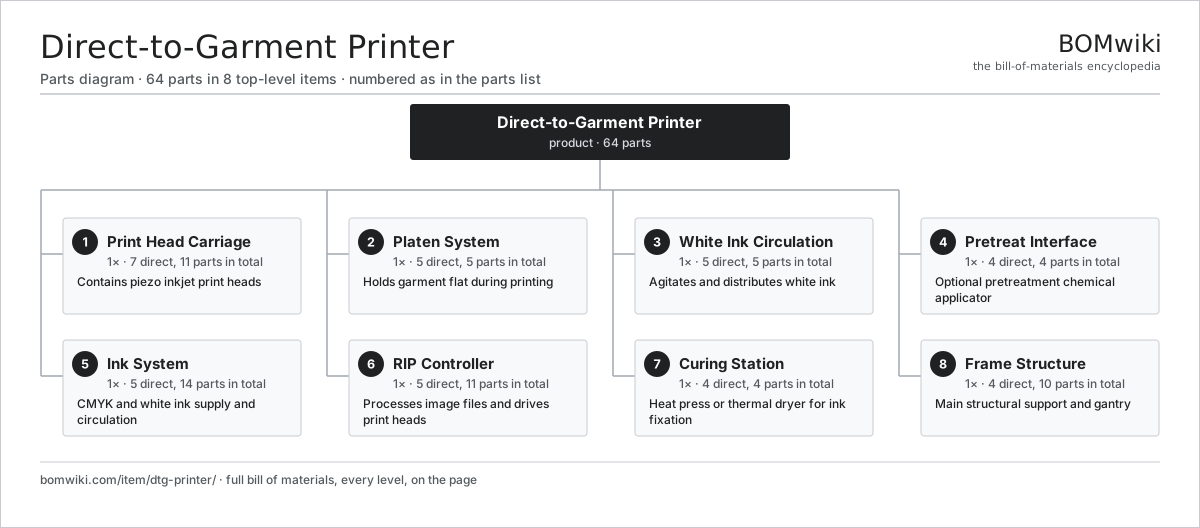
| # | Part | Qty | What it does |
|---|---|---|---|
| 1 | Print Head Carriage 7 parts | 1× | Contains piezo inkjet print heads |
| 2 | Platen System 5 parts | 1× | Holds garment flat during printing |
| 3 | White Ink Circulation 5 parts | 1× | Agitates and distributes white ink |
| 4 | Pretreat Interface 4 parts | 1× | Optional pretreatment chemical applicator |
| 5 | Ink System 5 parts | 1× | CMYK and white ink supply and circulation |
| 6 | RIP Controller 5 parts | 1× | Processes image files and drives print heads |
| 7 | Curing Station 4 parts | 1× | Heat press or thermal dryer for ink fixation |
| 8 | Frame Structure 4 parts | 1× | Main structural support and gantry |
3D model
No 3D model yet. Have a CAD file of this? Add a 3D model. STL renders right on this page; STEP, FreeCAD, and OpenSCAD sources are welcome too (openly licensed, like all 3D models on BOMwiki).
Build & assembly graph
expand / collapse · shared sub-assemblies converge · links to related products · est. labourTap an assembly to expand/collapse · tap a part to open it · use “Open page” for any node · drag to pan, scroll to zoom.
Bill of materials for Direct-to-Garment Printer
8 top-level lines · 47 rows shown · 64 parts total · indented to 3 levels| # | Item / sub-assembly | Part no. | Qty/assy | Ext. qty | Parts | Type |
|---|---|---|---|---|---|---|
| 1 | Print Head Carriage 7 parts | dtg-printer-print-head-carriage | 1× | 1 | 11 | assembly |
| 1.1 | Carriage Beam | dtg-printer-carriage-beam | 1× | 1 | · | part |
| 1.2 | Head Drive Motor | dtg-printer-head-motor | 1× | 1 | · | part |
| 1.3 | Head Position Sensor | dtg-printer-head-sensor | 1× | 1 | · | part |
| 1.4 | CMYK Print Head Array | dtg-printer-color-head-array | 1× | 1 | · | part |
| 1.5 | White Ink Print Head | dtg-printer-white-head | 1× | 1 | · | part |
| 1.6 | Ball Bearing | ball-bearing | 4× | 4 | · | part |
| 1.7 | Connector | connector | 2× | 2 | · | part |
| 2 | Platen System 5 parts | dtg-printer-platen-system | 1× | 1 | 5 | assembly |
| 2.1 | Platen Plate | dtg-printer-platen-plate | 1× | 1 | · | part |
| 2.2 | Platen Heating Element | dtg-printer-heating-element-platen | 1× | 1 | · | part |
| 2.3 | Platen Vacuum Pump | dtg-printer-vacuum-pump-platen | 1× | 1 | · | part |
| 2.4 | Platen Temperature Controller | dtg-printer-temperature-controller | 1× | 1 | · | part |
| 2.5 | Z-Lift Actuator | dtg-printer-z-lift-actuator | 1× | 1 | · | part |
| 3 | White Ink Circulation 5 parts | dtg-printer-white-ink-circulation | 1× | 1 | 5 | assembly |
| 3.1 | White Ink Agitator | dtg-printer-white-agitator-impeller | 1× | 1 | · | part |
| 3.2 | Circulation Pump | dtg-printer-circulation-pump | 1× | 1 | · | part |
| 3.3 | White Ink Supply Tank | dtg-printer-supply-tank-white | 1× | 1 | · | part |
| 3.4 | Bubble Trap | dtg-printer-bubble-trap | 1× | 1 | · | part |
| 3.5 | O-Ring Set | oring-set | 1× | 1 | · | part |
| 4 | Pretreat Interface 4 parts | dtg-printer-pretreat-interface | 1× | 1 | 4 | assembly |
| 4.1 | Pretreat Spray Head | dtg-printer-pretreat-spray-head | 1× | 1 | · | part |
| 4.2 | Pretreat Supply Pump | dtg-printer-pretreat-supply-pump | 1× | 1 | · | part |
| 4.3 | Pretreat Supply Tank | dtg-printer-pretreat-tank | 1× | 1 | · | part |
| 4.4 | Pretreat Dryer | dtg-printer-pretreat-dryer | 1× | 1 | · | part |
| 5 | Ink System 5 parts | dtg-printer-ink-system | 1× | 1 | 14 | assembly |
| 5.1 | Color Ink Tank | dtg-printer-color-tank-cmyk | 4× | 4 | · | part |
| 5.2 | Damper Assembly | dtg-printer-damper-assembly | 4× | 4 | · | part |
| 5.3 | Color Ink Supply Line | dtg-printer-supply-line-color | 1× | 1 | · | part |
| 5.4 | Ink Filter | dtg-printer-ink-filter | 2× | 2 | · | part |
| 5.5 | Connector | connector | 3× | 3 | · | part |
| 6 | RIP Controller 5 parts | dtg-printer-rip-controller | 1× | 1 | 11 | assembly |
| 6.1 | Microcontroller | mcu | 1× | 1 | · | part |
| 6.2 | Bare PCB | pcb-bare | 2× | 2 | · | part |
| 6.3 | SMD Passive (R/C/L) | smd-passives | 1× | 1 | · | part |
| 6.4 | Head Driver IC | dtg-printer-head-driver-ic | 4× | 4 | · | part |
| 6.5 | Connector | connector | 3× | 3 | · | part |
| 7 | Curing Station 4 parts | dtg-printer-curing-station | 1× | 1 | 4 | assembly |
| 7.1 | Curing Heat Element | dtg-printer-cure-heat-element | 1× | 1 | · | part |
| 7.2 | Cure Temperature Sensor | dtg-printer-cure-temperature-sensor | 1× | 1 | · | part |
| 7.3 | Cure Timer | dtg-printer-cure-timer | 1× | 1 | · | part |
| 7.4 | Heating Element | heating-element | 1× | 1 | · | part |
| 8 | Frame Structure 4 parts | dtg-printer-frame | 1× | 1 | 10 | assembly |
| 8.1 | Frame Linear Rail | dtg-printer-frame-rail | 2× | 2 | · | part |
| 8.2 | Gantry Beam | dtg-printer-gantry-beam | 1× | 1 | · | part |
| 8.3 | Base Platform | dtg-printer-base-platform | 1× | 1 | · | part |
| 8.4 | Ball Bearing | ball-bearing | 6× | 6 | · | part |
Something wrong in this list? Report a problem with this BOM.
Related products
same domain, ranked by shared parts Automatic Strapping Machine
251 parts · shares 2 with this page
Case Labeling Machine
120 parts · shares 2 with this page
Corrugator (Single-Facer)
875 parts · shares 2 with this page
Automatic Strapping Machine
251 parts · shares 2 with this page
Case Labeling Machine
120 parts · shares 2 with this page
Corrugator (Single-Facer)
875 parts · shares 2 with this page
 Digital Inkjet Web Press
3,001 parts · shares 2 with this page
Digital Inkjet Web Press
3,001 parts · shares 2 with this page
 Gravure Printing Press
2,094 parts · shares 2 with this page
Gravure Printing Press
2,094 parts · shares 2 with this page
 Industrial Screen Printing Press
162 parts · shares 2 with this page
Industrial Screen Printing Press
162 parts · shares 2 with this page
Sourcing: possible vendors
Browse the supplier directory → Prices, MOQ, and lead times are algorithmic estimates, not quotes, and not claims about these companies. Company mappings are curated by keyword; est. price band $10k–$3M. How estimates work| Vendor | HQ | Specialty | MOQ | Lead time |
|---|---|---|---|---|
| heidelberg.com ↗ | Heidelberg, DE | Printing presses | 10 units | 12–22 wks |
|
🇨🇭Bobst
bobst.com ↗
|
Lausanne, CH | Packaging machinery | 10 units | 12–22 wks |
| koenig-bauer.com ↗ | Würzburg, DE | Printing presses | 10 units | 12–22 wks |
| wuh-group.com ↗ | Lengerich, DE | Flexible packaging machines | 10 units | 12–22 wks |
| markandy.com ↗ | Chesterfield, US | Label presses | 10 units | 12–22 wks |
971-word article