DTY Texturing Machine
ProductOverview
A draw-texturing yarn (DTY) machine imparts crimp and bulk to smooth synthetic filament yarn using false-twist technology. The process rapidly inserts and removes twist, creating a permanent crimped structure that increases elasticity, covering power, and dyeability. DTY machines are essential in apparel production, converting cheap bulk-draw spun polyester or nylon into higher-value textured yarn used in sports wear, hosiery, and knit fabrics.
The key innovation is the false-twist mechanism: yarn passes through a high-speed rotating spindle that twists the filament, then untwists it immediately downstream, but the yarn retains crimp memory due to partial molecular reorganization during heat treatment. The machine combines heating, false-twisting, cooling, and winding into a single integrated process.
How It Works
Untextured partially oriented yarn (POY) feeds from the feed creel at constant tension. The yarn first passes through a heater zone raised to 200–250°C, softening the polymer chains. Temperature control is critical: too low and the yarn retains no crimp; too high and the filament loses strength.
The heated yarn enters the false-twist unit, where a rotor spinning at 500,000–1,000,000 rpm twists the filament at enormous rates. The yarn follows a helical path through the rotor chamber, exiting with full twist inserted. Immediately downstream, a second rotor (or mechanical design) removes the twist as the yarn exits, but the crimp remains imprinted in the molecular structure due to the thermal history.
The yarn then enters a cooling zone maintained at 40–60°C to set the crimp permanently. Precision godet wheels control yarn speed through each zone, ensuring proper dwell time for heat treatment and cooling.
The drive system maintains strict speed ratios. If feed godet speed is V₁ and false-twist spindle speed creates twist insertion rate V₂, the balance determines texture depth (crimp amplitude). Higher spindle speeds and longer dwell in the heater increase crimp.
Finally, the textured yarn is wound onto bobbins by the winding head at controlled tension. Bobbins are removed and sent to dyeing or knitting departments.
False-Twist Mechanism
The false-twist spindle is the machine's heart. A high-speed rotor, driven by a 1–2 kW electric motor, rotates inside a precision-bored housing. Yarn enters the rotor chamber tangentially, is gripped by centrifugal force, rotates with the rotor, and exits downstream. The rotor imparts twist at roughly 2–10 turns per meter for each spindle revolution, and at 500,000+ rpm, this generates twist at 1,000,000+ turns per minute.
The twist insertion point and untwisting point must be separated by enough yarn length (typically 50–200 mm) for the thermal history and cooling to set the crimp. Modern machines use precision ceramic or hybrid ball bearings rated for sustained high-speed operation, essential for reliability.
Temperature Control
The heater zone is typically a heated aluminum tube with internal heating elements. Temperature must be controlled to ±2°C across the yarn's residence time. Faster yarn speeds require higher heater temperatures to achieve the same thermal history. A feedback loop using a thermocouple allows the operator to adjust heater power (kW) to maintain setpoint despite feed speed changes.
The cooling zone must dissipate latent heat before the yarn is wound. Rapid cooling prevents crimp relaxation. Air-cooled designs are simpler; water-cooled designs allow tighter temperature control.
Godet System
Precision godet wheels control yarn speed in each zone. The feed godet pulls yarn at constant rate. The front godet (after false-twist) may run at the same speed or slightly slower, creating yarn tension. The winding speed godet drives at a rate matching production rate. Speed ratios determine texture depth: if the feed godet runs 100 m/min and the spindle residence time is fixed, a faster front godet reduces dwell time, reducing crimp depth.
Production Parameters
Operators adjust heater temperature, feed speed, spindle speed (indirectly, by frequency converter), and cooling airflow to achieve desired texture characteristics. Different yarn denier (fineness) requires different setpoints. A 150-denier POY and a 70-denier POY need different heater temperatures to achieve the same glass transition softening.
Production rates vary: coarse 300-denier yarn may produce 120 kg/hour, while fine 70-denier yields 40 kg/hour due to differences in yarn mass and processing speed limits.
Machine Variants
Single-spindle machines process one yarn at a time. Multi-spindle machines (2–12 spindles) process that many yarns simultaneously from the same creel. Multi-spindle machines are more productive but require more complex heat distribution and synchronization.
Some machines use a combined heater and rotor chamber, while others separate heating and twisting. High-speed machines (800 m/min) demand robust cooling; slower machines can use simpler air cooling.
The output is textured yarn (sometimes called "textured polyester" or "DTY polyester") ready for dyeing or directly knitting into socks, underwear, active wear, or woven dress fabrics.
DTY Texturing Machine parts and their functions
8 top-level parts · 118 parts in total · full bill of materials below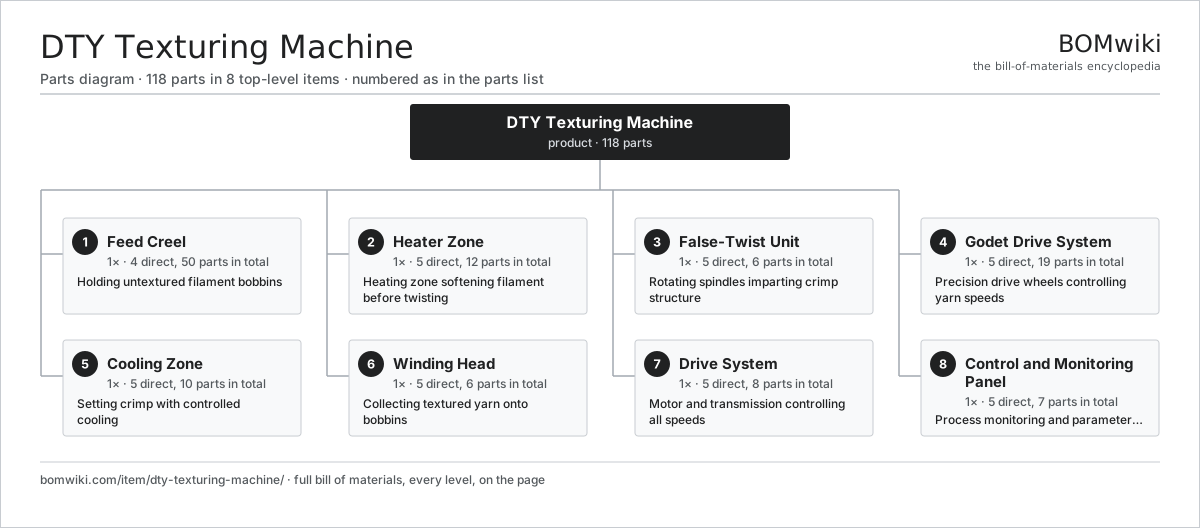
| # | Part | Qty | What it does |
|---|---|---|---|
| 1 | Feed Creel 4 parts | 1× | Holding untextured filament bobbins |
| 2 | Heater Zone 5 parts | 1× | Heating zone softening filament before twisting |
| 3 | False-Twist Unit 5 parts | 1× | Rotating spindles imparting crimp structure |
| 4 | Godet Drive System 5 parts | 1× | Precision drive wheels controlling yarn speeds |
| 5 | Cooling Zone 5 parts | 1× | Setting crimp with controlled cooling |
| 6 | Winding Head 5 parts | 1× | Collecting textured yarn onto bobbins |
| 7 | Drive System 5 parts | 1× | Motor and transmission controlling all speeds |
| 8 | Control and Monitoring Panel 5 parts | 1× | Process monitoring and parameter adjustment |
3D model
No 3D model yet. Have a CAD file of this? Add a 3D model. STL renders right on this page; STEP, FreeCAD, and OpenSCAD sources are welcome too (openly licensed, like all 3D models on BOMwiki).
Build & assembly graph
expand / collapse · shared sub-assemblies converge · links to related products · est. labourTap an assembly to expand/collapse · tap a part to open it · use “Open page” for any node · drag to pan, scroll to zoom.
Bill of materials for DTY Texturing Machine
8 top-level lines · 47 rows shown · 118 parts total · indented to 3 levels| # | Item / sub-assembly | Part no. | Qty/assy | Ext. qty | Parts | Type |
|---|---|---|---|---|---|---|
| 1 | Feed Creel 4 parts | dty-texturing-machine-feed-creel | 1× | 1 | 50 | assembly |
| 1.1 | Bobbin Shaft | dty-texturing-machine-bobbin-shafts | 24× | 24 | · | part |
| 1.2 | Creel Frame | dty-texturing-machine-creel-frame | 1× | 1 | · | part |
| 1.3 | Feed Tension Control | dty-texturing-machine-feed-tension-control | 1× | 1 | · | part |
| 1.4 | Ball Bearing | ball-bearing | 24× | 24 | · | part |
| 2 | Heater Zone 5 parts | dty-texturing-machine-heater-zone | 1× | 1 | 12 | assembly |
| 2.1 | Heating Element | heating-element | 3× | 3 | · | part |
| 2.2 | Heated Cylinder | dty-texturing-machine-hot-cylinder | 1× | 1 | · | part |
| 2.3 | Temperature Sensor | dty-texturing-machine-temperature-sensor | 1× | 1 | · | part |
| 2.4 | Thermal Insulation Block | dty-texturing-machine-insulation-block | 1× | 1 | · | part |
| 2.5 | High-Temperature Eyelet | dty-texturing-machine-guide-eyelets | 6× | 6 | · | part |
| 3 | False-Twist Unit 5 parts | dty-texturing-machine-false-twist-unit | 1× | 1 | 6 | assembly |
| 3.1 | Spindle Housing | dty-texturing-machine-spindle-housing | 1× | 1 | · | part |
| 3.2 | False-Twist Rotor | dty-texturing-machine-rotor-spindle | 1× | 1 | · | part |
| 3.3 | High-Speed Spindle Bearing | dty-texturing-machine-spindle-bearing | 2× | 2 | · | part |
| 3.4 | Yarn Insertion Guide | dty-texturing-machine-yarn-insertion-guide | 1× | 1 | · | part |
| 3.5 | Spindle Motor | dty-texturing-machine-spindle-motor | 1× | 1 | · | part |
| 4 | Godet Drive System 5 parts | dty-texturing-machine-godet-system | 1× | 1 | 19 | assembly |
| 4.1 | Godet Wheel | dty-texturing-machine-godet-wheel | 4× | 4 | · | part |
| 4.2 | Godet Shaft | dty-texturing-machine-godet-shaft | 4× | 4 | · | part |
| 4.3 | Godet Drive Motor | dty-texturing-machine-godet-motor | 2× | 2 | · | part |
| 4.4 | Ball Bearing | ball-bearing | 8× | 8 | · | part |
| 4.5 | Speed Encoder | dty-texturing-machine-encoder | 1× | 1 | · | part |
| 5 | Cooling Zone 5 parts | dty-texturing-machine-cooling-zone | 1× | 1 | 10 | assembly |
| 5.1 | Cooling Cylinder | dty-texturing-machine-cool-cylinder | 1× | 1 | · | part |
| 5.2 | Cooling Blower | dty-texturing-machine-blower-fan | 1× | 1 | · | part |
| 5.3 | Chiller Unit | dty-texturing-machine-water-cooler | 1× | 1 | · | part |
| 5.4 | Cooling Eyelet | dty-texturing-machine-cool-eyelets | 6× | 6 | · | part |
| 5.5 | Pressure Sensor | pressure-sensor | 1× | 1 | · | part |
| 6 | Winding Head 5 parts | dty-texturing-machine-winding-head | 1× | 1 | 6 | assembly |
| 6.1 | Winding Spindle Motor | dty-texturing-machine-spindle-motor-wind | 1× | 1 | · | part |
| 6.2 | Wind Spindle | dty-texturing-machine-wind-spindle | 1× | 1 | · | part |
| 6.3 | Yarn Guide Wheel | dty-texturing-machine-yarn-guide-wheel | 1× | 1 | · | part |
| 6.4 | Winding Tension Arm | dty-texturing-machine-tension-arm | 1× | 1 | · | part |
| 6.5 | Ball Bearing | ball-bearing | 2× | 2 | · | part |
| 7 | Drive System 5 parts | dty-texturing-machine-drive-system | 1× | 1 | 8 | assembly |
| 7.1 | Main Drive Motor | dty-texturing-machine-main-motor | 1× | 1 | · | part |
| 7.2 | Spindle Drive Unit | dty-texturing-machine-spindle-drive | 1× | 1 | · | part |
| 7.3 | Frequency Converter | dty-texturing-machine-frequency-converter | 1× | 1 | · | part |
| 7.4 | Power Transmission | dty-texturing-machine-mechanical-transmission | 1× | 1 | · | part |
| 7.5 | Relay | relay | 4× | 4 | · | part |
| 8 | Control and Monitoring Panel 5 parts | dty-texturing-machine-control-panel | 1× | 1 | 7 | assembly |
| 8.1 | Microcontroller | mcu | 1× | 1 | · | part |
| 8.2 | Temperature Display Module | dty-texturing-machine-temperature-display | 1× | 1 | · | part |
| 8.3 | Speed Adjustment Potentiometer | dty-texturing-machine-speed-potentiometer | 3× | 3 | · | part |
| 8.4 | LCD Panel | lcd-panel | 1× | 1 | · | part |
| 8.5 | Bare PCB | pcb-bare | 1× | 1 | · | part |
Something wrong in this list? Report a problem with this BOM.
Related products
same domain, ranked by shared parts Automatic Fabric Cutting Machine
1,695 parts · shares 2 with this page
Automatic Fabric Cutting Machine
1,695 parts · shares 2 with this page
 Digital Textile Printer
1,093 parts · shares 2 with this page
Fabric Coating Machine
316 parts · shares 2 with this page
FDY Filament Spinning Line
679 parts · shares 2 with this page
Digital Textile Printer
1,093 parts · shares 2 with this page
Fabric Coating Machine
316 parts · shares 2 with this page
FDY Filament Spinning Line
679 parts · shares 2 with this page
 Meltblown Nonwoven Line
933 parts · shares 2 with this page
Mercerizing Range
585 parts · shares 2 with this page
Meltblown Nonwoven Line
933 parts · shares 2 with this page
Mercerizing Range
585 parts · shares 2 with this page
Sourcing: possible vendors
Browse the supplier directory → Prices, MOQ, and lead times are algorithmic estimates, not quotes, and not claims about these companies. Company mappings are curated by keyword; est. price band $10k–$1M. How estimates work| Vendor | HQ | Specialty | MOQ | Lead time |
|---|---|---|---|---|
|
🇨🇭Rieter
rieter.com ↗
|
Winterthur, CH | Spinning machinery | 10 units | 14–24 wks |
| truetzschler.com ↗ | Mönchengladbach, DE | Textile machinery | 10 units | 14–24 wks |
|
🇧🇪Picanol
picanol.be ↗
|
Ypres, BE | Weaving machines | 10 units | 14–24 wks |
| karlmayer.com ↗ | Obertshausen, DE | Warp knitting machines | 10 units | 14–24 wks |
|
🇨🇭Saurer
saurer.com ↗
|
Arbon, CH | Spinning & embroidery | 10 units | 14–24 wks |
873-word article