Dumbwaiter
ProductOverview
A dumbwaiter is a small elevator that carries goods only, meals between a restaurant kitchen and dining floor, books in a library, files and pharmaceuticals in hospitals, stock in shops. Codes define it by being too small for a person: ASME A17.1 caps the car at 0.84 m² of floor, 1.2 m of height and 227 kg (500 lb); EN 81-3 covers the equivalent European class with cars up to 1 m² and 1.2 m high. Because no passenger can ride, the safety apparatus of a passenger lift, governor-tripped safety gear, progressive braking, light curtains, is replaced by a much simpler chain of interlocks, limits and a slack-rope cutout, which is what keeps a dumbwaiter cheap and its shaft footprint under a square metre.
The classic configuration is counter loading: the Door Sill of every landing opening sits about 900 mm above the floor, so a loaded tray slides straight across from a worktop into the car without lifting.
How it works
The Traction Drive Machine sits on bearers at the top of the shaft. A 0.75 kW induction motor turns a worm Helical Gear Pair of roughly 50:1 inside the Gearbox Housing; the worm stage is self-locking, so the car cannot drift under load even before the spring-applied Machine Brake sets. The output shaft carries the Drive Sheave, around 200 mm in diameter, which drives two 6 mm Hoist Ropes by friction. The ropes pass over the sheave to the Suspension & Counterweight counterweight, a narrow Counterweight Frame stacked with Filler Weight weights balancing the car plus about half the rated load, so the motor only ever works against the imbalance, not the full mass. Drum-drive variants exist for the smallest units, winding the rope directly onto a grooved drum and dispensing with the counterweight at the cost of motor size.
Car and counterweight each ride a pair of light machined T-rails in the Guide Rail System system, spliced with Fishplates and held by Rail Brackets every 1.5 m or so. The Car itself is a stainless box, commonly 600 × 600 × 800 mm, hung in a welded Car Frame on nylon-gibbed Guide Shoes. Removable Shelf inserts split the volume for trays; a roll-down Car Gate keeps the load from shifting into the shaft. Food-service cars are fully stainless for washdown, and heated or refrigerated variants add an insulated liner.
Doors and interlocks
Each landing has a Hall Door, two stainless-faced Door Panels that part vertically in side Door Tracks, counterbalancing each other through a chain link. On most units they are hand-operated; powered doors are an option on heavy-traffic installations. The Door Interlock enforces the two rules that make a goods-only shaft safe: the car cannot be dispatched while any hall door is open, and no hall door can be opened unless the car is parked at that landing. Since users routinely lean into the opening to load trays, this interlock is the primary protection in the whole machine.
Control
The Controller runs simple call-and-send logic. A Call Station at each landing carries a button per floor plus "car here" and "door open" indicators; pressing a destination dispatches the empty or loaded car there, where it waits. There is no in-car control because there is no occupant. Small units use a handful of Relay contactors for motor direction and brake; current production replaces the relay logic with an Microcontroller board, adds soft-start, and often a buzzer or annunciator that tells the kitchen a car has arrived. Hall Sensors on the rail line give floor-level stopping accurate to a few millimetres, which matters when trays slide across the sill gap.
Safety devices
The Safety Devices set is deliberately minimal. A Slack-Rope Switch cuts the drive if rope tension is lost, the failure mode where a car jams in the shaft and the machine would otherwise pile rope on top of it. Cam-operated Final Limit Switch switches kill power on terminal overrun, and a pair of Coil Spring buffers in the pit absorb whatever momentum remains. EN 81-3 additionally requires protection against free fall where the well opens onto accessible spaces, met on larger units with an instantaneous gripper, but the small counterweighted traction machine described here relies on its self-locking worm drive and twin ropes, each sized with a safety factor of 8 or more.
Dumbwaiter parts and their functions
7 top-level parts · 128 parts in total · full bill of materials below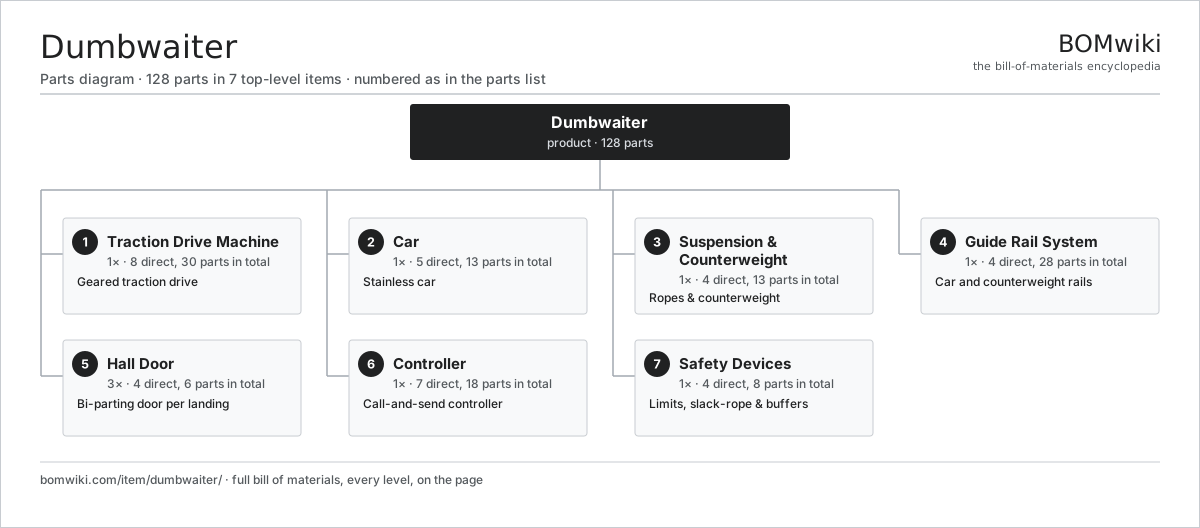
| # | Part | Qty | What it does |
|---|---|---|---|
| 1 | Traction Drive Machine 8 parts | 1× | Geared traction drive |
| 2 | Car 5 parts | 1× | Stainless car |
| 3 | Suspension & Counterweight 4 parts | 1× | Ropes & counterweight |
| 4 | Guide Rail System 4 parts | 1× | Car and counterweight rails |
| 5 | Hall Door 4 parts | 3× | Bi-parting door per landing |
| 6 | Controller 7 parts | 1× | Call-and-send controller |
| 7 | Safety Devices 4 parts | 1× | Limits, slack-rope & buffers |
3D model
No 3D model yet. Have a CAD file of this? Add a 3D model. STL renders right on this page; STEP, FreeCAD, and OpenSCAD sources are welcome too (openly licensed, like all 3D models on BOMwiki).
Build & assembly graph
expand / collapse · shared sub-assemblies converge · links to related products · est. labourTap an assembly to expand/collapse · tap a part to open it · use “Open page” for any node · drag to pan, scroll to zoom.
Bill of materials for Dumbwaiter
7 top-level lines · 50 rows shown · 128 parts total · indented to 3 levels| # | Item / sub-assembly | Part no. | Qty/assy | Ext. qty | Parts | Type |
|---|---|---|---|---|---|---|
| 1 | Traction Drive Machine 8 parts | dumbwaiter-machine | 1× | 1 | 30 | assembly |
| 1.1 | Stator Assembly 3 parts | stator-assembly | 1× | 1 | 3 | assembly |
| 1.1.1 | Stator Core (laminations) | stator-core | 1× | 1 | · | part |
| 1.1.2 | Copper Winding | copper-winding | 1× | 1 | · | part |
| 1.1.3 | Slot Insulation | stator-insulation | 1× | 1 | · | part |
| 1.2 | Rotor Assembly 4 parts | rotor-assembly | 1× | 1 | 19 | assembly |
| 1.2.1 | Rotor Shaft | rotor-shaft | 1× | 1 | · | part |
| 1.2.2 | Rotor Core | rotor-core | 1× | 1 | · | part |
| 1.2.3 | Neodymium Magnet | neodymium-magnet | 16× | 16 | · | part |
| 1.2.4 | Ball Bearing | ball-bearing | 1× | 1 | · | part |
| 1.3 | Motor Housing | motor-housing | 1× | 1 | · | part |
| 1.4 | Helical Gear Pair | gear-pair | 1× | 1 | · | part |
| 1.5 | Gearbox Housing | gearbox-housing | 1× | 1 | · | part |
| 1.6 | Drive Sheave | dumbwaiter-drive-sheave | 1× | 1 | · | part |
| 1.7 | Machine Brake | dumbwaiter-brake | 1× | 1 | · | part |
| 1.8 | Ball Bearing | ball-bearing | 3× | 3 | · | part |
| 2 | Car 5 parts | dumbwaiter-car | 1× | 1 | 13 | assembly |
| 2.1 | Sheet Metal Panel | sheet-panel | 5× | 5 | · | part |
| 2.2 | Car Frame | dumbwaiter-car-frame | 1× | 1 | · | part |
| 2.3 | Shelf | dumbwaiter-shelf | 2× | 2 | · | part |
| 2.4 | Car Gate | dumbwaiter-car-gate | 1× | 1 | · | part |
| 2.5 | Guide Shoe | dumbwaiter-guide-shoe | 4× | 4 | · | part |
| 3 | Suspension & Counterweight 4 parts | dumbwaiter-suspension | 1× | 1 | 13 | assembly |
| 3.1 | Hoist Rope | dumbwaiter-hoist-rope | 2× | 2 | · | part |
| 3.2 | Rope Termination | dumbwaiter-rope-termination | 4× | 4 | · | part |
| 3.3 | Counterweight Frame | dumbwaiter-cwt-frame | 1× | 1 | · | part |
| 3.4 | Filler Weight | dumbwaiter-cwt-filler | 6× | 6 | · | part |
| 4 | Guide Rail System 4 parts | dumbwaiter-rails | 1× | 1 | 28 | assembly |
| 4.1 | Guide Rail Section | dumbwaiter-rail-section | 8× | 8 | · | part |
| 4.2 | Rail Bracket | dumbwaiter-rail-bracket | 12× | 12 | · | part |
| 4.3 | Fishplate | dumbwaiter-fishplate | 6× | 6 | · | part |
| 4.4 | Fastener Set | fastener-set | 2× | 2 | · | part |
| 5 | Hall Door 4 parts | dumbwaiter-hall-door | 3× | 3 | 6 | assembly |
| 5.1 | Door Panel | dumbwaiter-door-panel | 2× | 6 | · | part |
| 5.2 | Door Interlock | dumbwaiter-interlock | 1× | 3 | · | part |
| 5.3 | Door Track | dumbwaiter-door-track | 2× | 6 | · | part |
| 5.4 | Door Sill | dumbwaiter-sill | 1× | 3 | · | part |
| 6 | Controller 7 parts | dumbwaiter-controller | 1× | 1 | 18 | assembly |
| 6.1 | Bare PCB | pcb-bare | 1× | 1 | · | part |
| 6.2 | Microcontroller | mcu | 1× | 1 | · | part |
| 6.3 | Relay | relay | 4× | 4 | · | part |
| 6.4 | Power Supply | power-supply | 1× | 1 | · | part |
| 6.5 | Connector | connector | 6× | 6 | · | part |
| 6.6 | Wire Bundle | wire-bundle | 2× | 2 | · | part |
| 6.7 | Call Station | dumbwaiter-call-station | 3× | 3 | · | part |
| 7 | Safety Devices 4 parts | dumbwaiter-safety | 1× | 1 | 8 | assembly |
| 7.1 | Slack-Rope Switch | dumbwaiter-slack-rope-switch | 1× | 1 | · | part |
| 7.2 | Final Limit Switch | dumbwaiter-final-limit | 2× | 2 | · | part |
| 7.3 | Coil Spring | coil-spring | 2× | 2 | · | part |
| 7.4 | Hall Sensor | hall-sensor | 3× | 3 | · | part |
Something wrong in this list? Report a problem with this BOM.
Related products
same domain, ranked by shared parts Moving Walkway
1,050 parts · shares 16 with this page
Moving Walkway
1,050 parts · shares 16 with this page
 Home Elevator
133 parts · shares 14 with this page
Home Elevator
133 parts · shares 14 with this page
 Escalator
2,337 parts · shares 14 with this page
Pneumatic Vacuum Elevator
122 parts · shares 13 with this page
Escalator
2,337 parts · shares 14 with this page
Pneumatic Vacuum Elevator
122 parts · shares 13 with this page
 Boat Lift
102 parts · shares 13 with this page
Boat Lift
102 parts · shares 13 with this page
Sourcing: possible vendors
Browse the supplier directory → Prices, MOQ, and lead times are algorithmic estimates, not quotes, and not claims about these companies. Company mappings are curated by keyword; est. price band $10k–$200k. How estimates work| Vendor | HQ | Specialty | MOQ | Lead time |
|---|---|---|---|---|
|
🇺🇸Otis
otis.com ↗
|
Farmington, US | Elevators & escalators | 20 units | 14–24 wks |
| schindler.com ↗ | Ebikon, CH | Elevators & escalators | 20 units | 14–24 wks |
|
🇫🇮KONE
kone.com ↗
|
Espoo, FI | Elevators & escalators | 20 units | 14–24 wks |
| tkelevator.com ↗ | Düsseldorf, DE | Elevators | 20 units | 14–24 wks |
| mitsubishielectric.com ↗ | Tokyo, JP | Elevators & electronics | 20 units | 14–24 wks |
766-word article