HEPA Dust Extractor
ProductOverview
A portable HEPA dust extractor is a shop vacuum designed to capture fine woodworking dust, construction sawdust, and hazardous particulate matter before it enters the workplace air. HEPA-grade filtration removes 99.97% of particles down to 0.3 microns, protecting the operator from inhalation of silica, lead dust, and other occupational hazards.
Unlike standard shop vacuums with pleated prefilters, HEPA extractors employ auto-cleaning filter cartridges that periodically pulse clean themselves, extending filter life from weeks (manual cleaning) to months (auto-cleaned). This design is essential in professional woodworking, demolition, and renovation work where dust exposure regulations apply.
How it Works
The Brushless Blower Motor is an AC induction motor running at 15,000 RPM, powered by 110–240V mains. The motor couples directly or via a belt to the Centrifugal Fan Impeller, a multi-stage centrifugal fan impeller.
As the impeller rotates, the radial blades accelerate air outward. The centrifugal action creates a pressure differential, lower pressure inside the impeller center compared to the discharge chamber. This pressure drop draws air and dust-laden air from the hose toward the impeller.
The hose connects to the Tool Interface Coupling on the tank side. As the tool operator connects a power tool (circular saw, orbital sander, etc.) or manually activates the vacuum, air is drawn through the tool, up the hose, and into the tank volume where the Centrifugal Fan Impeller is located.
Inside the tank, air velocity drops and gravity causes coarse dust and debris to settle to the tank bottom. The air continues upward through the HEPA Filter Cartridge Assembly cartridge, where the pleated HEPA media traps fine particulate. Clean air exits the cartridge through the center tube and is exhausted through the motor discharge.
The Auto-Clean Pulse Solenoid solenoid mechanism periodically pulses (approximately every 10–30 seconds, user-adjustable). On each pulse, the Solenoid Coil energizes, pulling the Solenoid Plunger and opening the Pulse Delivery Valve. Compressed air from a small on-board reservoir (or directly from the motor discharge line) is directed backward through the filter cartridge, dislodging accumulated dust and allowing it to fall to the tank bottom for later disposal.
This auto-cleaning cycle maintains filter airflow, extending filter life from approximately 2–4 weeks (manual cleaning interval) to 6–12 months (auto-cleaned interval) before replacement is necessary.
HEPA Filter Technology
The HEPA Filter Media is a non-woven fiberglass sheet composed of random-oriented fibers 0.5–2 microns in diameter. The media is pleated (folded in a zigzag pattern) to maximize surface area within the compact cartridge envelope. The small pore size and tortuous airpath trap particles via interception and impaction as air flows through.
HEPA H13 filters, the standard for shop use, capture 99.97% of particles 0.3 microns and larger. This efficiency covers sawdust (5–50 microns), silica dust (0.1–10 microns), and allergens (pollen, mold spores, 2–100 microns).
A new cartridge presents minimal restriction and excellent airflow. As dust accumulates, resistance increases, reducing flow rate until the filter reaches saturation. An auto-cleaning cycle dislodges accumulated dust before saturation occurs, maintaining steady airflow throughout the filter life.
Tank Design and Settlement
The Tank Vessel Body is a simple cylindrical vessel; the bottom acts as a settling chamber. Coarse debris (wood chips, metal shavings) gravity-settles in seconds and accumulates at the tank bottom. The operator periodically opens the Tank Drain Valve valve to empty accumulated debris into a waste bin.
The tank volume is typically 35–50 liters for portable shop extractors. Larger tanks (60+ liters) exist for heavy industrial use but sacrifice portability. The capacity is adequate for 2–4 hours of typical tool use before emptying is necessary.
Tool-Trigger Vacuum Switch
Some professional-grade extractors include an optional Tool Trigger Switch that automatically starts the vacuum when a pneumatic tool activates. As the tool draws air (vacuum), the low pressure opens the switch contact, energizing the motor. When the tool stops drawing air, the switch de-energizes the motor, saving energy and extending motor life.
This feature is particularly valuable in production woodworking where the vacuum runs for sustained periods aligned with tool operation.
Motor and Sound Levels
The Brushless Blower Motor AC induction motor produces 1400W of continuous power. Noise levels are 75–80 dB(A), comparable to a running lawn mower or moderate rock concert. Hearing protection is recommended for operators working continuously near the extractor.
Three-phase motors are slightly quieter and more efficient than single-phase equivalents and are standard in professional equipment.
Thermal Protection
The Motor Overload Protection thermal protection circuit monitors motor temperature. If the motor overheats (due to blocked filter, jam, or sustained high-load operation), the Thermal Fuse opens the circuit, de-energizing the motor and allowing it to cool before power is restored.
A blocked HEPA Filter Cartridge Assembly is the most common cause of motor shutdown. Regular cleaning (auto-clean cycle) prevents premature blockage; if the filter has reached end-of-life, replacement is necessary.
Hose and Tool Interface
The Tool Interface Coupling is a quick-disconnect male coupling on the tank that accepts standard shop-vacuum hoses. Hoses range from 1.5 to 2.5 inches in diameter; larger hoses accept higher airflow and are preferred for high-demand tools (large diameter sanders, tile saws).
The hose connects to tool-integrated dust ports (sander dust shroud, saw blade housing). For handheld tools without integrated ports, users employ external shrouds or suction cups that capture dust at the point of generation.
Filtration and Occupational Health
Prolonged inhalation of fine silica dust (from tile, concrete, masonry cutting) causes silicosis, a progressive lung disease. Lead dust (from sanding paint-coated wood) accumulates in the body and causes neurological damage. HEPA extraction is the primary control method in occupational safety regulations (OSHA, HSE).
Modern extractors with auto-cleaning HEPA filters reduce worker exposure to <1/10 the level of uncontrolled tool operation, meeting regulatory thresholds.
Maintenance and Filter Replacement
The cartridge filter requires replacement when airflow drops to unacceptable levels despite auto-cleaning cycles. This typically occurs after 6–12 months of heavy use. Replacement filters cost $30–80 and install in seconds: unlock the Tank Access Lid, slide out the old cartridge, insert the new one, and re-lock.
The tank requires periodic emptying (depending on dust generation rate, typically 4–8 hours of tool use) and occasional spray-wash with water to remove settled dust residue.
The motor and fan require no user maintenance; bearing replacement is a field service item after 5–10 years of heavy use.
Stationary vs. Portable Design
This specification covers portable extractors (35–50 liters, 8–12 kg). Stationary shop extractors (200+ liters) are more powerful and better suited to permanent woodshop installations but sacrifice mobility. Portable extractors serve job-site work where the extractor must travel between locations.
Cost-Benefit and Regulations
HEPA extractors cost 2–3× more than standard vacuums ($300–600 vs. $100–200), but the health and regulatory benefits are substantial. In jurisdictions with occupational exposure limits, HEPA extraction is mandatory for dust-generating work. Even where regulations are lenient, the noise reduction and improved air quality improve worker comfort and productivity.
Integration with Tools
Many modern power tools (orbital sanders, miter saws, circular saws) include integrated dust ports that connect directly to the extractor hose. This at-source capture is superior to room-sweeping methods, reducing shop air contamination and improving filter service life.
HEPA Dust Extractor parts and their functions
8 top-level parts · 51 parts in total · full bill of materials below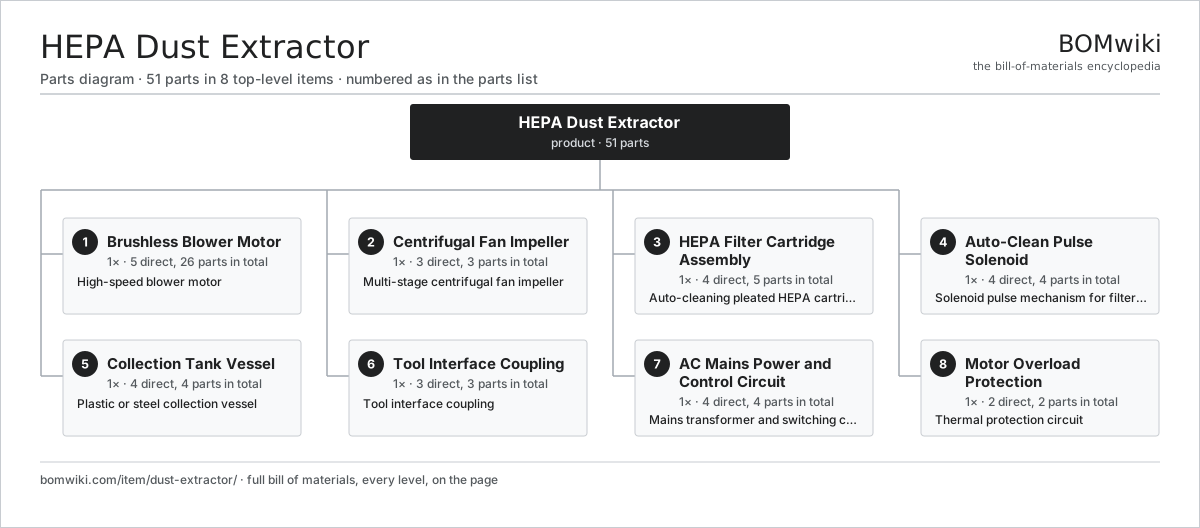
| # | Part | Qty | What it does |
|---|---|---|---|
| 1 | Brushless Blower Motor 5 parts | 1× | High-speed blower motor |
| 2 | Centrifugal Fan Impeller 3 parts | 1× | Multi-stage centrifugal fan impeller |
| 3 | HEPA Filter Cartridge Assembly 4 parts | 1× | Auto-cleaning pleated HEPA cartridge |
| 4 | Auto-Clean Pulse Solenoid 4 parts | 1× | Solenoid pulse mechanism for filter regeneration |
| 5 | Collection Tank Vessel 4 parts | 1× | Plastic or steel collection vessel |
| 6 | Tool Interface Coupling 3 parts | 1× | Tool interface coupling |
| 7 | AC Mains Power and Control Circuit 4 parts | 1× | Mains transformer and switching circuit |
| 8 | Motor Overload Protection 2 parts | 1× | Thermal protection circuit |
3D model
No 3D model yet. Have a CAD file of this? Add a 3D model. STL renders right on this page; STEP, FreeCAD, and OpenSCAD sources are welcome too (openly licensed, like all 3D models on BOMwiki).
Build & assembly graph
expand / collapse · shared sub-assemblies converge · links to related products · est. labourTap an assembly to expand/collapse · tap a part to open it · use “Open page” for any node · drag to pan, scroll to zoom.
Bill of materials for HEPA Dust Extractor
8 top-level lines · 41 rows shown · 51 parts total · indented to 3 levels| # | Item / sub-assembly | Part no. | Qty/assy | Ext. qty | Parts | Type |
|---|---|---|---|---|---|---|
| 1 | Brushless Blower Motor 5 parts | dust-extractor-motor | 1× | 1 | 26 | assembly |
| 1.1 | Motor Housing | motor-housing | 1× | 1 | · | part |
| 1.2 | Copper Winding | copper-winding | 3× | 3 | · | part |
| 1.3 | Rotor Assembly 4 parts | rotor-assembly | 1× | 1 | 19 | assembly |
| 1.3.1 | Rotor Shaft | rotor-shaft | 1× | 1 | · | part |
| 1.3.2 | Rotor Core | rotor-core | 1× | 1 | · | part |
| 1.3.3 | Neodymium Magnet | neodymium-magnet | 16× | 16 | · | part |
| 1.3.4 | Ball Bearing | ball-bearing | 1× | 1 | · | part |
| 1.4 | Ball Bearing | ball-bearing | 2× | 2 | · | part |
| 1.5 | Thermal Fuse | thermal-fuse | 1× | 1 | · | part |
| 2 | Centrifugal Fan Impeller 3 parts | dust-extractor-turbine | 1× | 1 | 3 | assembly |
| 2.1 | Centrifugal Impeller Rotor | dust-extractor-impeller-wheel | 1× | 1 | · | part |
| 2.2 | Motor Coupling Shaft | dust-extractor-motor-shaft | 1× | 1 | · | part |
| 2.3 | Motor Bearing | dust-extractor-motor-bearing | 1× | 1 | · | part |
| 3 | HEPA Filter Cartridge Assembly 4 parts | dust-extractor-hepa-filter | 1× | 1 | 5 | assembly |
| 3.1 | HEPA Filter Media | dust-extractor-hepa-media | 1× | 1 | · | part |
| 3.2 | Filter Cartridge Frame | dust-extractor-filter-frame | 1× | 1 | · | part |
| 3.3 | Filter End Cap | dust-extractor-filter-end-cap | 2× | 2 | · | part |
| 3.4 | Filter Seal Gasket | dust-extractor-filter-seal | 1× | 1 | · | part |
| 4 | Auto-Clean Pulse Solenoid 4 parts | dust-extractor-filter-cleaner | 1× | 1 | 4 | assembly |
| 4.1 | Solenoid Coil | dust-extractor-solenoid-coil | 1× | 1 | · | part |
| 4.2 | Solenoid Plunger | dust-extractor-solenoid-plunger | 1× | 1 | · | part |
| 4.3 | Plunger Return Spring | dust-extractor-solenoid-spring | 1× | 1 | · | part |
| 4.4 | Pulse Delivery Valve | dust-extractor-pulse-valve | 1× | 1 | · | part |
| 5 | Collection Tank Vessel 4 parts | dust-extractor-tank | 1× | 1 | 4 | assembly |
| 5.1 | Tank Vessel Body | dust-extractor-tank-body | 1× | 1 | · | part |
| 5.2 | Tank Access Lid | dust-extractor-tank-lid | 1× | 1 | · | part |
| 5.3 | Tank Drain Valve | dust-extractor-tank-drain | 1× | 1 | · | part |
| 5.4 | Tank Base and Feet | dust-extractor-tank-mounts | 1× | 1 | · | part |
| 6 | Tool Interface Coupling 3 parts | dust-extractor-hose-port | 1× | 1 | 3 | assembly |
| 6.1 | Tool Hose Coupling | dust-extractor-port-fitting | 1× | 1 | · | part |
| 6.2 | Backflow Check Valve | dust-extractor-flow-check-valve | 1× | 1 | · | part |
| 6.3 | Tool Trigger Switch | dust-extractor-tool-trigger-switch | 1× | 1 | · | part |
| 7 | AC Mains Power and Control Circuit 4 parts | dust-extractor-power-electronics | 1× | 1 | 4 | assembly |
| 7.1 | Power Supply | power-supply | 1× | 1 | · | part |
| 7.2 | Thermal Fuse | thermal-fuse | 1× | 1 | · | part |
| 7.3 | Main Power On-Off Switch | dust-extractor-power-switch | 1× | 1 | · | part |
| 7.4 | Motor Start Contactor | dust-extractor-motor-contactor | 1× | 1 | · | part |
| 8 | Motor Overload Protection 2 parts | dust-extractor-motor-overload | 1× | 1 | 2 | assembly |
| 8.1 | Thermal Fuse | thermal-fuse | 1× | 1 | · | part |
| 8.2 | Soft-Start Module | dust-extractor-soft-start | 1× | 1 | · | part |
Something wrong in this list? Report a problem with this BOM.
Related products
same domain, ranked by shared parts Industrial Hot Glue Gun
28 parts · shares 2 with this page
Industrial Hot Glue Gun
28 parts · shares 2 with this page
 Desktop 3D Printer
56 parts · shares 1 with this page
Desktop 3D Printer
56 parts · shares 1 with this page
 Desktop CNC Mill
52 parts · shares 1 with this page
Desktop Laser Engraver
43 parts · shares 1 with this page
Desktop Vacuum Former
37 parts · shares 1 with this page
Desktop CNC Mill
52 parts · shares 1 with this page
Desktop Laser Engraver
43 parts · shares 1 with this page
Desktop Vacuum Former
37 parts · shares 1 with this page
 Bench Power Supply
46 parts · shares 1 with this page
Bench Power Supply
46 parts · shares 1 with this page
Sourcing: possible vendors
Browse the supplier directory → Prices, MOQ, and lead times are algorithmic estimates, not quotes, and not claims about these companies. Company mappings are curated by keyword; est. price band $30–$800. How estimates work| Vendor | HQ | Specialty | MOQ | Lead time |
|---|---|---|---|---|
| stanleyblackanddecker.com ↗ | New Britain, US | Tools (DeWalt, Craftsman) | 500 units | 6–12 wks |
| bosch-professional.com ↗ | Leinfelden, DE | Power tools | 500 units | 6–12 wks |
| ttigroup.com ↗ | Hong Kong, CN | Tools (Milwaukee, Ryobi) | 500 units | 6–12 wks |
|
🇯🇵Makita
makita.com ↗
|
Anjo, JP | Power tools | 500 units | 6–12 wks |
|
🇨🇭Hilti
hilti.com ↗
|
Schaan, CH | Construction tools | 500 units | 6–12 wks |
1,258-word article