Ear Piercing System
ProductOverview
An ear piercing system is a precision handheld device that performs safe, rapid earlobe and cartilage piercings by accelerating a sterile needle and earring through tissue in a single spring-powered motion. Unlike traditional handheld piercing needles that require manual force and skill to achieve consistent depth, spring-powered systems deliver controlled velocity independent of operator strength, resulting in clean, trauma-minimized piercings.
The system consists of a spring-compressed Cartridge Applicator that triggers via a hand-operated lever, accelerating a Needle Shaft (hollow 16-gauge stainless steel) through the ear. Behind the needle, a hypoallergenic Earring Post (titanium or solid gold) follows, creating the initial piercing and backing sterile earring post simultaneously. The whole procedure takes <1 second and produces minimal bleeding.
Spring discharge mechanism
The Spring Mechanism stores energy in a compressed Coil Spring rated 40 N/mm stiffness, precompressed to ~20 mm length and stored in a hardened Spring Guide Tube. This spring is retained by a Catch Ball mechanical detent and Safety Catch pawl, both preventing unintended discharge.
When the operator depresses the Trigger Lever, the pawl disengages, and spring energy rapidly accelerates the Piston Rod and connected cartridge downward. Peak velocity reaches 8–12 m/s, delivering ~800 N impact force over a ~0.5 mm distance at the needle tip.
The accelerated needle passes cleanly through earlobe tissue (typically 6–8 mm thickness) and emerges from the opposite surface. The Earring Post immediately threads into the fresh piercing channel, providing initial backing and sterile material. Bleeding is minimal due to the high velocity creating a clean surgical cut rather than a crushed wound.
Sterile cartridge system
Each Sterile Cartridge is a single-use, pre-sterilized polycarbonate capsule (15 mm × 10 mm × 8 mm) containing:
- A Needle Shaft (hollow 16-gauge cannula, sharpened 45° bevel)
- A Earring Post (hypoallergenic titanium or 14k gold)
- Sterile backing pad
- Inert nitrogen gas atmosphere for sterility preservation
The cartridge is sealed under vacuum with an aluminized foil wrap. When loaded into the applicator, a Firing Pin engages the cartridge, and spring discharge accelerates the needle-post assembly through the ear.
Post-piercing, the needle is disposed of, and the earring remains in the fresh hole. Professional studios stock cartridges in multiple ear materials and styles (lobe vs. cartilage angle variations).
Positioning and accuracy
The Alignment Jig ensures the applicator contacts the ear at precisely 90° perpendicular angle. Two Jig Arms pivot independently and are locked together by a Jig Centering Pin alignment pin. This prevents angled piercings that can lead to embedding or migration.
The Ear Support Block provides firm backing and features laser-etched Guide Marks indicating standard anatomical locations: upper cartilage, mid-cartilage, helix, and lobe regions. The block is held against the back of the ear while the applicator positions against the front.
Safety interlocks
Multiple safety mechanisms prevent accidental discharge:
- Sterile Cartridge must be properly seated, enabling the mechanical pawl.
- Catch Ball detent requires positive lever pressure to disengage.
- Optional Solenoid Release (Optional) adds electronic double-click confirmation, preventing one-handed operation.
The Grip Handle is ergonomically contoured to distribute operator hand stress evenly.
Advantages and limitations
Advantages include speed (piercing in <1 second), consistency (velocity independent of operator skill), and minimal trauma (clean surgical cut vs. blunt needle force). Hypoallergenic titanium cartridges reduce allergic reaction risk compared to traditional earrings.
Limitations include inability to pierce thickened keloid-prone tissue safely and the inability to adjust needle depth post-trigger (spring force is pre-set). Professional piercers still manually inspect ear anatomy before loading to ensure appropriate cartridge velocity for that tissue type.
Cartridge magazine and workflow
The Cartridge Magazine holds up to 10 pre-sterilized cartridges in an indexed carousel tray. A transparent Tray Cover maintains visibility while keeping cartridges sterile. Between clients, the cartridge is exchanged by rotating the magazine slot and loading the next sterile capsule.
Post-piercing care
After piercing, the client retains the hypoallergenic Earring Post in the fresh hole. The studio provides aftercare instructions: saline rinses, avoiding heavy jewelry for 6–8 weeks, and sleeping on the opposite ear. The backing post typically remains in place for the initial healing phase (2–4 weeks).
Ear Piercing System parts and their functions
8 top-level parts · 27 parts in total · full bill of materials below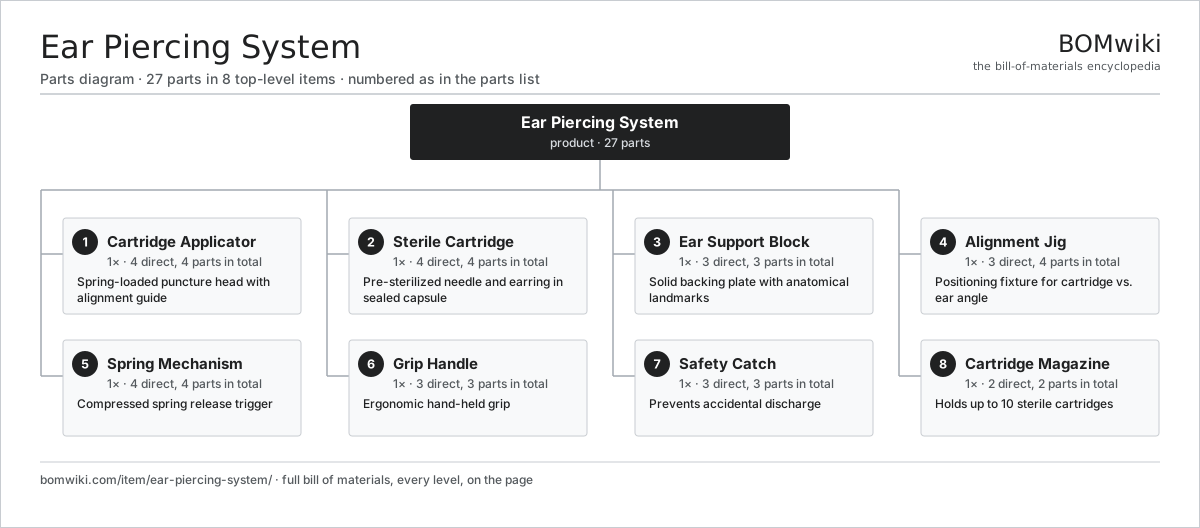
| # | Part | Qty | What it does |
|---|---|---|---|
| 1 | Cartridge Applicator 4 parts | 1× | Spring-loaded puncture head with alignment guide |
| 2 | Sterile Cartridge 4 parts | 1× | Pre-sterilized needle and earring in sealed capsule |
| 3 | Ear Support Block 3 parts | 1× | Solid backing plate with anatomical landmarks |
| 4 | Alignment Jig 3 parts | 1× | Positioning fixture for cartridge vs. ear angle |
| 5 | Spring Mechanism 4 parts | 1× | Compressed spring release trigger |
| 6 | Grip Handle 3 parts | 1× | Ergonomic hand-held grip |
| 7 | Safety Catch 3 parts | 1× | Prevents accidental discharge |
| 8 | Cartridge Magazine 2 parts | 1× | Holds up to 10 sterile cartridges |
3D model
No 3D model yet. Have a CAD file of this? Add a 3D model. STL renders right on this page; STEP, FreeCAD, and OpenSCAD sources are welcome too (openly licensed, like all 3D models on BOMwiki).
Build & assembly graph
expand / collapse · shared sub-assemblies converge · links to related products · est. labourTap an assembly to expand/collapse · tap a part to open it · use “Open page” for any node · drag to pan, scroll to zoom.
Bill of materials for Ear Piercing System
8 top-level lines · 34 rows shown · 27 parts total · indented to 3 levels| # | Item / sub-assembly | Part no. | Qty/assy | Ext. qty | Parts | Type |
|---|---|---|---|---|---|---|
| 1 | Cartridge Applicator 4 parts | ear-piercing-system-cartridge-applicator | 1× | 1 | 4 | assembly |
| 1.1 | Piston Rod | ear-piercing-system-piston-rod | 1× | 1 | · | part |
| 1.2 | Coil Spring | coil-spring | 1× | 1 | · | part |
| 1.3 | Piston Seal | ear-piercing-system-piston-seal | 1× | 1 | · | part |
| 1.4 | Firing Pin | ear-piercing-system-firing-pin | 1× | 1 | · | part |
| 2 | Sterile Cartridge 4 parts | ear-piercing-system-cartridge | 1× | 1 | 4 | assembly |
| 2.1 | Needle Shaft | ear-piercing-system-needle-shaft | 1× | 1 | · | part |
| 2.2 | Earring Post | ear-piercing-system-earring-post | 1× | 1 | · | part |
| 2.3 | Cartridge Housing | ear-piercing-system-cartridge-housing | 1× | 1 | · | part |
| 2.4 | Cartridge Seal | ear-piercing-system-cartridge-seal | 1× | 1 | · | part |
| 3 | Ear Support Block 3 parts | ear-piercing-system-ear-support-block | 1× | 1 | 3 | assembly |
| 3.1 | Block Material | ear-piercing-system-block-material | 1× | 1 | · | part |
| 3.2 | Guide Marks | ear-piercing-system-guide-marks | 1× | 1 | · | part |
| 3.3 | Fastener Set | fastener-set | 1× | 1 | · | part |
| 4 | Alignment Jig 3 parts | ear-piercing-system-alignment-jig | 1× | 1 | 4 | assembly |
| 4.1 | Jig Arms | ear-piercing-system-jig-arms | 2× | 2 | · | part |
| 4.2 | Jig Centering Pin | ear-piercing-system-jig-centering-pin | 1× | 1 | · | part |
| 4.3 | Coil Spring | coil-spring | 1× | 1 | · | part |
| 5 | Spring Mechanism 4 parts | ear-piercing-system-spring-mechanism | 1× | 1 | 4 | assembly |
| 5.1 | Coil Spring | coil-spring | 1× | 1 | · | part |
| 5.2 | Spring Guide Tube | ear-piercing-system-spring-guide-tube | 1× | 1 | · | part |
| 5.3 | Trigger Lever | ear-piercing-system-trigger-lever | 1× | 1 | · | part |
| 5.4 | Catch Ball | ear-piercing-system-catch-ball | 1× | 1 | · | part |
| 6 | Grip Handle 3 parts | ear-piercing-system-grip-handle | 1× | 1 | 3 | assembly |
| 6.1 | Handle Shell | ear-piercing-system-handle-shell | 1× | 1 | · | part |
| 6.2 | Grip Padding | ear-piercing-system-grip-padding | 1× | 1 | · | part |
| 6.3 | Fastener Set | fastener-set | 1× | 1 | · | part |
| 7 | Safety Catch 3 parts | ear-piercing-system-safety-catch | 1× | 1 | 3 | assembly |
| 7.1 | Catch Pawl | ear-piercing-system-catch-pawl | 1× | 1 | · | part |
| 7.2 | Coil Spring | coil-spring | 1× | 1 | · | part |
| 7.3 | Solenoid Release (Optional) | ear-piercing-system-solenoid-release | 1× | 1 | · | part |
| 8 | Cartridge Magazine 2 parts | ear-piercing-system-cartridge-magazine | 1× | 1 | 2 | assembly |
| 8.1 | Magazine Tray | ear-piercing-system-magazine-tray | 1× | 1 | · | part |
| 8.2 | Tray Cover | ear-piercing-system-tray-cover | 1× | 1 | · | part |
Something wrong in this list? Report a problem with this BOM.
Related products
same domain, ranked by shared parts Beard Trimmer
52 parts · shares 1 with this page
Beard Trimmer
52 parts · shares 1 with this page
 Curling Iron
28 parts · shares 1 with this page
Electric Nail Drill
133 parts · shares 1 with this page
Curling Iron
28 parts · shares 1 with this page
Electric Nail Drill
133 parts · shares 1 with this page
 Electric Toothbrush
35 parts · shares 1 with this page
Electrolysis Machine
97 parts · shares 1 with this page
Electric Toothbrush
35 parts · shares 1 with this page
Electrolysis Machine
97 parts · shares 1 with this page
 Hair Clipper
103 parts · shares 1 with this page
Hair Clipper
103 parts · shares 1 with this page
Sourcing: possible vendors
Browse the supplier directory → Prices, MOQ, and lead times are algorithmic estimates, not quotes, and not claims about these companies. Company mappings are curated by keyword; est. price band $15–$500. How estimates work| Vendor | HQ | Specialty | MOQ | Lead time |
|---|---|---|---|---|
| philips.com ↗ | Amsterdam, NL | Grooming & care | 2,000 units | 6–10 wks |
|
🇩🇪Braun
braun.com ↗
|
Kronberg, DE | Grooming (P&G) | 2,000 units | 6–10 wks |
|
🇺🇸Conair
conair.com ↗
|
Stamford, US | Personal care appliances | 2,000 units | 6–10 wks |
|
🇬🇧Dyson
dyson.com ↗
|
Malmesbury, GB | Vacuums & hair care | 2,000 units | 6–10 wks |
| panasonic.com ↗ | Osaka, JP | Electronics & appliances | 2,000 units | 6–10 wks |
771-word article