Ebb and Flow System
ProductOverview
Ebb and flow (also called flood and drain) is a hydroponic cultivation method combining periodic flooding with passive drainage. A pump pressurizes nutrient solution from a central reservoir into shallow trays, flooding them 4–6 times daily for 15–30 minutes. When the pump shuts off, a siphonic standpipe drains each tray completely, returning solution to the reservoir. This cycle provides plants with intermittent root-zone access to nutrients and simultaneously ensures complete drainage and air exposure, promoting aerobic root respiration.
Ebb and flow systems are versatile, supporting everything from leafy greens and herbs to fruiting plants and even small trees in larger installations. The periodic dry-down prevents root rot (Pythium, Rhizoctonia) and improves oxygen availability compared to continuous-flow systems.
How It Works
The Pump and Timer contains a submersible centrifugal pump receiving 230V power via a GFCI Power Cord circuit with ground-fault protection. On programmed intervals (e.g., every 3–4 hours), the Timer Relay Module energizes the pump motor.
The pump draws oxygenated nutrient solution from the Nutrient Reservoir through a Intake Strainer Basket, pressurizing it at 1–2 bar. This pressurized solution enters the Fill Manifold, a network of distribution headers and Tray Shutoff Valve valves that direct flow to each of the four Flood Tray.
Inside each tray, water level rises. Plant roots sitting in Growing Medium (expanded clay, rockwool, or coco coir) become saturated. When water level reaches the height of the Standpipe and Siphon (typically 20–25 cm fill depth), a siphonic action is triggered.
The standpipe itself is a vertical PVC tube mounted at the tray center, with a Siphon Bell Cap seated on top. As water rises above the bell cap's inlet slot, air is trapped inside the bell, creating a partial vacuum. This vacuum siphons water rapidly from the tray, through the Return Tube Outlet elbow, and down the Return Tray Connector into the Return Header Pipe.
Siphon action is so efficient that the tray fully drains in 5–10 seconds once started. The Return Check Valve (a one-way check valve) prevents backflow to the trays. Drained solution returns by gravity into the Overflow Sump and back into the reservoir.
During the drain phase (typically 2–3 hours), the tray dries down. Roots absorb dissolved oxygen from air pockets in the growing medium, promoting secondary rootlet formation and improving nutrient uptake efficiency. The Air Stone in the reservoir maintains dissolved oxygen (DO 6–8 ppm) in bulk solution while it sits idle.
A Float Switch in the reservoir provides a high-level alarm, preventing overflow if the pump is manually operated or a timer malfunction causes extended flooding. The Pressure Gauge on the fill manifold allows visual verification of fill-line pressure (typically 1–1.5 bar).
Nutrient Management
The Monitoring Sensors include an EC Sensor Probe (electrical conductivity) and pH Sensor Probe (pH) measuring solution composition. As plants transpire, water is removed from the reservoir; nutrient concentration rises (EC increases). Growers manually add fresh water to dilute the EC back to target range (typically 1.2–1.8 mS/cm depending on crop).
At each flood cycle, all roots contact solution simultaneously, providing uniform nutrient availability. Because solution returns completely to the reservoir between cycles (unlike drip systems where some solution clings to media), the ratio of nutrient uptake to total solution volume is high, reducing solution change frequency (can run 4–8 weeks on one batch with top-ups only).
Growing Medium Selection
Expanded clay (LECA) is the standard: inert, reusable, excellent aeration, and drains completely between floods. Rockwool cubes work well for short-cycle crops (lettuce, herbs) but must be disposed after harvest (not reusable). Coco coir is sustainable, holds some residual water (beneficial for larger plants), but requires saltwater management (high sodium cations from coir extraction).
Depth of 10–15 cm is typical. Shallow media dry quickly between floods, promoting aeration; deeper media retain more moisture, better for fruiting plants needing longer intervals between floods.
Timing Optimization
Daylight cycles: 4 floods per day, spaced 4–5 hours apart, with 20–30 minute flood duration. This gives roots 4 hours of drying between floods.
Night operation: Typically 0–2 floods at night, as transpiration drops 80% and roots need less frequent feeding. Some growers stop flooding entirely at night to conserve energy.
Transition periods (spring/fall): Fine-tuning flood frequency is critical. Too frequent (every 2 hours) → waterlogged roots; too infrequent (every 6 hours) → wilting, especially in high-transpiration periods.
Modern systems use a Timer Relay Module with multiple daily programs, or a controller detecting soil moisture to adjust cycles adaptively.
Root Zone Benefits
The periodic drying-down creates aerobic conditions incompatible with anaerobic pathogens (Pythium zoospores die in air-filled media). This, combined with the Air Stone keeping bulk solution oxygenated, gives ebb-flow exceptionally good disease suppression compared to continuous deep-water culture.
Secondary benefits: Roots develop dense hair roots in the dry phase, improving nutrient absorption; EC builds uniformly across all plants (no concentration gradients in piping); and system is very water-efficient (complete drainage means no waste).
Scalability and Crop Suitability
Four-tray installations are common in research or small commercial settings. Industrial greenhouses expand this: 16, 32, or even 64 tray arrays on a single pump timer, occupying 100–300 m². The siphonic standpipe design scales perfectly; each additional tray requires only one more standpipe and a manifold extension.
Crops span from lettuce and basil (4–6 weeks) to tomatoes, peppers, and cucumbers (12–16 weeks) to ornamentals and seedlings (8–12 weeks). Fruit crops benefit from ebb-flow's aeration; yields typically exceed continuous-drip systems by 10–15%.
Maintenance
Weekly: Check Float Switch operation by manually raising water level; reset if stuck.
Bi-weekly: Clean Intake Strainer Basket basket if algae or sediment accumulates.
Monthly: Test EC Sensor Probe and pH Sensor Probe against known standards; recalibrate if drift >0.1 pH units or >50 µS/cm.
Quarterly: Inspect all Return Tray Connector tubes for cracks; replace if brittle.
Seasonally (end of crop): Clean all trays, flush standpipes with dilute bleach, and allow to air dry to prevent mold.
Standpipe siphons very rarely fail if initially primed correctly. If a tray does not drain, likely cause: bell cap cracked, drain outlet kinked, or standpipe tube misaligned with tray floor. All are simple mechanical fixes.
Energy and Water Efficiency
Power use: 500–1500 W pump × 4–6 cycles/day × 0.25 hours per cycle = ~0.5–2.25 kWh/day (minimal).
Water: Complete drain-down means all moisture is returned; evapotranspiration (ET) is the only loss. Typical ET is 20–40 L/day for four trays, vs. 80–120 L/day for drip systems (where residual media moisture is not recovered). Ebb-flow is 50–60% more water-efficient than continuously irrigated systems.
Ebb and Flow System parts and their functions
7 top-level parts · 61 parts in total · full bill of materials below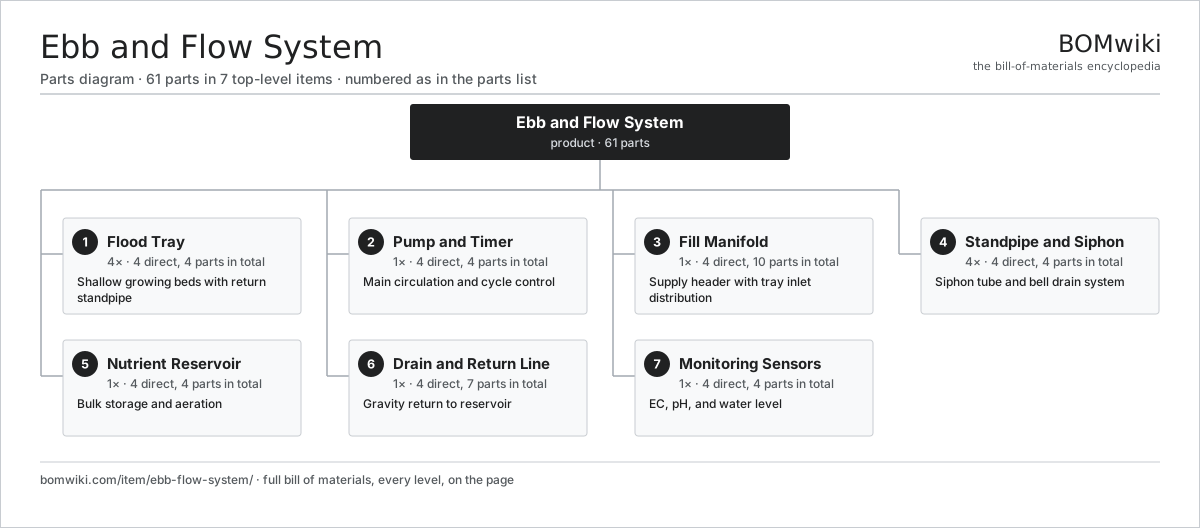
| # | Part | Qty | What it does |
|---|---|---|---|
| 1 | Flood Tray 4 parts | 4× | Shallow growing beds with return standpipe |
| 2 | Pump and Timer 4 parts | 1× | Main circulation and cycle control |
| 3 | Fill Manifold 4 parts | 1× | Supply header with tray inlet distribution |
| 4 | Standpipe and Siphon 4 parts | 4× | Siphon tube and bell drain system |
| 5 | Nutrient Reservoir 4 parts | 1× | Bulk storage and aeration |
| 6 | Drain and Return Line 4 parts | 1× | Gravity return to reservoir |
| 7 | Monitoring Sensors 4 parts | 1× | EC, pH, and water level |
3D model
No 3D model yet. Have a CAD file of this? Add a 3D model. STL renders right on this page; STEP, FreeCAD, and OpenSCAD sources are welcome too (openly licensed, like all 3D models on BOMwiki).
Build & assembly graph
expand / collapse · shared sub-assemblies converge · links to related products · est. labourTap an assembly to expand/collapse · tap a part to open it · use “Open page” for any node · drag to pan, scroll to zoom.
Bill of materials for Ebb and Flow System
7 top-level lines · 35 rows shown · 61 parts total · indented to 3 levels| # | Item / sub-assembly | Part no. | Qty/assy | Ext. qty | Parts | Type |
|---|---|---|---|---|---|---|
| 1 | Flood Tray 4 parts | ebb-flow-system-flood-trays | 4× | 4 | 4 | assembly |
| 1.1 | Tray Shell | ebb-flow-system-tray-shell | 1× | 4 | · | part |
| 1.2 | Tray Inlet Fitting | ebb-flow-system-tray-inlet-fitting | 1× | 4 | · | part |
| 1.3 | Growing Medium | ebb-flow-system-growing-medium-layer | 1× | 4 | · | part |
| 1.4 | Tray Support Shelf | ebb-flow-system-tray-support-shelf | 1× | 4 | · | part |
| 2 | Pump and Timer 4 parts | ebb-flow-system-pump-timer | 1× | 1 | 4 | assembly |
| 2.1 | Blower Motor | blower-motor | 1× | 1 | · | part |
| 2.2 | Float Switch | ebb-flow-system-float-switch | 1× | 1 | · | part |
| 2.3 | Timer Relay Module | ebb-flow-system-timer-relay | 1× | 1 | · | part |
| 2.4 | GFCI Power Cord | ebb-flow-system-power-cord-gfci | 1× | 1 | · | part |
| 3 | Fill Manifold 4 parts | ebb-flow-system-fill-manifold | 1× | 1 | 10 | assembly |
| 3.1 | Manifold Main Pipe | ebb-flow-system-manifold-main-pipe | 1× | 1 | · | part |
| 3.2 | Tray Distribution Tee | ebb-flow-system-tray-distribution-tee | 4× | 4 | · | part |
| 3.3 | Tray Shutoff Valve | ebb-flow-system-shutoff-valve | 4× | 4 | · | part |
| 3.4 | Pressure Gauge | ebb-flow-system-pressure-gauge | 1× | 1 | · | part |
| 4 | Standpipe and Siphon 4 parts | ebb-flow-system-standpipe-assembly | 4× | 4 | 4 | assembly |
| 4.1 | Standpipe Tube | ebb-flow-system-standpipe-tube | 1× | 4 | · | part |
| 4.2 | Siphon Bell Cap | ebb-flow-system-siphon-bell-cap | 1× | 4 | · | part |
| 4.3 | Drain Seal Ring | ebb-flow-system-drain-seal-ring | 1× | 4 | · | part |
| 4.4 | Return Tube Outlet | ebb-flow-system-return-tube-outlet | 1× | 4 | · | part |
| 5 | Nutrient Reservoir 4 parts | ebb-flow-system-nutrient-reservoir | 1× | 1 | 4 | assembly |
| 5.1 | Reservoir Tank | ebb-flow-system-reservoir-tank | 1× | 1 | · | part |
| 5.2 | Intake Strainer Basket | ebb-flow-system-pump-intake-strainer | 1× | 1 | · | part |
| 5.3 | Air Stone | ebb-flow-system-air-pump-stone | 1× | 1 | · | part |
| 5.4 | Reservoir Cover | ebb-flow-system-reservoir-cover | 1× | 1 | · | part |
| 6 | Drain and Return Line 4 parts | ebb-flow-system-drain-return-line | 1× | 1 | 7 | assembly |
| 6.1 | Return Header Pipe | ebb-flow-system-return-header-pipe | 1× | 1 | · | part |
| 6.2 | Return Tray Connector | ebb-flow-system-return-tray-connector | 4× | 4 | · | part |
| 6.3 | Return Check Valve | ebb-flow-system-return-valve | 1× | 1 | · | part |
| 6.4 | Overflow Sump | ebb-flow-system-overflow-sump | 1× | 1 | · | part |
| 7 | Monitoring Sensors 4 parts | ebb-flow-system-monitoring-sensors | 1× | 1 | 4 | assembly |
| 7.1 | EC Sensor Probe | ebb-flow-system-ec-sensor-probe | 1× | 1 | · | part |
| 7.2 | pH Sensor Probe | ebb-flow-system-ph-sensor-probe | 1× | 1 | · | part |
| 7.3 | Water Level Sensor | ebb-flow-system-water-level-sensor | 1× | 1 | · | part |
| 7.4 | Sensor Reader Display | ebb-flow-system-sensor-reader-display | 1× | 1 | · | part |
Something wrong in this list? Report a problem with this BOM.
Related products
same domain, ranked by shared parts


Sourcing: possible vendors
Browse the supplier directory → Prices, MOQ, and lead times are algorithmic estimates, not quotes, and not claims about these companies. Company mappings are curated by keyword; est. price band $5k–$800k. How estimates work| Vendor | HQ | Specialty | MOQ | Lead time |
|---|---|---|---|---|
| deere.com ↗ | Moline, US | Agriculture & turf | made to order | 14–24 wks |
| cnh.com ↗ | Basildon, GB | Agriculture (Case IH, New Holland) | made to order | 14–24 wks |
|
🇺🇸AGCO
agcocorp.com ↗
|
Duluth, US | Agriculture (Fendt, Massey Ferguson) | made to order | 14–24 wks |
|
🇩🇪Claas
claas.com ↗
|
Harsewinkel, DE | Harvesters & tractors | made to order | 14–24 wks |
|
🇯🇵Kubota
kubota.com ↗
|
Osaka, JP | Compact tractors & equipment | made to order | 14–24 wks |
1,221-word article