Eddy Current Separator
ProductOverview
An eddy-current separator is an electromagnetic machine that selectively removes nonferrous metals (aluminum, copper, brass, stainless) from mixed scrap granules by inducing opposing eddy currents in the nonferrous material, causing it to be repelled away from ferrous fraction. The device is standard in modern metal recycling facilities, installed downstream of shredders, cable grinders, or wire processing lines to achieve high-purity product streams.
The principle is electromagnetic induction: as a granule passes over the rotating magnetic rotor, the changing magnetic field induces circular eddy currents in any electrically conductive material. These currents generate an opposing magnetic field that repels the granule away from the rotor surface. Ferrous materials (iron, steel) experience attraction instead and remain on the conveyor belt longer, allowing the splitter to mechanically separate the two streams by trajectory.
Typical installations achieve 95–98% nonferrous recovery with less than 1–2% ferrous contamination in the separated aluminum stream. The technology is non-contact (no blades, brushes, or screens to wear) and handles continuous operation in dusty, wet, or frozen-material conditions.
How it works
Mixed granular scrap (2–5 mm) is fed onto the horizontal conveyor belt, which moves at 30–100 fpm. Just before the belt discharge, the rotating magnetic rotor (3000–6000 rpm) creates a time-varying magnetic field directly beneath or adjacent to the conveyor surface.
As a granule travels over the rotor, the magnetic flux (3500–4500 gauss) oscillates through it. In aluminum, copper, and brass, this induction creates circular eddy currents that generate a repulsive magnetic force, pushing the granule upward and laterally away from the rotor surface. Ferrous granules (iron, steel) experience attraction and remain firmly on the belt.
The differential trajectory is the separation mechanism: nonferrous granules are launched or deflected toward one trajectory; ferrous granules continue straight. At the conveyor discharge, a mechanical splitter blade positioned at an optimized angle directs the two streams to separate nonferrous and ferrous chutes.
The rotor is driven by a 15–30 hp motor coupled via flexible coupling to the rotor shaft. Speed is controlled independently via VFD or phase control allowing optimization for different material densities and sizes. Higher rotor speeds (5000–6000 rpm) provide stronger repulsion but increase heat and magnet stress; lower speeds (3000–3500 rpm) save energy but reduce separation sharpness.
The magnetic circuit consists of 12–16 radial permanent neodymium magnets (N52 grade, 1–2 inch cubes) housed in a rotating aluminum or steel drum. Permanent magnets are preferred over electromagnets because they generate constant flux without requiring excitation power or cooling, and they eliminate the risk of field collapse on power loss.
The conveyor belt is driven by a separate 3–5 hp motor at 30–100 fpm, independent of rotor speed. This allows fine-tuning of residence time over the magnetic field: slower belt speeds allow longer magnetic interaction (sharper separation) but reduce throughput; faster speeds maximize throughput but require higher rotor speed to achieve the same deflection.
All electrical control is managed by a control panel featuring a soft-start module that limits inrush current during startup, and a tachometer that monitors rotor rpm in real-time. A safety switch detects rotor over-speed (risk of magnet demagnetization) or stall (jamming) and triggers automatic shutdown.
Factors Affecting Separation Quality
Material Size: Finer granules (2–3 mm) separate more sharply because they experience higher acceleration per unit mass. Larger fragments (4–6 mm) require higher rotor speed to achieve equivalent deflection.
Rotor Speed: Higher speed increases repulsive force but also increases heat in the magnets and motor. Most installations operate at 4000–5000 rpm as a compromise.
Conveyor Speed: Slower belt speeds increase magnetic exposure time and yield cleaner separation but reduce throughput. A typical setting is 50–70 fpm for 3 mm granules.
Splitter Angle: The splitter blade angle is adjusted empirically; 25–35° from horizontal is typical. Too shallow fails to separate; too steep deflects ferrous material as well.
Magnetic Field Strength: Measured at the rotor surface in gauss. Higher field (4000+ gauss) improves separation but increases cost and power. 3500–4000 gauss is typical for production units.
Nonferrous Metallic Range
Eddy-current separators work on any electrically conductive nonferrous metal:
- Aluminum (high conductivity): reliably separated
- Copper (highest conductivity): strongly separated
- Brass and Bronze (80–90% copper): separated
- Stainless Steel (austenitic, nonmagnetic): separated
- Magnesium and Titanium: separated if sufficiently conductive
Ceramics, plastics, and glass pass straight through without deflection and are collected with ferrous fraction, further screening or air-classification may be required if high ferrous purity is critical.
Maintenance and Operating Life
Permanent magnets do not demagnetize under normal operating temperatures (up to 80–100°C). However, repeated mechanical impacts (e.g., large metal stones striking the rotor) can crack magnets. The bearings supporting the high-speed rotor should be inspected and relubricated every 500–1000 operating hours.
The conveyor belt is the main wear item, typically replaced every 2000–3000 hours depending on material abrasiveness. Damaged rotor drums must be replaced as an assembly; individual magnet repair is not practical.
Energy Efficiency
Eddy-current separation is relatively energy-efficient compared to wet processing or mechanical screening. A typical 2 ton/hr unit consumes 20–35 kW (rotor + conveyor + controls). Energy cost is approximately $0.50–$1.00 per ton of material processed in North American markets.
Environmental and Safety
Eddy-current separators are inherently safe: no rotating blades, no chemical usage, no water discharge. Noise levels are modest (78–85 dB), mostly from the motor and belt drive. The main hazard is the rotating rotor, which is typically enclosed by interlocked guards preventing hand insertion.
Stray magnetic fields extend 1–2 feet from the rotor and may interfere with cardiac pacemakers; warning signage and operator training are standard practice. Ferromagnetic tools (steel wrenches) must be kept away from the active magnetic field during operation.
Eddy Current Separator parts and their functions
8 top-level parts · 69 parts in total · full bill of materials below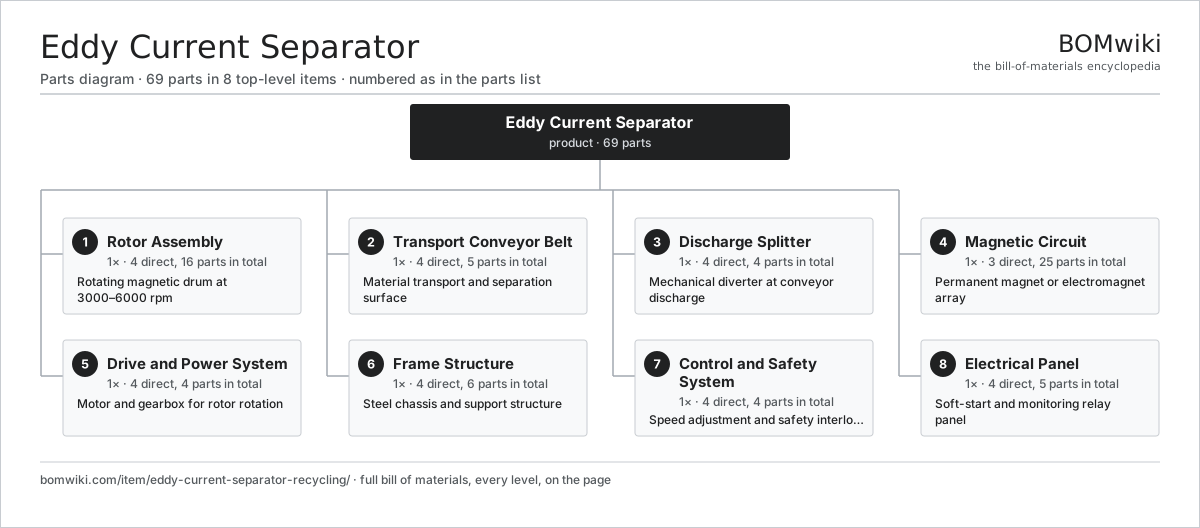
| # | Part | Qty | What it does |
|---|---|---|---|
| 1 | Rotor Assembly 4 parts | 1× | Rotating magnetic drum at 3000–6000 rpm |
| 2 | Transport Conveyor Belt 4 parts | 1× | Material transport and separation surface |
| 3 | Discharge Splitter 4 parts | 1× | Mechanical diverter at conveyor discharge |
| 4 | Magnetic Circuit 3 parts | 1× | Permanent magnet or electromagnet array |
| 5 | Drive and Power System 4 parts | 1× | Motor and gearbox for rotor rotation |
| 6 | Frame Structure 4 parts | 1× | Steel chassis and support structure |
| 7 | Control and Safety System 4 parts | 1× | Speed adjustment and safety interlocks |
| 8 | Electrical Panel 4 parts | 1× | Soft-start and monitoring relay panel |
3D model
No 3D model yet. Have a CAD file of this? Add a 3D model. STL renders right on this page; STEP, FreeCAD, and OpenSCAD sources are welcome too (openly licensed, like all 3D models on BOMwiki).
Build & assembly graph
expand / collapse · shared sub-assemblies converge · links to related products · est. labourTap an assembly to expand/collapse · tap a part to open it · use “Open page” for any node · drag to pan, scroll to zoom.
Bill of materials for Eddy Current Separator
8 top-level lines · 39 rows shown · 69 parts total · indented to 3 levels| # | Item / sub-assembly | Part no. | Qty/assy | Ext. qty | Parts | Type |
|---|---|---|---|---|---|---|
| 1 | Rotor Assembly 4 parts | eddy-current-separator-rotor-assembly | 1× | 1 | 16 | assembly |
| 1.1 | Rotor Shaft | eddy-current-separator-rotor-shaft | 1× | 1 | · | part |
| 1.2 | Permanent Magnet | eddy-current-separator-permanent-magnets | 12× | 12 | · | part |
| 1.3 | Rotor Drum | eddy-current-separator-rotor-drum | 1× | 1 | · | part |
| 1.4 | Rotor Bearing | eddy-current-separator-rotor-bearing | 2× | 2 | · | part |
| 2 | Transport Conveyor Belt 4 parts | eddy-current-separator-conveyor-belt | 1× | 1 | 5 | assembly |
| 2.1 | Conveyor Belt | eddy-current-separator-belt-material | 1× | 1 | · | part |
| 2.2 | Belt Pulley | eddy-current-separator-belt-pulleys | 2× | 2 | · | part |
| 2.3 | Conveyor Motor | eddy-current-separator-belt-motor | 1× | 1 | · | part |
| 2.4 | Belt Tensioner | eddy-current-separator-belt-tensioner | 1× | 1 | · | part |
| 3 | Discharge Splitter 4 parts | eddy-current-separator-splitter | 1× | 1 | 4 | assembly |
| 3.1 | Splitter Blade | eddy-current-separator-splitter-blade | 1× | 1 | · | part |
| 3.2 | Splitter Hinge | eddy-current-separator-splitter-hinge | 1× | 1 | · | part |
| 3.3 | Nonferrous Chute | eddy-current-separator-splitter-chute-nf | 1× | 1 | · | part |
| 3.4 | Ferrous Chute | eddy-current-separator-splitter-chute-fe | 1× | 1 | · | part |
| 4 | Magnetic Circuit 3 parts | eddy-current-separator-magnetic-circuit | 1× | 1 | 25 | assembly |
| 4.1 | Magnet Housing | eddy-current-separator-magnet-housing | 1× | 1 | · | part |
| 4.2 | Neodymium Magnet | neodymium-magnet | 12× | 12 | · | part |
| 4.3 | Magnet Spacer | eddy-current-separator-magnet-spacers | 12× | 12 | · | part |
| 5 | Drive and Power System 4 parts | eddy-current-separator-drive-unit | 1× | 1 | 4 | assembly |
| 5.1 | Main Motor | eddy-current-separator-motor | 1× | 1 | · | part |
| 5.2 | Gearbox Assembly | eddy-current-separator-gearbox | 1× | 1 | · | part |
| 5.3 | Motor Coupling | eddy-current-separator-coupling | 1× | 1 | · | part |
| 5.4 | Speed Control Unit | eddy-current-separator-speed-control | 1× | 1 | · | part |
| 6 | Frame Structure 4 parts | eddy-current-separator-frame-structure | 1× | 1 | 6 | assembly |
| 6.1 | Base Frame | eddy-current-separator-base-frame | 1× | 1 | · | part |
| 6.2 | Upright Support | eddy-current-separator-uprights | 2× | 2 | · | part |
| 6.3 | Access Cover Plate | eddy-current-separator-cover-plates | 2× | 2 | · | part |
| 6.4 | Fastener Set | fastener-set | 1× | 1 | · | part |
| 7 | Control and Safety System 4 parts | eddy-current-separator-controls | 1× | 1 | 4 | assembly |
| 7.1 | Soft-Start Module | eddy-current-separator-soft-start | 1× | 1 | · | part |
| 7.2 | Speed Sensor | eddy-current-separator-speed-sensor | 1× | 1 | · | part |
| 7.3 | Limit Switch | eddy-current-separator-limit-switch | 1× | 1 | · | part |
| 7.4 | Control Cable Harness | eddy-current-separator-control-cable | 1× | 1 | · | part |
| 8 | Electrical Panel 4 parts | eddy-current-separator-electronics | 1× | 1 | 5 | assembly |
| 8.1 | Motor Contactor | eddy-current-separator-contactor | 1× | 1 | · | part |
| 8.2 | Overload Relay | eddy-current-separator-overload-relay | 1× | 1 | · | part |
| 8.3 | Control Relay | eddy-current-separator-control-relay | 2× | 2 | · | part |
| 8.4 | Auxiliary Power Supply | eddy-current-separator-power-supply | 1× | 1 | · | part |
Something wrong in this list? Report a problem with this BOM.
Related products
same domain, ranked by shared parts All-Electric Injection Molding Machine
851 parts · shares 1 with this page
Automated Paint Spray Line
2,003 parts · shares 1 with this page
All-Electric Injection Molding Machine
851 parts · shares 1 with this page
Automated Paint Spray Line
2,003 parts · shares 1 with this page
 Automobile Shredder
222 parts · shares 1 with this page
Binder Jetting Printer
112 parts · shares 1 with this page
Blown Film Extrusion Line
436 parts · shares 1 with this page
Automobile Shredder
222 parts · shares 1 with this page
Binder Jetting Printer
112 parts · shares 1 with this page
Blown Film Extrusion Line
436 parts · shares 1 with this page
Sourcing: possible vendors
Browse the supplier directory → Prices, MOQ, and lead times are algorithmic estimates, not quotes, and not claims about these companies. Company mappings are curated by keyword; est. price band $5k–$2M. How estimates work| Vendor | HQ | Specialty | MOQ | Lead time |
|---|---|---|---|---|
| atlascopco.com ↗ | Stockholm, SE | Compressors & industrial | 10 units | 12–20 wks |
|
🇦🇹Andritz
andritz.com ↗
|
Graz, AT | Process plants & machinery | 10 units | 12–20 wks |
| buhlergroup.com ↗ | Uzwil, CH | Food & materials processing | 10 units | 12–20 wks |
| gea.com ↗ | Düsseldorf, DE | Process technology | 10 units | 12–20 wks |
| mhi.com ↗ | Tokyo, JP | Heavy machinery | 10 units | 12–20 wks |
1,099-word article