EEG Machine
ProductOverview
Electroencephalography (EEG) machines measure electrical potential differences across scalp electrodes to detect abnormal brain activity. The system integrates 19–21 electrodes positioned per the 10–20 international standard, low-noise amplifiers, analog filtering, analog-to-digital conversion, and real-time software for waveform display and event annotation. Clinicians use EEG to diagnose epilepsy (interictal spike detection, seizure characterization), encephalopathy (background slowing), and functional status during coma or anesthesia. The photic stimulator (strobe light) evokes photosensitive responses; flickering frequencies that trigger EEG abnormalities identify patients at risk for photogenic seizures.
Signal acquisition and electrode placement
The Electrode Cap positions 19 active electrodes across the scalp using the 10–20 distance formula: frontal (Fp1, Fp2, F3, F4, F7, F8), central (C3, C4, Cz), temporal (T3, T4, T5, T6), parietal (P3, P4, Pz), and occipital (O1, O2, Oz). Two reference electrodes (A1, A2 at the mastoid process) provide the reference potential for bipolar and referential montages. Electrolyte Electrolyte Paste Dispenser reduces electrode-to-skin impedance; the Impedance Checking Device validates impedance <5 kΩ per lead before acquisition begins.
Amplification and analog frontend
The Amplifier Chassis contains an Input Isolation Module per electrode channel, providing galvanic isolation (>60 dB CMRR) to reject common-mode interference (powerline noise, body currents) that would otherwise drown 10–100 µV EEG signals. Each channel is independently programmable to gain 10×, 100×, 1,000×, or 10,000×, allowing display ranges from 100 µV/div (myogenic artifact rejection) to 2 µV/div (sleep spindle detection). The Programmable Filter Card removes 50/60 Hz powerline contamination via a notch filter and attenuates muscle EMG (>60 Hz) and drift (<0.1 Hz); the high-pass cutoff of 0.1 Hz removes DC offsets while preserving slow EEG rhythms (delta 0.5–4 Hz).
Real-time data acquisition and display
The USB Digitizer Bridge buffers the 19 analog channels through a 16-bit ADC at 2 kHz per channel, timestamping each frame with microsecond precision. The Acquisition Workstation software displays real-time montages (longitudinal bipolar, referential, or specialized arrays for spike detection); neurophysiologists can toggle between traces and select which 4–8 channels appear on screen simultaneously to focus on regions of interest. Automatic eeg-machine-artifact-detection (built into software) flags high-amplitude transients (eye blinks >100 µV, muscle twitch >200 µV, electrode pops) that obscure clinical interpretation.
Photic stimulation protocol
The Photic Stimulator Unit delivers flashes at clinician-controlled frequencies 1–70 Hz. Starting at 1 Hz, frequency is gradually increased; EEG abnormalities (spike-wave bursts, polyspike-wave complexes) that emerge during specific frequency ranges indicate photosensitivity. The strobe driver outputs a sync pulse to an auxiliary EEG channel so that flash timing and EEG response are precisely correlated. Patients with photoparoxysmal responses are counseled to avoid strobe lights and video games.
Montage flexibility and event marking
A clinical EEG study records 20–60 minutes of continuous activity. Software montages allow real-time remontaging (switching electrode derivations without re-recording): the neurophysiologist can view data as frontal-to-central chains, then instantly switch to temporal-lobe-focused arrays, then switch to ear-to-ear transverse chains, all from the same stored raw data. Event buttons allow the technician to mark time stamps of patient behavior (speech, eye opening, generalized jerking) synchronized to the EEG trace; during interpretation, the neurophysiologist reviews video recordings (if simultaneous video is available) at marked epochs.
Artifact handling and clinical decision support
EEG recordings are heavily contaminated with non-cerebral artifacts: eye blinks and saccades (eye-movement artifact >100 µV), scalp muscle contraction (EMG >200 µV from forehead or jaw), cardiac pulsation (1 Hz low-amplitude sine wave), and electrode movement (slow drift). The software flagging algorithms highlight suspicious epochs; neurophysiologists manually inspect flagged segments to distinguish cerebral spikes from muscle artifact. Chewing artifact (repetitive 2–3 Hz burst) is readily distinguished from sleep spindles (12–14 Hz burst) by frequency inspection.
Diagnostic output and archival
At session end, the neurophysiologist reviews the entire trace epoch-by-epoch, marking spike locations, seizure onset/offset, and background rhythm abnormalities. The system generates a summary report with printed samples (short representative traces from key regions), spike count per region, and clinical impression. Full raw data is archived to disk for future reference, re-analysis, or teaching.
Typical clinical workflow
A patient with suspected epilepsy or recent syncope is scheduled for an EEG study. The technician applies the electrode cap using conductive paste; impedance checks confirm contact <5 kΩ per lead. The patient sits comfortably in a reclining chair with eyes closed; the neurophysiologist begins recording. After 3–5 minutes of baseline, the photic stimulator protocol begins (flashing at 1, 2, 3, 5, 10, 15, 20, 30, 50, 70 Hz for 5–10 seconds each). During hyperventilation (patient instructed to deep-breathe for 3–5 minutes), absence seizures and generalized spike-wave discharges commonly surface. After hyperventilation, the patient is allowed to rest; spontaneous sleep is encouraged to capture sleep-stage transitions (sleep deprivation is a common trigger for interictal spikes). The entire session lasts 30–60 minutes; the neurophysiologist begins formal interpretation the same day.
EEG Machine parts and their functions
6 top-level parts · 46 parts in total · full bill of materials below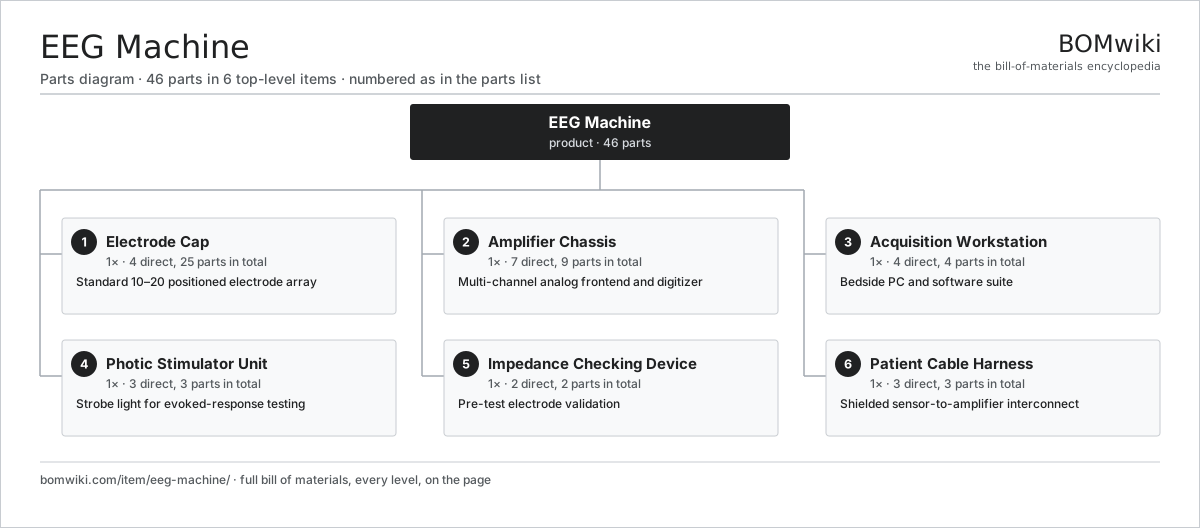
| # | Part | Qty | What it does |
|---|---|---|---|
| 1 | Electrode Cap 4 parts | 1× | Standard 10–20 positioned electrode array |
| 2 | Amplifier Chassis 7 parts | 1× | Multi-channel analog frontend and digitizer |
| 3 | Acquisition Workstation 4 parts | 1× | Bedside PC and software suite |
| 4 | Photic Stimulator Unit 3 parts | 1× | Strobe light for evoked-response testing |
| 5 | Impedance Checking Device 2 parts | 1× | Pre-test electrode validation |
| 6 | Patient Cable Harness 3 parts | 1× | Shielded sensor-to-amplifier interconnect |
3D model
No 3D model yet. Have a CAD file of this? Add a 3D model. STL renders right on this page; STEP, FreeCAD, and OpenSCAD sources are welcome too (openly licensed, like all 3D models on BOMwiki).
Build & assembly graph
expand / collapse · shared sub-assemblies converge · links to related products · est. labourTap an assembly to expand/collapse · tap a part to open it · use “Open page” for any node · drag to pan, scroll to zoom.
Bill of materials for EEG Machine
6 top-level lines · 29 rows shown · 46 parts total · indented to 3 levels| # | Item / sub-assembly | Part no. | Qty/assy | Ext. qty | Parts | Type |
|---|---|---|---|---|---|---|
| 1 | Electrode Cap 4 parts | eeg-machine-electrode-cap | 1× | 1 | 25 | assembly |
| 1.1 | Cap Fabric Base | eeg-machine-cap-fabric | 1× | 1 | · | part |
| 1.2 | Spring Electrode Cup | eeg-machine-spring-electrode | 21× | 21 | · | part |
| 1.3 | Reference/Ground Electrodes | eeg-machine-chin-ground | 2× | 2 | · | part |
| 1.4 | Electrolyte Paste Dispenser | eeg-machine-contact-paste | 1× | 1 | · | part |
| 2 | Amplifier Chassis 7 parts | eeg-machine-amplifier-chassis | 1× | 1 | 9 | assembly |
| 2.1 | Main Amplifier PCB | eeg-machine-main-pcb | 1× | 1 | · | part |
| 2.2 | Input Isolation Module | eeg-machine-input-isolation-stage | 1× | 1 | · | part |
| 2.3 | Programmable Filter Card | eeg-machine-filter-module | 1× | 1 | · | part |
| 2.4 | Medical Isolated PSU | eeg-machine-power-supply | 1× | 1 | · | part |
| 2.5 | Front Panel Assembly | eeg-machine-front-panel | 1× | 1 | · | part |
| 2.6 | Connector | connector | 3× | 3 | · | part |
| 2.7 | Fastener Set | fastener-set | 1× | 1 | · | part |
| 3 | Acquisition Workstation 4 parts | eeg-machine-acquisition-station | 1× | 1 | 4 | assembly |
| 3.1 | Acquisition PC | eeg-machine-pc-unit | 1× | 1 | · | part |
| 3.2 | Clinical Display Monitor | eeg-machine-monitor-display | 1× | 1 | · | part |
| 3.3 | USB Digitizer Bridge | eeg-machine-usb-digitizer | 1× | 1 | · | part |
| 3.4 | Thermal Report Printer | eeg-machine-printer | 1× | 1 | · | part |
| 4 | Photic Stimulator Unit 3 parts | eeg-machine-photic-stimulator | 1× | 1 | 3 | assembly |
| 4.1 | Strobe Light Head | eeg-machine-strobe-head | 1× | 1 | · | part |
| 4.2 | Strobe Driver Circuit | eeg-machine-strobe-driver | 1× | 1 | · | part |
| 4.3 | Stimulus Sync Cable | eeg-machine-stim-cable | 1× | 1 | · | part |
| 5 | Impedance Checking Device 2 parts | eeg-machine-impedance-device | 1× | 1 | 2 | assembly |
| 5.1 | Impedance Meter Unit | eeg-machine-impedance-meter-unit | 1× | 1 | · | part |
| 5.2 | Test Lead Set | eeg-machine-impedance-test-lead | 1× | 1 | · | part |
| 6 | Patient Cable Harness 3 parts | eeg-machine-patient-cable-harness | 1× | 1 | 3 | assembly |
| 6.1 | Multicore Shielded Cable | eeg-machine-multicore-cable | 1× | 1 | · | part |
| 6.2 | Strain Relief Boot | eeg-machine-strain-relief | 1× | 1 | · | part |
| 6.3 | Connector Backshell | eeg-machine-connector-backshell | 1× | 1 | · | part |
Something wrong in this list? Report a problem with this BOM.
Sourcing: possible vendors
Browse the supplier directory → Prices, MOQ, and lead times are algorithmic estimates, not quotes, and not claims about these companies. Company mappings are curated by keyword; est. price band $500–$3M. How estimates work| Vendor | HQ | Specialty | MOQ | Lead time |
|---|---|---|---|---|
| gehealthcare.com ↗ | Chicago, US | Medical imaging & devices | 100 units | 12–20 wks |
| siemens-healthineers.com ↗ | Erlangen, DE | Medical systems | 100 units | 12–20 wks |
|
🇳🇱Philips
philips.com ↗
|
Amsterdam, NL | Health technology | 100 units | 12–20 wks |
| medtronic.com ↗ | Minneapolis, US | Medical devices | 100 units | 12–20 wks |
|
🇨🇳Mindray
mindray.com ↗
|
Shenzhen, CN | Medical devices | 100 units | 12–20 wks |
860-word article