Electric Egg Cooker
ProductOverview
An electric egg cooker steams eggs instead of boiling them in a pot, and it times the cook with an unusual mechanism: the volume of water poured in. A small measured charge of water sits on the heated Boiling Plate; once it has all evaporated, the plate temperature jumps and a thermostat shuts the machine off. More water means more steam time and a harder egg, so the Water Measuring Cup carries separate graduation scales for soft, medium and hard eggs at various egg counts. There is no clock anywhere in the machine.
The arrangement has a self-correcting property that a fixed timer lacks. Cold eggs, more eggs, or a cold start all condense steam faster, which would undercook on a clock-timed cycle. Here the same water lasts longer when more heat is being absorbed, so doneness stays roughly constant across load and starting conditions.
How it works
Pressing the Power Switch energizes the Heating Element, a 350-500 W heater bonded under the dished aluminum plate, and lights the Indicator Lamp. The water charge boils within a minute or two and fills the dome with steam at essentially 100 degrees C. Eggs sit point-up in the Egg Tray above the plate, surrounded by saturated steam, which transfers heat to the shell faster than dry air at the same temperature because each gram of condensing steam gives up about 2.26 kJ.
While any liquid water remains, evaporative cooling pins the plate a little above 100 degrees C. When the last of it flashes off, nothing limits the plate temperature and it climbs steeply. The Shutoff Thermostat, a bimetal switch set around 110-130 degrees C against the plate underside, snaps open within seconds of dry-out, cutting the element and triggering the Speaker buzzer. A series Thermal Fuse backs up the thermostat: if the bimetal ever fails closed, the fuse opens permanently before the plastic Base Shell is endangered. A silicone Plate Gasket keeps boil-over and condensate out of the wiring below, and the Heat Shield protects the base molding.
Using the accessories
The Piercing Pin, a steel point set in the base of the measuring cup, addresses the main failure mode of steamed in-shell eggs: the air cell at the blunt end expands faster than it can vent through the shell pores, cracking the shell. A single pinhole through the blunt end gives the air a path out. Eggs then load point-down in the tray cradles.
Swapping the tray for the Poaching Tray converts the machine to poaching: shelled eggs sit in nonstick cups and cook in the same steam, using the smallest water graduation. The Omelette Bowl does the same for beaten egg. In every mode the Lid Dome traps the steam, the Steam Vent meters a small controlled loss so pressure never builds, and the Lid Handle keeps fingers out of the vapor plume when the buzzer sounds. The vent loss is already accounted for in the cup graduations, which is why lids and cups are not interchangeable between models.
Construction
The product is built like a kettle turned sideways: one heated plate, one thermostat, one switch, no electronics. Connections run from the Cord Set through a Strain Relief Grommet into a short Wire Bundle, with crimped Connector terminals at the switch, lamp, element Element Terminal Block and thermostat. Four Rubber Foot pads steady the base. The simplicity shows in the service record: descaling the plate (the same limescale a kettle accumulates, which insulates the plate and can trip the thermostat early) covers most complaints, with the thermal fuse the only common electrical repair. Vinegar descaling restores the plate; the Fastener Set under the base opens the unit for fuse replacement.
The measured-water principle has limits worth knowing. The graduations are calibrated for refrigerator-cold large eggs at the maker's reference altitude; at high elevation, water boils cooler and evaporates faster, so eggs come out softer for the same fill line and users compensate with extra water. Conversely, room-temperature eggs absorb less heat and finish slightly harder. None of this requires recalibrating the machine, only adjusting the pour, which is why the cup rather than the cooker carries all the timing information.
Electric Egg Cooker parts and their functions
8 top-level parts · 32 parts in total · full bill of materials below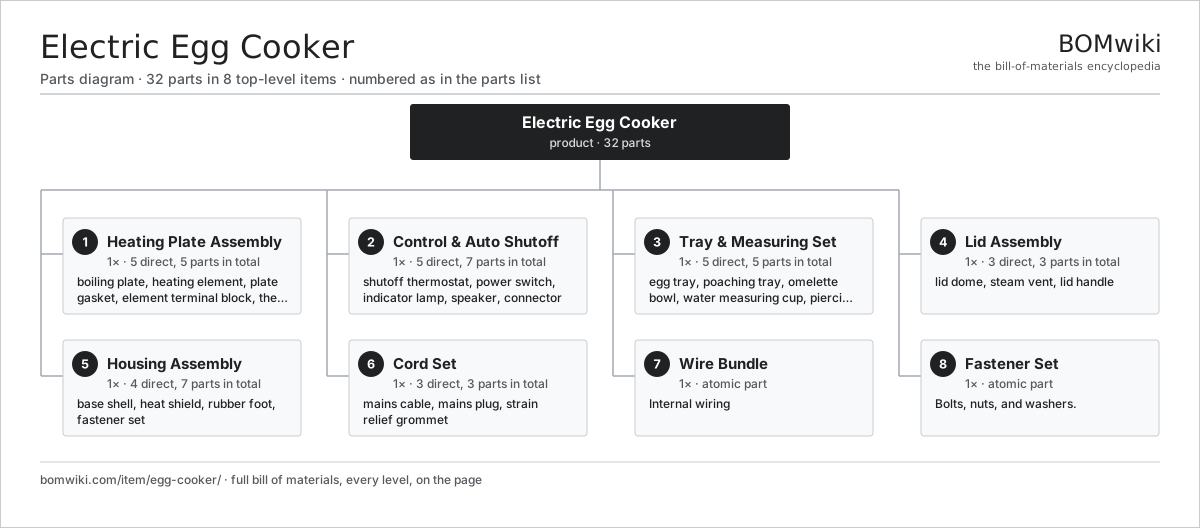
| # | Part | Qty | What it does |
|---|---|---|---|
| 1 | Heating Plate Assembly 5 parts | 1× | Shallow heated water reservoir whose element boils the measured water into steam. |
| 2 | Control & Auto Shutoff 5 parts | 1× | Switching and dry-plate detection: the plate temperature jumps past 100 degrees C once the water boils away, tripping the shutoff thermostat and the buzzer. |
| 3 | Tray & Measuring Set 5 parts | 1× | Racks and accessories that position the eggs in the steam and meter the water that sets doneness. |
| 4 | Lid Assembly 3 parts | 1× | Domed cover that traps steam around the eggs. |
| 5 | Housing Assembly 4 parts | 1× | Plastic base enclosing the element, thermostat and wiring. |
| 6 | Cord Set 3 parts | 1× | Mains lead and its anchorage. |
| 7 | Wire Bundle | 1× | Internal wiring |
| 8 | Fastener Set | 1× | Bolts, nuts, and washers. |
3D model
No 3D model yet. Have a CAD file of this? Add a 3D model. STL renders right on this page; STEP, FreeCAD, and OpenSCAD sources are welcome too (openly licensed, like all 3D models on BOMwiki).
Build & assembly graph
expand / collapse · shared sub-assemblies converge · links to related products · est. labourTap an assembly to expand/collapse · tap a part to open it · use “Open page” for any node · drag to pan, scroll to zoom.
Bill of materials for Electric Egg Cooker
8 top-level lines · 33 rows shown · 32 parts total · indented to 3 levels| # | Item / sub-assembly | Part no. | Qty/assy | Ext. qty | Parts | Type |
|---|---|---|---|---|---|---|
| 1 | Heating Plate Assembly 5 parts | egg-cooker-heating | 1× | 1 | 5 | assembly |
| 1.1 | Boiling Plate | egg-cooker-boil-plate | 1× | 1 | · | part |
| 1.2 | Heating Element | heating-element | 1× | 1 | · | part |
| 1.3 | Plate Gasket | egg-cooker-plate-gasket | 1× | 1 | · | part |
| 1.4 | Element Terminal Block | egg-cooker-terminal-block | 1× | 1 | · | part |
| 1.5 | Thermal Fuse | thermal-fuse | 1× | 1 | · | part |
| 2 | Control & Auto Shutoff 5 parts | egg-cooker-control | 1× | 1 | 7 | assembly |
| 2.1 | Shutoff Thermostat | egg-cooker-shutoff-thermostat | 1× | 1 | · | part |
| 2.2 | Power Switch | egg-cooker-power-switch | 1× | 1 | · | part |
| 2.3 | Indicator Lamp | egg-cooker-indicator-lamp | 1× | 1 | · | part |
| 2.4 | Speaker | speaker | 1× | 1 | · | part |
| 2.5 | Connector | connector | 3× | 3 | · | part |
| 3 | Tray & Measuring Set 5 parts | egg-cooker-tray-set | 1× | 1 | 5 | assembly |
| 3.1 | Egg Tray | egg-cooker-egg-tray | 1× | 1 | · | part |
| 3.2 | Poaching Tray | egg-cooker-poaching-tray | 1× | 1 | · | part |
| 3.3 | Omelette Bowl | egg-cooker-omelette-bowl | 1× | 1 | · | part |
| 3.4 | Water Measuring Cup | egg-cooker-measuring-cup | 1× | 1 | · | part |
| 3.5 | Piercing Pin | egg-cooker-piercing-pin | 1× | 1 | · | part |
| 4 | Lid Assembly 3 parts | egg-cooker-lid | 1× | 1 | 3 | assembly |
| 4.1 | Lid Dome | egg-cooker-lid-dome | 1× | 1 | · | part |
| 4.2 | Steam Vent | egg-cooker-steam-vent | 1× | 1 | · | part |
| 4.3 | Lid Handle | egg-cooker-lid-handle | 1× | 1 | · | part |
| 5 | Housing Assembly 4 parts | egg-cooker-housing | 1× | 1 | 7 | assembly |
| 5.1 | Base Shell | egg-cooker-base-shell | 1× | 1 | · | part |
| 5.2 | Heat Shield | egg-cooker-heat-shield | 1× | 1 | · | part |
| 5.3 | Rubber Foot | egg-cooker-foot | 4× | 4 | · | part |
| 5.4 | Fastener Set | fastener-set | 1× | 1 | · | part |
| 6 | Cord Set 3 parts | egg-cooker-cord-set | 1× | 1 | 3 | assembly |
| 6.1 | Mains Cable | egg-cooker-cord | 1× | 1 | · | part |
| 6.2 | Mains Plug | egg-cooker-plug | 1× | 1 | · | part |
| 6.3 | Strain Relief Grommet | egg-cooker-strain-relief | 1× | 1 | · | part |
| 7 | Wire Bundle | wire-bundle | 1× | 1 | · | part |
| 8 | Fastener Set | fastener-set | 1× | 1 | · | part |
Something wrong in this list? Report a problem with this BOM.
Related products
same domain, ranked by shared parts Air Popcorn Popper
36 parts · shares 1 with this page
Belgian Waffle Maker
75 parts · shares 1 with this page
Air Popcorn Popper
36 parts · shares 1 with this page
Belgian Waffle Maker
75 parts · shares 1 with this page
 Bread Machine
162 parts · shares 1 with this page
Bread Machine
162 parts · shares 1 with this page
 Bread Maker
66 parts · shares 1 with this page
Bread Maker
66 parts · shares 1 with this page
 Capsule Coffee Machine
123 parts · shares 1 with this page
Capsule Coffee Machine
123 parts · shares 1 with this page
 Chocolate Fondue Fountain
110 parts · shares 1 with this page
Chocolate Fondue Fountain
110 parts · shares 1 with this page
Sourcing: possible vendors
Browse the supplier directory → Prices, MOQ, and lead times are algorithmic estimates, not quotes, and not claims about these companies. Company mappings are curated by keyword; est. price band $20–$600. How estimates work| Vendor | HQ | Specialty | MOQ | Lead time |
|---|---|---|---|---|
|
🇦🇺Breville
breville.com ↗
|
Sydney, AU | Kitchen appliances | 2,000 units | 6–10 wks |
| groupeseb.com ↗ | Écully, FR | Cookware & small appliances | 2,000 units | 6–10 wks |
| hamiltonbeach.com ↗ | Glen Allen, US | Small appliances | 2,000 units | 6–10 wks |
| panasonic.com ↗ | Osaka, JP | Electronics & appliances | 2,000 units | 6–10 wks |
|
🇨🇳Midea
midea.com ↗
|
Foshan, CN | Home appliances | 2,000 units | 6–10 wks |
740-word article