Ejection Seat
ProductOverview
An ejection seat has one job and roughly one second to begin it: remove a pilot from an aircraft that may be on fire, tumbling, or 50 feet above the ground inverted, and deliver them to a parachute descent. Modern seats, the Martin-Baker Mk16 and Collins ACES 5 are the dominant designs, are rated "zero-zero": they work from a standstill on the runway, where there is no airspeed to inflate a parachute and no altitude to fall through. Everything about the seat follows from compressing the parachute-opening problem into the energy of a Underseat Rocket Motor and about three seconds.
The seat is also a piece of furniture the pilot sits on for every uneventful flight of a 25-year service life, which is why its pyrotechnics are sealed cartridges with shelf lives measured in years, its Thermal Battery sits inert until fired, and its Safety Pin Set keeps ground crews safe around a device containing the better part of a megajoule of propellant.
The first 200 milliseconds
Pulling the Firing Handle between the knees, a deliberate 20–30 kg pull, usable by either hand under g, trips the Sear Mechanism and sends cartridge gas through the Gas Line Set. Before the seat moves, the restraints fire: the Inertia Reel snatches the shoulders back, Leg Restraint Line garters pull the legs against the Seat Bucket, and on high-speed seats Arm Restraint webbing captures the arms. Posture is survival here: the spine must be straight and aligned with the thrust axis before the gun fires, because a slouched vertebral column under 14 g is how ejections break backs.
The canopy leaves next, jettisoned, or shattered by detonating cord, and then the Catapult Tube fires. Two Gas Cartridge charges burn with a shaped pressure curve that holds acceleration near 12–14 g and onset below about 250 g/s, the physiological ceiling for an unbroken spine. One metre of guided travel up the Rail Slipper Set rails later, the seat leaves the aircraft at roughly 15 m/s and the underseat rocket lights, adding 20 kN for a quarter second. The rocket is what makes zero-zero possible: it buys the 60–90 m of trajectory height that the parachute needs and the aircraft cannot provide. In two-seat aircraft an Interseat Sequencer Valve staggers the two firings by about 0.4 s so the seats diverge.
Stabilise, slow, separate
A seat departing at 600 knots is an unstable bluff body that would tumble violently. Within 0.2 s of rail departure the Drogue Gun mortars the Drogue Chute, a 0.6 m ribbon canopy, clear of the seat's wake. Riding the Drogue Bridle, the seat decelerates and stabilises with the load held along the occupant's spine.
The Electronic Sequencer decides everything that follows. Dual redundant channels, woken within 10 ms by thermal batteries, read Pressure Sensor pitot-static data and the Accelerometer to classify the ejection: low and slow demands the main canopy almost immediately; high and fast demands waiting. Above roughly 3,000 m the Barostat Release holds the occupant on the seat and drogue, free-falling through air too thin and too cold for a survivable canopy ride, with the Emergency Oxygen Bottle feeding the mask. At the release point the Parachute Container opens, the harness lugs free, and the seat falls away as the Main Parachute inflates on its Riser Set, the same Harness Webbing the pilot strapped on at walk-around now serving as the parachute harness. From handle pull to full canopy at low speed: under three seconds.
Descent and survival
The 6.5 m aeroconical canopy delivers 6–7 m/s, a firm parachute-landing-fall arrival. The Survival Pack in the seat pan descends with the occupant and drops on its Drop Lanyard to hang below, so the pilot lands unencumbered with raft, water and signals already on the surface. A 406 MHz Locator Beacon begins transmitting at seat separation. After landing, one twist of the Quick-Release Box frees the harness.
Engineering margins
Seat design is the management of contradictory percentiles. The catapult that safely accelerates a 135 kg aircrew member will hit a 47 kg one with far more g, which is why modern seats sense occupant weight (via the Seat Height Actuator setting or dedicated switches) and throttle catapult and rocket output. The Headrest, bucket geometry and harness anchors are sized across the 3rd-to-98th percentile body range. Every cartridge is life-limited and replaced on a 6–10 year schedule whether fired or not. The statistics justify the care: since 1949 ejection seats have saved over 7,700 lives on Martin-Baker seats alone, with survival rates above 90 per cent inside the envelope.
Ejection Seat parts and their functions
8 top-level parts · 53 parts in total · full bill of materials below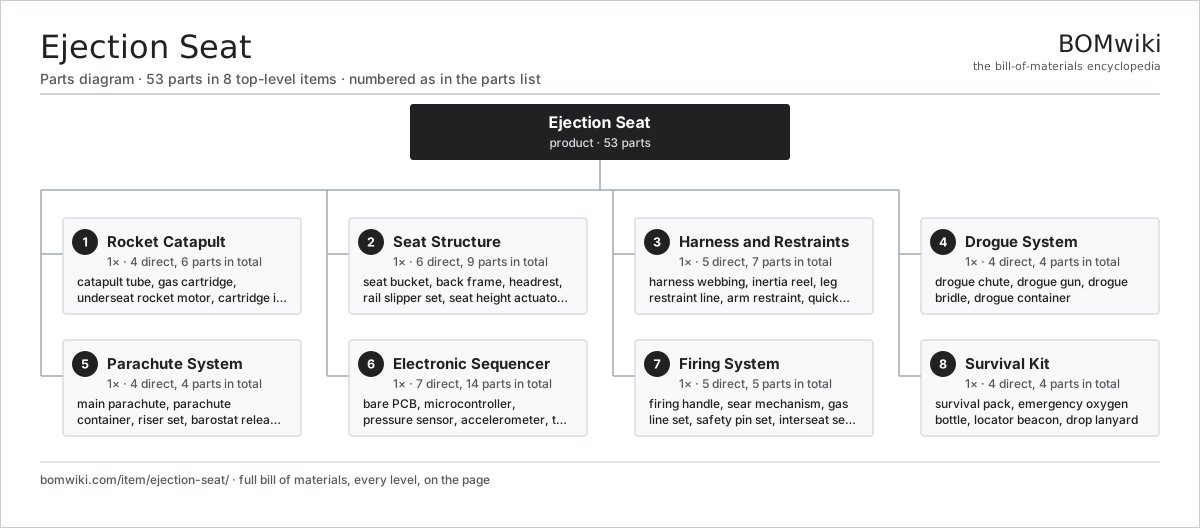
| # | Part | Qty | What it does |
|---|---|---|---|
| 1 | Rocket Catapult 4 parts | 1× | Two-stage propulsion: a telescopic cartridge gun ejects the seat from the cockpit, then an underseat rocket sustains thrust for trajectory height. |
| 2 | Seat Structure 6 parts | 1× | Aluminium bucket and back frame carrying the occupant and every subsystem, sliding on aircraft-mounted rails. |
| 3 | Harness and Restraints 5 parts | 1× | Restraint set that snatches the occupant into the survivable ejection posture milliseconds before the catapult fires. |
| 4 | Drogue System 4 parts | 1× | Small stabilising chute fired within 0.2 s of rail departure, killing seat tumble and decelerating it to main-canopy speed. |
| 5 | Parachute System 4 parts | 1× | Main recovery canopy and the releases that free the occupant from the seat before it inflates. |
| 6 | Electronic Sequencer 7 parts | 1× | Sensor-driven controller choosing the event timeline from airspeed and altitude in the first 50 ms of the ejection. |
| 7 | Firing System 5 parts | 1× | Handle, sears and gas plumbing that turn one pull between the pilot's knees into canopy jettison and seat ignition. |
| 8 | Survival Kit 4 parts | 1× | Seat-pan container that descends with the occupant carrying oxygen, raft, beacon and survival stores. |
3D model
No 3D model yet. Have a CAD file of this? Add a 3D model. STL renders right on this page; STEP, FreeCAD, and OpenSCAD sources are welcome too (openly licensed, like all 3D models on BOMwiki).
Build & assembly graph
expand / collapse · shared sub-assemblies converge · links to related products · est. labourTap an assembly to expand/collapse · tap a part to open it · use “Open page” for any node · drag to pan, scroll to zoom.
Bill of materials for Ejection Seat
8 top-level lines · 47 rows shown · 53 parts total · indented to 3 levels| # | Item / sub-assembly | Part no. | Qty/assy | Ext. qty | Parts | Type |
|---|---|---|---|---|---|---|
| 1 | Rocket Catapult 4 parts | ejection-seat-catapult | 1× | 1 | 6 | assembly |
| 1.1 | Catapult Tube | ejection-seat-catapult-tube | 1× | 1 | · | part |
| 1.2 | Gas Cartridge | ejection-seat-gas-cartridge | 2× | 2 | · | part |
| 1.3 | Underseat Rocket Motor | ejection-seat-rocket-motor | 1× | 1 | · | part |
| 1.4 | Cartridge Initiator | ejection-seat-initiator | 2× | 2 | · | part |
| 2 | Seat Structure 6 parts | ejection-seat-structure | 1× | 1 | 9 | assembly |
| 2.1 | Seat Bucket | ejection-seat-bucket | 1× | 1 | · | part |
| 2.2 | Back Frame | ejection-seat-back-frame | 1× | 1 | · | part |
| 2.3 | Headrest | ejection-seat-headrest | 1× | 1 | · | part |
| 2.4 | Rail Slipper Set | ejection-seat-slipper-set | 1× | 1 | · | part |
| 2.5 | Seat Height Actuator | ejection-seat-height-actuator | 1× | 1 | · | part |
| 2.6 | Fastener Set | fastener-set | 4× | 4 | · | part |
| 3 | Harness and Restraints 5 parts | ejection-seat-harness | 1× | 1 | 7 | assembly |
| 3.1 | Harness Webbing | ejection-seat-harness-webbing | 1× | 1 | · | part |
| 3.2 | Inertia Reel | ejection-seat-inertia-reel | 1× | 1 | · | part |
| 3.3 | Leg Restraint Line | ejection-seat-leg-restraint | 2× | 2 | · | part |
| 3.4 | Arm Restraint | ejection-seat-arm-restraint | 2× | 2 | · | part |
| 3.5 | Quick-Release Box | ejection-seat-release-box | 1× | 1 | · | part |
| 4 | Drogue System 4 parts | ejection-seat-drogue-system | 1× | 1 | 4 | assembly |
| 4.1 | Drogue Chute | ejection-seat-drogue-chute | 1× | 1 | · | part |
| 4.2 | Drogue Gun | ejection-seat-drogue-gun | 1× | 1 | · | part |
| 4.3 | Drogue Bridle | ejection-seat-drogue-bridle | 1× | 1 | · | part |
| 4.4 | Drogue Container | ejection-seat-drogue-container | 1× | 1 | · | part |
| 5 | Parachute System 4 parts | ejection-seat-parachute-system | 1× | 1 | 4 | assembly |
| 5.1 | Main Parachute | ejection-seat-main-parachute | 1× | 1 | · | part |
| 5.2 | Parachute Container | ejection-seat-parachute-container | 1× | 1 | · | part |
| 5.3 | Riser Set | ejection-seat-riser-set | 1× | 1 | · | part |
| 5.4 | Barostat Release | ejection-seat-barostat-release | 1× | 1 | · | part |
| 6 | Electronic Sequencer 7 parts | ejection-seat-sequencer | 1× | 1 | 14 | assembly |
| 6.1 | Bare PCB | pcb-bare | 2× | 2 | · | part |
| 6.2 | Microcontroller | mcu | 2× | 2 | · | part |
| 6.3 | Pressure Sensor | pressure-sensor | 2× | 2 | · | part |
| 6.4 | Accelerometer | ejection-seat-accelerometer | 1× | 1 | · | part |
| 6.5 | Thermal Battery | ejection-seat-thermal-battery | 2× | 2 | · | part |
| 6.6 | SMD Passive (R/C/L) | smd-passives | 1× | 1 | · | part |
| 6.7 | Connector | connector | 4× | 4 | · | part |
| 7 | Firing System 5 parts | ejection-seat-firing-system | 1× | 1 | 5 | assembly |
| 7.1 | Firing Handle | ejection-seat-firing-handle | 1× | 1 | · | part |
| 7.2 | Sear Mechanism | ejection-seat-sear-mechanism | 1× | 1 | · | part |
| 7.3 | Gas Line Set | ejection-seat-gas-line-set | 1× | 1 | · | part |
| 7.4 | Safety Pin Set | ejection-seat-safety-pin-set | 1× | 1 | · | part |
| 7.5 | Interseat Sequencer Valve | ejection-seat-interseat-sequencer-valve | 1× | 1 | · | part |
| 8 | Survival Kit 4 parts | ejection-seat-survival-kit | 1× | 1 | 4 | assembly |
| 8.1 | Survival Pack | ejection-seat-survival-pack | 1× | 1 | · | part |
| 8.2 | Emergency Oxygen Bottle | ejection-seat-oxygen-bottle | 1× | 1 | · | part |
| 8.3 | Locator Beacon | ejection-seat-locator-beacon | 1× | 1 | · | part |
| 8.4 | Drop Lanyard | ejection-seat-drop-lanyard | 1× | 1 | · | part |
Something wrong in this list? Report a problem with this BOM.
Sourcing: possible vendors
Browse the supplier directory → Prices, MOQ, and lead times are algorithmic estimates, not quotes, and not claims about these companies. Company mappings are curated by keyword; est. price band $50k–$300M. How estimates work| Vendor | HQ | Specialty | MOQ | Lead time |
|---|---|---|---|---|
|
🇺🇸Boeing
boeing.com ↗
|
Arlington, US | Aerospace OEM | made to order | 40–80 wks |
|
🇫🇷Airbus
airbus.com ↗
|
Toulouse, FR | Aerospace OEM | made to order | 40–80 wks |
| lockheedmartin.com ↗ | Bethesda, US | Aerospace & defense | made to order | 40–80 wks |
|
🇧🇷Embraer
embraer.com ↗
|
São José dos Campos, BR | Aircraft OEM | made to order | 40–80 wks |
| txtav.com ↗ | Wichita, US | Aircraft OEM | made to order | 40–80 wks |
846-word article