Electric Fence Energizer
ProductOverview
An electric fence does not hold an animal by force; it teaches respect through a sharp, memorable shock and then relies on the animal avoiding the wire. The energizer is the box that makes that shock. It does not put a continuous high voltage on the fence, that would be lethal and would short away through any contact with vegetation. Instead it stores a measured amount of energy and releases it as a single brief pulse roughly once a second, with long dead-time between pulses. During that pulse a HV Pulse Transformer raises the voltage to several thousand volts; between pulses the line is effectively dead.
The architecture is the same across the range: a Power Input feeds a Charging Converter converter that fills a capacitor in the Capacitor Discharge Circuit, which dumps into the transformer, with a Control & Monitor board timing it all and Output Terminals connecting to the fence and earth. Everything lives in a sealed Sealed Case.
How a pulse is made
Start at the power source. Most field energizers run from a 12 V 12 V Battery, often kept topped up by a Solar Panel through a Solar Regulator; mains-powered models use a Power Supply adapter instead. Twelve volts cannot shock anything, so the Charging Converter stage is a switch-mode boost converter: a Power MOSFET chops current through the Boost Inductor, and each cycle pushes a packet of charge through the Charge Diode into the Storage Capacitor. Over most of the second between pulses, this slowly winds the capacitor up to a few hundred volts, monitored by the Charge Controller IC.
When the Microcontroller decides it is time to fire, the Trigger Board gates the Discharge Thyristor (an SCR). It switches on in under a microsecond and connects the charged capacitor directly across the transformer primary Copper Winding. The capacitor empties in well under 100 µs, driving a fast, high-current pulse into the primary. The HV Secondary Winding, many thousands of turns over the same Transformer Core, steps this up to 5,000–10,000 V at the Fence Terminal. The whole HV winding is sealed in Epoxy Potting epoxy to stop moisture and corona breakdown.
The key safety property is energy, not voltage. International standards (IEC 60335-2-76) cap the energy per pulse and the duration so the shock is intensely unpleasant but cannot stop a heart. A 5 J energizer delivers that 5 J in a fraction of a millisecond once a second, painful, not dangerous.
Earthing and reach
A shock only happens if current can return to the energizer. The animal completes the circuit: it touches the live wire, current flows through its body into the soil, through the ground back to the energizer's Earth Terminal and its buried rods. This is why earthing is the single most common failure point, a poor ground means a weak shock no matter how good the energizer. Dry or sandy soil needs multiple ground rods. The Fence Voltage Monitor divider samples each pulse's peak so the Microcontroller can flash the Status Indicator faster when fence voltage falls below about 3 kV, the usual sign of vegetation shorting the line, a broken wire, or a failing earth.
Energizer size is rated by stored joules and by the fence length it can drive against leakage. A small garden unit of under 1 J handles a few hundred metres; a 15 J farm unit drives tens of kilometres of multi-wire fence even with grass touching it.
Protection and packaging
A long fence line is an excellent lightning aerial. A nearby strike induces a surge that would destroy the output transistors, so a Lightning Surge Gap spark gap sits between the fence and earth terminals to flash over and divert most of that energy around the electronics. The Input Fuse guards against a reversed battery, and a Bleed Resistor safely drains the capacitor when the On/Off Switch is turned off, so a technician opening the Enclosure Shell is not met by a charged capacitor. The IP-rated shell, Lid Gasket, and Terminal Cover keep rain out of a unit that lives outdoors year-round on its Mount Bracket.
Use and faults
Commissioning is mostly about earth and insulation: drive enough ground rods, keep the live wire clear of posts and weeds, and verify open-circuit voltage with a fence tester. The commonest field fault is a gradual voltage sag from grass growing into the bottom wire, which the indicator's changing flash rate flags before the fence stops working. A flat battery on a solar system points to undersized panel for the season rather than energizer failure.
Electric Fence Energizer parts and their functions
7 top-level parts · 37 parts in total · full bill of materials below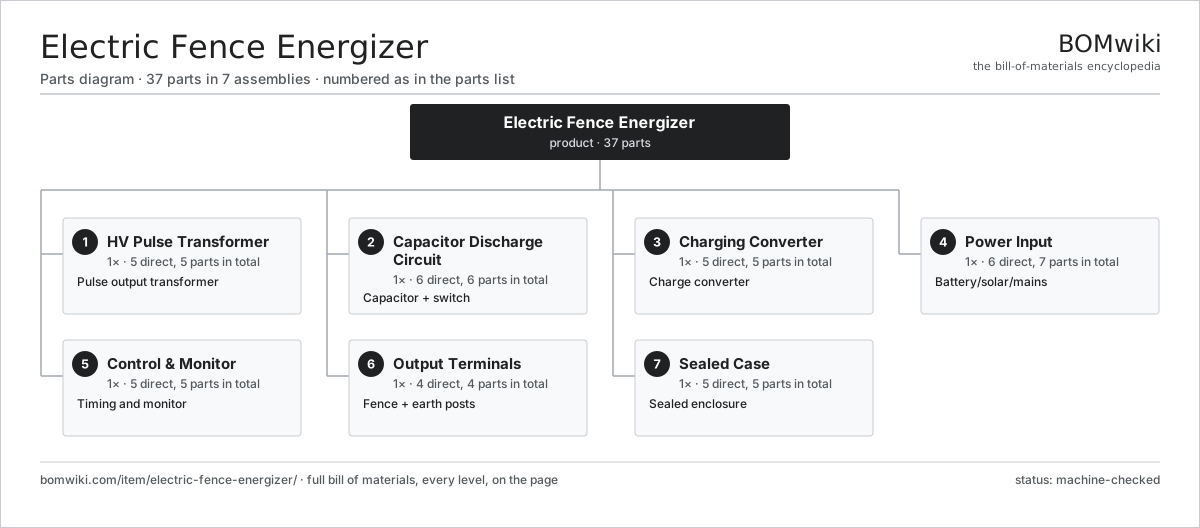
| # | Part | Qty | What it does |
|---|---|---|---|
| 1 | HV Pulse Transformer 5 parts | 1× | Pulse output transformer |
| 2 | Capacitor Discharge Circuit 6 parts | 1× | Capacitor + switch |
| 3 | Charging Converter 5 parts | 1× | Charge converter |
| 4 | Power Input 6 parts | 1× | Battery/solar/mains |
| 5 | Control & Monitor 5 parts | 1× | Timing and monitor |
| 6 | Output Terminals 4 parts | 1× | Fence + earth posts |
| 7 | Sealed Case 5 parts | 1× | Sealed enclosure |
3D model
No 3D model yet. Have a CAD file of this? Add a 3D model — STL renders right on this page; STEP, FreeCAD, and OpenSCAD sources are welcome too (openly licensed, like all 3D models on BOMwiki).
Build & assembly graph
expand / collapse · shared sub-assemblies converge · links to related products · est. labourTap an assembly to expand/collapse · tap a part to open it · use “Open page” for any node · drag to pan, scroll to zoom.
Bill of materials for Electric Fence Energizer
7 top-level lines · 43 rows shown · 37 parts total · indented to 3 levels| # | Item / sub-assembly | Part no. | Qty/assy | Ext. qty | Parts | Type |
|---|---|---|---|---|---|---|
| 1 | HV Pulse Transformer 5 parts | electric-fence-energizer-hv-transformer | 1× | 1 | 5 | assembly |
| 1.1 | Transformer Core | electric-fence-energizer-transformer-core | 1× | 1 | · | part |
| 1.2 | Copper Winding | copper-winding | 1× | 1 | · | part |
| 1.3 | HV Secondary Winding | electric-fence-energizer-secondary-winding | 1× | 1 | · | part |
| 1.4 | Winding Bobbin | electric-fence-energizer-bobbin | 1× | 1 | · | part |
| 1.5 | Epoxy Potting | electric-fence-energizer-potting | 1× | 1 | · | part |
| 2 | Capacitor Discharge Circuit 6 parts | electric-fence-energizer-discharge-circuit | 1× | 1 | 6 | assembly |
| 2.1 | Storage Capacitor | electric-fence-energizer-storage-cap | 1× | 1 | · | part |
| 2.2 | Discharge Thyristor | electric-fence-energizer-thyristor | 1× | 1 | · | part |
| 2.3 | Trigger Board | electric-fence-energizer-trigger-board | 1× | 1 | · | part |
| 2.4 | Power MOSFET | mosfet | 1× | 1 | · | part |
| 2.5 | Bleed Resistor | electric-fence-energizer-bleed-resistor | 1× | 1 | · | part |
| 2.6 | Bare PCB | pcb-bare | 1× | 1 | · | part |
| 3 | Charging Converter 5 parts | electric-fence-energizer-charging | 1× | 1 | 5 | assembly |
| 3.1 | Boost Inductor | electric-fence-energizer-boost-inductor | 1× | 1 | · | part |
| 3.2 | Power MOSFET | mosfet | 1× | 1 | · | part |
| 3.3 | Charge Diode | electric-fence-energizer-charge-diode | 1× | 1 | · | part |
| 3.4 | Charge Controller IC | electric-fence-energizer-charge-controller | 1× | 1 | · | part |
| 3.5 | SMD Passive (R/C/L) | smd-passives | 1× | 1 | · | part |
| 4 | Power Input 6 parts | electric-fence-energizer-power-input | 1× | 1 | 7 | assembly |
| 4.1 | 12 V Battery | lv-battery | 1× | 1 | · | part |
| 4.2 | Solar Panel | electric-fence-energizer-solar-panel | 1× | 1 | · | part |
| 4.3 | Solar Regulator | electric-fence-energizer-solar-regulator | 1× | 1 | · | part |
| 4.4 | Power Supply | power-supply | 1× | 1 | · | part |
| 4.5 | Input Fuse | electric-fence-energizer-input-fuse | 1× | 1 | · | part |
| 4.6 | Connector | connector | 2× | 2 | · | part |
| 5 | Control & Monitor 5 parts | electric-fence-energizer-control | 1× | 1 | 5 | assembly |
| 5.1 | Microcontroller | mcu | 1× | 1 | · | part |
| 5.2 | Fence Voltage Monitor | electric-fence-energizer-fence-monitor | 1× | 1 | · | part |
| 5.3 | Status Indicator | electric-fence-energizer-indicator | 1× | 1 | · | part |
| 5.4 | Relay | relay | 1× | 1 | · | part |
| 5.5 | SMD Passive (R/C/L) | smd-passives | 1× | 1 | · | part |
| 6 | Output Terminals 4 parts | electric-fence-energizer-terminals | 1× | 1 | 4 | assembly |
| 6.1 | Fence Terminal | electric-fence-energizer-fence-terminal | 1× | 1 | · | part |
| 6.2 | Earth Terminal | electric-fence-energizer-earth-terminal | 1× | 1 | · | part |
| 6.3 | Lightning Surge Gap | electric-fence-energizer-surge-gap | 1× | 1 | · | part |
| 6.4 | Terminal Cover | electric-fence-energizer-terminal-cover | 1× | 1 | · | part |
| 7 | Sealed Case 5 parts | electric-fence-energizer-case | 1× | 1 | 5 | assembly |
| 7.1 | Enclosure Shell | electric-fence-energizer-enclosure | 1× | 1 | · | part |
| 7.2 | Mount Bracket | electric-fence-energizer-mount-bracket | 1× | 1 | · | part |
| 7.3 | Lid Gasket | electric-fence-energizer-gasket | 1× | 1 | · | part |
| 7.4 | On/Off Switch | electric-fence-energizer-on-off-switch | 1× | 1 | · | part |
| 7.5 | Fastener Set | fastener-set | 1× | 1 | · | part |
Related products
same domain, ranked by shared parts Smart Irrigation Controller
53 parts · shares 6 with this page
Smart Irrigation Controller
53 parts · shares 6 with this page
 Soil Steam Sterilizer
83 parts · shares 5 with this page
Soil Steam Sterilizer
83 parts · shares 5 with this page
 Robotic Lawn Mower
136 parts · shares 5 with this page
Robotic Lawn Mower
136 parts · shares 5 with this page
 Pop-Up Sprinkler System
135 parts · shares 3 with this page
Pop-Up Sprinkler System
135 parts · shares 3 with this page
 Hedge Trimmer
68 parts · shares 4 with this page
Hedge Trimmer
68 parts · shares 4 with this page
Sourcing: possible vendors
Prices, MOQ, and lead times are algorithmic estimates, not quotes, and not claims about these companies. Company mappings are curated by keyword; est. price band $80–$5k. How estimates work| Vendor | HQ | Specialty | MOQ | Lead time |
|---|---|---|---|---|
| husqvarna.com ↗ | Stockholm, SE | Outdoor power products | 500 units | 8–14 wks |
|
🇩🇪STIHL
stihl.com ↗
|
Waiblingen, DE | Chainsaws & outdoor power | 500 units | 8–14 wks |
|
🇺🇸Toro
thetorocompany.com ↗
|
Bloomington, US | Turf & outdoor equipment | 500 units | 8–14 wks |
| powerequipment.honda.com ↗ | Tokyo, JP | Engines & outdoor power | 500 units | 8–14 wks |
|
🇨🇳Chervon
chervongroup.com ↗
|
Nanjing, CN | Power tools (EGO, SKIL) | 500 units | 8–14 wks |
852-word article